Books
Books
in random order
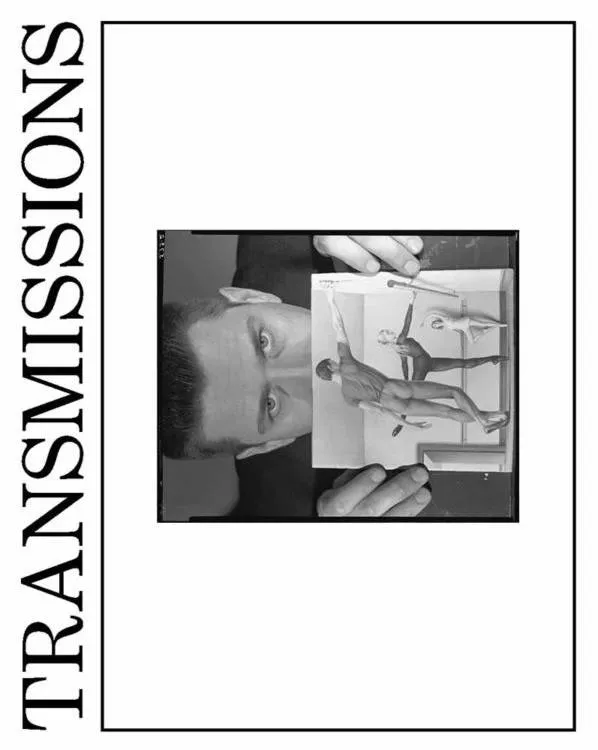
Transmissions
An aesthetic and social history of art and dance in mid-20th-century New York interpreted by contemporary artist Nick Mauss.
Over the past decade, Nick Mauss (b. 1980) has pursued a hybrid mode of working that melds the roles of curator, artist, and scholar. This catalogue leans heavily into the scholarship side of his practice, building on his 2018 Whitney Museum exhibition with a closer look at the relationship between modernist ballet and the New York avant-garde. In the 1930s through 1950s, ballet was introduced to a popular audience in New York and was simultaneously influenced by developments in Europe in painting, photography, fashion, music, and poetry. Mauss reflects on this period of rich cross-media production and synergy, ultimately arguing for the inseparability of dance and art history.

Up Your Ass
Valerie Solanas's rarely published, legendary play, Up Your Ass, explodes social and sexual mores and the hypocritical, patriarchal culture that produces them through her signature irreverence and wit, incisiveness and camp.
The play, whose full title is Up Your Ass Or From the Cradle to the Boat Or The Big Suck Or Up from the Slime, marches out a cast of screwy stereotypes: the unknowing john, the frothy career girl, the boring male narcissist, two catty drag queens, the sex-depraved housewife, and a pair of racialized pickup artists, among others. At the center is protagonist Bongi Perez—a thinly veiled Solanas—a sardonic, gender-bending hustler who escorts us through the back alleys of her street life. The fictionalized predecessor to SCUM Manifesto, the play shares the same grand, subversive, implicative language, equally spitting and winking, embracing the margins, the scum, and selling a trick along the way.
Valerie Solanas (1936-1988) is an American radical feminist intellectual, known for her SCUM Manifesto—a pamphlet with which she declares the power of women and imagines a political future through the margin—, and for having tried to assassinate Andy Warhol.
Edited by Leah Whitman-Salkin.
With a contribution by Paul B. Preciado.
Graphic design: Roxanne Maillet.

ROT
ROT is a publication reflecting the research “Wicked technology/Wild fermentation,” by Sara Manente that focuses on forms and practice of fermentation as ways to rethink bodies and their making. This glossy magazine performs research, aiming to infect the reader, and questioning how to spread, publish, and help the work survive.
Sara Manente is a performance artist, dance maker and researcher born in Italy and living in Brussels. She is interested in narrowing the distance between the performer, the audience, and the work. Her research starts from a dance practice that problematizes perception, translation, and ways of doing. Her work comes out in hybrid forms: book launch, 3Dfilm, written text, interview, choreographic piece, workshop, telepathic experience, collaboration, et al.

stewarding
stewarding maps the joyful and embodied ways we can resist oppressive structures that control our food, housing, and socialisation. We begin in an abandoned school, previously the union headquarters for a coal board, which became a legal guardianship, now condemned. We witness acts of communing between human inhabitants, composting worms, microbes in fermentation, and learn working class histories along the way. Here, complex networks emerge between agents, and thrive, disrupting the monolithic power of corporate extraction. Sean Roy Parker’s debut collection of poetry is a generous account of hopeful ways to eat and ways to live.

F.R. David - With Love
F.R.DAVID is a typographical journal, dealing with the organisation of reading and writing in contemporary art practises.
“With Love,” takes correspondence and calligraphy—or letter-writing—as model for information theory, and adaptive, cybernetic relations.

Poster Edition (bundle)
4 poèmes-affiches, format A3, impriméx en risographie au studio Colorama (Berlin), sur papiers variés, tirage à 150 exemplaires
«GASOLINE, Apocalypse 1998», «the category is: phone sex», «zona nudista», «(fête) sentimental-e-s» : étés d'apocalypse, émojis banane, cruising transocéanique, SMS en short, sales coeurs, baraques à frissons et grand-huit sentimental... ces poèmes courent toustes ~ à genoux, à nu ou en solex ~ après la question du désir, après l'amour aussi, avec une tendre obsession
Design graphique signé Auriane Preud’homme, Enz@ Le Garrec, Roxanne Maillet & Martha Salimbeni, avec des dessins de Gaëlle Loth

Verlag der Buchhandlung Walther König
Past Words
Past Words is three books in one: a collection of previously published texts and two exhibition-like experiments: A Year with Prem Krishnamurthy at the KW Institute for Contemporary Art, Berlin, and Endless Exhibition at the Kunsthal Gent. These parts are iinterconnected but distinct, not least because each is designed by a different designer—Ann Richter, David Knowles, Mark Foss & Valentijn Goethals. Together, they chart the past—and future—of a peripatetic performance of a practice, taking stock of a fifteen-year period through writing, a medium that 1s both primary and secondary. This writing is about design, about curating, about exhibition-making, and about how all three are themselves forms of storytelling. They allow us to draft narratives that stand just to the side of accepted realities, to sneak wild ideas into the world with the hope they may—with time—turn into facts.
Based in Berlin and New York, designer and curator Prem Krishnamurthy (born 1977) is head of the artist group Department of Transformation and of the design consultancy Wkshps. In 2015 he was the recipient of the Cooper Hewitt’s National Design Award for Communication essDesign. As both creator and curator, Krishnamurthy aims to discover “how art & design can be agents of transformation for individuals, communities and institutions.”
With an introduction by Krist Gruijthuijsen.

Traces of Dance
Traces of Dance brings together scores, drawings, sketches, notes, graphics and paintings, which contributes to define a textuality of movement between writing and image.
The drawings and notations of choreographers rarely come before the public eye; and yet they are far more than simple memory aids. Several types of speech and writing have been called upon to lead the viewer's perception through the traces that the dancing body lays down. While these texts are not all concerned with the specific practices of dance, they all deal with the most profound contribution that a knowledge of the moving body brings to our culture, to our lives.
With Georges Appaix, Dominique Bagouet, Trisha Brown, Lucinda Childs, Régine Chopinot, Merce Cunningham, Philippe Decouflé, Raoul-Auger Feuillet, Roxane Huilmand, Isaac, Anne Teresa De Keersmaeker, Rudolf Laban, Daniel Larrieu, Jean-Marc Matos, Dana Reitz, Hervé Robbe, Kellon Tomlinson, Mary Wigman, André Lorin, Vaslav Nijinski, Louis-Guillaume Pécour, Pierre Rameau, Bob Wilson.
Texts by Daniel Dobbels, Jean-Noel Laurenti, Laurence Louppe, Valérie Preston-Dunlop, René Thom, Paul Virilio.

MAKAN #3 / Synthetic Agencies
Building on the foundations of the first two issues, Synthetic Agencies invites a rethinking [and unthinking] of the assumptions, polarities, and discontents surrounding the notion of agency. Traditionally defined in Western thought as the capacity to act and effect change, agency is inseparable from questions of power and the often invisible structures through which power operates. The various contributions interrogate how agency is produced, constrained, or distributed through the systems of knowledge, design, and governance that shape our built environments, technologies, media, and cultures. They were are invited to right (as much as write on) agency, reflecting on how it operates across different scales and contexts, and imagining alternative worlds or configurations. Ultimately, Synthetic Agencies understands agency not as a fixed attribute but as a contested lens through which we might read, reshape, or resist the conditions of the present.
With contributions by Amine Houari, Driss Ksikes, Fehras Publishing Practices, Hamed Sinno, Helga Tawil-Souri, Lada Hršak, Mayada Madbouly, Myriam Ababsa, Nzinga Biegueng Mboup, Ola Hassanain, Omer Shah, OPPA, Salma Barmani, Samia Henni, Tarek El-Ariss, Zaidoun Hajjar.

Égal infini
Égal infini cherche le contact : une crêpe oubliée dans un tram, un tatouage de baiser, une présence derrière un écran. Ici, les algorithmes affectifs côtoient des recettes de consolation, les robots parlants croisent les animaux marins, et la vitesse d’une voiture dans la nuit rejoint le mouvement fragile des relations. Journal éparpillé, galerie de gestes et de paroles collectées, le livre avance comme le refrain « marabout, bout de ficelle… », laissant à chacun·e la liberté de tracer son propre chemin.

Christian Eschatology of Artificial Intelligence: Pastoral Technologies of Cybernetic Flesh
The book tracks the overlap of various “regimes of truth” from the Greco- Roman period through to the AI and cybernetic period, in order to present a continuity that ties together Christian Pastoralism and Neoliberal Self-Governance. The result is a fascinating and detailed examination of western hegemonial doctrines and signs, such as the Logos, the Flesh, and the Fall.
Vachnadze leaves us with no conclusion besides a certain feeling in our stomachs, a feeling that often comes when someone makes you aware of something fascinating, but deeply unnerving. The author weaves scripture and theory together in a way which can be as exciting as conspiratorial fictions, but it is executed without compromising the respectable position he has established at the point where non meets sense.

Black Cine-Body Sonics: Racializing the Soundtrack
Black Cine-Body Sonics: Racializing the Soundtrack surveys how Black audiovisuality developed and thrives in films and television through importing and materializing the sonics of Black musical representation — from 'Blaxploitation' classics (Shaft and Truck Turner) to cine-auteurs (Melvin Van Peebles, Spike Lee and Jordan Peele) to music video performers (Michael Jackson, Beyoncé and Kendrick Lamar) to video artists (Arthur Jafa and Isaac Julien) to contemporary multi-genre explorations of race (Sinners, Lovecraft Country, Atlanta and Swarm). The book views Jazz Soul Funk Disco Hip Hop Techno and House not as 'source music' but as genetic origins in the transformation of movies and shows resulting in new cinematic and televisual formations — all of which foreground the body performance and musicality.
— Philip Brophy
This is the 4th publication in the Echoes of Dissent series, devoted to the politics of the soundtrack.

Parapraxis 08: Groups
To be in a group is to submit to a form of disorganizing organization that hangs on careful balance: to be devoted to a collective without being engulfed, to be disciplined by it without sleepwalking to the tune of a leader’s will, to integrate without dissolving into it. As infants born into a sexual union from which we are then necessarily excluded, the yields and limits of assembly are evident from the outset. Before we arrived in the bloc, we lived our lives in other groups: the family, the religious order, the cafeteria table clique. You can sit with us. You can’t. Some groups we remember entering. Others we didn’t elect, but deselected.
As a form of critique whose object of analysis is suffering, psychoanalysis understands the pains of the group. Its full task is to make sense of them as a condition of the many as much as of the one. As the psychoanalyst Didier Anzieu glosses the problem of thinking about groups, the “commonplace” assumption is that the group “is a pooling, a sharing” through which “the energies, enthusiasm and capacities of individuals who freely assent to the discipline of the group” coalesce into a unified forcefield. Yet, as Anzieu stresses, this idealized description eats itself. It collapses union with sharing, with collectivity. We know that groups rely on sharing. He asks, “a sharing of what?”
Psychoanalytic cults. Cowboy churches. The Epstein Class. Iranian monarchists. Fascist liberals. Clinics and their radicals. Discipline and holding. Getting together, falling apart.
Essays by Séamus Malekafzali, Tracy McNulty, Richard Seymour, Zahid Chaudhary, Danny Hayward, Eri Linsker, hannah baer, and more.
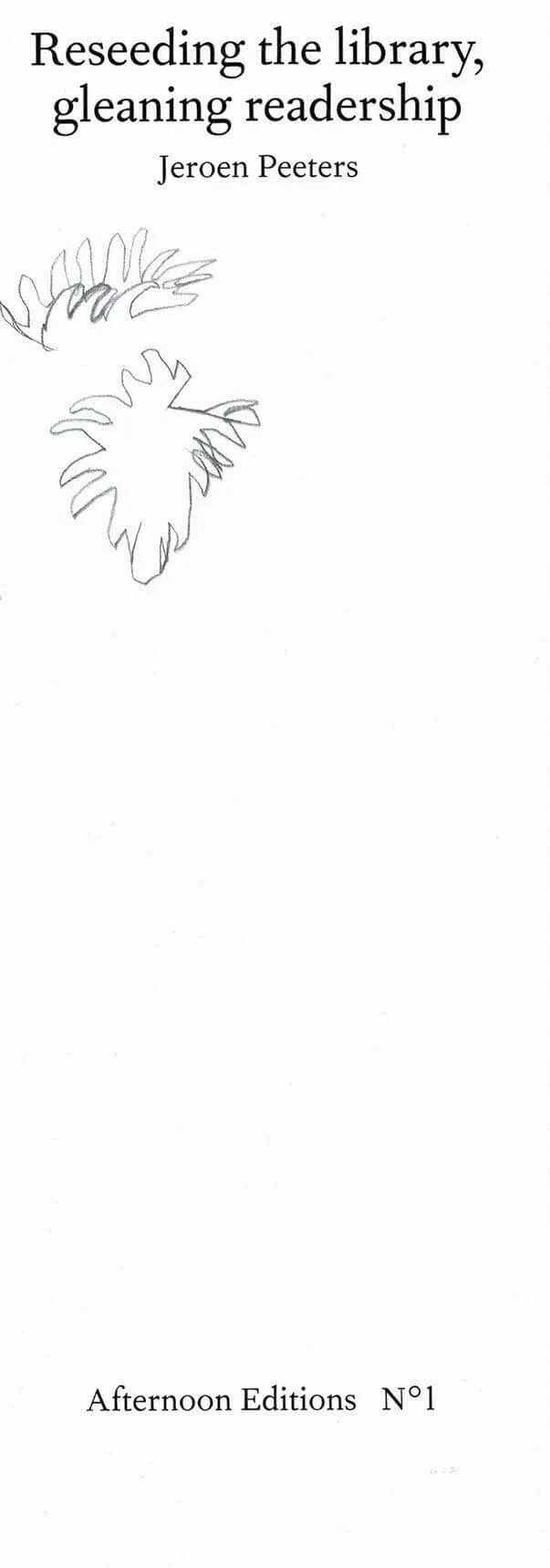
Reseeding the library, gleaning readership
Afternoon Editions no. 1: an essay by Jeroen Peeters titled Reseeding the library, gleaning readership. In May 2017, Time has fallen asleep in the afternoon sunshine settled during three weeks in the Ravenstein Gallery in Brussels as part of the Kunstenfestivaldesarts. Invited as a writer in residence, Jeroen Peeters visited the library of living books on a daily basis and recorded his observations by hand in a notebook, which formed the basis for Afternoon Edition #1. Reseeding the library, gleaning readership is an essay on the seed library, on the dispersion of literature through wind, water and animals, on biodiversity and commoning at the heart of readership. On the cover a drawing by Wouter Krokaert of a Philodendron Xanadu. Published May 2018.

Could It Be Love
Greer Lankton’s iconic and startling doll sculptures as we have never seen them before: through her own eyes.
Magic Hour Press is proud to present the first monograph on the trans visionary artist Greer Lankton (1958–96), whose lifelike doll sculptures shocked 1980s New York. Lankton’s dolls, which she began making as a child and produced obsessively until her death at age 38, were a means to explore her fraught relationship with the human body. In the book’s 100 photographs, all shot by Lankton herself, these figures take on a life of their own, kvetching at a party, strolling along a beach, or lounging on a stoop in the East Village. Among this extraordinary cast of oddballs—usually femme, often freakish, always radiating a glamorous confidence—we find characters of Lankton’s own invention alongside well-known icons such as Divine, Coco Chanel, Andy Warhol and even Lankton herself.
Born in 1958 to a Presbyterian minister in Michigan, Greer Lankton moved to New York in 1978 and became a rising star of the downtown scene. There, her deviant elegance was immortalized in photographs by Peter Hujar, David Armstrong, and Lankton’s close friend Nan Goldin, who described her as “one of the luminaries of the East Village renaissance: beautiful, glamorous, wild and hysterically funny.”
Edited by Francis Schichtel, Jordan Weitzman and Nan Goldin
Text by Hilton Als
These are the tools of the present
Mai Abu ElDahab, November Paynter and 1 more
This publication comprises a series of interviews with contemporary artists, musicians, and writers who are in dialogue with Beirut and Cairo. While not purporting to be an overview of the art scenes in these cities, this book begins to draw a picture of how artists think about what it means to be active in the contexts of these cities. It offers insight into the circumstances that structured these artists’ stories, and the often accidental influences that have shaped how their practices have developed.

Story of the Eye
Bataille’s first novel: a legendary shocker that uncovers the dark side of the erotic by means of forbidden obsessive fantasies of excess and sexual extremes.
A classic of pornographic literature, Story of the Eye finds the parallels in Sade and Nietzsche and in the investigations of contemporary psychology; it also forecasts Bataille’s own theories of ecstasy, death and transgression which he developed in later work.
“Bataille’s works … indicated the aesthetic possibilities of pornography as an art form: Story of the Eye being the most accomplished artistically of all pornographic prose I’ve read.” – Susan Sontag, “Notes on ‘Camp'”
“Bataille denudes himself, exposes himself, his exhibitionism aims at destroying all literature. He has a holocaust of words. Bataille speaks about man’s condition, not his nature. His tone recalls the scornful aggressiveness of the surrealist. Bataille has survived the death of God. In him, reality is conflict.” – Jean Paul Sartre, Nausea
“I found myself being absorbed in Story of the Eye … the symbolism really intrigued me. … I am fascinated by the surreal erotic style of Bataille; I think he is an author I need to explore in greater details.” – Michael Kito, Knowledge Lost

The (Incomplete) Cosmic Catalogue
Mapping constellations between five specific pre-colonial cosmological examples extending from the Sahel to the Horn of Africa, this work reframes cosmology as a multi-dimensional and scalable practice of situated technologies and embodied cartographies. The resulting publication which was produced during the Jan van Eyck residency is a culmination of several years of research and exploration into precolonial cosmologies and spatial orders rooted in the African Sahel extending to the Horn of Africa.
The (Incomplete) Cosmic Catalogue is an output of a research project that was initially commissioned by the Canadian Centre for Architecture as part of the multi-disciplinary research fellowship, The Digita Now: Architecture and Intersectionality in 2022.

How to Sleep Faster 2
How to Sleep Faster 2 is the second of our biannually published journals that form the backbone of Arcadia Missa’ critical collaborative discourse on participation, post-digital visual-production and institutional subjectivity.This issue explores moments of collapse, shift and potential in a cultural moment framed by economic, political and societal disturbance.
Arcadia Missa Publication; eds Rozsa Farkas, Tom Clark et al.

Tricyclist
The love child of The L Word and Brontez Purnell’s 100 Boyfriends, with a disaffected flair all its own.
It’s San Francisco in the early aughts, and Howie Song is floundering. His failed projects—as a professional ballet dancer, as a boyfriend, as a friend—have left him forever the “third wheel.” But maybe he likes it that way? Leaping wildly between lovers, centuries, and an ever-changing cultural landscape, Howie might just feel most himself in the fracture.
Delicious, poetic, and delightfully pornographic, Tricyclist is an ode to the “abnormal angles” of people and art. As Howie overcomes his own ambivalences—in large part thanks to two suitors, and a circle of supporters who happen to be lesbians—Joon Oluchi Lee portrays, with his signature flamboyance, all of life’s joys, pitfalls, and pirouettes.
Joon Oluchi Lee is one of my favorite writers. A quick-change artist with a blazing intellect, he startles with his wicked wit and mix of rawness and sophistication. In Tricyclist, vexed, sexed, and indexed types orbit the narrator Howie Song, offering all kinds of distractions and attractions. Identity is a flipbook of possibilities, malleable in a way that excites and also threatens dissolution (which is maybe a relief). Raunch, philosophical asides, and a scavenger hunt for connection and love are all propelled by Lee’s masterful maverick style and brilliant humor. - Nate Lippens
Across lush hangouts with friends and hookups with lovers, Joon Oluchi Lee’s Tricyclist paints shimmering portraits of the most beautiful blouses and bars and bodies laid bare alongside our hopelessly alluring narrator. Through Howie’s careening sex drives and death drives, sensuality is everything, and with Lee’s keen attunement to life’s viscera, Tricyclist aches gorgeously. What a rhapsodic balm to my 2026. - Benedict Nguyễn
Tricyclist is a sex-forward, strikingly original story of queer life in San Francisco that feels so fresh it left my fingers wet. Joon Oluchi Lee’s eye is as sharp as his prose, rendering characters and scenarios with gossipy frankness. Kinetic and true and hyper-alive. - Michelle Tea

Manifestly Haraway
Electrifying, provocative, and controversial when first published thirty years ago, Donna Haraway's "Cyborg Manifesto" is even more relevant today, when the divisions that she so eloquently challenges—of human and machine but also of gender, class, race, ethnicity, sexuality, and location—are increasingly complex. The subsequent "Companion Species Manifesto," which further questions the human-nonhuman disjunction, is no less urgently needed in our time of environmental crisis and profound polarization.
Manifestly Haraway brings together these momentous manifestos to expose the continuity and ramifying force of Haraway's thought, whose significance emerges with engaging immediacy in a sustained conversation between the author and her long-term friend and colleague Cary Wolfe. Reading cyborgs and companion species through and with each other, Haraway and Wolfe join in a wide-ranging exchange on the history and meaning of the manifestos in the context of biopolitics, feminism, Marxism, human-nonhuman relationships, making kin, literary tropes, material semiotics, the negative way of knowing, secular Catholicism, and more.
The conversation ends by revealing the early stages of Haraway's "Chthulucene Manifesto," in tension with the teleologies of the doleful Anthropocene and the exterminationist Capitalocene. Deeply dedicated to a diverse and robust earthly flourishing, Manifestly Haraway promises to reignite needed discussion in and out of the academy about biologies, technologies, histories, and still possible futures.
Donna J. Haraway is distinguished professor emerita in the History of Consciousness Department at the University of California, Santa Cruz, where she is also affiliated with the departments of anthropology, feminist studies, environmental studies, and film and digital media. She is an active participant in UCSC's Science and Justice Research Center and the Center for Cultural Studies.
Published 2016

I am Welton Santos.
I am Welton Santos reenacts a dialogue between the Brazilian geo-bio-architect Welton Santos and an Interviewer. The book, which is always read collectively, is used in reading performances by groups of at least 3 people.
Printed on the occasion of an artist residency at PAV, Parco d’Arte Vivente, Turin, July 2016. Texts based on transcripts of interviews with Welton Santos.

Spectres IV: A Thousand Voices
Bartolomé Sanson, François J. Bonnet
The fourth issue of the annual publication dedicated to sound and music experimentation, co-published by Shelter Press and Ina GRM – Groupe de Recherches Musicales, around the topic of voice.
The voice is everywhere, infiltrating everything, making civilisation, marking out territories with infinite borders, spreading from the farthest reaches to the most intimate spaces. It can be neither reduced nor summarised. And accordingly, when taken as a theme, the voice is inexhaustible, even when seen in the light of its very particular relation with the sonic or the musical, as is the case in most of the texts collected in this volume. There is no point therefore in trying to circumscribe or amalgamate the multiple avatars of the voice. We must rather try to apprehend what the voice can do, to envisage its landscape, its potential effects.
Spectres is an annual publication dedicated to sound and music experimentation, co-published by Shelter Press and Ina GRM – Groupe de Recherches Musicales.
Edited by François J. Bonnet and Bartolomé Sanson.
Contributions by Joan La Barbara, Sarah Hennies, Peter Szendy, Youmna Saba, Lee Gamble, Ghédalia Tazartès, David Grubbs, Stine Janvin, Pierre Schaeffer, Akira Sakata, Haela Ravenna Hunt-Hendrix, Yannick Guédon, François J. Bonnet, John Giorno.

KAMERA CAHIER N° 10
A special edition issue curated, designed and published by AVARIE, Paris and Labor Neunzehn, Berlin. It accompanies KAMERA SERIES, while it is an independent and valuable object to collect. The central idea that informs and directs the booklets’ montage is the interplay between the concepts of addition and subtraction. This is achieved by unveiling a missing image in the screening or an unreleased second from an artist's film, expanded to 24 pages. Additionally, each booklet contains a piece directly removed from the show.
The editing establishes a dialogue between film frames and performed writings derived from texts, scripts, storyboards, and notes. The KAMERA exhibition is consequently extended into a physical space—the book—allowing for its widespread dissemination, complementing and contrasting with its potential online occurrence.
KAMERA SERIES is a screening program of experimental films, video art works and printed matter taking place in a former GDR building in Berlin. Each event showcases a retrospective of selected films by an artist and a small exhibition of his/her publications or works on paper over a span of 4 days.
KAMERA centers on fostering a critical dialogue between different film formats and artists’ books. Through its regular occurrence, it aspires to create a space for community exchanges about contemporary image-making. KAMERA is a series conceived and curated by Labor Neunzehn and AVARIE.
Fascinated by the intersection of visual art and cinema, Helga Fanderl’s short poetic films evoke intense and sensitive experiences of the real world. Using a small hand-held super 8 camera, she creates filmic responses to her perceptions, weaving together imagery and emotions in dense, rhythmic patterns solely through in-camera editing. She presents silent films in the form of ‘compositions’, crafting unique programs for site-specific personal projections and transforming spaces into temporary cinemas.