rile*books

Search books

Search books by title, author, publisher, keywords...

Cover of The Cricket – Black Music in Evolution, 1968-69

Blank Forms

The Cricket – Black Music in Evolution, 1968-69

Larry Neal ed., A. B. Spellman ed., Amiri Baraka ed.

€35.00

Complete facsimile of The Cricket, an important but underknown music magazine edited by poets and writers Amiri Baraka, A. B. Spellman, and Larry Neal in 1968–69—a rare document of the Black Arts Movement.

Published in the late 1960s by Baraka's New Jersey-based JIHAD productions around the time of the Newark Riots, The Cricket: Black Evolution in Music was an experimental music magazine running poetry, short plays, and gossip alongside concert and record reviews and essays on music and politics. Over four mimeographed issues, The Cricket laid out an anti-commercial ideology and took aim at the conservative jazz press, providing a space for critics, poets, and journalists (including Stanley Crouch, Haki Madhubuti, Ishmael Reed, Sonia Sanchez, and Keorapetse Kgositsile) and musicians (including Cecil Taylor, Milford Graves, Sun Ra, Mtume, Albert Ayler, the Black Unity Trio) to devise new styles of music writing. The publication emerged from the heart of a political movement—"a proto-ideology, akin to but younger than the Garveyite movement and the separatism of Elijah Mohammed," as Spellman write's in the books preface—and aimed to reunite advanced art with its community, "to provide Black Music with a powerful historical and critical tool," and to enable avant-garde Black musicians and writers "to finally make a way for themselves."

This publication gathers all issues of the magazine and a new substantial introduction by artist and writer Kodwo Eshun.

Preface by A. B. Spellman.
Introduction by David Grundy.

Texts by Billy Abernathy, Albert Ayler, LeRoi Jones / Imamu Ameer Baraka, Duncan Barber, Black Unity Trio, Hilary Broadus, Ben Caldwell, Stanley Crouch, Dan Dawson, Joe Goncalves, Milford Graves, Ronnie Gross, Clyde Halisi, E. Hill, Haasan Oqwiendha Fum al Hut, Norman Jordan, Larry A. Miller / Mwanafunzi Katibu, Willie Kgositsile, Don L. Lee, Mtume, Gaston Neal, Larry Neal, Ibn Pori, Sun Ra, Ishmael Reed, Roger Riggins, Sonia Sanchez, A. B. Spellman, James T. Stewart, Donald Stone, Askia Muhammad Touré.

Published in 2022 ┊ 192 pages ┊ Language: English

recommendations

Cover of Better Do It Now before You Die Later: Sonny Simmons with Marc Chaloin

Blank Forms

Better Do It Now before You Die Later: Sonny Simmons with Marc Chaloin

Sonny Simmons, Marc Chaloin

Though his years in the New York free-jazz scene of the sixties cemented his reputation as "one of the most forceful and convincing composers and soloists in his field," saxophonist Sonny Simmons (1933–2021) was nearly forgotten by the '80s, which found him broke, heavily dependent on drugs and alcohol, and separated from his wife and kids. "I played on the streets from 1980 to 1994, 365 days a year," Simmons tells jazz historian and biographer Marc Chaloin. "I would go to North Beach, and I'd sleep in the park. The word got around town that Sonny is a junkie, really strung out."

The resurrection of Simmons' career―upon the release of his critically acclaimed Ancient Ritual (Qwest Records) in 1994―has become a modern legend of the genre. In the last two decades of his musical career, Simmons broke through to a new echelon of recognition, joining the pantheon of great innovators and masters of the music. But to this day he remains an undersung figure. Here, in the first ever book dedicated to his life, Simmons recounts his childhood in the backwoods of Louisiana, his adolescence in the burgeoning Bay Area jazz scene and his star-studded life in New York playing alongside the greats.

Cover of Black Case Volume I and II – Return From Exile

Blank Forms

Black Case Volume I and II – Return From Exile

Joseph Jarman

Poetry €20.00

The republication in print form of the poems of Art Ensemble of Chicago's founding member breathes new life into a forgotten document of the Black Arts Movement.

In 1977, Art Ensemble of Chicago Publishing Co. published Jarman's Black Case Volume I and II: Return From Exile, a collection of writing conceived across America and Europe between 1960 and 1975. Comprised largely of Jarman's flowing, fiery free verse—influenced by Amus Mor, Henry Dumas, Thulani Davis, and Amiri Baraka—the book also features a manifesto for “GREAT BLACK MUSIC,” notated songs, concert program notes, Jarman's photos, and impressions of a play by Muhal Richard Abrams, the founder of the Association for the Advancement of Creative Musicians of which Jarman was also an original member.

Jarman writes poetry of personal revolutionary intent, aimed at routing his audience's consciousness towards growth and communication. He speaks with compassionate urgency of the struggles of growing up on Chicago's South Side, of racist police brutality and profound urban alienation, and of the responsibility he feels as a creative artist to nurture beauty and community through the heliocentric music that he considers the healing force of the universe. A practicing Buddhist and proponent of Aikido since a 1958 awakening saved him from the traumatic mental isolation of his time dropped by the US army into southeast Asia, Jarman sings praise for the self-awareness realization possible through the martial arts.

With cosmic breath as its leitmotif, his poetry both encourages and embodies a complete relinquishing of ego. While some of the poems contained within Black Case have already been immortalized via performances on classic records by Jarman and Art Ensemble of Chicago, its republication in print form breathes new life into a forgotten document of the Black Arts Movement.

Cover of Intelligent Life

Blank Forms

Intelligent Life

Maryanne Amacher

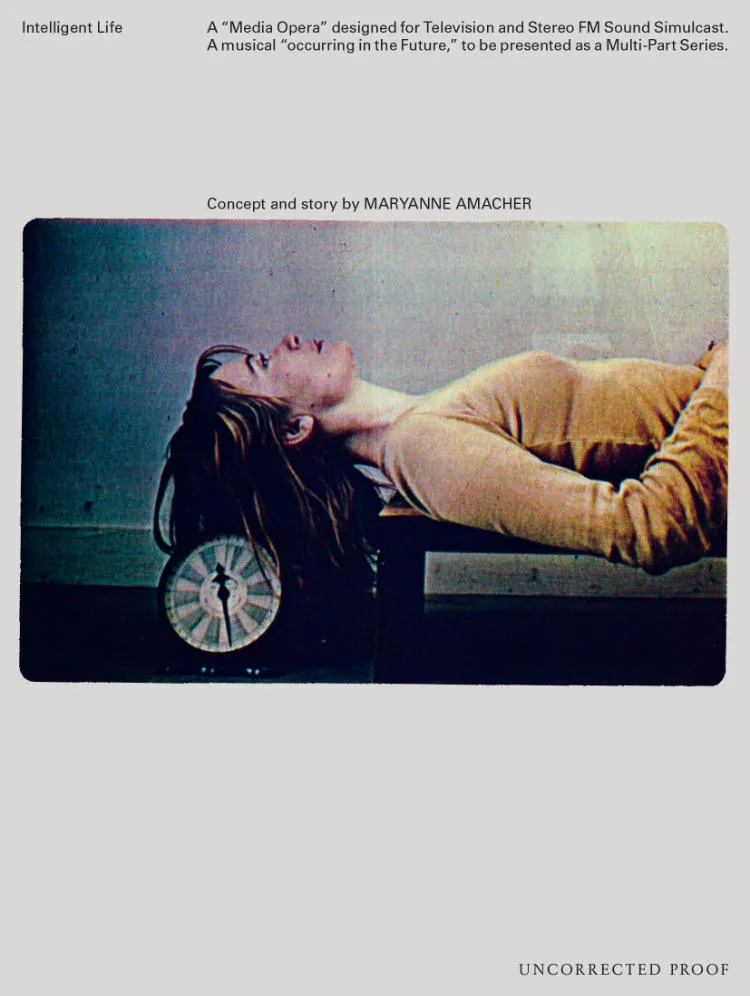
Comprehensive and previously unpublished documentation on the American composer's unproduced magnum opus.

Had it been produced, Maryanne Amacher's media opera Intelligent Life would have represented the summation of the composer's concept to date. As she wrote to John Cage in the autumn of 1983, following the untimely deaths of the opera's patrons—Wies Smals, founder of De Appel, and curator Josine van Droffelaar, in a plane crash in the Swiss Alps—she would have at last had the support to "communicate the finest of my thought to others." Amacher's serial, intended for broadcast, sought to transmit her evolving ideas about perception, listening, and composition to a broader public—shifting music away from "nod and tap recognition" toward a transformative practice that could awaken intelligence to "unrecognized and new perceptual modes."

Set in the year 2021, Intelligent Life follows the employees of Supreme Connections LLC, a music entertainment corporation navigating a future in which artificial intelligence generates music faster than composers can. Anticipating an industry-wide downturn, Supreme Connections president Aplisa Kandel seeks advanced technologies that will revolutionize the act of listening and the future of music, including a bio-music script that lets the user hear Bach from the aural perspective of a reindeer and a wearable device that goes beyond replicating the mechanical tympanic resonances of the listening subject to produce the "listening mind" or the "sophisticated perceiver"—capturing and reproducing all the emotional and psychological associations unique to each individual.
Though Amacher could not realize Intelligent Life in any of its intended forms—she theorized its publication as a serialized radio broadcast and television simulcast, among other configurations—she continued designing "treatments" for the opera for much of her career. This volume makes the most complete of these working documents—including episodic scripts, notes on the use of LaserDisc, and an illustrated storyboard for the pilot—available to the public for the first time.

Maryanne Amacher (1938-2009) was a composer of large-scale fixed-duration sound installations and a highly original thinker in the areas of perception, sound spatialization, creative intelligence, and aural architecture. She is frequently cited as a pioneer of what has come to be called “sound art,” although her thought and creative practice consistently challenges key assumptions about the capacities and limitations of that genre. Often considered to be a part of a post-Cagean lineage, her work anticipates some of the most important developments in network culture, media arts, acoustic ecology, and sound studies.

Cover of A Book Knot Book

Body Text

A Book Knot Book

Sara Kaaman

A Book Knot Book is a 208 pages long performance, the first from the research and publishing initiative Body Text. In this study of language in action systems of meaning-making crash, sparkle and swoon. In a playful voice over A Book Knot Book self-reflects on the materialities and choreographies of publishing, reading and writing. With guest stars in fragments; Monique Wittig, Yvonne Rainer, Cristina Rivera Garza, Amiri Baraka, Will Rawls, David Abram, Thich Nhat Hanh and more. 

Edited and designed by Sara Kaaman. Published with the support of Stockholm University of the Arts.

Cover of Adorno's Noise

Essay Press

Adorno's Noise

Carla Harryman

Poetry €18.00

Adorno’s Noise is a collection of experimental, poetic, and conceptual essays. Adorno’s Noise takes a stunning plunge into a kaleidoscopic world of globalization, female sexuality, the place of art and artist, and the looming power of the state. Phrases from Theodor Adorno’s aphoristic philosophical text, Minima Moralia, serve as catalysts for an explosion of thought and language that quickly breaks Adorno’s orbit.

“This work by Carla Harryman, startlingly astute, once again proves how necessary an encounter with her writing has become for us today. Her grasp of theoretical and poetic exigencies is unbypassable, and she moves lightly, lifting the prose poem into the amplitude of a new articulation.” — AVITAL RONELL

“Adorno’s ‘noise’ may be nothing more than the consonance of late modern capital talking to itself, but Carla Harryman listens to Adorno listening, and what she hears is a very different sort of dissonance, something Adorno himself may have been deaf to. Listening for a noise that can’t be heard, Harryman attends to the disruption of signal the aesthetic artifact called a corpse at the limit of Adorno’s magisterial eloquence, where thought steps over the body. Atonally faithful to his negativity the afterglow of torment passing through figures of speech while refusing the authority of a masterful dialectic, Harryman makes our unthought horizon “normality is death” audible, presencing a body that can’t be redeemed by aesthetics the bosy wants tobe art and fails at it. From Gender the Status of Dogs to works by Sun Ra, Anais Nin, Robert Smithson, and Kenzaburo Oe, this radically asynthetic writing moves thru polyphonic configuration of word, image and concept. Synthesia? Emotional truth? The intersection between abstraction and narration? Practicing a militant ethic of non-mastery as every one of its sentences sounds like a sensory organ in the process of becoming its own theoretician. Adorno’s Noise reinvents the “essay as form,” but it doesn’t stop short of reinventing thinking.” — ROB HALPERN

Carla Harryman is the author of twenty-four books of poetry, prose, plays, and essays. Harryman is widely acknowledged as an innovator in poetry, prose, and inter-disciplinary performance. An active collaborator, she is one of ten co-authors of The Grand Piano, an Experiment in Collective Autobiography: San Francisco, 1975-1980 (2006-2010). Open Box, a CD of music and spoken text performance created with composer and musician Jon Raskin was released on the Tzadik label in 2012. Her Poets Theater plays and music/text collaborations have been performed nationally and internationally, including at dOCUMENTA 13, where she presented the closing keynote performance Occupying Theodor W. Adorno’s “Music and New Music,” a music/text work that folds segments of Adorno’s Noise into her poetic adaptation of Adorno’s lecture. She is the editor of two critical volumes: Non/Narrative, a special issue of the Journal of Narrative Theory ( 2012) and Lust for Life: On the Writings of Kathy Acker (with Avital Ronell and Amy Scholder, Verso, 2006).

Other books by Carla Harryman include the collection of poetry and performance writings published in French and English editions Sue in Berlin and Sue á Berlin (2017); A Voice to Perform (Split/Level 2020); the epistolary essay, Artifact of Hope (2017); the diptych W—/M— (2013), Gardener of Stars: A Novel (2001), and two volumes of selected writing: Animal Instincts: Prose, Plays, Essays (1989) and There Never Was a Rose without a Thorn (1995). Her grants and awards include The Foundation of Contemporary Art, New York, Opera America Next Stage (with Erling Wold), and The Ronald W. Collins Distinguished Faculty in Creative Activity Award from Eastern Michigan University, where she serves on the faculty of an interdisciplinary creative writing program.

Cover of Pasts, Futures, and Aftermaths: Revisiting the Black Dada Reader

DABA

Pasts, Futures, and Aftermaths: Revisiting the Black Dada Reader

Adam Pendleton

Essays €40.00

The sequel to Pendleton's acclaimed Black Dada Reader, compiling an anti-canon of radical experimentation and thought.

In 2011, artist Adam Pendleton (born 1984) assembled Black Dada Reader, a compendium of texts, documents and positions that elucidated a practice and ethos of Black Dada. Resembling a school course reader, the book was a spiral-bound series of photocopies and collages, originally intended only for personal reference, and eventually distributed informally to friends and colleagues. The contents - an unlikely mix of Hugo Ball, W.E.B. Du Bois, Adrian Piper, Gertrude Stein, Sun Ra, Stokely Carmichael, Gilles Deleuze -formed a kind of experimental canon, realized through what Pendleton calls radical juxtaposition. In 2017, Koenig Books published the Reader in a hardcover edition, with newly commissioned essays and additional writings by the artist. A decade later, Pendleton has composed another reader, building upon the constellation of writers, artists, filmmakers, philosophers and critics that emerged in the first volume.

Source texts by Sara Ahmed, Mikhail Bakhtin, Toni Cade Bambara, Amiri Baraka, Augusto de Campos, Hardoldo de Campos, and Décio Pignatari, Angela Davis, Gilles Deleuze, Julius Eastman, Adrienne Edwards, Clarice Lispector, Achille Mbembe, Philippe-Alain Michaud, Charles Mingus, Piet Mondrian, Leslie Scalapino, Leonard Schwartz and Michael Hardt, Juliana Spahr, Cecil Taylor and Malcolm X.

Cover of Tripwire 19 - Sean Bonney Tribute Issue

Tripwire Journal

Tripwire 19 - Sean Bonney Tribute Issue

David Buuck, Sean Bonney

Poetry €19.00

Sean Bonney Tribute Issue

Don’t say “Rest in Peace,” say Fuck the Police: A Sean Bonney Tribute Portfolio, featuring: Katharina Ludwig, Lama El Khatib & Haytham El Wardany, Anahid Nersessian, Vicky Sparrow, Koshka Duff, Max Henninger, Joshua Clover, Jasper Bernes, D.S. Marriott, Fran Lock, Joey Frances, Mathilda Cullen, Nicholas Komodore, David Lau, Eve Richens, Sacha Kahir, Uwe Möllhusen & Marie Schubenz, Kashif Sharma-Patel, Linda Kemp, Daniel Eltringham & Fred Carter, Hugo García Manríquez, Jèssica Pujol Duran & Macarena Urzúa Opazo. With additional work by Belén Roca, translated by Noah Mazer, Adelaide Ivánova, translated by Chris Daniels, stevie redwood, Cait O’Kane, Mau Baiocco, Peter Bouscheljong, translated by Jonathan Styles. Zheng Xiaoqiong, translated by Zhou Xiaojing, Mayamor, translated by Eric Abalajon, Afrizal Malna, translated by Daniel Owen, Jorge Carlos Fonseca, translated by Shook, James Goodwin, Amalia Tenuta. Plus Engagements: Anne Boyer interviewed by Eduardo Rabassa, Gail Scott interviewed by Michael Nardone, Noah Ross on David Melnick, Guillermo Rebollo Gil on Pedro Pietri, Coco Fitterman on Ennio Moltedo, Sam Moore on Aaron Shurin, David Grundy on Lorenzo Thomas

Cover of Tripwire 16 - Performance/Writing

Tripwire Journal

Tripwire 16 - Performance/Writing

David Buuck, Kevin Killian

Essays €18.00

A special issue focused on performance writing, with work by Tanya Lukin Linklater (with Michael Nardone), Jibade-Khalil Huffman & Simone White, Jean-Thomas Tremblay, Claudina Domingo (trans. Ryan Greene), Kim Rosenfield, Nathan Walker, Liz Knox, Rona Lorimer, Léo Richard, & Hector Uniacke, Mohamed A. Gawad & Dalia Neis, Mei-mei Berssenbrugge & Teddy Yoshikami, interviewed by Michelle N. Huang, Kyoo Lee and Jocelyn Saidenberg, Adriana Garriga-López, Gabrielle Civil, plus a Kevin Killian Tribute, with Eileen Myles * Scott Hewicker * Cliff Hengst * Karla Milosevich * Craig Goodman * Michelle Rollman * Anne McGuire * Wayne Smith * Tanya Hollis * Steve Orth * Lindsey Boldt * Maxe Crandall * Arnold J. Kemp * Carla Harryman, Lee Ann Brown & Tony Torn * Susan Gevirtz * Laynie Browne * Patrick Durgin * Norma Cole * Jo Giardini. & reviews: Jessica Lopez Lyman & Jocelyn E. Marshall on Gabrielle Civil, alex cruse on Merce Cunningham, Rob Stanton on Anne Boyer, Jack Chelgren on Miyó Vestrini, David Grundy on Stephen Jonas, Virginia Konchan on Sarah Vap.

Cover of Spectres #05 – Diffusion

Shelter Press

Spectres #05 – Diffusion

François J. Bonnet, Bartolomé Sanson

Essays €16.00

The fifth issue of the annual publication dedicated to sound and music experimentation, co-published by Shelter Press and Ina GRM – Groupe de Recherches Musicales, on the theme of diffusion and dissemination.

In a 1955 pamphlet entitled Seven Years of Musique Concrète, Jacques Poullin wrote:
"[...] sound projection in a concert hall is a logical extension of the concerns of the Groupe de Recherches de Musique Concrète and requires its technicians to properly study multiple aspects of the problems of sonorisation that are often neglected and to date have been almost exclusively the preserve of 'public address' technicians".

From the very beginning, fixed media electroacoustic music in its various guises faced a significant challenge: that of how it could be shared with the public. Even before it was distributed in the form of records, musique concrète, having first been transmitted on radio, soon turned to the concert stage. From the time of its birth, a twofold question was posed: What strategy of diffusion could be used for this music which involves no live performers? But also, how could it make use of existing systems of sound amplification without losing its singular nature, making sure to preserve its own particularities? Identified very early on, these questions have lost none of their pertinence some seventy years later.

Under pressure from the cultural industries and faced with a largely commercially-driven standardisation of formats, it is important today to reaffirm both the singular nature of experimental electroacoustic practices, and the possibilities these practices open up beyond standards and rules.

This calls for an exploration of the vast domain of sound creation in which, here and there, ideas, concepts, and sometimes new works appear that fully embrace the question of the deployment of sound, its dissemination and its expansion. An exploration focussed on the listening experience—a fundamentally musical experience—but adopting a critical approach which may sometimes call into question traditional ways of sharing and listening to sound, the status of listener and creator, and which may even challenge the acoustic integrity of venues and the legitimacy of diffusion systems.

Such are the questions to be addressed here. Sketching out the contours of what is quite obviously a huge subject, this volume, drawing upon a wide variety of points of view, experiences, and ideas, hints at an entire critical apparatus that remains to be developed and consolidated, but is crucial given the primordial importance of the theme of dissemination. For dissemination is the transitional stage par excellence, the uncertain stage that sits between creation and reception while at the same time determining both. It is a critical stage, yet one that is often neglected or, as Poullin says, left to a technical intermediary who may impose conditions entirely exogenous to questions of music and listening.

For these reasons, it seems more necessary than ever to return to the experience of sounds, to once again listen attentively to their trajectories, their diffraction in space, their emergence and their disappearance. To get to grips with the mysteries of their deployment so as to reaffirm that this deployment is essential to them.

Edited by François J. Bonnet and Bartolomé Sanson.
Contributions by Marja Ahti, Scott Arford, Nicolas Debade, Michael Gatt, Tim Ingold, Rolf Julius, Jules Négrier, John Richards, Marina Rosenfeld, Hildegard Westerkamp, Randy Yau.

Spectres is an annual publication dedicated to sound and music experimentation, co-published by Shelter Press and Ina GRM – Groupe de Recherches Musicales.

Cover of Someone Who Isn't Me

Rose Books

Someone Who Isn't Me

Geoff Rickly

Fiction €22.00

Geoff Rickly’s debut novel Someone Who Isn’t Me is a feverish journey through the psyche of someone who no longer recognizes himself. 

When Geoff hears that a drug called ibogaine might be able to save him from his heroin addiction, he goes to a clinic in Mexico to confront the darkest and most destructive versions of himself. In this modern reimagining of the Divine Comedy, survival lurks in the darkest corners of Geoff’s brain, asking, will he make it? Can anyone?

Cover of Sonic Faction: Audio Essay as Medium and Method

Urbanomic

Sonic Faction: Audio Essay as Medium and Method

Maya B. Kronic, Steve Goodman and 1 more

Essays €20.00

Explorations of the audio essay as medium and method.

With contributors including Justin Barton, Angus Carlyle, Kodwo Eshun, Steve Goodman, Robin Mackay, Paul Nataraj, and Iain Sinclair, Sonic Faction presents extended lines of thought prompted by two Urbanomic events which explored the ways in which sound and voice can produce new sensory terrains and provoke speculative thought.

Three recent pieces provide the catalyst for a discussion of the potential of the "audio essay" as medium and method, a machine for intensifying listening and unsettling the boundaries between existing forms: documentary, music, ambient sound, audiobook, field recording, radio play….

Kode9's Astro-Darien (2022) is a sonic fiction about simulation, presenting an alternative history of the Scottish Space Programme, haunted by the ghosts of the British Empire. Justin Barton and Mark Fisher's On Vanishing Land (2006) is a dreamlike account of a coastal walk that expands into questions of modernity, capitalism, fiction, and the micropolitics of escape. Robin Mackay's By the North Sea (2021) is a meditation on time, disappearance, and loss as heard through the fictions of Lovecraft, Ccru, and the spectre of Dunwich, the city that vanished beneath the waves.

Alongside photographic documentation of the events and edited transcripts of the artists' discussions, Sonic Faction brings together contributors with diverse perspectives to address the question of the audio essay and to imagine its future.

Contributors
Lawrence Abu Hamdan, Lendl Barcelos, Justin Barton, Ben Borthwick, Angus Carlyle, Matt Colquhoun, Jessica Edwards, Kodwo Eshun, Steve Goodman, Ayesha Hameed, Eleni Ikoniadou, Lawrence Lek, Robin Mackay, Paul Nataraj, Emily Pethick, Iain Sinclair, Shelley Trower

Cover of Bodies of Sound: Becoming a Feminist Ear

Silver Press

Bodies of Sound: Becoming a Feminist Ear

Sarah Shin, Irene Revell

Fiction €20.00

‘I am concerned with the power of sound! and what it can do to the body and the mind,’ wrote composer Pauline Oliveros. In the body, histories and politics come together with sound and listening, memory and feeling. Bodies of Sound offers a resonant exploration of feminist sonic cultures and radical listening in over fifty contributions. In this book of echoes, a variety of forms – from essays to text scores to art, fiction and memoir – speak across gender, ways of knowing, witnessing, sounding and voicing, translation, displacement, violence and peace.

With contributions from: 

Sara Ahmed, Ximena Alarcón, Svetlana Alexievich, Ain Bailey & Frances Morgan, Anna Barham, Xenia Benivolski, Leanne Betasamosake Simpson & Kite, Elena Biserna, Karen Barad & Black Quantum Futurism, Anne Bourne, Daniela Cascella, Theresa Hak Kyung Cha, Maria Chávez, Don Mee Choi, Carson Cole Arthur, Petero Kalulé & AM Kanngieser, Lindsay Cooper, Julia Eckhardt, Lucia Farinati & Claudia Firth, Ella Finer, Annie Goh, Louise Gray, Christina Hazboun, Johanna Hedva, Sarah Hennies, Tomoko Hojo, IONE, Lee Ingleton, Hannah Catherine Jones, Christine Sun Kim, Nat Lall, Cathy Lane, Jeanne Lee & Lona Foote, Marysia Lewandowska, Annea Lockwood & Jennifer Lucy Allan, Cannach MacBride, Elaine Mitchener & Hannah Kendall, Alison O'Daniel, Naomi Okabe, Pauline Oliveros, Daphne Oram, Gascia Ouzounian, Holly Pester, Roy Claire Potter, Anna Raimondo, Tara Rodgers, Aura Satz & Barbara London, Shortwave Collective, Sisters of the Order of Celestial Nephology, Sop, Syma Tariq, Marie Thompson, Trinh T. Minh-ha & Stoffel Debuysere, Salomé Voegelin