rile*books

Search books

Search books by title, author, publisher, keywords...

Explore

Categories
Visit
Collections
Publishers
Back in stock
Any books
Cover of Blank Forms #10 – Alien Roots

Blank Forms

Blank Forms #10 – Alien Roots

Éliane Radigue

€28.00

The tenth and final anthology from Blank Forms offers an exceptional insight into the work, working methods and thinking of the French pioneer of musique concrète and electroacoustic composition Éliane Radigue, through key texts, a wealth of archival documents (including correspondence, notes and sketches for works, concert flyers, photographs, drawings, reviews, etc.), in-depth interviews and commissioned essays.

This volume explores the early electronic work of French composer Éliane Radigue, whose radical approach to feedback, analog synthesis, and composition on tape has long evaded historical and technical interpretation. Combining key texts, newly translated primary documents, in-depth interviews, and commissioned essays, this compendium interrogates the composer's idiosyncratic compositional practice, which both embraces and confounds the iterative nature of magnetic tape, the subtleties of amplification, and the very experience of listening.

Among these entries is an in-depth overview by cellist Charles Curtis, a close collaborator of Radigue's, examining the composer's earliest experiments with feedback techniques and analog synthesis, her eventual shift to composing for unamplified instruments and live performers, and her unique aesthetic configurations of time and presence. A number of detailed conversations between the composer and researchers Georges Haessig, Patrick de Haas, Ian Nagoski, and Bernard Girard provide crucial insights into her working methods at different points throughout her career. Religious studies scholar Dagmar Schwerk reflects upon Radigue's profound 1988 synthesizer work, Kyema, in the context of Tibetan Buddhist thought and its history, while texts by musicians Daniel Silliman and Madison Greenstone examine, in notably different ways, the technical characteristics of Radigue's sound practice. Sketches for unrealized work, contemporary reviews, concert programs, and other ephemera mapping the performance history of Radigue's early work are presented together for the first time. The anthology concludes with a roundtable discussion between Curtis, Greenstone and Anthony Vine, untangling the knot of paradoxes at the center of Radigue's artistic practice to trace the thread of her continued "ethos of resistance."

Edited by Lawrence Kumpf and Charles Curtis.
Texts by Éliane Radigue, Charles Curtis, Georges Haessig, Patrick de Haas, Ian Nagoski, Bernard Girard, Dagmar Schwerk, Daniel Sillman, Madison Greenstone, Anthony Vine.

Blank Forms' journal brings together a combination of never-before published, lost, and new materials that supplement Blank Forms' live programs. It is envisioned as a platform for critical reflection and extended dialogue between scholars, artists, and other figures working within the world of experimental music and art.

Éliane Radigue (born 1932 in Paris) is considered one of the most innovative and influential contemporary composers, from her early electronic music through to her acoustic work of the last fifteen years. Influenced by musique concrète and shaped by regular sojourns in the United States, where she discovered analogue synthesisers, her work unfolds an intensity which is at once subtle and monumental. Through her deep reflections on sound and listening, not only her music but also her working methods have come to shape a widely resonating set of new parameters for working with sound as musical material.

Published in 2025 ┊ 412 pages ┊ Language: English

recommendations

Cover of Better Do It Now before You Die Later: Sonny Simmons with Marc Chaloin

Blank Forms

Better Do It Now before You Die Later: Sonny Simmons with Marc Chaloin

Sonny Simmons, Marc Chaloin

Though his years in the New York free-jazz scene of the sixties cemented his reputation as "one of the most forceful and convincing composers and soloists in his field," saxophonist Sonny Simmons (1933–2021) was nearly forgotten by the '80s, which found him broke, heavily dependent on drugs and alcohol, and separated from his wife and kids. "I played on the streets from 1980 to 1994, 365 days a year," Simmons tells jazz historian and biographer Marc Chaloin. "I would go to North Beach, and I'd sleep in the park. The word got around town that Sonny is a junkie, really strung out."

The resurrection of Simmons' career―upon the release of his critically acclaimed Ancient Ritual (Qwest Records) in 1994―has become a modern legend of the genre. In the last two decades of his musical career, Simmons broke through to a new echelon of recognition, joining the pantheon of great innovators and masters of the music. But to this day he remains an undersung figure. Here, in the first ever book dedicated to his life, Simmons recounts his childhood in the backwoods of Louisiana, his adolescence in the burgeoning Bay Area jazz scene and his star-studded life in New York playing alongside the greats.

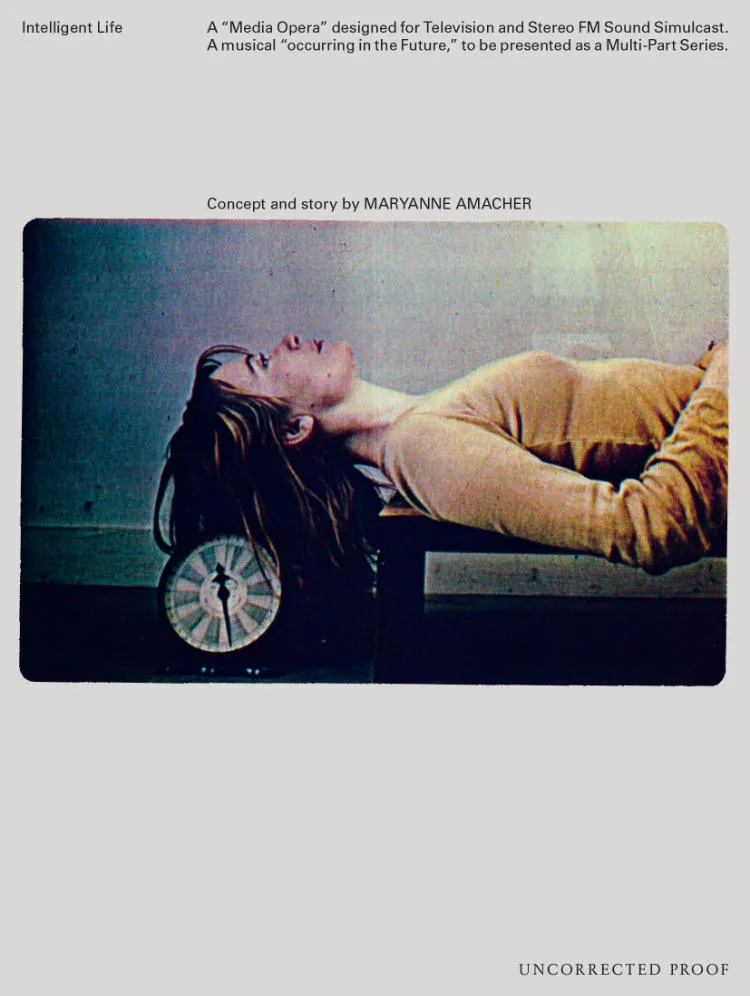
Cover of Intelligent Life

Blank Forms

Intelligent Life

Maryanne Amacher

Comprehensive and previously unpublished documentation on the American composer's unproduced magnum opus.

Had it been produced, Maryanne Amacher's media opera Intelligent Life would have represented the summation of the composer's concept to date. As she wrote to John Cage in the autumn of 1983, following the untimely deaths of the opera's patrons—Wies Smals, founder of De Appel, and curator Josine van Droffelaar, in a plane crash in the Swiss Alps—she would have at last had the support to "communicate the finest of my thought to others." Amacher's serial, intended for broadcast, sought to transmit her evolving ideas about perception, listening, and composition to a broader public—shifting music away from "nod and tap recognition" toward a transformative practice that could awaken intelligence to "unrecognized and new perceptual modes."

Set in the year 2021, Intelligent Life follows the employees of Supreme Connections LLC, a music entertainment corporation navigating a future in which artificial intelligence generates music faster than composers can. Anticipating an industry-wide downturn, Supreme Connections president Aplisa Kandel seeks advanced technologies that will revolutionize the act of listening and the future of music, including a bio-music script that lets the user hear Bach from the aural perspective of a reindeer and a wearable device that goes beyond replicating the mechanical tympanic resonances of the listening subject to produce the "listening mind" or the "sophisticated perceiver"—capturing and reproducing all the emotional and psychological associations unique to each individual.
Though Amacher could not realize Intelligent Life in any of its intended forms—she theorized its publication as a serialized radio broadcast and television simulcast, among other configurations—she continued designing "treatments" for the opera for much of her career. This volume makes the most complete of these working documents—including episodic scripts, notes on the use of LaserDisc, and an illustrated storyboard for the pilot—available to the public for the first time.

Maryanne Amacher (1938-2009) was a composer of large-scale fixed-duration sound installations and a highly original thinker in the areas of perception, sound spatialization, creative intelligence, and aural architecture. She is frequently cited as a pioneer of what has come to be called “sound art,” although her thought and creative practice consistently challenges key assumptions about the capacities and limitations of that genre. Often considered to be a part of a post-Cagean lineage, her work anticipates some of the most important developments in network culture, media arts, acoustic ecology, and sound studies.

Cover of Intermediary Spaces (2nd edition)

Umland / Q-02

Intermediary Spaces (2nd edition)

Julia Eckhardt, Éliane Radigue

In the long interview that forms the body of this publication, Éliane Radigue talks about her work, her reflections and underlying research, as well as her historical context. The publication also contains a commented list of works and Radigue's programmatic text on The Mysterious Power of the Infinitesimal.

New expanded edition of the book first published in 2019.

Éliane Radigue (born 1932 in Paris) is considered one of the most innovative and influential contemporary composers, from her early electronic music through to her acoustic work of the last fifteen years. Influenced by musique concrète and shaped by regular sojourns in the United States, where she discovered analogue synthesisers, her work unfolds an intensity which is at once subtle and monumental. Through her deep reflections on sound and listening, not only her music but also her working methods have come to shape a widely resonating set of new parameters for working with sound as musical material.

Julia Eckhardt is a musician and curator in the field of the sound arts. She is a founding member and artistic director of Q-O2 workspace in Brussels, for which she conceptualized various thematic research projects. As a performer of composed and improvised music she has collaborated with numerous artists, and extensively with Eliane Radigue. She has performed internationally, and released a number of recordings. She has been lecturing about topics such as sound, gender and public space, and is (co-)author of The Second Sound, Conversation on Gender and Music, Grounds for Possible Music, and The Middle Matter, Sound as Interstice.

Edited by Julia Eckhardt.
Texts by Éliane Radigue and Julia Eckhardt.

Cover of Rab-Rab, Issue 5

Rab-Rab Press

Rab-Rab, Issue 5

Rab-Rab

Periodicals €27.00

The fifth issue of Rab-Rab: Journal of Political and Formal Inquiries in Art includes stories about nation traitors, fierce masses, socialist women struggles, love-forms, psychedelic counter-revolutionaries, workers unions, Brecht fiddlers, jazz surrealism, Soviet trains, and anti-fascism.

Among the contributors to the fifth issue are Anna Thew, Yehuda Safran, Peter Gidal, Cana Bilir-Meier, David Black, Marjo Liukkonen, Alejandro Pedregal, Peter Hallward, Minna Henriksson, and Jyrki Siukonen.

It has also two extensive dossiers. One dedicated to Franklin Rosemont is presented by Joe Feinberg and is introducing some unpublished and difficult to find texts parallel with writings of T-Bone Slim and Joe Hill. The other dossier on Robert Linhart is presented by Tevfik Rada, and it includes a translation of a chapter from Linhart's book on productivism, an article against Western bourgeois dissidents, and an interview with him.

Cover of The Organ is the World's Greatest Synthesizer (vinyl LP)

Staalplaat

The Organ is the World's Greatest Synthesizer (vinyl LP)

Charlemagne Palestine

Recorded live at Amsterdam's Oude Kerk during the 2024 Sonic Acts Festival, The Organ is the World's Greatest Synthesizer finds Charlemagne Palestine returning to the Staalplaat catalog after many years. Taking its title and cover from a drawing made by Palestine during the performance, the work expands his singular mythology of sound and spirit. Opening with resonating bells and falsetto overtones before surrendering to the vast sonic tides of the church organ, the 40-minute piece unfolds as an ecstatic continuum—tones intertwining, frequencies colliding, and space itself becoming an instrument. A testament to the living dialogue between artist, instrument, and place, this is Palestine at his most immersive and transcendent.

For over six decades, Charlemagne Palestine has been a pioneering composer, performer, and multimedia artist, celebrated for his ecstatic sonic explorations and ritualistic, metaphysical performances. Emerging from the cross-disciplinary New York art scene of the 1960s and '70s, he helped shape a heretical edge of minimalism alongside figures like Conrad, Riley, Niblock, and Glass. Trained as a Jewish cantor and later as the carillonneur at St. Thomas Church, Palestine cultivated a deep fascination with resonance and overtone—an obsession that evolved through his use of percussion, early synthesizers, and monumental piano works, influencing artists from John Cale to Nick Cave.

Cover of  Là

Futura Resistenza

Laszlo Umbreit, Sirah Foighel Brutmann and 1 more

Là is an immersive, politically charged sound journey – a lament for the Al Naqab desert in Palestine. It is the result of a collaboration between Sirah Foighel Brutmann, Eitan Efrat, Laszlo Umbreit, and Ot Lemmens. The album combines acoustic instruments like flute and cymbals with processed electronics and mechanical sounds. 

The track Ensemble is made from sound recordings of eleven 16mm film projectors, playing simultaneously and in intervals, creating a texture centered around a single pitch – La/A. 

The tracks For Her, There, and No are recordings of live sessions played by Laszlo Umbreit and Eitan Efrat.  

The album also features an extended text by Rose Higham-Stainton titled Strategies for Survival, spread across a 12-page booklet.

Cover of Sonic Meditations

Self-Published

Sonic Meditations

Pauline Oliveros

Pauline Oliveros (1932-2016) Pauline Oliveros' life as a composer, performer and humanitarian was about opening her own and others' sensibilities to the universe and facets of sounds. Her career spanned fifty years of boundary dissolving music making. In the '50s she was part of a circle of iconoclastic composers, artists, poets gathered together in San Francisco. In the 1960's she influenced American music profoundly through her inclusive work with improvisation, meditation, electronic music, myth and ritual.

She founded 'Deep Listening(R), ' which came from her childhood fascination with sounds and from her works in concert music with composition, improvisation and electro-acoustics. She described Deep Listening as a way of listening in every possible way to everything possible to hear no matter what you are doing. Such intense listening includes the sounds of daily life, of nature, of one's own thoughts as well as musical sounds. 'Deep Listening is my life practice, ' Oliveros explained, simply. Oliveros founded Deep Listening Institute, formerly Pauline Oliveros Foundation, now the Center For Deep Listening at Rensselaer, NY. Her creative work is currently disseminated through Pauline Oliveros Publications and the Ministry of Maåt, Inc