rile*books

Search books

Search books by title, author, publisher, keywords...

Explore

Categories
Visit
Collections
Publishers
Back in stock
Any books
Cover of Stuck Rubber Baby

First Second Books

Stuck Rubber Baby

Howard Cruse

€22.00

As a young gay man leading a closeted life in the 1960s American South, Toland Polk tries his best to keep a low profile, until he finds himself unexpectedly drawn to a lively community of civil rights activists, folk singers, and night club performers. Emboldened by his new friends, he joins local protests and even finds the courage to venture into a gay bar. No longer content to stay on the sidelines, Toland takes a stand against bigotry. But in Clayfield, Alabama, that can be dangerous—even deadly. Painstakingly researched and exquisitely illustrated, Stuck Rubber Baby is a groundbreaking graphic novel that draws on Howard Cruse's experience coming of age and coming out in 1960s Birmingham, Alabama. Just in time for its 25th anniversary, this rich and moving tale of identity and resistance is back in print—complete with unpublished archival material and a behind-the-scenes look at the author's creative process.

Howard Cruse's career as an underground cartoonist was launched during the 1970s, and in 1980 he served as the founding editor of the groundbreaking Gay Comix series. His comic strip Wendel was serialized in the Advocate through much of the 1980s. Stuck Rubber Baby, his most widely known work, was the winner of Eisner and Harvey Awards in the U.S. and (in translation) a Comics Critics Award in Spain, a Luchs Award in Germany, and a Prix de la critique at the International Comics Festival in Angoulême, France.

Published 2020. 

Published in 2020 ┊ 240 pages ┊ Hardcover ┊ Language: English

recommendations

Cover of Borderlands / La Frontera: The New Mestiza 5th Edition

aunt lute books

Borderlands / La Frontera: The New Mestiza 5th Edition

Gloria Anzaldua

Poetry €29.00

A new edition of Anzaldúa's classic text.

Borderlands/La Frontera: The New Mestiza is a 1987 semi-autobiographical work by Gloria E. Anzaldúa that examines the Chicano and Latino experience through the lens of issues such as gender, identity, race, and colonialism. Borderlands is considered to be Anzaldúa’s most well-known work and a pioneering piece of Chicana literature.

Rooted in Gloria Anzaldúa's experience as a Chicana, a lesbian, an activist, and a writer, the essays and poems in Borderlands/La Frontera: The New Mestiza profoundly challenged, and continue to challenge, how we think about identity. Borderlands/La Frontera remaps our understanding of what a border' is, presenting it not as a simple divide between here and there, us and them, but as a psychic, social, and cultural terrain that we inhabit, and that inhabits all of us.

Cover of BUTT 37

BUTT magazine

BUTT 37

Periodicals €13.00

Lots of straight-talking in BUTT no. 37. Catch Édouard Louis shot by Nan Goldin, Bruce LaBruce meeting Omar Apollo, real talk with Brazilian deputy Erika Hilton and dirty talk with Martin Margiela and Jean Paul Gaultier. Plus a lesbian threeway, Bogotá’s sauna/museum, cocks in sock and oh so much more. Bangers only.

Cover of Love Me Tender

Semiotext(e)

Love Me Tender

Constance Debré

LGBTQI+ €18.00

A novel of lesbian identity and motherhood, and the societal pressures that place them in opposition. 

The daughter of an illustrious French family whose members include a former Prime Minister, a model, and a journalist, Constance Debré abandoned her marriage and legal career in 2015 to write full-time and begin a relationship with a woman. Her transformation from affluent career woman to broke single lesbian was chronicled in her 2018 novel Play boy, praised by Virginie Despentes for its writing that is at once "flippant and consumed by anxiety."  

In Love Me Tender, Debré goes on to further describe the consequences of that life-changing decision. Her husband, Laurent, seeks to permanently separate her from their eight-year old child. Vilified in divorce court by her ex, she loses custody of her son and is allowed to see him only once every two weeks for a supervised hour. Deprived of her child, Debré gives up her two-bedroom apartment and bounces between borrowed apartments, hotel rooms, and a studio the size of a cell. She involves herself in brief affairs with numerous women who vary in age, body type, language, and lifestyle. But the closer she gets to them, the more distant she feels. Apart from cigarettes and sex, her life is completely ascetic: a regime of intense reading and writing, interrupted only by sleep and athletic swimming. She shuns any place where she might observe children, avoiding playgrounds and parks "as if they were cluster bombs ready to explode, riddling her body with pieces of shrapnel."  

Writing graphically about sex, rupture, longing, and despair in the first person, Debré's work is often compared with the punk-era writings of Guillaume Dustan and Herve Guibert, whose work she has championed. As she says of Guibert: "I love him because he says I and he's a pornographer. That seems to be essential when you write. Otherwise you don't say anything." But in Love Me Tender, Debré speaks courageously of love in its many forms, reframing what it means to be a mother beyond conventional expectations.

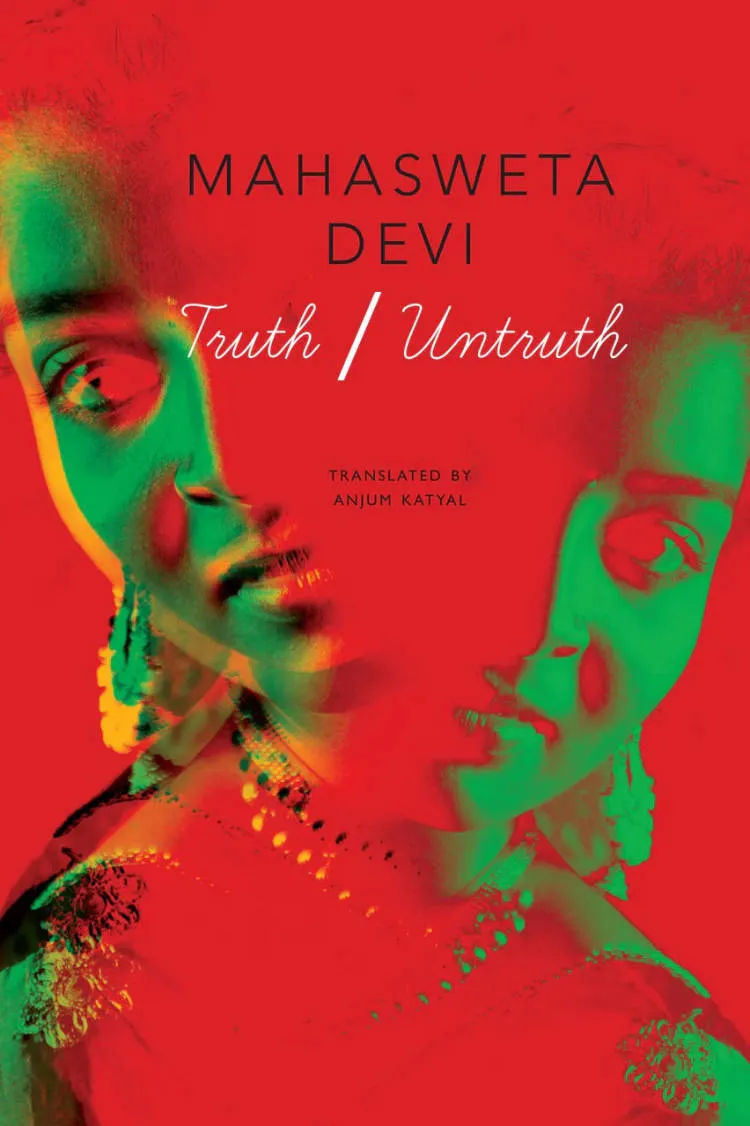
Cover of Truth / Untruth

Seagull Books

Truth / Untruth

mahasweta devi, Anjum Katyal

Fiction €22.00

A trenchant, darkly humorous, and unsentimental look at Calcutta society. 

Set in Calcutta in the mid-1980s, Truth/Untruth is a fast-paced thriller built around the death of the pregnant Jamuna—a maid in a newly affluent residential apartment complex—and Arjun, the upwardly mobile businessman who seduced her. Packed with a cast of colourful characters, this novel is a trenchant, darkly humorous, and unsentimental look at the different segments of Calcutta society: from the middle-class culture vultures to the unscrupulous ‘promoter’ class and the domestic helpers and slum goons who form an intrinsic part of the city’s life. All are implicated in a complex web of guilt and bizarre twists and turns. Sex, lies, death—the great modernist themes—run like a thread through this book, exposing societal greed, lust, corruption, and moral hypocrisy with a sardonic tone that spares none. An unusual novel by an author who is otherwise known for her hard-hitting activist-feminist stories, Truth/Untruth underlines the exploitative vicious cycle that defines urban relations between the haves and have-nots.

‘Although not of the margins herself, Devi was accomplished in writing from the margins [ . . . ] However, it is indeed worth it if you are looking for an exhilarating social commentary and biting satire that remains relevant today. Devi also reflects the jargon and dialects of the lower classes as deftly as the peculiarities of upper-class speech patterns. A feat of this work is Katyal’s ability to mediate these multiple registers, rewarding the reader with sharp writing that is at once funny, sardonic, and darkly pleasurable to read.‘—Jack Greenbert, Cha: An Asian Literary Journal.

Cover of Crystal Pantomime

Taufic

Crystal Pantomime

Mina Loy

Fiction €16.00

Recognized as a poet, less so as a visual artist […] Mina Loy also wrote in the style of Crystal Pantomime, a text from one hundred years ago [c. 1915] describing a ballet in prose. The writing evokes images with which actual theater effects can only interfere. It projects in the mind as onto a screen. But this restless writing does more than that, shifting registers and unfolded in equal parts fairy tale description, precise impossible stage directions, notes for impossible costumes and sets, guidelines for impossible choreography, and a glancing archeology of personal association, opinion, art historical commentary, and psychoanalysis, all floating in suspension, all shading into poetry, and with this manner of overflowing every frame defining its poetics. — Matthew Goulish

This first standalone edition of Crystal Pantomime opens with a biographical introduction by Mina Loy’s literary executor—poet Roger Conover—originally published in Eliot Weinberger’s journal Montemora in 1981, as well as a dramaturgical introduction by Matthew Goulish of Chicago performance group Every house has a door, originally prepared as opening remarks to Every house’s reading of Loy’s Pantomime at the Arts Club of Chicago in spring of 2024. In tandem these supplementary texts begin to frame what is a rather strange and singular sketch for a work never realized.