rile*books

Search books

Search books by title, author, publisher, keywords...

Explore

Categories
Visit
Collections
Publishers
Back in stock
Any books
Cover of SIXFINGERAFTERWARDS

Veer2

SIXFINGERAFTERWARDS

William Rowe

€13.00

William Rowe, the poet, and eminent translator of Latin American poetry from Vallejo to Raul Zurita & others presents his latest book of poems, Sixfingersafterwards, in six sections. The title word ‘afterwards’, which refers to a large part of the first section of poems takes inspiration from an Ayahuasca session. According to Freud, Afterwardness or Nachtraglichkeit as originally harmless memory can later be re-experienced as traumatic through the lens of new mature understanding. The Marxists view the capitalist state as inherently connected to a ‘death culture’ where the pursuit of profit overrides the human life, turning the system into a form of a vampirism that consumes the living labour. All the sections are written with a deep commitment, elaborating a painful truth in a remarkable open poetic sensitivity. Our language ravaged by ‘vampirism’ where ‘Language itself seemed to form death communiques.’  Other sections are about love, ‘when my daughter says she loves me very much.’  Or a section of Quechua poems translated by Rowe, which shed light on the extensive range of his writing and interconnectedness of his creativity. The poems in this collection leave nothing out of the traumatic pain from capitalism nor its ‘dark dark shine of money.

I dreamt of Rowe, reading these poems to the track called Walking on the ceiling, by the late Chicago blues guitarist, who played with six fingers. I renamed it to Walking the ceiling toward eternity, to honour the Sixfingersafterwards. A must-read!
- Ulli Freer

Published in 2025 ┊ 86 pages ┊ Paperback ┊ Language: English

recommendations

Cover of And most of all I would miss

Veer2

And most of all I would miss

Mira Mattar

Poetry €13.00

Picture a pencil curved, implausibly, parabolically. An implement bending back on itself (core straining) so as to be drawing the surest line, even as its eraser-end is simultaneously rubbing that graphite out. What remains almost never was: mark as memorial to foreclosure. Examined from a certain angle, the un-line flickers in and out of thereness. On registration, it lives, it goes forth. Sub rosa, it knows never to clear its throat. It has learnt to calibrate its signature; it can evade infra-red. Propelling itself through the narrowest channels, it proceeds with resolve, flayingly. Mattar’s And most of all I would miss the shadows of the tree’s own leaves cast upon its trunk by the orange streetlight in the sweet blue darks of spring is taut as writing can be. The tone she makes sound is singular and desperately (gloriously) intent.
- Sarah Hayden

Piercing and lucid in its exposition of atmospheric violence and total erasure, Mira Mattar gets to the grain of how the languages of selfhood, mediated but also inhibited by the force of the ‘un-universal’, become complicit in forming the sovereign imperative to self-determination, ‘oh arrogant ambition / to transform / you & keep myself / plumed’, through the reproduction of a ‘contested field / of meaning’, one both marked by the lure and ruse of psychic stability as the real fantasy of occupation, and immanent to concrete, unknown modes of personal resistance and collective recovery thread like a ‘rope / in a knot in a line / of knots’, an inherited ‘excess of memory / mostly portal.’ Mattar carefully gleans in its undecidability, given over to moments of precarious decision without ties or duplicity.
- James Goodwin

Cover of Ends

Veer2

Ends

Lotte L.S.

Poetry €13.00

Lotte L.S.’s ‘selected poems’ (the scare quotes and lower case are important), which begin and end with standardised gaps produced by hitting the tab key with prefabricated empty space symbolising other gaps produced by other textual means, also associates those standardised gaps, these absences, wit acts of what she calls ‘seeing’, meaning seeing as self-seeing; a seeing that is often impossible to distinguish from blindness. The second line of her book ‘she could not see to see’, is modified by its last: ‘o         I am so thankful for the seeing’; and the rhyme across distance upholds, if only just, a transitio in grammatical person, a transition in grammar that may also be, or that may represent, though these verbs too are contested—‘she went (an unconvincin verb: went)’—that may also be or represent a transition in experienced subjecthood The suggestion anyway is of development, passage, narrative; of motion towards completion; though the development is no way self-explanatory, and it is punctuated by double takes.
— from Danny Hayward's Preface: A note on Ends

Cover of Working Museum

Veer2

Working Museum

Ziddy Ibn Sharam

Poetry €13.00

"In Spring and All, William Carlos Williams figures imagination as the springing off point to greater connection with the world and its gentle motions. ‘It is spring,’ he writes: ‘life again begins to assume its normal appearance as of “today.” Only the imagination is undeceived.’ Embracing the haecceity of the everyday and allowing the imagination to make silent and surprising connections are ways to withhold the deceptiveness of relying on old habits of thinking and writing. 

Ziddy Ibn Sharam’s Working Museum begins with another quotation from Spring and All: ‘There is not confusion – only difficulties’, and the sequence offers delicate, poetical examinations how the confusions and frustrations of interpersonal communication are beneficent difficulties to be embraced and considered in gentle depth. This is a gorgeous sequence of poems, offering generous, gracious and graceful glimpses of a family’s birthday pilgrimage to Amberley Museum and Heritage Centre in Sussex. Working Museum is a tour de force of delicate poetry of feelings and feeling through feelings in a world of wordless connections and contacts, navigating the liminal but intimately understood spaces between two brothers and their family. In these poems, 

Sharam is trying to be still in language, as smiles, touches and profound intimacies are exchanged. Observing and being in his brother’s presence during this special time of spring, Sharam re-learns to experience, to become ‘plugged’ in, as he writes, to new ‘switchboards’ of sensation, thought and poetic possibility. The ‘old machines’ of mental expectation and habit are, in the presence of his other-sensing brother, found wanting for the appreciation of his ‘intellect just as it is’. Here, Sharam learns to ‘do things minimally’ and to revel in the ‘seismic proportions’ of the apparently mundane. Sharam and his readers are offered a space to share in a brother’s beautifully vivid world and are privileged to witness a profound, ‘beginning, // again." - Gareth Farmer

Cover of Anarcadia

Veer2

Anarcadia

Dominic Hand

Poetry €13.00

An epic poem in miniature, Anarcadia attempts to navigate the stark disintegration of the very world from which it’s made, mapping a catastrophe that seems both on its way and already occurring. Offering a collage of collapsing fragments – whirling ‘like bitstreams / in a blizzard’ – this sequence freefalls through a landscape of freak storms and surveillance satellites, ‘bio- / metric insects’ and ‘full- / body scanner[s]’, ‘leaving nothing left / undamned’. Continuing the sleek work of the previous collections, Hand’s command of language generates a livable terrain, humming with echoes of the pastoral tradition – from Sidney to Shelley, from Geoffrey Hill to J.H. Prynne. Hand’s poetry renders ‘an animate / climate’, through which we are forced to face the debris of a system that has failed us and a planet we, in turn, have failed. Nevertheless, the poet shows us a glimpse of the future. At the heart of Anarcadia is something of a love poem, revealing beauty in the art of losing, a way to ‘Re-salvage / sylvan camouflage / out of obscure selvage’, attempting a recovery. ‘Rife with hybrid vigour’, this book confirms Dominic Hand to be a poet of singular, clear-sighted vision, unafraid to see things as they are, ‘risking / bewilderment’.
– Rowland Bagnall

Cover of LllOovVee - Forbid me my love

Veer2

LllOovVee - Forbid me my love

Aodán McCardle

Poetry €13.00

It is right and necessary to be speaking with strangers. There are islands, backroads and cliffs of wet inked worded sea ridgelines where aodán McCardle’s work emerges concrete and lyric as a chant of delicately provoking permutations. forbid me my love, the first part of this beautiful book, is poetry as poiesis or making. By means of a series of concrete meditations, McCardle takes us where he, or perhaps the words themselves, unknit, erase, appear and disappear. Wor(l)ds of the size of terrorist and bomb are subject to a system of alterations that end up shooting lovebombs from the page as if love could become an error in the system. The second part of the book, LllOovVee, starts closer to verse. Reading it, one can almost hear aodán’s delicate Irish voice, but any easy reading gets explosively interrupted by the scanned handwritten, scribbled and scratched lines that open another set of permutations, one about what is behind us, how to be there here and what is it to be there then now, in the making, in the ear and in the eye with this revealing poetry.
 - Martín Gubbins 

Aodán McCardle is a performance poet, artist, & tattooist. In this book he combines all three artistic expressions into a performance. These poems are audacious. A poetic trajectory worthy of reading aloud.

Cover of Wretched Strangers

Boiler House Press

Wretched Strangers

Ágnes Lehóczky, JT Welsch

Poetry €18.00

In response to surges of violent British nationalism and political paranoia around borders, and to related social and ethical crises, JT Welsch and Ágnes Lehóczky have assembled an anthology to mark the vital contribution of non-UK-born writers to this country’s poetry culture. Wretched Strangers brings together innovative writing from around the globe, celebrating the irreducible diversity such work brings to ‘British’ poetry. While documenting the challenges faced by writers from elsewhere, these pieces offer hopeful re-conceptions of ‘shared foreignness’ as Lila Matsumoto describes it, and the ‘peculiar state of exiled human,’ in Fawzi Karim’s words.

The book is published by Boiler House Press to commemorate the anniversary of the June 2016 EU Referendum and in solidarity through struggles ongoing and to come. Proceeds will be donated to charities fighting for the rights of refugees.

Alireza Abiz • Astrid Alben • Tim Atkins • Andre Bagoo • Veronica Barnsley • Khairani Barokka • Leire Barrera-Medrano • Katherine E. Bash • Áine Belton • Caroline Bergvall • Sujata Bhatt • Rachel Blau DuPlessis • Fióna Bolger • Ben Borek • Andrea Brady • Serena Braida • Wilson Bueno • James Byrne • Kimberly Campanello • J.R. Carpenter • Mary Jean Chan • che • Matthew Cheeseman • Iris Colomb • Giovanna Coppola • Anne Laure Coxam • Sara Crangle • Emily Critchley • Ailbhe Darcy • Nia Davies • Tim Dooley • Benjamin Dorey • Angelina D’Roza • Katherine Ebury • Dan Eltringham • Ruth Fainlight • Kit Fan • León Felipe • Alicia Fernández • Veronica Fibisan • Steven J Fowler • Livia Franchini • Ulli Freer • Anastasia Freygang • Kit Fryatt • Monika Genova • Geoff Gilbert • Peter Gizzi • Chris Gutkind • Cory Hanafin • Edmund Hardy • David Herd • Jeff Hilson • Áilbhe Hines • Alex Houen • Anthony Howell • Nasser Hussain • Zainab Ismail • Maria Jastrzębska • Lisa Jeschke • Evan Jones • Loma Sylvana Jones • Maria Kardel • Fawzi Karim • Kapka Kassabova • Özgecan Kesici • Mimi Khalvati • Robert Kiely • Michael Kindellan • Igor Klikovac • Ágnes Lehóczky • Éireann Lorsung • Patrick Loughnane • John McAuliffe • Aodán McCardle • Niall McDevitt • Luke McMullan • Christodoulos Makris • Ethel Maqeda • Lila Matsumoto • Luna Montenegro • Stephen Mooney • Ghazal Mosadeq • Erín Moure • Vivek Narayanan • Cristina Navazo-Eguía Newton • Alice Notley • Terry O’Connor • Wanda O’Connor • Gizem Okulu • Claire Orchard • Daniele Pantano • Astra Papachristodoulou • Fani Papageorgiou • Richard Parker • Sandeep Parmar • Albert Pellicer • Pascale Petit • Adam Piette • Jèssica Pujol Duran • Alonso Quesada • Ariadne Radi Cor • Nat Raha • Nisha Ramayya • Peter Robinson • William Rowe • Lisa Samuels • Jaya Savige • Ana Seferovic • Sophie Seita • Seni Seneviratne • Timea Sipos • Zoë Skoulding • Irene Solà • Samuel Solomon • Agnieszka Studzinska • James Sutherland-Smith • George Szirtes • Rebecca Tamás • Harriet Tarlo • Shirin Teifouri • Virna Teixeira • David Toms • Sara Torres • Kinga Toth • Claire Trévien • David Troupes • Arto Vaun • Juha Virtanen • J. T. Welsch • David Wheatley • Elżbieta Wójcik-Leese • Jennifer Wong • Isaac Xubín • Jane Yeh

Cover of Tripwire 23 - Work/Anti-work

Tripwire

Tripwire 23 - Work/Anti-work

David Buuck

Periodicals €18.00

Work/Anti-work issue with writing by Nat Raha /. lisa minerva luxx /Ghayath Almadhoun, trans. Catherine Cobham / Jacqui Germain / Jazra Khaleed, trans. Peter Constantine / Finn Finneran / Cait O’Kane / Rebecca Kosick / Lara Durback Skye /Lotta Thießen / William Rowe / Danny Hayward / Rona Lorimer / Zoe Beloff / Jike Ayou, trans. Yě Yě / Miguel de Vallester, trans. Erasmo Pantoja / Lucas Martínez / ko ko thett / Hung Q. Tu / Raymond de Borja / etaïnn zwer, trans. Ilan A.L.S. Erikson Weisbrod / Annie Raab on Taylor Portela / Rachael Guynn Wilson on Lyn Hejinian / Will Rowe on Danny Hayward / Chloe Watlington on Joshua Clover. 

Cover of La Maison des Maladies

éditions Hourra

La Maison des Maladies

Unica Zürn, Ruth Henry and 1 more

Unica Zürn dans La maison des maladies raconte, par un ensemble de textes et dessins, un séjour en hôpital où elle est soignée d’une jaunisse. Elle y écrit et compose ce carnet où le regard qu’elle pose sur son propre corps, les lieux qu’elle habite et les personnages qu’elle rencontre, témoigne d’une sensibilité hors-norme qui tire à la fantaisie, voire au délire.

Pour la première fois en France, La maison des maladies est publié intégralement.

Le texte est traduit de l’allemand par Ruth Henry & Robert Valençay. Un après-propos de Mathilde Girard clôture le livre.

Cover of A Sand Book

Tin House Books

A Sand Book

Ariana Reines

Poetry €18.00

Deadpan, epic, and searingly charismatic, A Sand Book is at once relatable and out-of-this-world. In poems tracking climate change, bystanderism, state murder, sexual trauma, shopping, ghosting, love, and the transcendent shock of prophecy, A Sand Book chronicles new dimensions of consciousness for our strange and desperate times. What does the destruction of our soil have to do with the weather in the human soul? From sand in the gizzards of birds to the iridescence on the surface of spilt oil, from sand storms on Mars to our internet-addicted present, from the desertifying mountains of Haiti to Sandy Hook to Hurricane Sandy to Sandra Bland, A Sand Book is both a travelogue and a book of mourning.

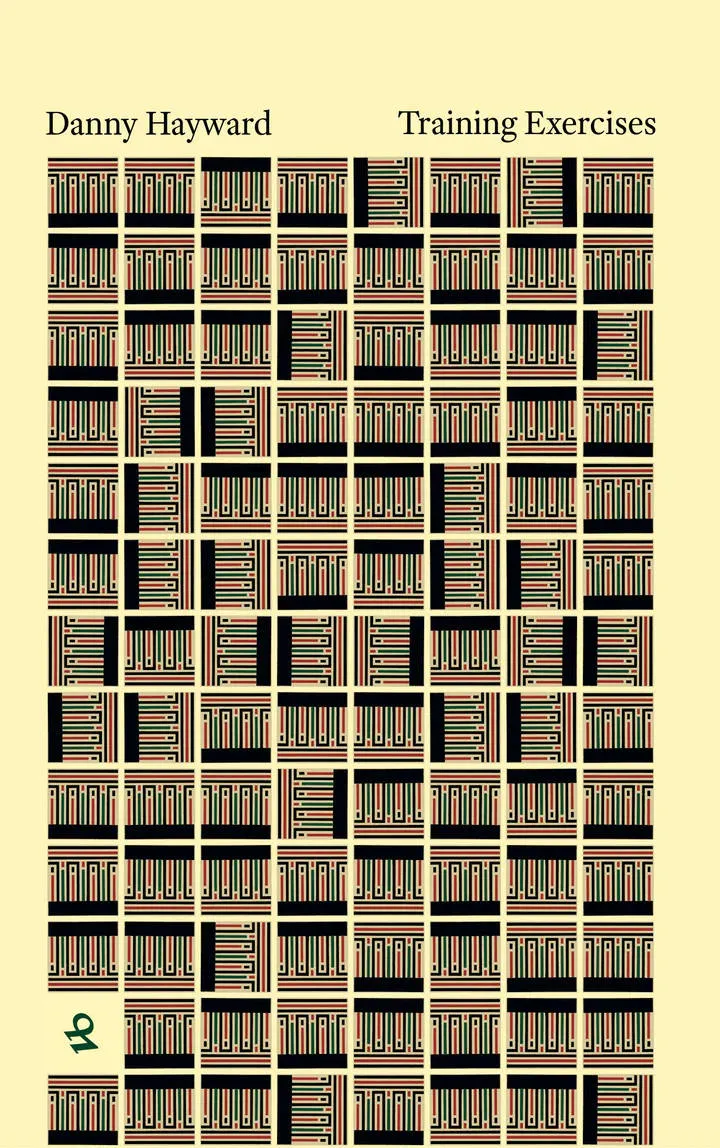
Cover of Training Exercises

both are worse

Training Exercises

Danny Hayward

Poetry €16.00

Organized violence committed on ordinary speech’ is therapy for those who don’t believe in literature as value. Training Exercises is an unpacking of that dictum: seven short essays, letters, reports and anti-biographies written to overcome the feeling of resistance to the defacement of what strikes us as true. An anti-purge written out by lipstick or hammer, scrawled over the top of itself and run through a translation program that turns everything upside inside down, its pieces include: a polemic against catharsis; a letter to the poet Dom Hale on his book Seizures; and a series of on-the-spot reports on the UK Illegal Migration Bill, East London poetry readings, the politics of the war in Ukraine, and a conversation about the meaning of damage in contemporary literature. 

‘First you learn to write down your ideas, then you learn again how to write all of your lurid political and intellectual and intimate disappointments and all of your childhood hopes over the top of them’. Jack Spicer scrawled the name of his book in pink lipstick on the cover of the academic journal he had published in: Training Exercises scrawls itself on top of that.

Cover of Mountainish

Prototype Publishing

Mountainish

Zsuzsanna Gahse, Katy Derbyshire

Fiction €16.00

A narrator and her dog are criss-crossing the Swiss Alps. She travels with friends who share her interest in food, languages and their topographical contexts. They collect colours, even look for colourlessness, and develop the idea of a walk-in diary, a vain attempt to archive their observations, encompassing portraits, descriptions and ruminations on mountains, hotels, people, language, food, flora and fauna.

Gradually, other mountains appear in their observations and memories, as do the mountains of literature and art. Mountains may be sites of fear and awe, of narrow-mindedness, racism and ever-looming collapse; Alpine lodges may be places of hospitality, retreat and unexpected encounters; of nature under threat.

In 515 notes, Zsuzsanna Gahse unfolds a finely woven interplay between her six characters while giving us a vivid panorama of mountain worlds, a multi-layered typology of all things mountainish.

Cover of Autobiography of Cotton

And Other Stories

Autobiography of Cotton

Cristina Rivera Garza, Christina MacSweeney

A novel about how cotton workers transformed the Mexico-US borderlands, by a Pulitzer Prize–winning author.

In 1934, a young José Revueltas traveled to Tamaulipas to support the cotton workers’ strike in Estación Camarón, which became the basis of his landmark novel, Human Mourning. In her own groundbreaking novel, Autobiography of Cotton, Cristina Rivera Garza recounts her grandparents’ journey from mining towns to those same cotton fields as it intersects with Revueltas’s life in a vivid and evocative history of cotton cultivation along the Mexico-US border.

Through archival research and personal narrative, Rivera Garza chronicles the way cotton transformed the borderlands by reconstructing the cotton workers’ strike and reveals how cycles of deprivation and ecocide persist across generations. Deeply personal and politically acute, Rivera Garza crafts a new kind of border novel that tells how a brittle land radically altered her grandparents’ lives and the territories they helped develop. An intimate fictionalization, Autobiography of Cotton reveals a rich social history of agricultural colonization, labor activism, environmental degradation, and cross-border migration.