rile*books

Search books

Search books by title, author, publisher, keywords...

Cover of Cursive Paradise

Wendy's Subway

Cursive Paradise

Kaur Alia Ahmed

€18.00

Kaur Alia Ahmed’s Cursive Paradise asks how a refusal of cogency can lyrically expand perception. They write, “To weigh heavily on something / is to decide its shape,” and throw language into a state of excess. These poems shift and eddy, loop, and undulate, seeking out spaces of desire and onomatopoeic attraction. All the while, Ahmed offers a view of subjectivity and gender made resonant and malleable, insisting on language that is lush with what cannot be contained by the voice or the page.

Cursive Paradise is the recipient of the 2021 Carolyn Bush Award.

Kaur Alia Ahmed is an artist and writer living in New York. He is interested in destabilizing language, handling it in similar ways to ink, skin, light. His work has been presented at Interstate Projects, 77 Mulberry, Alyssa Davis Gallery, island gallery, Entrance Gallery, and The Drawing Center. His poems can be found in the Poetry Project Newsletter, Baest Journal, Spoil Magazine, BOMB Magazine, and Rhizome. Cursive Paradise is his first book.

Cursive Paradise forces us to rethink feeling, to enter a world where purple is sharp and where nectar leaves us spellbound. Kaur’s writing shapes a space where form and function give up their historical antinomy and renders the world in layers—of light, fluid, fetish, and fissure—breaking the lyric down to its guttural release. 
Bianca Rae Messinger 

Kaur Alia Ahmed offers gleaming edges around the most beautifully staged immediate action. I read certain parts over and over, becoming more conscious of the physical dependence our bodies form in relation to words and music. These lines leap at the least provocation. Ahmed infuses the overall arrangement (visual, orchestral, narrative) with as much yearning as the language itself, leaving us a perfect, wavering space to land. 
— Cedar Sigo 

This is indeed a cursive paradise, but you’ll find no italics here. Emphasis happens differently, through repetition (if you catch Stein’s drift). Kaur Alia Ahmed’s poems, odes to momentum and transformation, refuse to settle into a single form. They propel readers forward and reward their desire to linger on their electric, libidinally charged utterances by having them recur, rearranged and slightly altered, again and again.
Mónica de la Torre

Published in 2025 ┊ 160 pages ┊ Language: English

recommendations

Cover of Discipline Park

Wendy's Subway

Discipline Park

Toby Altman

Non-fiction €18.00

Toby Altman’s Discipline Park documents the demolition of Prentice Women's Hospital in Chicago, a landmark of architectural brutalism designed by Bertrand Goldberg in the 1970s. Altman was born in the building, and years later, was employed by Northwestern University when they tore it down. His personal proximity to the site leads to a wider critical evaluation of the cruelty of a neoliberalism that asks us to draw sustenance from the very institutions that poison and erase our bodies, habitats, and histories. But, as it indicts the present and its claustrophobic, ruinous politics, Discipline Park also recovers or reinvents utopian vistas through an extended engagement with Goldberg's architectural practices.

Cover of Ad Học

Wendy's Subway

Ad Học

Teline Trần

Poetry €12.00

Teline Trần's Ad Học traverses the improvisational structures that shape social life in order to reflect their valences as both insufficient and abundant. In their first poetry chapbook, Trần locates those junctures with bittersweet pleasure and biting critique and asks how to sustain both at once. This is, Trần shows us, the work of living, against and within the ongoing attrition and amnesia at scales historical and governmental, interpersonal, familial, and social. Ad Học asks the reader to turn inwards, towards a personal politic, to self-revolution, in order to seek horizons dreamier, queerer, and hopefully insurgent.

Teline Trần is a writer from Orange, California or Gabrieleño/Tongva land. They write about home and interstitial faith via several mediums such as fiction, poetry, film, and ultimately, the browser. Teline works as the Membership and Community Engagement Coordinator at Wendy’s Subway, where they were a Fellow in 2020. They also work as the Development Coordinator at Mekong NYC, a Southeast Asian grassroots organization in the Bronx. They hold a degree in Comparative Literature from Reed College.

Cover of Some Monologues

Wendy's Subway

Some Monologues

Tyler Coburn

Fiction €25.00

Working at the nexus of performance, art writing, and fiction, Tyler Coburn creates monologues that explore how the “I” is marked in speech. His myriad topics—alternate history, legal personhood, digital labor, and resonant frequency, to name a few—defy straightforward modes of presentation, often insisting on site-specificity and social intimacy at the expense of conventional documentation. 

Some Monologues collects, for the first time, the scripts of Coburn’s work from the past fifteen years, many of which have not previously been published. Accompanying them are texts by eleven artists, writers, curators, and scholars who experienced these performances firsthand, collaborated in their making, conversed with the artist about them, or share an interest in the subjects they engage. Written in theoretical, poetic, and autobiographical registers, these contributions offer new perspectives on the monologue as an expansive and relational form.

Introduction by Elvia Wilk. Contributions by Yu Araki, A.E. Benenson, Mashinka Firunts Hakopian, Sven Lütticken, Kameelah Janan Rasheed, Spyros Papapetros, Camille Richert, Théo Robine-Langlois, Ian Wallace, and Michelle Wun Ting Wong.

Tyler’s scripts refuse to fix an authorial voice; instead, they make the conditions of authorship itself their subject. Blurring the boundaries between fiction and document, the human and the bureaucratic, the self and its doubles, his work thinks through systems from the inside, often using language as both architecture and trap. In their precision and porousness, I recognize a shared pursuit: how to locate agency within constraint, and how to turn the administrative or the technological into a site of intimacy. — Jill Magid

In Tyler Coburn’s Some Monologues, a binary that remains constitutive for the ideological continuity of modern life, in all its colonial and capital forms, is undone: digital vs. physical. In troubling that chasm, Coburn plays out the repercussions of these ideologies of anthropomorphic naturalism, guiding us through their resonances, doubles, codings, and relays. But he also renders himself as the relay of these transferences, in the process expanding art’s premodern calling: to exist as an invocation. Reification suddenly appears as what is situated between embodiment and disembodiment, with both potentially destabilized. Some Monologues, the book, is this destabilization’s ideal format: as much documentation, an echo, of Coburn’s works through their scripts, as it is an instruction manual for denaturalizing our sense/s. — Kerstin Stakemeier

Tyler Coburn is an artist, writer, and professor based in New York. He received a 2024 Andy Warhol Foundation Arts Writers Grant, and his writing has appeared in ArtReview, BOMB, C Magazine, Dis, e-flux journal, frieze, LEAP, Metropolis M, Mousse, and Rhizome. Coburn is the author of four books: I’m that angel (self-published, 2012), Robots Building Robots (CCA Glasgow, 2013), Richard Roe (Sternberg, 2019), and Solitary (Sternberg and Art Sonje Center, 2022). He has presented artwork at such venues as Centre Pompidou, Paris; Bergen Kunsthall; Hayward Gallery, London; Para Site, Hong Kong; and Kunstverein Munich. 

Cover of ONE THOUSAND GHOSTS IN THIS FEAST

Wendy's Subway

ONE THOUSAND GHOSTS IN THIS FEAST

Sahar Khraibani

Poetry €14.00

Sahar Khraibani’s ONE THOUSAND GHOSTS IN THIS FEAST contends with desire, grief, and language as sites of injury and release. Written over a period of three days—amid ongoing genocide, land seizure, and displacement—the long poem counters logics of possession with those of relation. Khraibani’s all-caps, first-person address impels the poem forward, centering intertextuality as a force through which spectral presences shine.

Sahar Khraibani is a writer and artist whose work has been presented with Montez Press, The Brooklyn Rail, Magnum Foundation, the Poetry Foundation, the Poetry Project, and Hyperallergic among others. Sahar is a recipient of the Creative Capital / Arts Writers Grant, a fellowship at The Poetry Project, a MacDowell Fellowship, a 2024 residency at Mass MoCA, and is an alumni of the Whitney Independent Study Program. Sahar teaches at Pratt Institute and is the author of Anatomy of A Refusal (1080PRESS, 2025). 

ONE THOUSAND GHOSTS IN THIS FEAST lays bare the “SENSELESS DECAY” potentiated by empire’s relentless categorization, containment, and calculated death delivery. Khraibani’s debut chapbook collapses the imposed and perceived distance written by borders, disrupts anticipated colonial language logics, and bursts “INTO THE MADNESS OF THE ORGY” with queer interference reverberating in all directions. From the soil, from the graveyard, from the dancefloor, from their favorite spot on the eroding waterfront, Sahar broadcasts, IN ALL CAPS, “THE UNNAMEABLE TRUTH.”
Andrea Abi-Karam

Cover of The Book of Na

Wendy's Subway

The Book of Na

Na Mira

Fiction €28.00

In The Book of Na, translation acts at the edge of perception. Tracing across projects in film, video, and performance, Na Mira reflects on the violent fragmentation of bodies while refusing the containment of geographic and corporeal borders. In 1977, a name is cut at an immigration office. This gap turns into an intergenerational score for becoming heat, hexagram, hologram. Using oracular and glitching technologies, Mira witnesses what escapes data: doppelgängers, dreams, endangered tigers, tesseracts, A. Turiyasangitananda Coltrane's stairs, Theresa Hak Kyung Cha in a theater, Korean shamanism, frozen ligaments, wildfires, borderlands, subatomic particles, and pink. Syncing to a clock with neither face nor hands, Mira’s hauntological permutations in time, death, and relation travel outside the symbolic order and draw energy from the void.

Na Mira’s autobody rites have been presented at sites including Seoul Museum of Art; Museum of Contemporary Art, Los Angeles; Portland Institute of Contemporary Art; Participant Inc., New York; and Whitney Museum of American Art, New York. She earned an MFA from the University of California, Los Angeles. She grew up between the US and East Asia and teaches outside.

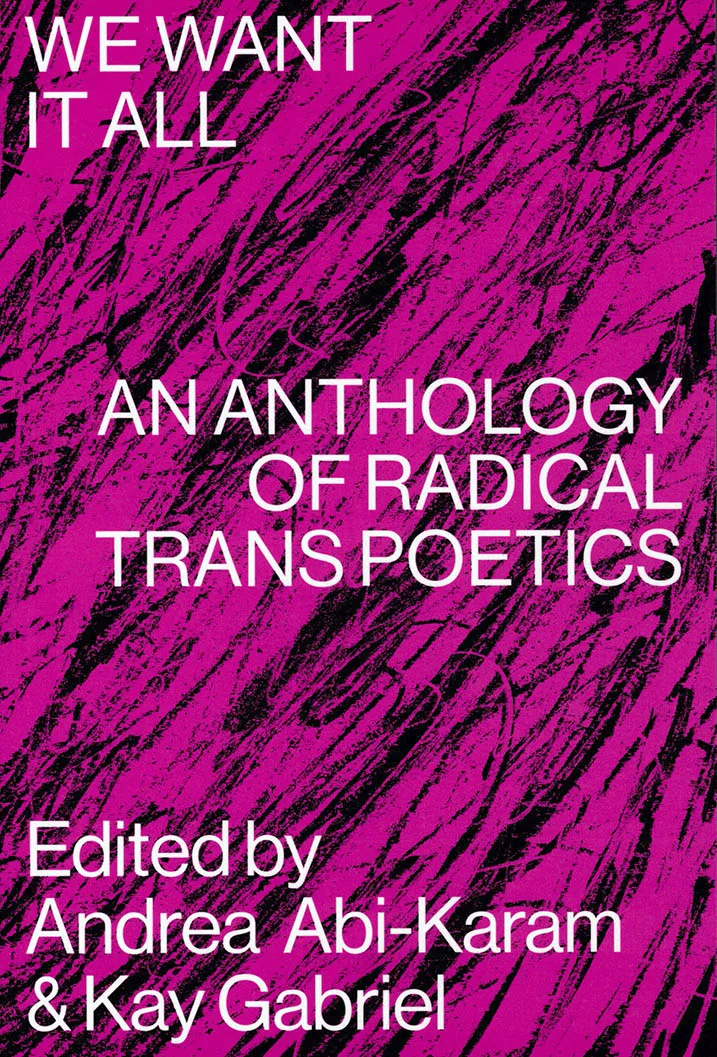
Cover of We Want It All: An Anthology of Radical Transpoetics

Nightboat Books

We Want It All: An Anthology of Radical Transpoetics

Kay Gabriel, Andrea Abi-Karam

Poetry €23.00

An anthology of formally inventive writing by trans poets against capital and empire.

With texts by: Andrea Abi-Karam, New York City Sam Ace, South Hadley, MA Bahaar Ahsan, Berkeley, CA jasper avery, Philadelphia, PA Ari Banias, Berkeley, CA Jo Barchi, Chicago, IL Joss Barton, St. Louis, MO Levi Bentley, Philadelphia, PA Jessica Bet, Baltimore, MA Rocket Caleshu, Los Angeles, CA Ching-in Chen, Seattle, WA listen chen, Vancouver, BC Faye Chevalier, Philadelphia, PA Cody-Rose Clevidence, Arkansas Miles Collins-Sibley, Easthampton, MA Valentine Conaty, New York City CA Conrad, Philadelphia, PA Jimmy Cooper, Rochester, MI Maxe Crandall, Oakland, CA José Díaz, Boston, MA Aaron El Sabrout, New Mexico Ian Khara Ellasante, Lewiston, ME Caelan Ernest, New York City, NY NM Esc, San Diego, CA joshua jennifer espinoza, Los Angeles, CA Logan February, Ibadan, Nigeria Ray Filar, Brighton, UK Nora Collen Fulton, Montreal, Canada Kay Gabriel, New York City Callie Gardner, Cardiff, Wales Jesi Gaston, Chicago, IL Harry Josephine Giles, Edinburgh, Scotland Aeon Ginsberg, Baltimore, MD Caspar Heinemann, Berlin, Germany Kamden Hilliard, Greenville, SC Stephen Ira, New York City Cyrée Jarelle Johnson, New York City Peach Kander, New York City Jayson Keery, Western, MA Evan Kleekamp, Los Angeles, CA Noah LeBien, New York City Ty Little, Richmond, VA Zavé Martohardjono, New York City Amy Marvin, Philadelphia, PA Natalie Mesnard, New York City Bianca Rae Messinger, Iowa City, IA Liam O'Brien, New York City Xandria Phillips, Madison, WI Rowan Powell, Santa Cruz, CA Nat Raha, Edinburgh, Scotland Holly Raymond, Philadelphia, PA Jackie S, New York City Trish Salah, Toronto, Canada Raquel Salas Rivera, Philadelphia, PA Mai Schwartz, New York City Kashif Sharma-Patel, London, UK Julian Talamantez Brolaski, Oakland, CA Charles Theonia, New York City Jamie Townsend, Oakland, CA Nora Treatbaby Laurel Uziell, London, UK Rachel Franklin Wood, Boulder, CO Clara Zornado Akasha-Mitra xtian w. and Anaïs Duplan, NYC.

Kay Gabriel is a poet and essayist. She's the author of Elegy Department Spring / Candy Sonnets 1 (BOAAT Press, 2017), the recipient of fellowships from Lambda Literary and the Poetry Project, and recently completed her PhD at Princeton University.

Andrea Abi-Karam is an arab-american genderqueer punk poet-performer cyborg, writing on the art of killing bros, the intricacies of cyborg bodies, trauma & delayed healing. Their chapbook, THE AFTERMATH (Commune Editions), attempts to queer Fanon's vision of how poetry fails to inspire revolution. Andrea's first book, EXTRATRANSMISSION (Kelsey Street Press, 2019), is a poetic critique of the U.S. military's role in the War on Terror.

Cover of Tongue Ring: Issue 01

Tongue Ring

Tongue Ring: Issue 01

Aodhan Madden, Claire Star Finch

Periodicals €13.12

Oh oh this is the first issue of Tongue Ring, a journal of experimental writing in English & French, with original contributions and translations of texts* by Ariana Reines*, CAConrad*, Camille Kingué, Kaur Alia Ahmed*, Rafael Moreno, Taos Bertrand, and Théo Robine-Langlois*. 

Vous voyez, c’est ça mon genre. Je ne sais pas ce que c’est. 
Mais c’est mon genre. J’ai cet esprit en moi—qui est très ému
par la féminité. Je pourrais me mettre à pleurer. Je veux poser
mon manteau par terre pour la laisser marcher dessus
—Ariana Reines

Premier numéro de la nouvelle revue fantastique et bilingue (FR + EN) d’écriture expérimentale Tongue Ring, avec des contributions originales ainsi que des traductions* de textes de Ariana Reines*, CAConrad*, Camille Kingué, Kaur Alia Ahmed*, Rafael Moreno, Taos Bertrand, and Théo Robine-Langlois*. 

Cover of Essays

Essay Press

Essays

Dorothea Lasky

Poetry €18.00

Poetry as both a form and genre has many possibilities to exist within; however, poetry too often is burdened by the imperative to have an argument and a set of imagery and meanings that are preconceived and placed within the poem. In this way, poetry gets conflated with writing a thesis or project, and the poet simply the presenter of perfectly argued language. When poets attempt to bridge the gap between genres and write within the contemporary essay form, they are tasked to construct perfect arguments there as well and avoid the associative and aesthetic logic that makes poems important. The term essay itself was coined by Michel de Montaigne in the 1500s — it comes from the French word essai, which means to test or experiment with what one knows as a learning tool, and is in partial opposition to the terms we use to discuss the essay now

ESSAYS calls on thinkers and writers to move beyond this linear thinking into the realm of what an essay by someone like Montaigne might do. His essays do as they say they will—they test out ideas, they are unafraid to get messy in their execution, they are brave enough to go forward into the uncharted waters. In them, it’s completely beside the point to get back to where they started, let alone where they’d say they would go. They are simply beside the point. It’s true.

ESSAYS, edited by Dorothea Lasky, is a book of essays on the essay, which enact and query these directives. The volume collects essays by poets Ariel Goldberg, Ken Chen, Wayne Koestenbaum, Tracie Morris, Anaïs Duplan, Raquel Salas Rivera, Brandon Shimoda, Cecilia Vicuña, Fred Moten, and Mónica de la Torre.