Books
Books
in random order

Five Stars: Selected Amazon Reviews, Vol 4
Five Stars: Selected Amazon Reviews, Volume 4 by Kevin Killian, selected by Ted Rees & David Buuck, with introductory words from Kevin edited by Dodie Bellamy. Curated from the over 2500 reviews that William Hall has lovingly archived, this latest edition showcases Kevin’s incomparable mix of wit and sincerity, pleasure and playfulness, his deep love of popular culture, and his unique critical voice.

Handwerk
David Schatz, Philipp Herrmann and 1 more
Handwerk revives Berthold Wolpe’s early type design, originally called Wolpe Kursiv and cut in metal by Paul Koch in 1932. It first appeared in a 1936 craft symbol book featuring unique blackletter capitals. Due to persecution as a Jewish designer under the Nazi regime, Wolpe’s work faced delays and alterations and was finally released in 1952 in a modified form. Handwerk captures the original hand-lettered feel and includes stylistic sets that reference both the 1952 release and the original blackletter capitals, providing a historical perspective on Wolpe’s type design.
This Handwerk specimen is edited by Hammer (David Schatz & Sereina Rothenberger) with Philipp Herrmann and designed by Rietlanden Women’s Office. It accompanies the release of the same name font on www.outofthedark.swiss.

The Wide Road
What would have happened had Thelma and Louise not driven off the cliff but stayed on the road? In Carla Harryman and Lyn Hejinian’s picaresque novella, friendship lives on to follow eros through a polymorphic landscape where their fearless, inquisitive “we” encounters “hunger in two places at once.
The Wide Road is a collaborative investigation of the female body, friendship, writing, community, activism, travel and the nature and possibility of human thinking.
Carla Harryman and Lyn Hejinian, two of the most honored innovators of language, began writing The Wide Road in 1991. Over the following twenty-years, the co-writing occurred in turn by letters, by walking, in cabins, together and apart, and finally together again. The reader of this original and major work will find that it is no longer possible to distinguish who wrote what. Instead, one finds a joyful new feminist voice breaking out new possibilities for the future of writing.
The event of the making-writing of this book is now matched by the event of the making-book object of the book, for which the artist Nancy Blum drew two botanical panels, the fruit and the flower of the strawberry tree. HR Hegnauer, in discussion with editor, Rachel Levitsky and the authors, came up with two designs, and in celebration of the book’s multiple origins, Belladonna* Collaborative printed both!
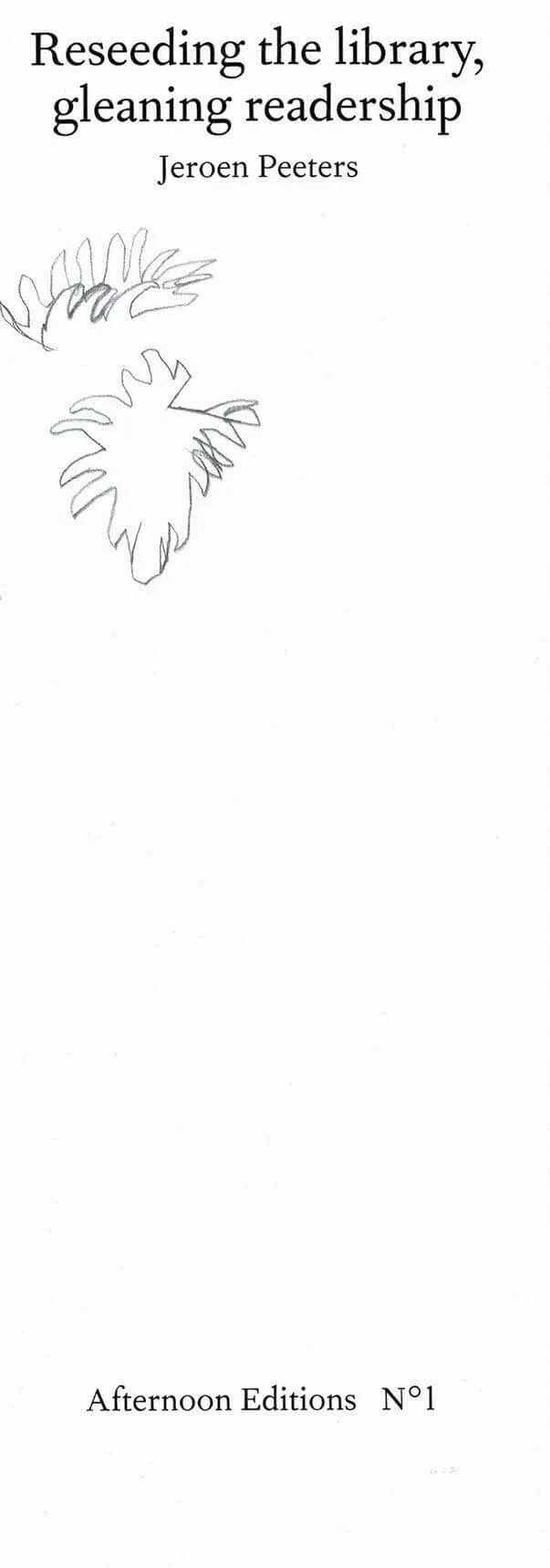
Reseeding the library, gleaning readership
Afternoon Editions no. 1: an essay by Jeroen Peeters titled Reseeding the library, gleaning readership. In May 2017, Time has fallen asleep in the afternoon sunshine settled during three weeks in the Ravenstein Gallery in Brussels as part of the Kunstenfestivaldesarts. Invited as a writer in residence, Jeroen Peeters visited the library of living books on a daily basis and recorded his observations by hand in a notebook, which formed the basis for Afternoon Edition #1. Reseeding the library, gleaning readership is an essay on the seed library, on the dispersion of literature through wind, water and animals, on biodiversity and commoning at the heart of readership. On the cover a drawing by Wouter Krokaert of a Philodendron Xanadu. Published May 2018.

next move in mirror world
Published in conjunction with the first major U.S. museum show of Joan Jonas’s art in nearly fifteen years, this monograph features new scholarship on her multimedia installations and performance practice from the early 1970s to the present. Inspired by the format of a reader, it breaks new ground by contextualizing and expanding understandings of Jonas’s body of work through three thematic approaches: the critical notions of gender, being and otherness; the politics of landscape and ecology; and new conceptions of medium specificity and un-specificity. Richly illustrated, with never-before-published sketches and drawings, the volume includes an interview with the late Douglas Crimp and Jonas’s personal reflection on their enduring friendship.
Edited by Barbara Clausen and Kristin Poor with Kelly Kivland, with an introduction by Clausen; essays by Clausen, Adrienne Edwards, André Lepecki, Poor, and Jeannine Tang; interview with Douglas Crimp; writings by Joan Jonas; conversation between Heather Davis, Joan Jonas, and Zoe Todd; and coda by Kivland

Safar Issue 9: Protests
"Journal Safar's 9th issue is Protests. To protest is a fundamental human act against injustice. It takes many forms: the defiant act of existing, the organized resistance of multitudes, armed struggles, and the disruption of systems through speech, action, and refusal in person, in prints and slogans online, or on the streets. Some forms of protest require symbols, flags, and specific attire, while others are carried out through non-verbal communication, secret dissemination, and ideological discipline. Yet all of them need cultural carriers–our bodies, our stories, and our marks to hold what can be remembered and learned from. Whether explicit or invisible, in communities or in solitude, this issue explores why we protest, and how, in the hopes of sparking solace, solidarity, and action.
In this issue: Maya Saikali sits down with Gérard Paris-Clavel, a co-founder of the pioneering Grapus Collective, to talk political image-making and the life of the image. Gérard delves into his own work and where it survives, “I don’t do exhibitions, I do demonstrations.” An illustrated Toolkit for Actions by Palestine Action makes direct action tactics accessible to anyone ready to confront the international system complicit in the Palestinian genocide. Two conversations by Maya Moumne: with Adbusters Magazine founder Kalle Lasn on the power of artists in revolutions, and with Ahmad Swaid, editor of Dazed MENA and former Editor-in-Chief of GQ Middle East, on censorship, identity, and building new cultural platforms across the region. While Audrey Tseng and Chong Gu write on Red Canary Song, a grassroots collective of Asian and migrant sex workers, massage workers, and allies of the Asian diaspora, that resist policing through notions of homemaking.
These highlights sit alongside stellar contributions by Alina Lupu, Ahmad Zaghmouri, Muhannad Hariri, Elias Erkan, Bettina Nagler, Rasha Dakkak, Yaa Adae, and Nihal ElAasar. And for the first time: another magazine inside this magazine: Design Drafts #3, a collaboration with Nieuwe Instituut, on protest and design with contributions by Tala Abdalhadi, Myriam Amri, Shruti Hussain, Candice Jensen, and Alice Wan on the theme of protest and design."

You Can Vibe Me On My Femmephone
You Can Vibe Me On My FemmePhone follows three friends, in a near-future Los Angeles, who are trying to improve themselves using a phone with a feminist operating system. Join Veronica, Phoebe, and Remy on their absurd adventures to seduce artists, entrap local Proud Boys, and enter a kinky queer horse-play scene. Their FemmePhones, programmed with their personal values, guide them toward the transformative love and professional passions they seek. But what choices will they make when they disagree with their phones and what does this mean about their feminist values? Kamala Puligandla’s heartfelt, humorous novella takes you on a wild ride about queer love, self-knowledge and growth.
Size: 4.5" x 7", 108 pages, perfect bound
Self-published by Co—Conspirator Press with the support of Feminist Center for Creative Work. Copy edited by Pratishtha Kohli. Illustrations by Phoebe Unter. Designed by MJ Balvanera, Riso-printed by Neko Natalia.

How to Sleep Faster 2
How to Sleep Faster 2 is the second of our biannually published journals that form the backbone of Arcadia Missa’ critical collaborative discourse on participation, post-digital visual-production and institutional subjectivity.This issue explores moments of collapse, shift and potential in a cultural moment framed by economic, political and societal disturbance.
Arcadia Missa Publication; eds Rozsa Farkas, Tom Clark et al.

The World After Rain
In her signature epic vision, Canisia Lubrin distils a radiant elegy for her mother along an interwoven and unresolvable axis of astonishment, belonging as much to history as to today. Grief, tender and searing, is the channel through which the poet refracts the realm of contemporary life to reveal the paradox of its private and public entanglements. This is poetry of haunting gravity and resonance, with meditations on love, time, and loss, at once meticulously far-seeing, interior and inexpressible.
‘How incandescent the language is, each line emitting light through the membrane of time and anticipated grief. The work has a rigorousness, the poet pushing through the ache of experience from the first to the last word.’ – Dionne Brand

SABR N°03 - Perles à compter
« Quelques perles coulent entre ses doigts. Les récits de Larem se délient du temps que l’on connaît. Elle raconte, superpose, recule et avance, jouissant des temps qu’elle invoque. »
Emma Berger-Pierre est artiste plasticienne et chercheuse. Dans son travail, elle reprend les objets de ses grands-parents pour tirer des récits familiaux de l’immigration algérienne, les enjeux liés aux guerres coloniales et aux banlieues françaises, plus particulièrement Mantes-la-Jolie. Liée à la silenciation de ces histoires et des violences, elle tisse les liens intimes et systémiques de continuation des stratégies et ambiance de guerre, et des résistances, qui se perpétuent dans les quartiers populaires et dans la sphère familiale.
SABR/Collection est une série de publications qui rassemble des œuvres littéraires de format court et de genres variés. Dirigée par Nesrine Salem, la collection souhaite mettre en avant les macro-réalités des auteur·ices choisi·es pour rendre visible le caractère intersectionnel des luttes.

Tense (Silver Edition)
Tense is a never-realised publication, written and composed by Lucy Lippard and Jerry Kearns in 1984, that only now has been released in a very limited run on our imprint. The book accompanied the exhibition Top Stories, which took a closer look at the 29 issues of the prose periodical with the same title, founded in the late 1970s by Anne Turyn.
Top Stories was dedicated to fiction by emerging women artists and writers from that time. Tense was originally intended to become part of the series as well, but never made it to print. It was only recently – during the making of the exhibition at Amsterdam’s Kunstverein – that the original mock-up was retrieved from the editor’s archives and finally sent off to the printer.

PARANOID CITI
"Desperate and playful. This iterative poetic series cries through the panic of now to bestill an ecstatic people. Paranoid Citi finds no doubt that if understanding is a matter of form, survival necessitates transformation." - Crystal Odelle, author of Trans Studies
"Who doesn't like to post ethereal lightly? Who isn't a citizenry draped in lilac ethics? Are you a froth? In Shannon Hearn's PARANOID CITI, an interrogative story is shaping up. She's uploading music for grace in crisis. She's writing poems for you, citizen, and kindly so." - Nick Sturm
Includes a bag tag and drawing by Elise Houcek.
Published as part of Paraphernalia and Addenda 2.2 of Tabloid Publications.

“If It's For The People, It Needs To Be Beautiful,” She Said
Accompanying a series of solo collaborations in 2020, this publication offers the first comprehensive and global perspective on Jeremiah Day's work as an artist, performer, researcher and teacher. As it details Day's specific works and evolution between visual and performing arts and between political reflection and engagement the result also serves as sourcebook for the legacy of the intersection between dance and the visual arts of the 1960s and 70's and the models of cultural practice emerging from the work of Hannah Arendt.
In his work, the Berlin-based American artist Jeremiah Day (born 1974 in Plymouth) re-examines recent political struggles and conflicts, revealing their subjective contexts and traces. To do this, he has developed a narrative and choreographic form in which personal and political realities intermingle, thus offering a thoroughly singular vision of these at times forgotten moments of history.
The distinctive feature of his method lies in a transversal approach. As a student of and regular collaborator with Simone Forti, one of the pioneers of Post-Modern Dance, he has turned performance into a now central and structure-providing practice. Since 2014, Jeremiah Day has in effect presented many performances, which contain movement, improvisation, photography and the spoken word, in order to broach universal historical and political subjects, but within an intimate and incarnated context.

Holes
Sometimes I pretended not to notice it (the black hole), but I knew it was always there. To tell the truth, I started to like having it around. I stuck quite close to it. Not too close, mind you. But it was useful, above all, to have somewhere to put things. Unwanted things. I am attracted to your attraction, he said. (I put it in the hole.) Night by night it got a little bigger.
Holes splices forms of fiction and nonfiction. The narrator, a researcher of limits at an unidentified university, figures her entanglement with an unobtainable love object as the descent into a black hole. Everything she reads seems to shed light on the non-events that comprise their relationship, and study collapses into life as she struggles to separate events and forms, reality and ideation. Holes is a study in thematic fixation, engaging a range of ‘obsessional artists’ (including Yayoi Kusama, from whom the term is borrowed, Lee Bontecou, and Carolee Schneemann) for whom holes—as idea, imagery, philosophy—have proved evocative, inviting, and occasionally obliterative.
Hilary White is a writer and researcher, currently an IRC postdoc at Maynooth University, Ireland, working on a project entitled Forms of Sleep. She co-ran the experimental poetry reading and commission series, No Matter, in Manchester, and co-edited the zine series, Academics Against Networking. Her writing appears in MAP, Banshee, zarf, and The Stinging Fly. Holes is her first novel.
![Cover of [45-120]](https://rile.space/storage/3794/conversions/01K7RPFBTZPK0NE1VQTCYB68XK-webp.webp)
[45-120]
Personal space is understood as the distance between 45 and 120 cm that surrounds a person. This bilingual anthology brings together the work of eighteen contemporary poets who take this intimate measurement as a starting point to challenge its apparent rigidity and explore how political, social, sexual, racial, class, and accessibility factors shape it. Beyond a simple physical distance, personal space also becomes a stage where desire draws and negotiates the boundaries between the inside and the outside.
The publication contains contributions by Samuel Ace, Justin Chin, Kyle Dacuyan, Rhea Dillon, Tracy Faud, Elijah Jackson, Taylor Johnson, Nadia Marcus, Park McArthur, Nat Raha, Joan Retallack, Trish Salah, Juan de Salas, María Salgado, Assotto Saint, Cedar Sigo, S*an D.Henry-Smith, Nayare Soledad, Perla Zúñiga.
Bilingual edition, edited by Juf.
JUF (Bea Ortega Botas and Leto Ybarra) explores the relationship between poetry, contemporary art, and theatricality through the organization of performances, readings, and exhibitions. They also publish online texts and a PDF series as an extension of their curatorial and research practice. Currently based between Madrid and New York.

Jokes
Jokes is a crash course in psychic disintegration for the genocide generation. Ever wondered what a spoonbill thinks of peremptory norms? Or what a hippo can do with an egg-slice? What’s the secret of the success of men like David Papazian and Johnnie Moore, who get to run the Gaza Humanitarian Foundation, while poetry-reading demographics, from the higher and intermediate managerial and professional occupations down to the footwells of unskilled manual self-erasure, lie around standing up for themselves and fornicating with the void? An Author’s a Joke, to all manner of Folk, wherever he pops up his Head, his Head, wherever he pops up his Head, according to Fielding. But why? The 27 jokes of Jokes unfold over the course of a duration-block, in an exclusive interior, under new management, in the capable trotters, paws, hooves, claws, tentacles, jaws, beaks, and blowholes of a fabulous parliament of beasts, some drunk, some dead, some leery, some high, some tender, in the tradition of Boccaccio or Isaiah. They are all funny.
Designed and typeset by Phil Baber.

Broken Villas
Written in response to three “physical” photographs, ‘Broken Villas’ contains and considers how a vessel might clasp tightly to known volumetric identities, but also loom with a set of accentuated clues towards otherness: the excavated seams in the earth and what we fill those holes with, imaginary or otherwise; the glacial erraticism of the boulder; the queer crimping of a hotel pillowcase; the modes via which objects are housed as display, but also packaged away, with sorrow, with fear, with erotism etc.

Tony Cokes Edition
On the occasion of Tony Cokes' solo-exhibition, ARGOS produced a unique purple t-shirt with silver lettering. 100% cotton; 180 grams. Silkscreen by Bootlegz in Brussels.
Available in XL (XS, S, M and L are sold out)
Edition of 100

Thee Display
From its situation in Ancient Greece through the various rewritings and commentaries and interventions of the last 2500 years, there is certainly no book being transmitted in the anything-but-unbroken and often comic transmission of The Phaenomena, a long didactic poem enumerating the constellations and their movement through the skies. There is certainly no origin apparent in such a transmission, even as the layers of compaction that this text attempts to unfold are themselves arguments about origin, plaintive debates about the irresolvable contradiction of a “first copier.” But what does it mean to give up the constellation, the relation, the durability that relation promises to guarantee, without being able to retreat into the security of origin or determinate meaning? What do you do then? This is to rephrase the question: what do we – “we,” obstinately – fail to see when we see the shapes of the stars so well?
Thee Display is a collection of poems written during an engagement with this ongoing transmission. It is a book about this, and a book about the horizon of communism, and a book about transition, and a book about a companionship characterized by a weird and sad kind of cheer.
Nora Collen Fulton lives in Montreal, where she is currently pursuing a doctorate focused on philosophy, trans theory and poetics. Thee Display is her third book of poetry - she is also the author of Presence Detection System, from Hiding Press (2019), and Life Experience Coolant, from Bookthug (2013). Nora's poems have been published in Social Text, Homintern, Some Magazine and elsewhere. Her critical and theoretical work can be found in Radical Philosophy, The Poetry Project, Music and Literature and more.

An Archive of Feelings
In this bold new work of cultural criticism, Ann Cvetkovich develops a queer approach to trauma. She argues for the importance of recognizing—and archiving—accounts of trauma that belong as much to the ordinary and everyday as to the domain of catastrophe. An Archive of Feelings contends that the field of trauma studies, limited by too strict a division between the public and the private, has overlooked the experiences of women and queers. Rejecting the pathologizing understandings of trauma that permeate medical and clinical discourses on the subject, Cvetkovich develops instead a sex-positive approach missing even from most feminist work on trauma. She challenges the field to engage more fully with sexual trauma and the wide range of feelings in its vicinity, including those associated with butch-femme sex and aids activism and caretaking.
An Archive of Feelings brings together oral histories from lesbian activists involved in act up/New York; readings of literature by Dorothy Allison, Leslie Feinberg, Cherríe Moraga, and Shani Mootoo; videos by Jean Carlomusto and Pratibha Parmar; and performances by Lisa Kron, Carmelita Tropicana, and the bands Le Tigre and Tribe 8. Cvetkovich reveals how activism, performance, and literature give rise to public cultures that work through trauma and transform the conditions producing it. By looking closely at connections between sexuality, trauma, and the creation of lesbian public cultures, Cvetkovich makes those experiences that have been pushed to the peripheries of trauma culture the defining principles of a new construction of sexual trauma—one in which trauma catalyzes the creation of cultural archives and political communities.

Sleigh Ride
In Sleigh Ride, a kinetically wondrous prose tale from poet Joe Fletcher, a father and his convalescing son plunge in carpentered, stallion-drawn sleigh slashing through lush forest, advancing through a sequence of diorama-like settings. The books ten chapters are interspersed with gouache collages by Kraków artist Mikołaj Moskal (REMMUS), rooted and riverine, functioning as curtains swept aside to reveal each chapter of Fletcher’s exhilarating nocturne.
There was a sleigh: jet black and gleaming.
The long steel runners curved at their termini like arabesques of ice. It was too dark to clearly discern the design on its side, but it was intricate, ornate, suggestive of cuneiform and the minarets of Cairo. Two orange lanterns mounted above the driver’s chair were each encircled by a cloud of gnats and moths. Draped in fabulously embroidered saddlecloths, Ajax and Hector stomped the earth.
Given that the only exit from the cellar was the door, hardly wider and taller than a man, I marveled at how father could have extracted his creation from his smithy and pointed it at the forest. But I said nothing as I climbed unaided onto the purple velvet couch.

All That's Left to You
"All That's Left to You presents the vivid story of twenty-four hours in the real and remembered lives of a brother and sister living in Gaza and separated from their family. The desert and time emerge as characters as Kanafani speaks through the desert, the brother, and the sister to build the powerful rhythm of the narrative. The Palestinian attachment to land and family, and the sorrow over their loss, are symbolized by the young man's unremitting anger and shame over his sister's sexual disgrace. This collection of stories provides evidence to the English-reading public of Kanafani's position within modern Arabic literature. Not only was he committed to portraying the miseries and aspirations of his people, the Palestinians, in whose cause he died, but he was also an innovator within the extensive world of Arabic fiction.
Ghassan Kanafani was a refugee, a journalist, an editor, and a political activist. First and foremost, though, he was a writer, "a commando who never fired a gun, whose weapon was a ball-point pen," said his obituary in Lebanon's Daily Star. He was born in 1936 in Akka (Acre) and was part of the 1948 exodus from Palestine. A politically active journalist in Beirut during the 1960s, Kanafani was killed in the explosion of his booby-trapped car in July 1972. He is the author of the highly acclaimed novel Men in the Sun and is considered a leading novelist in the Arab world. His works have been translated into 17 languages and published in 20 countries.

DRINK DEEPLY AND DREAM
Drink Deeply and Dream by Elspeth Walker is an ethereal, offbeat short story about wannabe vampires with a Marxist bent and their search for salvation from capitalism via eternal bloodlust.
Paperback, Staple Bound and Offset Printed

More Than Chilli
Chilli is one of the most popular food ingredients in contemporary China, and symbolic of modernisation. More Than Chilli goes beyond its trendy façade to explore Chongqing, known for its tradition of spicy food. From the perspective as a local, Rossy Liu reflects on her own personal memories associated with chilli. A combination of fragmented scenes, objects, dialogues, movements and sounds are drawn on to unravel the locality of culinary identity. While chilli has become a ubiquitous flavour in today's global society, the book emphasises the hidden intimacy that still exists between Chongqing locals and their unfiltered connection to chilli.