Books
Books
in random order

My Earliest Person
Lyrical drifts warped by syntax into blizzarding softness; odes to beauty, meaning, and inexperience splintered by history and grammar. An aqueous surface marbled with the lightest possible touch, lost footings arrested by change’s near-griplessness.
None of this matters. It’s only supposed
to save you from yourself. None of this
matters, when I try to take it out of me into
the world, which to find I can praise
I go out to
Composed across two winters between late 2022 and early 2024. Contains 43 poems.
“This luscious and needle sharp collection is a real feat of the textual imagination, wow.” —Adam Piette, Blackbox Manifold, no. 34

University of California Press
Covered in Time and History: The Films of Ana Mendieta
The book includes Mendieta's first published comprehensive filmography resulting from three years of collaborative research conducted by the Estate of Ana Mendieta and the University of Minnesota as well as original essays by John Perreault, Michael Rush, Rachel Weiss, Lynn Lukkas, Raquel Cecilia Mendieta, and Laura Wertheim Joseph.
The first book-length treatment of Mendieta's moving-image practice, Covered in Time and History aims to locate her films centrally within her larger oeuvre and at the forefront of the multidisciplinary shifts that characterized visual arts practice during the 1970s.

On The Rag
Casual Encountersz presents On The Rag, America’s Greatest Tabloid. Blending art and literature with sex, slime and sleaze, On The Rag emerges from LA's underground reading series Casual Encountersz to create a new media platform where the Ivory Tower and the gutter collide. On The Rag is a literary journal, gossip mag and conceptual art project all in one. Get off the apps…And get On The Rag!

How to live from fire to fire
Olivier Marboeuf takes us on a journey through myths, archives, and fables, where fire symbolizes Caribbean culture, colonial oppression, and ecological disasters, and where the echo of past revolts becomes the spark for future insurrections.
How to Live from Fire to Fire brings together two closely linked texts by Olivier Marboeuf. The volume opens with Marboeuf's latest work, How to Live from Fire to Fire, written as a new commission, and is followed by the first English translation of his earlier text The Night Just Before the Fire, originally published in French in 2025 by Atlantiques déchaînés.
Written as if in the same breath, the two texts follow one another in a fevered, relentless movement. In The Night Just Before the Fire, Marboeuf reworks Bernard-Marie Koltès's play La Nuit juste avant les forêts (Éditions de Minuit, 1977), transforming it into the delirious, unbroken monologue of a man with dark blue skin calling out to another man in the streets of a major European city. Through this act of rewriting, the echo of past revolts becomes the spark for future insurrections. Next time, a riot.
"The French believed that burning the king of the carnival would suffice to erase these old stories and impose a modicum of order in the beautiful Caribbean colony. They thought that everyone would return home and that the streets would take on their usual amnesiac calm after this necessary moment of release. At the end of the celebration, on Ash Wednesday, King Vaval would be burned and along with him, corruption, excess, and bad lives would burn too. But nothing was said about monopolies. Because even when residents returned home, exhausted by the festivities, even when the dark of night cloaked this whole little world and emptied its public squares, water continued to flow dark from taps and poison snaked a path into the land and its gardens. Somewhere, forests and cities continued to burn."
—Olivier Marboeuf
Olivier Marboeuf (born 1971) is an author-storyteller, artist, independent curator, cultural theorist and film producer from Guadeloupe. In the early 1990s, he co-founded éditions Amok (now Frémok) publishing and launched the Parisian literary café Autarcic Comix. He was artistic director of Espace Khiasma (2004–2018) which contributed to introducing postcolonial theories to the French art scene through numerous exhibitions and encounters
Translated from the French by Liz Duff Young.

Confidences / Oracle
Oracles don’t require belief—they now theatrically suspend disbelief. No longer advisors of world policy, they run Locus Solus, a town that has come to ramble around an eponymous theatre and chocolate factories. Theo, a centuries-old vampire intent on remaining contemporary through performance, visits Locus Solus, which is hosting Praise Estate, an international theatre festival. He uses the festival as an opportunity to stay with Gean, his oracle boyfriend, who is there visiting family. Theo has a fetish for the future, fixated on the one thing he is in no shortage of.
Confidences / Oracle is a lover’s trip to a weeklong theatre festival. A vehicle for recontextualising recent performance scripts and texts, Oracle is the third instalment in Ivan Cheng’s Confidences series, which intertwines vampires and performance as sites for circulation and recognition.

Glove Money
A hymn to perversity, a lyric pledge to desire and risk, Glove Money pages through the canon to “seed its sugar in your dreams.”
In this joyful and irreverent exploration of the role of poet-as lover, Sophia Dahlin plays Sappho, O’Hara, romantics and troubadours, assembling a self seaworthy of romance. With humor and a light touch, Glove Money dismisses bioessentialist gatekeeping and expands the lesbian imaginary.

What does an oracle look like?
What does an oracle look like? gathers essays and drawings made by Perri MacKenzie between 2020 and 2024, themed loosely around pottery painting and vocal expression. The drawings, rendered in splashy India ink and collage, range from expressive sketches to theatrical still lives and experimental bandes dessinées. The book presents for the first time the essay Cathedral. Part memoir, part literary/sonic investigation, it meditates on the vocal texture of a Hollywood actor.
Designed by Ilke Gers.
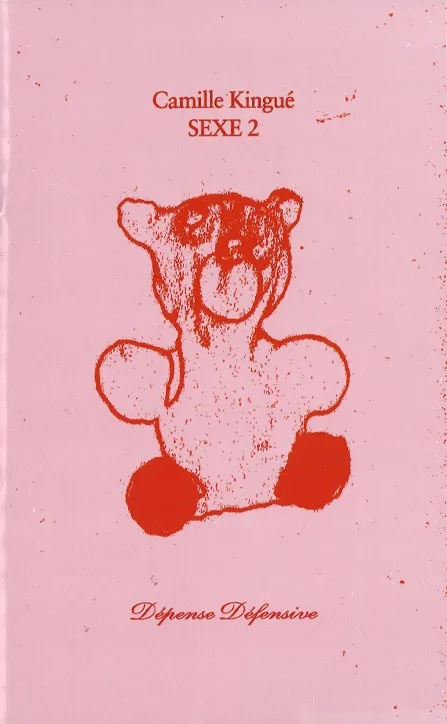
Sexe 2
Confession sur le désir (l’action et l’objet du), les liens de mutualité et de résistance, Sexe 2 alterne prose et versification en 27 fragments numérotés à l’adresse plus ou moins dure, plus ou moins sincère, plus ou moins formulée car plus ou moins éloignée du Toi et du Je. Camille Kingué s’attache à révéler, à voir quelque chose à travers son image réelle et virtuelle, agrandie et rétrécie, droite et renversée, déployant une recherche des principes de l’amour (l’amour comme amour, pourquoi est ce qu’il y a de l’amour) où la métaphysique et la compréhension de soi – donc de l’autre – n’ont jamais été aussi sexy.
Claire Star Finch, dans la magnifique préface qu’iel signe au début de l’ouvrage, écrit : « Après avoir lu tous les livres de Kingué, je ne sais pas si je crois en “l’amour”, que ce soit en tant que substantif absolu ou en tant que proto-résidu de tout ce que “le sexe” peut signifier. Mais je crois définitivement qu’il faut l’écrire. » Définitivement.

distinguish the limit from the edge
Theresa Hak Kyung Cha, Jimmy Robert
distinguish the limit from the edge is an intergenerational dialogue between Theresa Hak Kyung Cha and Jimmy Robert. Their connection emerges through the intersection of text and image between selected work from Cha’s oeuvre and Robert’s practice that share the formal strategies of the fold.
Robert’s work utilizes paper as a sculptural material, and his hand sometimes appears to shape the page. For Cha, the fold is present in her compositions enmeshing language through strategies of visual poetry, as in L’Image Concrete feuille L’Objet Abstrait (1976), and Untitled (après tu parti) (1976) which are both previously unpublished. The possibility of overlaying one’s work with the other, emphasised by the book’s spiral-bound double spine, and reverse fold-outs, forges an intimacy, a shared sensibility, and an encounter with the corporeal. In conversation with editor Jacob Korczynski, Robert refers to Fred Moten’s In The Break, stating, ‘Suddenly time falters. Words don’t go there. And if words don’t go there, then what does?’
distinguish the limit from the edge is commissioned by Book Works, edited by Jacob Korczynski and designed by Wolfe Hall. The book is published in association with Participant Inc. with the support of the Ministry of Culture, Sports and Tourism and Korea Arts Management Services, after the exhibition:
flipping through pages keeping a record of time: Theresa Hak Kyung Cha & Jimmy Robert curated by Jacob Korczynski at Participant Inc., 6 September – 3 November, 2024, supported by a Fall 2020 Curatorial Research Fellowship from The Andy Warhol Foundation for the Visual Arts.

Michigan State University Press
Citizens of Beauty: Poems of Jean Sénac
This stunning collection of poems by the Algerian poet Jean Sénac (1926–1973) was originally published when he was forty-one. Sénac represented the hope of the new generation of Algerians who were celebrating their independence from France after 130 years of colonialism, and in the tradition of René Char and the early Albert Camus, he portrayed an Algeria whose land and people would finally sing with their own voice.
Sénac celebrates revolution, love, and the body, beginning with the resonant verses: “And now we’ll sing love / for there’s no Revolution without love.” He sang, as well, of beauty: “No morning without smiling. / Beauty on our lips is one continuous fruit.”
Translated by Jack Hirschman

Day Book
Looking at pictures, she was reminded of the lack of time. And anyway, where did all the time go?
In Day Book a woman artist looks at time in an address to quotidian events and their unfolding. Exploring motherhood, unpaid labour, childcare, and the time of the artist, she reads the work of contemporary women filmmakers through the earlier works of filmmakers, writers, and photographers, including Chantal Akerman and Marguerite Duras, Natalia Ginzburg and Christa Wolf, Bertien van Manen and Bernadette Mayer. The inability to capture the accumulation of days emerges—a form without form, day after day after day.

Insula
Insula est un roman d’anticipation aussi intime que spéculatif qui mêle autofiction, confession intime, esthétique queer, jeu vidéo, et une formidable vision apocalyptique du monde contemporain. Insula (île, en latin), c’est d’abord le nom d’un jeu clandestin de réalité augmentée d’un nouveau genre : il suffit d’ingérer une pilule stupéfiante et illégale pour accéder à la simulation. Théo, le narrateur, en apprend l’existence lors d’une fête de cruising queer, au sommet d’un immeuble désaffecté du centre de Londres, dans une atmosphère d’apocalypse. Un garçon s’effondre à ses pieds quelques minutes après avoir consommé la substance, et pleure des larmes de sperme. Mais Théo doit tout interrompre pour se rendre au chevet de son père mourant, dans un hôpital parisien. C’est le moment de la dernière nuit, du dernier souffle et des derniers aveux. Le mot insula revient, cette fois dans la bouche des médecins, pour désigner une partie flottante du cerveau ravagée par la maladie, comme une île qu’on a dans la tête. Alors que les médias annoncent la disparition de plusieurs personnes qui auraient pris une pilule d’insula, l’étau se resserre sur Théo qui se résout à son tour à prendre un cachet prohibé avec l’intuition que les avatars ne sont que des fantômes, et qu’il pourra ainsi retrouver son père dans l’autre monde.
Ce roman aux accents dantesques (vision d’un enfer digital qui n’est que le double du monde réel), entre vertige technologique et exploration du désir, est marqué par la pensée critique du réel et la pop culture (Final Fantasy, Kanye West). Il ouvre un univers parallèle pour raconter l’histoire d’une traversée intime, convoquer des époques, des territoires et des identités multiples, dans une seule et même histoire qui navigue entre témoignage et fantasme. Dystopie, histoire d’amour et de fantômes, enquête et cauchemar, Insula est un portail entre plusieurs dimensions, le vrai et le faux, le réel et le digital, la vie et la mort.

La Captive
In the fifth published title of the Decadent Editions series, Christine Smallwood explores Chantal Akerman’s adaptation of Marcel Proust’s The Prisoner, the fifth volume of In Search of Lost Time, in a text that moves elegantly between Akerman’s films, Proust’s novel, and Smallwood’s own life.

Velvetyne Saved My Life, Libre Fonts for Everyone Since 2011
Sandra Chamaret, Velvetyne and 1 more
Since 2011, the Velvetyne collective has been dedicated to creating and distributing typefaces under open-source licenses. Its members advocate and promote an uninhibited typographic practice, guided by political principles and aesthetic risk-taking.
This monograph celebrates a generous collective creation—pioneering and recognized on the international scene—that continually questions and reinvents itself. Velvetyne Saved My Life reveals the distinctive workings of this unconventional structure within the contemporary type foundry landscape, its commitment to free-culture and open-source principles, its singular editorial policy, and its pedagogical practice.
The book is structured around a polyphonic interview conducted by Sandra Chamaret with the members of the collective, a series of in-depth articles on emblematic typefaces from the foundry, as well as an exhaustive catalogue of the more than 70 fonts published by nearly as many international authors.
Halfway between text and type specimen, this book is both a story to read and a manifesto to see.

Another Sun
Françoise Vergès, Mayra A. Rodríguez Castro
Waiting at Martinique Aimé Césaire International Airport, in the city of Le Lamentin, Mayra A. Rodríguez Castro browses the airport kiosk. Alongside books by Césaire, it offers titles by Frantz Fanon, Maryse Condé and Patrick Chamoiseau. She picks up a copy of Nègre je suis, nègre je resterai, a conversation between Françoise Vergès and Césaire published in 2005, and embarks. In Another Sun, Rodríguez Castro and Vergès revisit that seminal conversation, resulting in an eclectic text shaped by ongoing struggles.
In 2005, Françoise Vergès published a book with Aimé Césaire, in which she recorded – three years before his death – powerful remarks by the poet, as incisive and combative as ever, yet imbued, as always, with the universal humanism to which he had remained committed throughout his life. It is fortunate that, drawing inspiration from this interview, Another Sun allows us to hear, in their intertwining, the voices of Césaire and Vergès herself, conveying a message of emancipation and fraternity/sorority that our world needs to hear today. —Souleymane Bachir Diagne
With poems by Danielle Legros Georges, Wole Soyinka, Ishion Hutchinson, Clarisse Baleja Saïdi, Aimé Césaire and Jean Érian Samson.

Freud and the Non-European
In this influential lecture, Edward Said explores Freud’s foundational work Moses and Monotheism to rethink the relationship between identity, politics and psychoanalysis. The result is a study illuminating both Freud’s thinking and that of Said, on whom the great psychoanalyst was a formative influence.
Was Moses Jewish or an Egyptian? The question undermines any simple ascription of identity, highlighting the limits of these categories. Said suggests that such an unresolved, nuanced sense of identity might, if embodied in political reality, form the basis for a new understanding between Jews and Palestinians. In contrast, Israel's relentless march towards an exclusively Jewish state denies any sense of a more complex, inclusive past.
With an introduction by Christopher Bollas and a response by Jacqueline Rose.

Life with Fifi
Kris Dittel, Angelica Falkeling
A children’s book without a specific age category, offering a glimpse into the small rituals and shared moments that shape a day with Fifi Paris.
Fifi, a Pomeranian-Chihuahua mix, came into the lives of Angelica and Kris a few years ago. Taking care of a puppy is taking responsibility for building their world and letting the small animal transform yours. As her human caretakers, the authors created Fifi’s world with toys, cuddles, rules, snacks and walks in the park. In return, she transforms our world by bringing our community together and reminding us of the importance of caring for one another. In this book, Kris and Angelica narrate a day in the life of Fifi, from the moment she wakes up to when she falls asleep at night. Along the way, they share how they connect with her, how they see her understanding her surroundings and what she has taught them about companionship.
Design by Amy Suo Wu
Copy-editing by Clem Edwards
Photography by Lili Huston-Hertreich

An Encyclopedia of Radical Helping
Erin Segal, Chris Hoff and 1 more
From “abundance” to “zinemaking,” An Encyclopedia of Radical Helping* invites the reader to wander through a collection of interconnected entries on helping and healing by over 200 contributors from the worlds of social work and family therapy; art and design; body work; organizing; and more. Privileging co-construction over diagnosis, wisdom over evidence, collective healing over individual cure–yet always blurring categories and embracing contradictions–this world-making collection reveals a pluriverse of helping practices grounded in love and freedom.

Nymph: A Novel
A young woman from a long line of assassins, lives her life with the ardent mission to avoid the trappings of any enduring romantic love, while keeping one on the pursuit of an untimely death for herself.
Not yet thirty, Bathory, or 'Bat' to those near to her, has assembled a peculiar Model, sex worker, linguist and scholar of Latin. But nothing in her lively job history employs the singular traits she inherited from her strange family, chief among them an uncanny ability to sidestep seemingly certain death(s). An appropriate atavistic instinct, for someone from a long line of assassins and spies. Her clan are assassins of a romantic bent, her parents issuing theories on love galore. However Bat is set on swerving any enduring romantic loves, and she's set on dying young. Now, if she could only avoid that one alluring figure from her father's past.
A thriller, a love story, and a dynamic examination of class, violence and connection. The images we make to share and those we strive to conceal, alienation and salvation, magic and technology, LaCava's bold new novel is propelled by the compelling violence one can seed in contradiction.

Água Viva
In Água Viva Clarice Lispector aims to 'capture the present'. Her direct, confessional and unfiltered meditations on everything from life and time to perfume and sleep are strange and hypnotic in their emotional power and have been a huge influence on many artists and writers, including one Brazilian musician who read it one hundred and eleven times. Despite its apparent spontaneity, this is a masterly work of art, which rearranges language and plays in the gaps between reality and fiction.
Clarice Lispector (December 10, 1920 – December 9, 1977) was a Brazilian writer acclaimed internationally for her innovative novels and short stories. Born to a Jewish family in Podolia in Western Ukraine, as an infant she moved to Brazil with her family, amidst the disasters engulfing her native land following the First World War.


At the Full and Change of the Moon
Written with lyrical fire in a chorus of vividly rendered voices, Dionne Brand's second novel is an epic of the African diaspora across the globe.
It begins in 1824 on Trinidad, where Marie-Ursule, queen of a secret slave society called the Sans Peur Regiment, plots a mass suicide. The end of the Sans Peur is also the beginning of a new world, for Marie-Ursule cannot kill her young daughter, Bola, who escapes to live free and bear a dynasty of descendants who spill out across the Caribbean, North America, and Europe.
Haunted by a legacy of passion and oppression, the children of Bola pass through two world wars and into the confusion, estrangement, and violence of the late twentieth century.
"[Brand has] a lush and exuberant style that may put some readers in mind of Toni Morrison or Edwidge Danticat." — William Ferguson, The New York Times Book Review

L'Écriture de Monique Wittig À La Couleur De Sappho
Invitation au voyage à travers l’œuvre littéraire de Monique Wittig, ce livre nous embarque dans une passionnante exploration de ses textes de fiction, de L’opponax à Virgile, non. Il rend compte de la lutte amoureuse qu’elle livre au langage – matériau brut qu’elle travaille au corps pour faire advenir dans la réalité ce qui n’y a pas (encore) droit de cité. La convocation malicieuse et grave des grands récits du passé, les nombreux emprunts aux auteurs anciens, la pratique de la citation font des Guérillères une formidable épopée féministe, du Corps lesbien un Évangile selon Sappho, du Voyage sans fin le combat drôle et tragique d’une Quichotte féministe et lesbienne.
En soulignant la cohérence des textes et leur fragmentation, Catherine Écarnot met en évidence la passion poétique qui habite ces livres que Wittig concevait comme des « chevaux de Troie » : des machines de guerre destinées à fissurer la réalité pour y inscrire une subjectivité mouvante, échappée du continent noir de la féminité, rétive aux assignations de genre. Uniques et radicalement disruptives, les fictions ainsi créées ouvrent grands les chemins qui relient littérature et lesbianisme.
Publié pour la première fois en 2002, cet ouvrage, le premier consacré en Europe à l’œuvre witigienne, reparaît dans une nouvelle édition remaniée, actualisée et enrichie de nombreuses références aux études publiées depuis sa parution.

Unbidden Tongues #9: Potty Mouth
Unbidden Tongues #9: Potty Mouth is a collection of what could be described as concrete poetry, written over the past two years by our niece Violet Bartley, now aged five. Typed at a computer and sent exclusively via e-mail, the poems stand as clear evidence of a person in the beginnings of grasping (at) language. Throughout, characters are repeated uninterrupted until margins break them, keys pushed down by a finger not yet strong enough to lift itself up.
Over the years, as her written vocabulary grew and these attempts at communication slowly stacked up into the collection printed here, Violet delivered poem after poem within which different mutations of the word ‘poo’ were uttered in type: poo, poobum, bum poo, ipoo, poop. While simple, often illegible and definitely isolated utterances (she never replies when you send a poem back in turn), they are decipherable examples of someone learning defiance through language.