Books
Books
in random order

Grandma’s Story
‘May my story be beautiful and unwind like a long thread . . .’, she recites as she begins her story.
The storyteller is the living memory of her time: at once an oracle, weaver, healer, warrior, witch, protectress, teacher and great mother. Her powers are to do with passing on – not only the stories but transmission itself: ‘what grandma began, granddaughter completes and passes on to be further completed.’
In contrast to the idea that a story is ‘just a story’, pioneering postcolonial feminist theorist and filmmaker Trinh T. Minh-ha recodes ideas about truth and fantasy to tell a different story about power, civilisation, history, medicine and magic. Grandma’s Story shows how creative speech is connected to women’s powers of enchantment, drawing upon and speaking with storytellers including Theresa Hak Kyung Cha, Clarice Lispector, Maxine Hong Kingston, Leslie Marmon Silko and Zora Neale Hurston – all who may be known as ‘she who breaks open the spell’.
The story as a cure and a protection is at once musical, historical, poetical, ethical, educational, magical, and religious.

The (Incomplete) Cosmic Catalogue
Mapping constellations between five specific pre-colonial cosmological examples extending from the Sahel to the Horn of Africa, this work reframes cosmology as a multi-dimensional and scalable practice of situated technologies and embodied cartographies. The resulting publication which was produced during the Jan van Eyck residency is a culmination of several years of research and exploration into precolonial cosmologies and spatial orders rooted in the African Sahel extending to the Horn of Africa.
The (Incomplete) Cosmic Catalogue is an output of a research project that was initially commissioned by the Canadian Centre for Architecture as part of the multi-disciplinary research fellowship, The Digita Now: Architecture and Intersectionality in 2022.

Someone Who Isn't Me
Geoff Rickly’s debut novel Someone Who Isn’t Me is a feverish journey through the psyche of someone who no longer recognizes himself.
When Geoff hears that a drug called ibogaine might be able to save him from his heroin addiction, he goes to a clinic in Mexico to confront the darkest and most destructive versions of himself. In this modern reimagining of the Divine Comedy, survival lurks in the darkest corners of Geoff’s brain, asking, will he make it? Can anyone?

From static oblivion
A reflection about the status of the image as a balance of forces in tension and a paradoxical act of cancellation of the body through its own representation.
In Ion Grigorescu’s work, as in the book, the body is continually shown in different ways - from photography to film, from performance to drawing - and yet it remains absent, obscuring its own identity in an attempt to question the collective one. As it is impossible to show his art during the regime, it ends up hiding, disappearing inside the image. Instead of showing, the image conceals, because it is non-documentary and non-transmittable; it is an act of birth, a prove of the artist’s resistance, especially as a human being inside (or against) any geographical or historical background. In the rituals of his gestures and in the symbolism of his performances, Grigorescu finds a way to stay alive, preserving his own intellectual status while also defending the dignity of everyday life.
The book traces the progression, both expansive and inclusive, of his work, which inscribes itself into the space of the body and of the world. Grigorescu absorbs elements of the surrounding reality, showing us a continuity between art and life: his act of dissidence is not an outcry of provocation, nor is it extreme; it is an anti-aesthetic operation which uses experimentation and rough techniques to uncover the fiction of art, to denounce the artifice of representation and to affirm images as an instrument of subversive power.
Ion Grigorescu (Bucharest, 1945) is one of the most significant Romanian contemporary artists of the Post-War period and an iconic figure of the conceptual and performative art since the early 70s. He represented Romania at Venice Biennial in 1997 and 2011; his works are in the main public collections, such as MoMA, New York; mumok and Erste Foundation, Vienna; Tate Modern and Deutsche Bank AG, London; Centre Pompidou, Paris.

Life with Fifi
Kris Dittel, Angelica Falkeling
A children’s book without a specific age category, offering a glimpse into the small rituals and shared moments that shape a day with Fifi Paris.
Fifi, a Pomeranian-Chihuahua mix, came into the lives of Angelica and Kris a few years ago. Taking care of a puppy is taking responsibility for building their world and letting the small animal transform yours. As her human caretakers, the authors created Fifi’s world with toys, cuddles, rules, snacks and walks in the park. In return, she transforms our world by bringing our community together and reminding us of the importance of caring for one another. In this book, Kris and Angelica narrate a day in the life of Fifi, from the moment she wakes up to when she falls asleep at night. Along the way, they share how they connect with her, how they see her understanding her surroundings and what she has taught them about companionship.
Design by Amy Suo Wu
Copy-editing by Clem Edwards
Photography by Lili Huston-Hertreich

Oostende
Oostende is a book about displacement and the sometimes-overwhelming internal monologue we live with. In between poetry, diary and novel, the book reflects on Zicari’s life in Buenos Aires and Belgium, as he navigates work fragility, friendship, sex and love, migration and the fiction laying behind everyday actions and life changing decisions.
Zícari's portrayal of his private life is far from the domain of the concrete, instead he ventures into the uncontrollable production of fantasies that sustain his inner discourse. It is around this dichotomy between the real and the imaginary, the tension between the experienced and the illusion, that Martín Zícari builds a book sustained in orality and proximity.
Martín Zícari, PhD, is a writer and producer based in Brussels. He has published poetry collections such as "Oostende" (Paripé Books, Madrid, 2023), "Del Príncipe Azul al Hombre Invisible en una Semana" (Editorial Municipal de Rosario, Argentina, 2018), and "Pequellpu" (LUMA Foundation, Switzerland, 2015), as well as the short novel "Scalabritney" (Entropia, Argentina, 2014), among others. His research has been featured in scientific journals such as Performance Research, Memory Studies, and the Journal of Latin American Cultural Studies.

The Interpreter Dis/Appears
Virginie Bobin, Achim Lengerer
An artistic exploration of the political and emotional stakes of translation in the context of asylum law, through the lens of rarely heard testimonies: those of interpreters.
The Interpreter Dis/appears stems from an investigation conducted between 2019 and 2023 by curator, editor, and translator Virginie Bobin, focusing on both professional and volunteer interpreters and translators, as well as representatives from the state and organizations working with exiled individuals navigating asylum application procedures in France. By redirecting attention to the voices of interpreters—rarely visible figures in this ecosystem—the project delves into the ambiguous role of translation at the intersection of those who govern and those governed by asylum law. Within such a controlled environment, can the act of translation, with all its complexities, still express fleeting gestures of solidarity or even resistance? Through the exchanges prompted by these questions, the book seeks to reframe the prevailing public and political discourse on asylum, harnessing the embodied experiences of a small group of interpreters as an alternative lens to reveal the underlying power dynamics at play. It also probes the ethical and political potential of translation. The Interpreter Dis/appears unfolds across a variety of theatrical, artistic, and theoretical writing, alongside insightful contributions from artists and researchers who open up different perspectives for understanding and activating these issues.
The reader series Scriptings: Political Scenarios, edited by Achim Lengerer, publishes carefully selected scripts and texts by artists that refer neither to academic forms nor to purely literary forms of writing, but rather embed "text" as a fully integral part of contemporary political and visual art practice.
Contributions by Alix Eynaudi, Vir Andres Hera, Mihret Kebede, Franck Leibovici, Serena Lee, Marianne Mispelaëre, Eliana Otta, Rester. Étranger, Olia Sosnovskaya, Myriam Suchet, TOGETHER UNTIL _ __ (what)* ?

To Be Other-Wise
Published in conjunction with the eponymous exhibition at Gladstone Gallery, NYC, this book beautifully gathers pictures of the latest series of paintings by Amy Sillman – and, yeah, reproductions of the full series of 74 amazing works on paper, UGH for 2023 – “Torsos” and “Words” – where marks become membres become shapes become letters become layers bodies become shades – a diagram of time, “a broader contemplation of transformation and temporal fluidity”!
With an essay by Felix Bernstein titled, “AMY SILLMAN’S DIALECTICAL JACULATIONS”

The Witch Studies Reader
Stories about witches are by their nature stories about the most basic and profound of human experiences—healing, sex, violence, tragedies, aging, death, and encountering the mystery and magic of the unknown. It is no surprise, then, that witches loom large in our cultural imaginations. In academia, studies of witches rarely emerge from scholars who are themselves witches and/or embedded in communities of witchcraft practitioners. The Witch Studies Reader brings together a diverse group of scholars, practitioners, and scholar-practitioners who examine witchcraft from a critical decolonial feminist perspective that decenters Europe and departs from exoticizing and pathologizing writing on witchcraft in the global South. The authors show how witches are keepers of suppressed knowledges, builders of new futures, exemplars of praxis, and theorists in their own right. Throughout, they account for the vastly different national, political-economic, and cultural contexts in which “the witch” is currently being claimed and repudiated. Offering a pathbreaking transnational feminist examination of witches and witchcraft that upends white supremacist, colonial, patriarchal knowledge regimes, this volume brings into being the interdisciplinary field of feminist witch studies.
Contributors: Maria Amir, Ruth Asiimwe, Bernadette Barton, Ethel Brooks, Shelina Brown, Ruth Charnock, Soma Chaudhuri, Carolyn Chernoff, Saira Chhibber, Simon Clay, Krystal Cleary, Adrianna L. Ernstberger, Tina Escaja, Laurie Essig, Marcelitte Failla, D Ferrett, Marion Goldman, Jaime Hartless, Margaretha Haughwout, Patricia Humura, Apoorvaa Joshi, Govind Kelkar, Oliver Kellhammer, Ayça Kurtoğlu, Helen Macdonald, Isabel Machado, Brandy Renee McCann, Dev Nathan, Mary Jo Neitz, Amy Nichols-Belo, Allison (or AP) Pierce, Emma Quilty, Anna Rogel, Karen Schaller, Jacquelyn Marie Shannon, Shashank Shekhar Sinha, Gabriella V. Smith, Nathan Snaza, Shannon Hughes Spence, Eric Steinhart, Morena Tartari, Nicole Trigg, Katie Von Wald, Tushabe wa Tushabe, Jane Ward
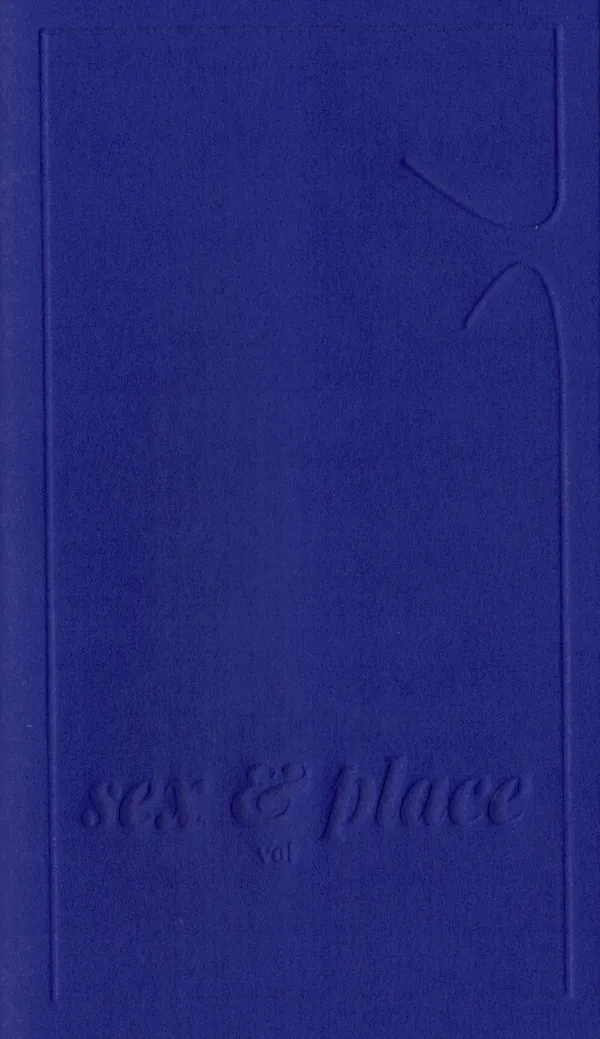
sex and place vol 1
Adriano Wilfert Jensen, Andrea Zavala Folache
sex and place is a series of workshops and publications exploring score-based and semi-anonymous writing as a tool for articulating shared concerns.
Vol. 1 ‘preliminiaries’ is written by Andrea Zavala Folache and Adriano Wilfert Jensen. In the midst of (learning) child care, (unlearning) performance and (experimenting with) sex, the publication interweaves three registers of writing as analogies and interruptions of each other.
The ‘sex and place’ series is part Domestic Anarchism, a project devoted to coalition-building beyond biological, chosen, or national conceptions of family. Dance serves as a set of tools and knowledge that can be applied beyond “the spectacle” to collectively study, write, and move.
Andrea Zavala Folache and Adriano Wilfert Jensen are choreographers and they co-parent three-year-old Penélope Cleo. Andrea and Adriano use dance and choreography to think about the distribution of care and solidarity beyond ‘the family’, and in turn consider how such a distribution could inform their dance practice. Inevitably themes like sex, economy, gender, and class get activated. But also notions such as prefiguration, anarchism, clitoridian* thinking, zones of non-domination and coalition building. They see dance as a knowledge that can be applied to different practices. Some of these include: co-habitations, score based writing and dancing, self-organised study groups and publications, workshops and dance performances.

YouYou Group – A li'nuage
Handmade artist's book combining drawings, photographs, and archival materials. This publication reflects on the YouYou Group's ten-year journey and its evolving relationship with space. It marks a transitional moment from the group's long-term engagement with public space toward a growing understanding of spatiality and collective presence.
YouYou Group is a Belgian choir that specializes in what is known in Arabic as zaghareed. This trilling cry is used by women at weddings and festive occasions, but also at funerals. Youyou is the French name for zaghareed. Depending on the regional origin, it is also called kululu, tsahalulim, or irrintzi. It is a long, shrill tone that is modulated (by the throat, glottis, or rapid tongue movements) and can be heard from far away. Brussels artist Myriam Van Imschoot was one of the founders of this singing group.

Archive Dora Diamant #07
A collection of photographs from the archives of the icon of underground and alternative Parisian nights Dora Diamant.
A self-taught photographer, Dora Diamant has left thousands of photos. The Dora Diamant Association, custodian of this archive, and Éditions L'Amazone have joined forces to bring them to life by devoting a series of publications to them. Each volume of the Dora Diamant Archive was created by a different person and is the result of a subjective selection and arrangement specific to its author.
Figurehead of the Parisian underground and queer nights, photographer, DJ, multimedia and polymorphic artist, Dora Diamant was the daughter of Pascal Doury.
Selected by Yamil Farah and Mélanie Matranga.

This Is Not My Cat
Renowned Japanese photographer Takashi Homma observes his daily life through the poses of his cat.
A cat wanders, perches, and lounges in various spaces around a humble Tokyo apartment. It is perfectly tranquil in its surroundings, simply going about its daily life. In one image, the cat lays serenely amidst pot plants on the balcony, squinting in morning sunlight; in others, it balances precariously on the edge of the bath, snuggles beneath a sleeping bag, plays in a cardboard box, hides beneath an open umbrella. Here and there, evidence of the cat's fellow inhabitant in the apartment—a man, who also happens to be the internationally renowned photographer Takashi Homma—creeps into the frame. A knee, a foot, a shock of blonde hair, half of a face. There are artefacts of his life and practice too. Framed photographic prints draped in bubblewrap lean against a wall; a tangle of musical effects pedals make for colourful constellation against the cool blue of the carpet.
Many have written of the unique atmosphere and energy of Takashi Homma's pictures. His photographic mannerisms are so light, so subtly empathetic to his subjects, that we all but dissolve into the world he creates. The photographs that populate This Is Not My Cat are no exception. Unencumbered by a sense of fussiness or perfection, these images are casual, diaristic, and quotidian. As viewers, we become part of the images and their atmosphere, rather than poring over their details. They are about feeling as much as they are about looking
The title—This Is Not My Cat—seems multipart. Whereas the anomaly imbedded in Homma's iconic photobook Tokyo and My Daughter is that the girl pictured was not in fact his own child, here, his own cat is recast as belonging to another. Or perhaps it is that a cat's independence cannot be truly curbed. They quietly live, play, and exist alongside us. They move through life in our shadow, but forever in their own world.
Takashi Homma (born 1962, lives and works in Tokyo) is one of the most internationally recognised Japanese photographers active at the front lines of contemporary photography today.

The New Television: Video After Television
Rachel Churner, Rebecca Cleman and 1 more
On the rich history of video art and its enduring relevance to today's artistic and critical practices.
The New Television delves into the rich history of video art, reexamining the pivotal Open Circuits conference held at MoMA in 1974 and exploring its enduring relevance to today's artistic and critical practices. Open Circuits was an important event in establishing video art in American museums and articulated a range of conflicting teloses for the medium, some which materialized (like local cable television) and others that remain unrealized. The conference proceedings were published in 1977 as The New Television: A Public/Private Art, and the radical design of the book reflected the conference's utopian aims.
This two-part publication includes a facsimile of the long-out-of-print conference proceedings and new essays and discussions by over a dozen scholars and artists. The new scholarly texts and previously unpublished archival documents in The New Television illuminate the network of institutional histories of video art, consider global televisual contexts and alternative critical approaches, and examine contemporary video art and its continued relevance from new perspectives.
Rachel Churner is the director of the Carolee Schneemann Foundation. She is also an art critic and editor, whose writings have appeared in Artforum and October magazine, among other publications. She was a recipient of the 2018 Creative Capital/Andy Warhol Foundation Arts Writers Grant and is the editor of multiple books, including Jacqueline Humphries: jHΩ1:) (2022); Yvonne Rainer: Revisions (no place press, 2020), Hans Haacke (MIT Press, 2015), and two volumes of writings by film historian Annette Michelson (MIT Press, 2017 and 2020). Churner is a faculty member at Eugene Lang College at The New School, New York.
Rebecca Cleman is Executive Director of Electronic Arts Intermix (EAI) and a writer. She has programmed screenings and special projects for such venues as the International House Philadelphia; the Museum of Art and Design, Anthology Film Archives, and Andrea Rosen Gallery, New York City; and the Julia Stoschek Collection, Germany; and organized or co-organized many events for EAI, including a panel discussion on the films of David Wojnarowicz and a conversation between Hilton Als and The Wooster Group's director and co-founder Elizabeth LeCompte.
Tyler Maxin is curator at Blank Forms. He was previously the Communications and Special Projects Associate at Electronic Arts Intermix (EAI). His writing has appeared in publications including Artforum, BOMB, and Film Comment.

Taming a Wild Tongue
Laura Cemin, Bianca Hisse and 1 more
Referring to Gloria Anzaldúa's notion of 'wild tongue' (Borderlands/ La Frontera, 1987), the publication departs from the questions: How to tame a wild tongue? How to carry language? The verbs 'taming' and 'carrying' imply certain dynamics of permission and restriction of movement, and suggest the entanglement between language and the body. The project delves into the notion of 'tonuge' as an archive: the 'tongue' as a muscle shaped by the physical practice of moving/ talking, having memory; the 'tongue' as a 'cultured' part of the body. It addresses accent as part of our linguistic identity, but also something that defines access or restriction. (From Monika Charkowska's preface to the publication)
Artists: Bianca Hisse, Laura Cemin
Curated by: Monika Charkowska
Texts by: Monika Charkowska, Claire Goodall, Kübra Gümüsay, Bianca Hisse, Laura Cemin
Edited by: Monika Charkowska
Translations: Epp Aareleid (ENG to EST), Ksenia Krimer (ENG to RUS), Keiu Krikmann (ENG to EST), Anita Kodanik (ENG to RUS)
English Proof-Reading: Epp Aareleid
Graphic Design: Kersti Heile
Edition of 200.

Dreaming Water
Dreaming Water is the most thorough monograph dedicated to the work of Chilean artist Cecilia Vicuña to date. Vicuña coined the term “Arte Precario” in the mid-1960s as a new category for her works composed of debris and structures that disappear in the landscape, and which also include her quipus (“knot” in Quechua), envisioned as poems in space.
Dreaming Water brings together over 200 works—including paintings, drawings, screenprints, collages, textiles, videos, photographs, installations, poetry, artist books and performances—created throughout the artist’s remarkable career. It also features several stimulating texts—a lengthy epistolary piece by curator and editor Miguel A. López as well as new essays by anthropologist Elizabeth A. Povinelli, curator Catherine de Zegher and art historian José de Nordenflycht. Vicuña herself contributes two texts, reflecting on her drawings from the “Palabrarmas” project and the activism of the group Artists for Democracy, which she cofounded in 1974. A rousing conversation between Vicuña, anthropologist Marisol de la Cadena and curator Camila Marambio also figures in the book, blending the artist’s voice with those who are experts in fields pertinent to her practice.

The Sunflower
Jackie Wang's magnetic and spellbinding debut collection of poetry that attempts to speak in the language of dreams.
The poems in The Sunflower Cast A Spell To Save Us From The Void read like dispatches from the dream world, with Jackie Wang acting as our trusted comrade reporting across time and space. By sharing her personal index of dreams with its scenes of solidarity and resilience, interpersonal conflict and outlaw jouissance, Wang embodies historical trauma and communal memory. Here, the all-too-familiar interplay between crisis and resistance becomes first distorted, then clarified and refreshed. With a light touch and invigorating sense of humor, Wang illustrates the social dimension of dreams and their ability to inform and reshape the dreamer's waking world with renewed energy and insight.
Jackie Wang is a student of the dream state, black studies scholar, prison abolitionist, poet, performer, library rat, trauma monster and PhD candidate in the Department of African and African American Studies at Harvard University, specializing in race and the political economy of prisons and police in the United States. She is the author of a number of punk zines including On Being Hard Femme, as well as a collection of dream poems titled Tiny Spelunker of the Oneiro-Womb. In 2018 she published a book, titled Carceral Capitalism on the racial, economic, political, legal, and technological dimensions of the US carceral state. She is currently an Arleen Carlson and Edna Nelson Graduate Fellow at the Radcliffe Institute for Advanced Study.

I Was Going to Work
“Invest in a floating city or gentrify a submerged one.”
Nourhan Maayouf’s I Was Going to Work is a hybrid sci-fi picture book by the Cairo-based artist, in which the proto-cyborg citizens of Happy Land Nation establish new-fashioned diurnal rhythms against the ever-present backdrop of a monorail to nowhere and its pillars, idle and idolatrous.
Across forty-four spreads of what might be thought of as a picture book for adults, Maayouf delves into every aspect of a deeply familiar society in which retrograde devolution is billboarded as reinvention by Orwellian technocrats and speculators.
And yet pockets of the cyborg population continue striving, dreaming, craving, protesting, gleaning, and inventing. For a situation to be bleak, some notion of beauty must remain tenaciously rooted where it matters most.

Nights of the Dispossessed
Natasha Ginwala, Gal Kirn and 1 more
Riots are extraordinary events that have been recurring with increasing frequency and occupy a highly controversial space in the political imagination. Despite their often negative portrayals, it is undeniable that riots have played a pivotal role in the confrontation between authority and dissent. Recently, with the deepening crises of capitalism, racial violence, and communal tension, an “age of riots” has powerfully begun. As master fictions of the sovereign nation-state implode, and the hegemonic silencing of the dispossessed reveals the cracks in governability, Nights of the Dispossessed: Riots Unbound brings together artistic works, political texts, critical urban analyses, and research projects from across the world in an endeavor to “sense,” chronicle, and think through recent riots and uprisings—evoking a phenomenology of the multitude and surplus population.
With contributions from Asef Bayat, Joshua Clover, Vaginal Davis, Keller Easterling, Zena Edwards, Nadine El-Enany, Dilip Parameshwar Gaonkar, Gauri Gill, Natasha Ginwala, Natascha Sadr Haghighian, Louis Henderson, Satch Hoyt, Hamid Khan, Gal Kirn, Josh Kun, Léopold Lambert, Margit Mayer, Vivek Narayanan, Ai Ogawa, Oana Pârvan, Elizabeth A. Povinelli, SAHMAT, Thomas Seibert, Niloufar Tajeri, Chandraguptha Thenuwara, Dariouche Tehrani, and Ala Younis.

Men in the Off Hours
In Men in the Off Hours, Carson offers further proof of her tantalizing gifts. Reinventing figures as diverse as Oedipus, Emily Dickinson, and Audubon, Carson sets up startling juxtapositions: Lazarus among video paraphernalia, Virginia Woolf and Thucydides discussing war, Edward Hopper paintings illuminated by St. Augustine. And in a final prose poem, she meditates movingly on the recent death of her mother. With its quiet, acute spirituality and its fearless wit and sensuality, Men in the Off Hours shows us a fiercely individual poet at her best.

Woman Journal Vol. 6: Back in Shape
Do we always have to be nice, kind and communicate respectfully? Wouldn't it sometimes be better to change our tone, to use force or even violence? We often want to act in a spirit of “care” and benevolence, but how do we know if we're really being altruistic and sympathetic? Vol.5 asks the question: Nice?
With contributions from :
Muf architecture/art, Mélanie Mazet, Bui Quy Son, Paul-Antoine Lucas, Armelle Breuil, Annabelle Vaillant, Napsugár Trömböczky, Alessandro Di Egidio,
Elsa Muller, Clara Lenoir, Léo Jacqmin, Clem Koren, Pola Noury, Grève cœur and Cassiane C. Pfund
This publication is edited by the Woman Cave collective founded by Leticia Chanliau and Chloé Macary-Carney.
318 black & white pages, brown cover
Micro edition of 700, printed in Aubervilliers by Isiprint.

The Book of Na
In The Book of Na, translation acts at the edge of perception. Tracing across projects in film, video, and performance, Na Mira reflects on the violent fragmentation of bodies while refusing the containment of geographic and corporeal borders. In 1977, a name is cut at an immigration office. This gap turns into an intergenerational score for becoming heat, hexagram, hologram. Using oracular and glitching technologies, Mira witnesses what escapes data: doppelgängers, dreams, endangered tigers, tesseracts, A. Turiyasangitananda Coltrane's stairs, Theresa Hak Kyung Cha in a theater, Korean shamanism, frozen ligaments, wildfires, borderlands, subatomic particles, and pink. Syncing to a clock with neither face nor hands, Mira’s hauntological permutations in time, death, and relation travel outside the symbolic order and draw energy from the void.
Na Mira’s autobody rites have been presented at sites including Seoul Museum of Art; Museum of Contemporary Art, Los Angeles; Portland Institute of Contemporary Art; Participant Inc., New York; and Whitney Museum of American Art, New York. She earned an MFA from the University of California, Los Angeles. She grew up between the US and East Asia and teaches outside.

OEI #82-83 Art in the Age of Kleptomania
Jonas J. Magnusson, Cecilia Grönberg and 1 more
Aeron Bergman and Alejandra Salinas, co-editors at INCA Press (along with Irena Borić), are the guest-editors of this issue of OEI: it contains essays, artworks, and archival materials by 21 artists, theorists, writers, and artist-run spaces (mostly from the Americas).
The subject of the issue is art and neoliberalism, and it encompasses essays, images and other works by Dorothée Dupuis, Max Jorge Hindered Cruz, Luciano Concheiro, Yvonne Osei, Diego Bruno, John Riepenhoff, Suhail Malik, Good Weather, The Luminary, Bikini Wax, Beta-Local and more.

The Autobiography of H. LAN Thao Lam
Situated between memoir, social criticism, and conceptual art, The Autobiography of H. Lan Thao Lam is an incisive response to a modernist classic and an affecting exploration of the poetics and politics of our times. "We are supposed to know where we are with biography and autobiography, they are the literary equivalents of the portrait and the self-portrait," writes Jeanette Winterson about Gertrude Stein's 1932 classic, The Autobiography of Alice B. Toklas. By narrating her own story from the perspective of her partner, Stein invented a literary form that was both intimate and uncanny, blurring lines of authority and identity as it winds through a story of two women living and loving together through a tumultuous moment in history. Almost a century later, experimental filmmaker and artist Lana Lin has resurrected Stein's project to tell another story of queer love, life, and artistic collaboration in a differently discordant age. At heart a candid chronicle of her partner Lan Thao's life journey from Vietnam during the war and her own troubled history as a gender-queer Taiwanese American, Lin's Autobiography draws in subjects as varied as photography, tropical fruit, New York real estate, and queer theorist Eve Sedgewick's eyeglasses, weaving a landscape of living that is also a critical investigation of race and gender in our time.
Lana Lin is a writer, artist, and filmmaker based in New York and Connecticut. She is the author of the book Freud's Jaw and Other Lost Objects: Fractured Subjectivity in the Face of Cancer and film and video works including The Cancer Journals Revisited. Her various works and collaborative projects (with Lan Thao Lam as "Lin + Lam") have exhibited at festivals and art and educational spaces throughout the world, including the Museum of Modern Art, Whitney Museum, and New Museum, New York; The National Gallery of Art, Washington, D.C.; Gasworks, London; the Taiwan International Documentary Festival and Taiwan Film and Audiovisual Institute, New Taipei City; Arko Art Center, Korean Arts Council, Seoul; and the 2018 Busan Biennale. Having had three years of psychoanalytic training before dropping out, she sometimes still dreams of becoming a psychoanalyst one day.