Books
Books
in random order
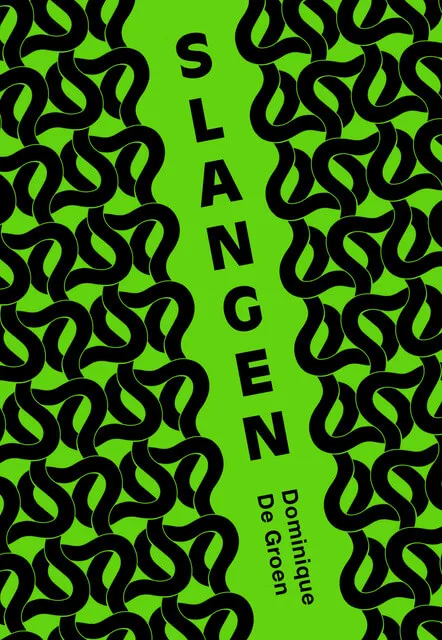
Slangen
Slangen krioelen in de sarcofaag van het heden, in de krochten van de popcultuur, in de mummie van de natuur, in wondes en rot vlees, in artificiële woestijnen en op geoliede dad bods. Ze wentelen zich rond beursgrafieken, raken verstrengeld met wurgende algoritmes, orkestreren een trage ondergrondse revolutie. Een meisje snijdt zich aan een nepdiamanten piramide en werpt haar slangenvel van zich af.
Dominique De Groen is schrijver en beeldend kunstenaar. Ze publiceerde de dichtbundels Shop Girl (2017), Sticky Drama (2019) en offerlam (2020). Ze werd genomineerd voor de Poëziedebuutprijs Aan Zee 2018, de Herman de Coninckprijs 2020 en de Fintroliteratuurprijs 2021 en won de Frans Vogel Poëzieprijs 2019 en de Fintropublieksprijs 2021.

Worms #8 'The Elements Issue'
In this special edition, double-cover issue of Worms, we bring you not one, but two cover stars. The indelible Tyson Yunkaporta and the iconic Anne Waldman adorn both sides of Worms 8 which can also be thought of as ‘The Elements Issue’. It was dreamt up in a dreary and grey August in London, while the rest of the world suffered through the hottest days on record. As we witnessed, and continue to witness, such climate catastrophe, we turned to the literature we love to help us understand, to challenge us, and to offer us some comfort.
The issue is split into four sections—earth, fire, air and water—but its roots and webs push beyond what we typically think of as ‘the natural’: tales from the kitchen from Rebecca May Johnson and Slutty Cheff, reflections on gardening and colonialism, writer's block and clogged pipes, how to blow up pipelines with Andreas Malm, grief and writing, recovery and nature with Octavia Bright, social mobility with Isabel Waidner, the wide range of issues raised by the underrepresentation of First Nations people in literature with Evelyn Araluen and much, much more.
We hope that this issue can be a flame of hope, inspiration, or something that simply sustains in such turbulent times.
Featuring
Tyson Yunkaporta, Isabel Waidner , Jamaica Kincaid, Melissa Broder , Evelyn Araluen, Bruce Pascoe, Octavia Bright, Nora Treatbaby , Nerea Calvillo , Anne Waldman , Alexis Pauline Gumbs , Léuli Eshrāghi, Madeline Cash , Andreas Malm, Rebecca May Johnson
Contributors
Stella Murphy , Ben Redhead, Phoenix Yemi, Sam Moore, Devils Claws, Pierce Eldridge, Manon Mikolaitis, Caitlin McLoughlin, Isabel MacCarthy, Elodie Saint-Louis , Nettle Grellier, Amelia Abraham, Ryan Pfluger, Rose Higham-Stainton , Emma Crabtree, Ignota, Lydia Luke, Chloe Sheppard , Clem MacLeod , Carolyne Loreé Teston , Emma Cohen, Olive Couri, Raheela Suleman , No Land , Jacqueline Ennis-Cole , Sufia Ikbal-Doucet, Rhett Hammerton, Zara Joan Miller , Kate Morgan , Bug Shepherd-Barron, Zoe Freilich , Slutty Cheff , Clemmie Bache , Violet Conroy , Sarah White , Jemima Skala , Stephanie Francis-Shanahan

Toffe. édition générale : système de production d'actions graphiques
toffe. édition générale
publication issue de reproduction générale,
système de production d'actions graphiques
développé en trois temps :
projection générale
dispositif multi-écran, pour la chaufferie
galerie de l'école supérieure des arts décoratifs de strasbourg
du 14 février au 23 mars 2003
présentation, édition générale
école nationale supérieure des beaux-arts d'alger
du 24 mai 2003
exposition, occurrence récente
diffusion, édition générale
galerie madé, paris
du 12 mai au 5 juin 2003

ONE THOUSAND GHOSTS IN THIS FEAST
Sahar Khraibani’s ONE THOUSAND GHOSTS IN THIS FEAST contends with desire, grief, and language as sites of injury and release. Written over a period of three days—amid ongoing genocide, land seizure, and displacement—the long poem counters logics of possession with those of relation. Khraibani’s all-caps, first-person address impels the poem forward, centering intertextuality as a force through which spectral presences shine.
Sahar Khraibani is a writer and artist whose work has been presented with Montez Press, The Brooklyn Rail, Magnum Foundation, the Poetry Foundation, the Poetry Project, and Hyperallergic among others. Sahar is a recipient of the Creative Capital / Arts Writers Grant, a fellowship at The Poetry Project, a MacDowell Fellowship, a 2024 residency at Mass MoCA, and is an alumni of the Whitney Independent Study Program. Sahar teaches at Pratt Institute and is the author of Anatomy of A Refusal (1080PRESS, 2025).
ONE THOUSAND GHOSTS IN THIS FEAST lays bare the “SENSELESS DECAY” potentiated by empire’s relentless categorization, containment, and calculated death delivery. Khraibani’s debut chapbook collapses the imposed and perceived distance written by borders, disrupts anticipated colonial language logics, and bursts “INTO THE MADNESS OF THE ORGY” with queer interference reverberating in all directions. From the soil, from the graveyard, from the dancefloor, from their favorite spot on the eroding waterfront, Sahar broadcasts, IN ALL CAPS, “THE UNNAMEABLE TRUTH.”
— Andrea Abi-Karam

OEI #86/87 Publishing Practices, Publishing Poetics
Tobi Maier, Cecilia Grönberg and 1 more
Once more, an astonishing issue of OEI – a thrilling, compelling, stimulating feast of ideas regarding publishing and the book: the perfect big companion to read and hug in bed while the virus spreads outside.
Bringing together contributions from circa 130 publishing structures, publishing communities, magazines, small press endeavors, artists, poets, writers, editors, theoreticians, curators, scholars, and art bookstores, OEI # 86–87 reflects upon the challenges, pressures and possibilities of publishing and creating publics in different contexts and places in a time of far-reaching – economical, medial, political, social, technological – transformations.
The potential and the versatility of publishing open it to a diversity of practices and approaches in the arts, but as an eminently social form of art, a collective or micro-collective work with shared responsibilities, it is also a never-ending process of “crafting a variegated approach to how you create, publish, distribute, and build a social ecosystem around your efforts”, of trying to “build up and strengthen the community around these printed forms” (Temporary Services).
It is the conviction of OEI #86–87 that print has the power to play an important part in the construction of social spaces, of a social world. As Benjamin Thorel puts it in one of the essays in the issue, “conceiving of the dynamics of publishing as making publics as well as making things public is not a pun – insofar as the artists/publishers encompass, beyond the book itself, its possible ‘lives’, imagining the different spaces, and the different people, amongst whom a publication will circulate.” This is what Michael Warner has called “a public [as] poetic worldmaking”, implying “that all discourse or performance addressed to a public must characterize the world in which it attempts to circulate, projecting for that world a concrete and livable shape, and attempting to realize that world through address.”
This is also, as stressed by Annette Gilbert and others, what can make publishing such an active force, a force co-constituting texts and publications and publics. Indeed, with Michalis Pichler, it is tempting to say that in publishing as practice – perhaps more than in any other art field – “artists have been able to assert the aesthetic value of their own socio-politically informed concerns and to engage, often under precarious conditions, in cultural activities fully aligned with their political values.”
OEI #86–87 also includes sections on and with contemporary poetry from Canada; Fluxus publishing; Krister Brandt/Astrid Gogglesworth; Kalas på BORD (Öyvind Fahlström); Lars Fredrikson; Claude Royet-Journoud’s poetry magazines; Carl Einstein; Gail Scott; Ållebergshändelser; OEI #79: edit/publish/distribute!; “det offentligas försvinnande” and many many other things. [publisher’s note]
Design by Konst & Teknik

Radical Media Archive Vol 01
Ramdane Touhami, Émile Shahidi
Do you remember the last time you were looking forward to the future? We're not talking about flying cars or floating screens. We're talking about a credible vision of a better time to come. So when was the last time? How did it look? How did it feel?
Have a glance at page 223, about two-thirds in. This is a portrait of Frantz Fanon by Milton Glaser. One of the biggest names in commercial graphic design of the 20th century, painting the likeness of the giant of anti-colonial thought. Let’s leave aside the question of "who's the Milton Glaser of today?" for now, but if there was one, whose portrait would they be painting?
What we’re attempting, in these few hundred pages, is to track our favorite examples of the visual language of revolt and solidarity in the 1960s and 1970s, put them in dialogue with our most beloved works of graphic design of those decades, and celebrate the heroes who made them.
Creative currents flowing from Paris to Tokyo, Cuba to Milano, Beirut to New York, Berkeley to London, with innovations and revolutions (both political and artistic) happening every year. Causes supported by incredible talent and inspiring design that activated people, uplifted liberation movements, advanced the struggles for social justice, and created bonds of global solidarity.
Sadly this cross-pollination between commercial art and the political ended around the late 1980s and those two worlds are now completely isolated from one another.
Why do movements not produce beautiful and memorable visuals anymore? Why do the biggest image makers of today not lend their talents to the good fights that need their help? We hope that these will intersect again, and the first step is to study their history.Friends, we are here to tell you that fighting for a better world is, in fact, not only extremely cool, but the coolest thing you can do — and we have the images to prove it!
Ramdane Touhami and Émile Shahidi have spent years researching and traveling to assemble a huge collection of books, rare periodicals and radical art that will soon be available for consultation in person and online, and of which this little book is just a taste.

Traces of Dance
Traces of Dance brings together scores, drawings, sketches, notes, graphics and paintings, which contributes to define a textuality of movement between writing and image.
The drawings and notations of choreographers rarely come before the public eye; and yet they are far more than simple memory aids. Several types of speech and writing have been called upon to lead the viewer's perception through the traces that the dancing body lays down. While these texts are not all concerned with the specific practices of dance, they all deal with the most profound contribution that a knowledge of the moving body brings to our culture, to our lives.
With Georges Appaix, Dominique Bagouet, Trisha Brown, Lucinda Childs, Régine Chopinot, Merce Cunningham, Philippe Decouflé, Raoul-Auger Feuillet, Roxane Huilmand, Isaac, Anne Teresa De Keersmaeker, Rudolf Laban, Daniel Larrieu, Jean-Marc Matos, Dana Reitz, Hervé Robbe, Kellon Tomlinson, Mary Wigman, André Lorin, Vaslav Nijinski, Louis-Guillaume Pécour, Pierre Rameau, Bob Wilson.
Texts by Daniel Dobbels, Jean-Noel Laurenti, Laurence Louppe, Valérie Preston-Dunlop, René Thom, Paul Virilio.

Semi-Nomadic Debt-Ridden Bedouins
Semi-Nomadic Debt-Ridden Bedouins offers an in-depth look at nearly two decades of artistic output by the Palestinian artist and filmmaker Basma al-Sharif. Retracing her practice from recent works back to her earliest experiments, the book provides an original overview of how her visual language and conceptual concerns have evolved over time.
Basma al-Sharif's films and installations navigate the unstable terrains of displacement, colonialism, and representation—often shaped by the ongoing reality of the occupation of Palestine. Through a rich selection of images and curatorial essays, the monograph highlights the layered political and cinematic frameworks within which her works are embedded.
Also included are two newly commissioned literary contributions: a fictional piece by Karim Kattan that resonates with the themes of place and estrangement, and a conversation between al-Sharif and the artist Diego Marcon, in which they reflect on shared affinities, artistic processes, and their long-standing dialogue. Blurring the personal and the political, the real and the imagined, Semi-Nomadic Debt-Ridden Bedouins captures the complexity and urgency of al-Sharif's artistic journey.
Texts by Basma al-Sharif, Karim Kattan, Diego Marcon, et al.
Basma al-Sharif (born 1983 in Koweit) is a Palestinian artist working in cinema and installation. She developed her practice nomadically between the Middle East, Europe, and North America and is currently based in Berlin. Her practice looks at cyclical political conflicts and confronts the legacy of colonialism through satirical, immersive, and lyrical works.

the boy, the bucket and the persistent tide
the netherlands has been the home of irishman charlie jermyn for the last 5 years; it’s a nation that has been dredged up from the water and which attempts, to this day, to hold back the persistent tide. in this brilliant and very-hard-to-describe debut novel, jermyn brings the common and absurd to crisp, shimmering life through his essays and short non-fiction pieces, reminding us to take note of the mad and brilliant world around us before the tide comes in again.
illustrated by samuel van heijningen

MsHeresies 7 - Introduction to The Weather
This seventh issue, four folded offset-printed posters, publishes sampled and reworked material from the feminist collective and publication Big Mama Rag (1972–84, Denver, Colorado), specifically focusing on the issues and articles dealing with the Palestinian and international feminist struggle. Typeset alongside this archival collage is “Introduction to The Weather” (2001) by poet Lisa Robertson.
4 folded posters (narrow A2)

Woman Journal Vol. 6: Back in Shape
Do we always have to be nice, kind and communicate respectfully? Wouldn't it sometimes be better to change our tone, to use force or even violence? We often want to act in a spirit of “care” and benevolence, but how do we know if we're really being altruistic and sympathetic? Vol.5 asks the question: Nice?
With contributions from :
Muf architecture/art, Mélanie Mazet, Bui Quy Son, Paul-Antoine Lucas, Armelle Breuil, Annabelle Vaillant, Napsugár Trömböczky, Alessandro Di Egidio,
Elsa Muller, Clara Lenoir, Léo Jacqmin, Clem Koren, Pola Noury, Grève cœur and Cassiane C. Pfund
This publication is edited by the Woman Cave collective founded by Leticia Chanliau and Chloé Macary-Carney.
318 black & white pages, brown cover
Micro edition of 700, printed in Aubervilliers by Isiprint.

New Forms of Art and Contagious Mental Illness
Over the years 1919–20, the celebrated medical scientist and doctor Carl Julius Salomonsen began giving public lectures and publishing pamphlets regarding a new “epidemic” that had begun to affect the European populace: the increasing ubiquity of modernist art.
In a 1919 pamphlet titled New Forms of Art and Contagious Mental Illness, he wrote: “We stand, at this moment, before a movement in art which is psychopathic in character, and whose victorious journey through all countries is probably caused by the same spiritual disease that gave the older, religious spiritual epidemic such a powerful spread.” This pamphlet and the accompanying talks were countered by a retaliatory pamphlet published by members of Grønningen, a Copenhagen modernist painters group, to which Salomonsen responded with a further pamphlet.
Translated into English for the first time by literary theorist Andrew Hodgson, the entire altercation is gathered in this book, documenting one of the earliest rejections of modernist art.
Edited & Translated by Andrew Hodgson.

Gravity Road: A Rollercoaster Reader
Jesse Darling, Heinrich Dietz and 2 more
Constructed in Pennsylvania in 1827, Gravity Road was a precursor to the modern roller coaster; a sloping stretch of railroad used to cart coal out of mines. With passenger rides on offer soon afterwards, the rapid descent became an attraction and the technology was appropriated for thrill rides in amusement parks.
Jesse Darling’s sculptures, drawings and installations address the fallibility, fungibility and mortality of living beings, systems of government, ideologies and technologies – nothing is too big to fail. For his exhibition at Kunstverein Freiburg in 2020, Darling created a sculpture of a dysfunctional roller coaster, broken down to a child-like scale, becoming an anti-monument to a modernity that celebrates progress, acceleration and mastery and produces violence.
Exploring the entangled history of labour, leisure, extraction and entertainment, Gravity Road: A Rollercoaster Reader was commissioned in response to Darling’s 2020 exhibition, bringing together new texts by artist and Darling-collaborator Joe Highton and writer Sabrina Tarasoff along with a correspondence between Darling and the Kunstverein’s director Heinrich Dietz.
FEATURING TEXTS BY:
Jesse Darling
Heinrich Dietz
Joe Highton
Sabrina Tarasoff

Brick by Brick: How We Build a World Without Prisons
The fight for prison abolition is a struggle for collective liberation: a transformative vision of a safer world, in which communities live free from exploitation on a thriving planet.
Drawing connections across social justice movements with a shared abolitionist ethic, this revolutionary book illuminates how harmful ideas of criminality and punishment can manifest in many ways beyond the prison industrial complex. This work is a collaboration with friends, mentors and giants fighting for housing justice, food justice, climate justice, migrant justice, justice for survivors of violence, and more.
With this insightful and generous book, now in its second edition, Cradle Community invites us to explore what it will take to dismantle structures of oppression, and to imagine the future we can rebuild together—brick by brick.
Cradle Community is a collective of organisers committed to radical education and building understanding of prison abolition and transformative justice. Brick by Brick is their first book.

Michigan State University Press
Citizens of Beauty: Poems of Jean Sénac
This stunning collection of poems by the Algerian poet Jean Sénac (1926–1973) was originally published when he was forty-one. Sénac represented the hope of the new generation of Algerians who were celebrating their independence from France after 130 years of colonialism, and in the tradition of René Char and the early Albert Camus, he portrayed an Algeria whose land and people would finally sing with their own voice.
Sénac celebrates revolution, love, and the body, beginning with the resonant verses: “And now we’ll sing love / for there’s no Revolution without love.” He sang, as well, of beauty: “No morning without smiling. / Beauty on our lips is one continuous fruit.”
Translated by Jack Hirschman

Unconscious/Television
This book stems from the author’s discontents with Lacanian Psychoanalysis, by drawing from psychoanalysts like Félix Guattari and Sándor Ferenczi, as well as authors like Viveiro DeCastro, and Thomas Lamarre, to whom the book is dedicated.
As Lucas Ferraço Nassif elaborates on the possibility of a multiplicitous Unconscious, or rather, a mass of many Unconscious(es), he attempts here to fold the book itself into the text, to make the organisation of the physical book itself a part of the elaboration.
This 2nd Edition comes with a few editorial changes, and a slightly different design approach. It is being presented now with a suite of endorsements from a group of exciting writers and researchers, including Persis Bekkering, Thomas Lamarre, and Yuchen Li. Much of the first edition is preserved, and an extra text has been added, written by the editor as a part of the lecture at Ifilnova. There has been a focus on making this book more accessible, so we have reworked the design of this edition in Black & White.
The Unconscious is Semiotic, not Linguistic, and it only jumps out when you read between the lines. Do you remember, back in 1997, when 600 kids had epileptic shocks whilst watching Television—the Pokémon Shock? This might sound strange at first, but Lucas Ferraço Nassif theorises that, contrary to the claim that this was caused by oscillations of blue and red light alone, it could have been caused by microperceptions and intensities within narrative. As Porygon takes Ash and friends into the digital world, the immanence of unconscious assemblages drags viewers in, too.
Such is the haptic and imagetic nature of this book. Using several design and editorial strategies, and a particular mode of writing, the author attempts to elaborate on their work on the Unconscious by recreating a similar possibility—where book, language and reader collapse into a composition, an assemblage or a haecceity. Unconsciousness operates as the multiplanar compositions of Japanese Anime do, so this book has been organized accordingly—different texts, different temporalities, different voices—and like the Japanese concept of Ma (negative space), or even like CoreCore, something jumps out of the breaks, the gaps in between the layers, and therein lies, for this book, a departure point for elaborating on not just one, but many, Unconscious(es).

Chapel Road
Louis Paul Boon, Adrienne Dixon
A meta-textual matryoshka doll of a novel from a renowned voice in Flemish literature.
The twisting narrative of Louis Paul Boon's 1953 masterpiece follows a young girl named Ondine and her brother Valeer, born into poverty at the turn of the century in the industrial city of Aalst, Belgium. Ondine's coming of age is interwoven with a reworking of the medieval fable of Reynard the Fox, as well as a metanarrative in which an author named Louis Paul Boon and his colorful group of friends discuss the writing of a novel named Chapel Road, debating how best to present Ondine's story.
Groundbreaking among post-war Dutch literature for its postmodern structure and irreverent, dialect-studded use of language, Boon's allegory of the rise and fall of socialism in Flanders presents his theory of the novel as a type of "illegal writing" where digressions are far more important than a carefully constructed plot.
Introduction by Chad W. Post
Louis Paul Boon (1912-1979) started out as a house painter but went on to become the author of a large and rich oeuvre spanning several genres: from the compelling historical epics he composed later in life to his sharp, witty work as a newspaper columnist and his tongue-in-cheek, scabrous novels. Boon is one of the most important writers of Flemish literature in the twentieth century, a keen observer of society, the individual and the interplay between them.
Adrienne Dixon is a translator of Dutch and Flemish literature.
Chad W. Post is the founder and publisher of Open Letter Books. He is also the editorial director of Dalkey Archive Press, where he was formerly the associate director. Over the course of his career, he founded the Translation Database, the Best Translated Book Awards, multiple literary podcasts (Two Month Review, Three Percent), the Three Percent website, and currently writes two newsletters: The Three Percent Problem, and Mining the Dalkey Archive. He is also the author of The Three Percent Problem: Rants and Responses on Publishing, Translation, and the Future of Reading. His articles and book reviews have appeared in a range of publications. In 2018 he received the Words Without Borders Ottaway Award for the Promotion of International Literature.

The Lesbian Body
In this genre- and gender-breaking work of theory-fiction, legendary writer and cofounder of the 1970s French feminist movement Monique Wittig celebrates the body—lesbian, literary and defiantly political—and challenges the order of heterosexuality in literature.
First published in French in 1973, The Lesbian Body mines the relationship between a lover and a beloved—also a writer and a text—to explore the ideological and historical constructions of the female subject. Organized according to the principle of montage, poetic passages are juxtaposed with anatomic lists that mark lesbian eros. Through expressions of joy, violence, and tenderness, the site of pleasure is celebrated. In her transfiguration of gender and its paradigms, Wittig transformed French vocabulary, feminizing grammar and lesbianizing myths. This edition brings the English translation of Wittig’s groundbreaking work back into circulation for the first time since the mid-1980s, revised according to the author's notes, and with an introduction by Paul B. Preciado.
“The Lesbian Body is a fundamental work of lesbian existence. Wittig's applied vision is a state of natural delirium, a revolutionary excess of utopianism, refusal, and mutual self-creation. Revisiting it reveals how much passionate free thought has been lost, and simultaneously, how many of her tropes and discoveries have integrated into our collective consciousness.” — Sarah Schulman
“In this stunning new rendering of The Lesbian Body by the French author, theorist, activist and teacher, the late Monique Wittig, we are plunged into an imagined world of passionate violence and erotic lesbian mayhem intertwined in strikingly bold poetic images. Wittig, in the reach and volatility of her imagination, stands alongside such important American writers as Audre Lorde, Adrienne Rich, and Valerie Solanas, all of whose work deserves to be read again, or for the first time.” — Esther Newton
“To read the book is to be forced by Wittig into another grammar and happily contaminated by its strange forms. You will never think straight again.” — Jack Halberstam
“For me, Wittig opened up a sense of the world that had been, quite literally, unimaginable. She tore us apart.” — Judith Butler
“Together with Ursula Le Guin and Samuel R. Delany, Wittig is the first to design a nonbinary utopia, a world in which the binary categorization of sexes and genders will have ceased to exist.” — Paul B. Preciado
Introduction by Paul B. Preciado
Translated by David Le Vay

Play-White
The racist term "play-white" comes from the apartheid era, when it connoted a black or mixed race person who lived as a white person: “So and so is a play-white.” South African artist Bianca Baldi draws from studies of biomimicry and her own family history, as well as literary precedents—such as Nella Larsen’s novel Passing (1929)—to reflect on racial passing and the instability of racial identities. Play-White alternates between layers of visualization and moments of discretion in order to explore questions of presence and evasion beyond their representation in black and white.
With contributions by Bianca Baldi, Mika Conradie, Shoniqua Roach, Amy Watson, and others; design by Katharina Tauer & Wolfgang Hückel in collaboration with K. Verlag.
Published 2021

SABR N°04 - Half a life
“Perhaps much of what we once believed was never truth but a gentle and necessary illusion.It was something we chose quietly and almost unconsciously so we could continue without falling apart.”
Bayan Abu Nahla is a visual artist born in 2001 in Gaza, Palestine. Her artistic practice functions as a visual diary, documenting and reflecting rapidly evolving events, both before and after the genocide. Through her work, she explores realities and daily living conditions often unknown to those who have not lived in Gaza.
SABR/Collection is a series of publications that bring together short literary works in a variety of genres. Curated by Nesrine Salem, SABR/Collection wishes to highlight the macro-realities of the authors chosen, to make visible the intersectional nature of struggles.

Reality (Dark) Fragments (Light)
This monograph covers more than fifty years of creation by Art & Language, whose artists are at the origin of conceptual art. Through unpublished texts by Matthew Jesse Jackson and Art & Language, a transcript of their opera libretto Victorine, and an interview with the artist collective, this publication questions their journey, and more broadly, the relationship between contemporary art and conceptual art.
The permanent collection of the Château de Montsoreau – Museum of Contemporary Art has grown to include 800 works from Art & Language. To celebrate this event, the museum produced a major exhibition and a publication titled Reality (Dark) Fragments (Light). The monograph and exhibition look back at 50 years of creation by these critical, provocative, subversive, punk art collective. They question the main issues involved in Art & Language's work: conversation as an artwork, description, transdiciplinarity, crisis in the relationship between the artist, the museum and the art gallery.
Edited by Marie-Caroline Chaudruc.
Foreword by Marie-Caroline Chaudruc.
Text by Matthew Jesse Jackson, interview with Art & Language by Victorine Meurent.

At the Full and Change of the Moon
Written with lyrical fire in a chorus of vividly rendered voices, Dionne Brand's second novel is an epic of the African diaspora across the globe.
It begins in 1824 on Trinidad, where Marie-Ursule, queen of a secret slave society called the Sans Peur Regiment, plots a mass suicide. The end of the Sans Peur is also the beginning of a new world, for Marie-Ursule cannot kill her young daughter, Bola, who escapes to live free and bear a dynasty of descendants who spill out across the Caribbean, North America, and Europe.
Haunted by a legacy of passion and oppression, the children of Bola pass through two world wars and into the confusion, estrangement, and violence of the late twentieth century.
"[Brand has] a lush and exuberant style that may put some readers in mind of Toni Morrison or Edwidge Danticat." — William Ferguson, The New York Times Book Review

A Dance Mag - Issue 04: Structure
Issue 04, Structure, traces the scaffolding of our lives, seen and unseen. We travel from the palaces of Versailles to the basements of Russian resistance, from origami folds to mechanized labor, from cosmic geometry to the twitch of a stimming hand. These are the choreographies that hold us, train us, divide us, and sometimes set us free. This issue moves through power's choreography with Vinícius Portella tracing repression from TikTok algorithms to Candomblé persecution, Sasha Portyannikova documenting dance as survival under Russian authoritarianism, and Ellen Jeffrey revealing how stimming becomes its own radical dance practice. Mariam Ala-Rashi finds cosmic alignment in contortion while Michael O'Connor explores the body as origami, structure folded into self. Katja Vaghi contrasts baroque precision with contemporary chaos, and Nathaniel Moore exposes the market forces shaping European dance. Cover and insert artist, Maria Harfouche, captures structure through double-exposed analog photography and layered compositions that reveal how moments build upon each other.
A Dance Mag is an independent magazine that looks at the world through the lens of dance. It transcends differences, distances, and disciplines to tell the stories of people from all over the world, who are dancing their lives and giving their bodies a voice.

Magenta Soul Whip
Lisa Robertson writes poems that mine the past, its ideas, its personages, its syntax, to construct a lexicon of the future. Her poems both court and cuckold subjectivity by unmasking its fundament of sex and hesitancy, the coil of doubt in its certitude. Reading her laments and utopias, we realize that language, whiplike, casts ahead of itself a fortuitous form. The form brims here pleasurably with dogs, movie stars, broths, painting's detritus, Latin and pillage.
Erudite and startling, the poems in Lisa Robertson's Magenta Soul Whip, occasional works written over the past fifteen years, turn vestige into architecture, chagrin into resplendence. In them, we recognize our grand, saddened century.