rile*books

Search books

Search books by title, author, publisher, keywords...

Cover of Brick by Brick: How We Build a World Without Prisons

Hajar Press

Brick by Brick: How We Build a World Without Prisons

Cradle Community

€18.00

The fight for prison abolition is a struggle for collective liberation: a transformative vision of a safer world, in which communities live free from exploitation on a thriving planet.

Drawing connections across social justice movements with a shared abolitionist ethic, this revolutionary book illuminates how harmful ideas of criminality and punishment can manifest in many ways beyond the prison industrial complex. This work is a collaboration with friends, mentors and giants fighting for housing justice, food justice, climate justice, migrant justice, justice for survivors of violence, and more.

With this insightful and generous book, now in its second edition, Cradle Community invites us to explore what it will take to dismantle structures of oppression, and to imagine the future we can rebuild together—brick by brick.

Cradle Community is a collective of organisers committed to radical education and building understanding of prison abolition and transformative justice. Brick by Brick is their first book.

Published in 2021 ┊ 216 pages ┊ Language: English

recommendations

Cover of October

Hajar Press

October

Nur Turkmani

Poetry €21.00

What do we carry from one year to the next? What remains after devastation, and what, despite everything, takes root again?

October in Lebanon is heavy with memory. The euphoria of the 2019 revolution feels far away, its anniversaries marked by crisis, war and the genocide in Gaza.

Across multiple Octobers, Nur Turkmani meditates on rupture, transformation and the quiet undoing and remaking of relationships during collective catastrophe. Part archive, part love letter, her debut poetry collection holds the ordinary and the extraordinary in the same breath, spanning balconies and border towns, fig trees and songs for friends, autumn light and the instinct to flee.

Formally spare and emotionally saturated, October refuses both numbness and spectacle. These poems ask what it means to survive the world and still long for it; and how we hold what’s disappearing, or changing too quickly to make sense of.

Cover of We, the Heartbroken

Hajar Press

We, the Heartbroken

Gargi Bhattacharyya

Essays €21.00

What do we do when the world breaks our hearts? Racial capitalism in the age of pandemic continues to crush ever more lives and spirits. Yet, we are told repeatedly to master, to overcome, to be resilient. Beneath this fragile pretence of coping, many of us have grown used to living with profound and fathomless sorrow.

In graceful prose, Gargi Bhattacharyya navigates collective grief and how it mingles with personal tragedy. Alongside love and joy, perhaps grief is what makes us human―and while its pain scrapes our wounds, its presence can help us renounce that which exists and build anew. 

Heartbreak is the class consciousness of our times. So, it is up to us, the heartbroken, to learn again to heal—and remake the world.

"We, the Heartbroken reckons with loss and grief’s fullness and its surprising abilities to make us alive to one another … entranced by one another again. We are called upon to do this work, to allow for heartbreak to engender capaciousness and collectivity."
Full Stop

Gargi Bhattacharyya lives and works in London. Their work includes writing on racism, racial capitalism, austerity and war.

Cover of The Stone House

Hajar Press

The Stone House

Yara Hawari

Fiction €21.00

A vivid, haunting tale of intergenerational trauma and survival under Israeli occupation. 

A New Arab Book of the Year 2021.

The year is 1968. The recent Arab defeat in the Naksa has led to the loss of all of historic Palestine. In the midst of violent political upheaval, Mahmoud, a young Palestinian boy living in the Galilee, embarks on a school trip to visit the West Bank for the first time.

For Mahmoud, his mother and his grandmother, the journey sets off a flood of memories, tracing moments that bond three generations together. How do these personal experiences become collective history? Why do some feel guilty for surviving war? Is it strange to long for a time never lived?

In this groundbreaking novella, Yara Hawari harnesses the enduring power of memory in defiance of the constrictions on Palestinian life. Against a system bent on the erasure of their people, the family’s perseverance is unbroken in the decades-long struggle for their stone house.

Yara Hawari is a Palestinian writer and political commentator. She completed her PhD in Middle East Politics at the University of Exeter, where her research focused on oral history and Indigenous Studies. She currently works as a senior analyst at Al-Shabaka, a Palestinian think tank. The Stone House is her first book.

Cover of Sambac Beneath Unlikely Skies

Hajar Press

Sambac Beneath Unlikely Skies

Heba Hayek

Memoir €18.00

Tender yet brutal vignettes on a girlhood in Gaza, Palestine, filled with honey and warmth.

Winner of the Creative Award in the 2022 Palestine Book Awards.

Chosen as a 2021 Book of the Year by The White Review, Middle East Eye & The New Arab.

Sambac Beneath Unlikely Skies is written for those who had to leave—collected remembrances of a childhood in Gaza by a woman far from Palestine’s sun and sea. Overindulgent, chaotic and sentimental, Heba Hayek’s narrator struggles to navigate life in colder, unfamiliar worlds. She holds tightly to memories of home, hoping they will lead back to her sisters and mothers.

With brilliance and grace, Hayek’s vignettes explore the methods of survival nurtured by Palestinian women in the face of colonial occupation and patriarchy—the power of community care, and of loving what’s not meant to be loved. Her reflections reveal the intimate magnificence and quiet devastation of everyday life: a family drive on the shore, waxing for the first time with aunties, or peeling figs while waiting at a checkpoint.

Heba Hayek is a London-based, Gaza-raised Palestinian author, creative and facilitator. She completed an MFA in Creative Writing at Miami University, Ohio, and studied for an MA in Social Anthropology at SOAS University of London.

Heba’s first book, Sambac Beneath Unlikely Skies, won the Creative Award in the 2022 Palestine Book Awards and was chosen as a 2021 Book of the Year by The White Review, Middle East Eye and The New Arab.

Cover of You Must Believe in Spring

Hajar Press

You Must Believe in Spring

Mohamed Tonsy

Fiction €18.00

Twenty years after she first chanted in Tahrir, Hanan’s son is living under military rule in Egypt. Though he is both a disciple of the national Sufi institute and a swimmer representing the Armed Forces, proximity to power cannot undo his revolutionary birthright: like his mother and grandmother before him, Shahed is an undercover rebel.

When a general arrives at the Sufi institute looking for help with a military assignment, Shahed accepts, all while concealing his own plans for resistance. The mission takes him behind the walls of a prison town, inside a secret army barracks in the Sinai desert, and deep into the murky waters of the past.

As he wades through his mother’s repressed memories and the state’s repressed histories, Shahed grapples with the traumas of the revolution and the weight of authoritarian rule, searching for new ways to revolt for freedom.

Mohamed Tonsy is a queer Egyptian writer and ceramicist. Formerly an architect and a triathlete representing the Egyptian Triathlon Federation, he completed a PhD in Creative Writing at the University of Edinburgh. His writing has appeared in Mizna and Epoch Press and was shortlisted in MFest’s 2021 Short Story Competition. You Must Believe in Spring is his first book.

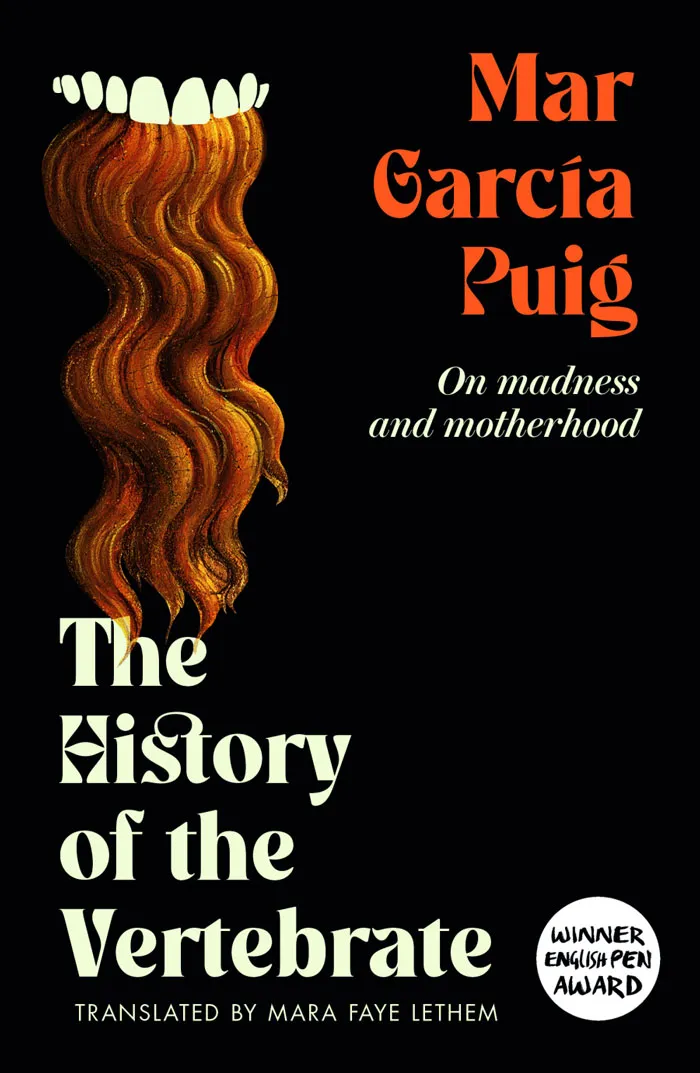
Cover of The History of the Vertebrate

Peninsula Press

The History of the Vertebrate

Mar García Puig, Mara Faye Lethem

Mothering €19.00

‘On 20 December 2015 I became a mother and I went mad.’ 

On a single day, Mar García Puig gives birth to twins and becomes elected to the Spanish Parliament as a member of the insurgent left-wing party Podemos. What might have been the best day of her life becomes the start of a terrifying ordeal; García Puig’s grip on reality begins to slip as she grapples with uncertainty, the weight of expectation, and misogyny in both of her new roles. 

In defiance of a culture that tells her the problem lies within, García Puig chooses to look outwards, examining the imbrication of madness and motherhood across centuries of science, myth, and politics while dissecting the ways in which women have been pathologized and banished from public life. 

At once intimate and epic, The History of the Vertebrate is a searing account of postpartum madness. Moving between memory, culture, and the history of medicine, García Puig transforms her experience into a story about the countless women who have felt that sanity was leaving them, and about the patriarchal forces that have silenced them. 

MAR GARCÍA PUIG is an editor and author. From 2015 to 2023 she was a member of the Spanish Congress of Deputies for Podemos, where she served on the Culture Committee and the Equality Committee. Her books include The History of the Vertebrate and This Thing of Darkness.

Cover of Constructing Worlds Otherwise

AK Press

Constructing Worlds Otherwise

Raúl Zibechi, George Ygarza Quispe

Non-fiction €18.00

A new collection from one of Latin America's most dynamic radical thinkers—in the tradition of Frantz Fanon and Eduardo Galeano.

Through a survey of the most marginalized voices across Latin America—feminists, the Indigenous, people of African descent, and inhabitants of urban favelas and rural towns—Zibechi introduces the Anglo world to a range of critical perspectives and new forms of struggle in Peru, Mexico, Brazil, Colombia, and Bolivia. His book contributes to global geographies of autonomous and anti-state thinking, including that of the revolutionaries in Rojava and Abdullah Öcalan, ideological theorist of Kurdish resistance, for a rich and dynamic survey of movements of nonstate power. Constructing Worlds Otherwise comes at a time when the global left—struggling to expand its vision in an era of climate chaos and rising authoritarianism—finds itself at an impasse, desperate to animate and renew its critical imaginary.

Cover of Jill Johnston in Motion

Duke University Press

Jill Johnston in Motion

Clare Croft

Performance €28.00

Performer, activist, and writer Jill Johnston was a major queer presence in the history of dance and 1970s feminism. She was the first critic to identify postmodernism’s arrival in American dance and was a fierce advocate for the importance of lesbians within feminism. In Jill Johnston in Motion, Clare Croft tracks Johnston’s entwined innovations and contributions to dance and art criticism and activism. She examines Johnston’s journalism and criticism—in particular her Village Voice columns published between 1960 and 1980—and her books of memoir and biography. At the same time, Croft attends to Johnston’s appearances as both dancer and audience member and her physical and often spectacular participation at feminist protests. By bringing together Johnston’s criticism and activism, her writing and her physicality, Croft emphasizes the effect that the arts, particularly dance, had on Johnston’s feminist thinking in the 1970s and traces lesbian feminism’s roots in avant-garde art practice.

Cover of Shifting the Angle of Shine

yáo collaborative

Shifting the Angle of Shine

Quinn Chen, Kira Simon-Kennedy and 1 more

Non-fiction €26.00

This publication spans a decade of resilient artists and collectives in, around, and about China and the greater Sinosphere. Composed of essays, images, conversations, and projects, Shifting the Angle of Shine documents innovative tactics of artists and collectives as they weave relationships of mutuality and solidarity to thrive through the cracks.

Shifting the Angle of Shine explores how artists experiment with practices ranging from idiosyncratic business models to counterfeit and mimicry as tools for cultural change, from DIY collectives searching for stability to artists developing new ways to dance around the restrictive pressures of a capitalistic mainstream, and much more. In bringing these artists together to speak and lay compiled in this book, we ask ourselves: what kind of spaces are necessary to incubate productive conversations in an art world prone to creating destabilizing conditions?

Spanning the art nonprofit's decade of existence, a lot of the work has been documented in fragmented ways over the internet, on social media accounts, and in the memories of those there in person. Through materializing this project, this publication hopes to not only shine light on the work of some artists and collectives we admire, but also to archive their stories, processes, and methodologies that should be passed on.

Cover of Sustaining the Otherwise

Archive Books

Sustaining the Otherwise

Amal Alhaag, Selene Wendt

Sustaining the Otherwise is a collaborative research and artistic project about restitution, reparation and transformation taking place in multiple locations over several years. Initiated and conceptualized by researchers and curators Amal Alhaag & Selene Wendt, it offers a space for artists, activists, scholars and writers to be in dialogue and to explore the topic of restitution in relation to both material and immaterial culture, through a program that frames restitution within the context of contemporary art practice.

Edited by Amal Alhaag & Selene Wendt

Featuring an introduction by Amal Alhaag & Selene Wendt as well as provocations, reflections, and essays by Barby Asante, Michael Barrett, Quinsy Gario, Sana Ginwalla, Aude Christel Mgba, Lennon Mhsishi, Ogutu Muraya, in addition to a sonic contribution by Robert Machiri.