Books
Books
in random order

French Cooking for One
French cuisine, classic though it is, still holds delicious surprises. From quick bites for busy days to sumptuous main courses for those who enjoy spending more time in the kitchen, the focus throughout is on dishes that are simple and fun to prepare, and results that are mouthwatering to contemplate and, of course, to eat. A unique work of literary and culinary joie de vivre, part food memoir, part recipe book, French Cooking for One is Michèle Roberts' first cookbook, and a quirky take on Édouard de Pomiane's ten-minute cooking classic. Once a food writer for the New Statesman, Roberts was born in 1949 and raised in a bilingual French-English household, learning to cook from her French grandparents in Normandy. Her love of food and cookery has always shone through in her novels and short stories.

Vesicapiscis
Vesicapiscis details a poetics of self-reflection / self-projection. What cannot be defined is pulled into the body, examined, dissected, regurgitated. Its form is prodded and rearranged. Every word / phrase / sentence is suseptible to mutation. And these mutations inevtiably proliferate onto the speaker's tongues, their throat, deep into their nervous system. Language is a virus, and as such, it must be studied.
Here we are, at the abyss.

Portrait of the Artist as a Writer
"Portrait of the Artist as a Writer" is a collection of short stories, quotes and drawings about dinosaurs, gay lesbians and how to lose a joke at the lake.
Risoprinted in pumpkin and purple, perfect binding with glue, first edition of 300, Berlin 2022.

Anxiety vol.1
Featuring poems and short stories by Coco Gordon Moore, Nate Lippens, Jimmy Cooper, Danielle Chelosky, Matthew Kinlin, and Thomas Moore, as well as an interview of Jack Skelley by Lydia Sviatoslavsky and photographs by David Catalano. Edited

How to love a homeland
Russian writer and philosopher Oxana Timofeeva was born and grew up in various parts of the USSR. The book explores the difficulty of reducing one’s sense of homeland to one’s country alone, the philosophical interconnectedness of movement and rootedness, our plant and animal souls, and how we need to reimagine our desired, fictional if need be, homelands. The book interweaves vignettes from Timofeeva’s childhood across different parts of the USSR with a philosophical discussion of ideas on homeland in the thought of Brecht, Deleuze and Guattari, and other main figures of literature and philosophy.
Oxana Timofeeva is Sc.D., professor at “Stasis” Center for Philosophy at the European University at St. Petersburg, leading researcher at Tyumen State University, member of the artistic collective “Chto Delat” (“What is to be done”), deputy editor of the journal “Stasis”, and the author of books History of Animals (London: Bloomsbury Academic, 2018; Maastricht: Jan van Eyck, 2012), Introduction to the Erotic Philosophy of Georges Bataille (Moscow: New Literary Observer, 2009), Solar Politics(forthcoming, Polity, 2022).
Commissioned and published by Kayfa ta (2020)
Translation from Russian by Maria Afanasyeva
Design template by Julie Peeters
Cover illustration by Jumana Emil Abboud

Salvage 8: Comrades, this is madness
The Salvage Editorial Collective on the Covid-19 crisis.
Including: ‘Mothering Against the World' by Sophie Lewis on ‘Momrades’, ‘The Bushes’ a new fiction by China Miéville, ‘Hookers and Other Angels’ photography from Juno Mac, ‘Prepared for the Worst’ by Richard Seymour on Disaster Nationalism, ‘Welfare State Populism and the “Left-Behind Left”’ by Kevin Ochieng Okoth, ‘A Glimmer of a Shell of a Husk’ by Maya Osborne; ‘The Phallic Road to Socialism’ by Sebastian Budgen; A newly translated interview with Daniel Guérin, ‘Nationalism After Coronavirus’ by Sivamohan Valluvan, ‘Striking in Striking Times: Capitalism’s Coronavirus Crisis’ by Gregor Gall, ‘Getting Dressed for a Pandemic’ by Camila Valle, ‘Out of the Iron Lung: A Miasma Theory of Coronavirus’ by Matthew Broomfield.
Poetry by Nisha Ramayya, this issue’s featured poet, and an interview with her conducted by Salvage poetry editor, Caitlín Doherty. Plus the return of the Salvage Editorial Collective perspectives pamphlet, and a postcard.
Salvage is a bi-annual journal of revolutionary arts and letters. Salvage is written by and for the desolated Left, by and for those sick of capitalism and its planetary death-drive, implacably opposed to the fascist reflux and all ‘national’ solutions to our crisis, committed to radical change, guarded against the encroachments of ‘woke’ capitalism and its sadistic dramaphagy, and impatient with the Left’s bad faith and bullshit.
Published June 2020

4 Tales
The power of Sabahattin Ali comes from beyond his words. It is his sense of observation, insight and commitment to fight for a fairer society that have carried his voice into the modern day.
The four tales in this book - Death of the Giants, A Tale of Love, A Tale of Sheep and The Glass Pavilion - were compiled and published in Sırça Köşk [The Glass Pavilion] in 1947. At the time Sabahattin Ali penned these tales, the young Turkish Republic was still struggling to establish a proper democracy with one sole party in parliament. In 1948 the Turkish Council of Ministers decided to ban Sırça Köşk, and all remaining copies were swiftly confiscated. Even after his death, the words of Sabahattin Ali were deemed as a governmental threat and for decades publishers were reluctant to print his work.
Almost eighty years later, these political and social tales remain just as poignant. Does this showcase Sabahattin Ali’s visionary spirit or a general lack of vision within our societies?

Blame It On The Rain
The second poetry collection from artist, curator and writer Hana Pera Aoake. The book begins with a placenta placed into a Pohutukawa tree and spirals out across manifold interrogations and anecdotes of the poet’s life. the poetry harnesses a vibrant decolonial commentary on the life/death cycle:
“Bodies that span the past, present and future
It’s non linear, omnipresent, human and non human”
The poetry maps ways in which the lived and living memories of colonial histories are held, endured and warped inside one’s body, which is to say the whole Earth. “Pain and age are knotted together” she states. In many ways the book attempts to illustrate a delicate symbiosis of all living and non-living things, yet localises the pain and joy which manifests from these systems within her own life. The poetry asks how ideology changes the way we love, parent and make art.
Hana Pera Aoake expands these cyclical frameworks of flux and impermanence across her otherwise diaristic and witty verse. Hana Pera Aoake writes on sculpture, anger, labor, detention, greed, genocide, the ocean, the family, sovereignty, sanity and love. The writing spares no opportunity for irony and opinion, housing articulations of political dreaming within a resilient and potent humour. The book is generous in its exploration of Māori belief systems and indigenous solidarity as much as it is on rhythmic, free-associative verse. An exciting and expansive collection of poems.

October
What do we carry from one year to the next? What remains after devastation, and what, despite everything, takes root again?
October in Lebanon is heavy with memory. The euphoria of the 2019 revolution feels far away, its anniversaries marked by crisis, war and the genocide in Gaza.
Across multiple Octobers, Nur Turkmani meditates on rupture, transformation and the quiet undoing and remaking of relationships during collective catastrophe. Part archive, part love letter, her debut poetry collection holds the ordinary and the extraordinary in the same breath, spanning balconies and border towns, fig trees and songs for friends, autumn light and the instinct to flee.
Formally spare and emotionally saturated, October refuses both numbness and spectacle. These poems ask what it means to survive the world and still long for it; and how we hold what’s disappearing, or changing too quickly to make sense of.

Bodies of Sound: Becoming a Feminist Ear
‘I am concerned with the power of sound! and what it can do to the body and the mind,’ wrote composer Pauline Oliveros. In the body, histories and politics come together with sound and listening, memory and feeling. Bodies of Sound offers a resonant exploration of feminist sonic cultures and radical listening in over fifty contributions. In this book of echoes, a variety of forms – from essays to text scores to art, fiction and memoir – speak across gender, ways of knowing, witnessing, sounding and voicing, translation, displacement, violence and peace.
With contributions from:
Sara Ahmed, Ximena Alarcón, Svetlana Alexievich, Ain Bailey & Frances Morgan, Anna Barham, Xenia Benivolski, Leanne Betasamosake Simpson & Kite, Elena Biserna, Karen Barad & Black Quantum Futurism, Anne Bourne, Daniela Cascella, Theresa Hak Kyung Cha, Maria Chávez, Don Mee Choi, Carson Cole Arthur, Petero Kalulé & AM Kanngieser, Lindsay Cooper, Julia Eckhardt, Lucia Farinati & Claudia Firth, Ella Finer, Annie Goh, Louise Gray, Christina Hazboun, Johanna Hedva, Sarah Hennies, Tomoko Hojo, IONE, Lee Ingleton, Hannah Catherine Jones, Christine Sun Kim, Nat Lall, Cathy Lane, Jeanne Lee & Lona Foote, Marysia Lewandowska, Annea Lockwood & Jennifer Lucy Allan, Cannach MacBride, Elaine Mitchener & Hannah Kendall, Alison O'Daniel, Naomi Okabe, Pauline Oliveros, Daphne Oram, Gascia Ouzounian, Holly Pester, Roy Claire Potter, Anna Raimondo, Tara Rodgers, Aura Satz & Barbara London, Shortwave Collective, Sisters of the Order of Celestial Nephology, Sop, Syma Tariq, Marie Thompson, Trinh T. Minh-ha & Stoffel Debuysere, Salomé Voegelin
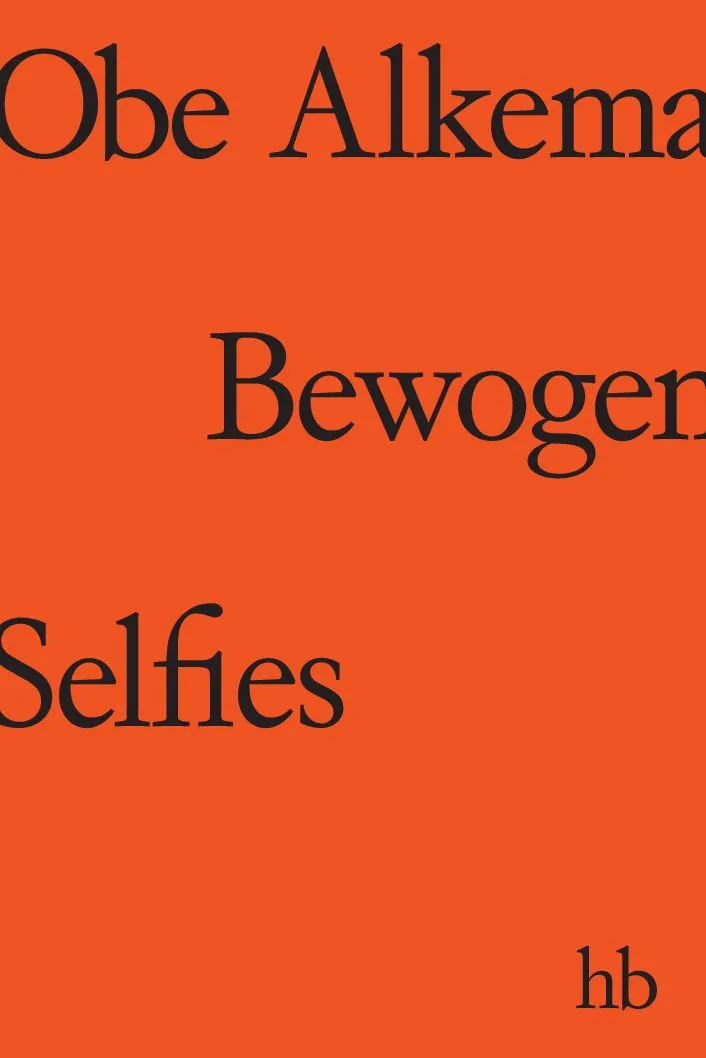
Bewogen selfies
In Bewogen selfies onderzoekt Obe Alkema de verhouding tussen landschap en herinnering. Wat treft hij aan bij terugkeer naar belangrijke plaatsen uit zijn geheugen? Wat herinnert hij zich niet, maar Google wel? Is er een gedenkschrift te puren uit zijn metadata?
Memoires, rechtstreeks verteld en met omwegen, uit eerste hand en van horen zeggen. Archieven en herinneringen eisen spreektijd, houden het niet meer droog of worden tot spreken gebracht. Wat hebben ze eigenlijk te melden? Ze lopen helemaal leeg, net als Alkema zelf. Een leven zoals zovele, poedelnaakt en geretoucheerd, vol zin en onzin.
![Cover of [45-120]](https://rile.space/storage/3794/conversions/01K7RPFBTZPK0NE1VQTCYB68XK-webp.webp)
[45-120]
Personal space is understood as the distance between 45 and 120 cm that surrounds a person. This bilingual anthology brings together the work of eighteen contemporary poets who take this intimate measurement as a starting point to challenge its apparent rigidity and explore how political, social, sexual, racial, class, and accessibility factors shape it. Beyond a simple physical distance, personal space also becomes a stage where desire draws and negotiates the boundaries between the inside and the outside.
The publication contains contributions by Samuel Ace, Justin Chin, Kyle Dacuyan, Rhea Dillon, Tracy Faud, Elijah Jackson, Taylor Johnson, Nadia Marcus, Park McArthur, Nat Raha, Joan Retallack, Trish Salah, Juan de Salas, María Salgado, Assotto Saint, Cedar Sigo, S*an D.Henry-Smith, Nayare Soledad, Perla Zúñiga.
Bilingual edition, edited by Juf.
JUF (Bea Ortega Botas and Leto Ybarra) explores the relationship between poetry, contemporary art, and theatricality through the organization of performances, readings, and exhibitions. They also publish online texts and a PDF series as an extension of their curatorial and research practice. Currently based between Madrid and New York.

Mother Tongue Magazine
In celebration of February 21st, International Mother Language Day, we’re happy to present our new yearly magazine: μητρική γλώσσα (Mitrikí Glóssa) / Lingua Maternal / (Leşono Emhoyo) ܠܫܢܐ ܐܡܗܝܐ / Anadil / Mother Tongue.
Our first issue gathers three mother languages within Turkey and their dialects : Anatolian Greek, Ladino and Syriac. With an interest in everyday life, personal memories and cultural production, Mother Tongue Magazine brings together people who work and produce in these languages along with contributors who speak them, are learning them or never had the chance to learn them, embracing plurality over standardisation. Given the discourse surrounding the survival of these mother tongues, we are especially delighted to have received contributions by so many young people that are striving to keep them alive!
With contributions by: Lukas Aktaş, Nesi Altaras, Nektaria Αnastasiadou, Syrian Cassette Archives, Dilara Lüle Baklacıoğlu, Onur Çimen, Alp Etensel, Atra Givarkes, Fayrouz Library, The Pontian Library, Sara Jajou, Isla Hanna Karademir-Khoury, Iokasti Kyriaki Zografou Mantzakidou, Melisa Yağmur Saydı, Münir Tireli, Lîs Yayınevi, Beni Yorohan
Design / Illustration: Bilge Emir

How to speak dead
A meditative reflection on language and its loss.
How does one language inherit another? Defeat, erase or live through another? How to speak dead is Walid Sadek's meditative reflection on language, dead or victorious. At heart, beyond defeat and victory, it is a reflection on how one can approach a speaking that is of neither a living language nor a dead one. A speaking that knows loss and knows it is woven into every uttered word, every spoken sentence. A loss that becomes syntax.
"There, where the battle is lost and won and where, after the hurly-burly is done, we may approach a speaking that is of neither a living language nor a dead one. A speaking that knows loss and knows it is woven into every uttered word, every spoken sentence. A loss that becomes syntax."
Walid Sadek
Walid Sadek (born 1966 in Beirut) is a Lebanese artist and writer. He is a professor at the Department of Fine Arts and Art History of the American University of Beirut.

The Flesh
The Flesh is a collection of Yves B. Golden's poems, lyric essays and social criticism – and often these generic distinctions become blurred. Published by Ediciones La Escocesa (Barcelona, ES), TABLOID facilitated this book's production as editors and book designers. A selection of Golden's texts are also translated by Leto Ybarra, rendering the author's work into Spanish for the first time.
“Respectfully! The Flesh feels like a conjuring and a force of nature—unyieldingly raw, full of delectable sensitivity that shapes a world Yves B. Golden deliveries with formidable honesty—where her word is the journey, the body and the bond. Yves writes: ‘not one bird is declined entry into heaven’. The Flesh is succulent in the mouth of the mother— Yves is a steward of time machines, celestial bliss and untethered healing. The Flesh unties the tongue, waters the mouth and the garden. Within Yves’ 5th book she offers us a timeline in recognizing that all birds and angels alike can touch the sky. We are always, already, held and drenched in glory and deserving of love and safety. The Flesh is Black like obsidian. May our love bloom like the flesh in every lifetime.”
- keioui keijaun thomas
“Yves B Golden has given us a protection spell against tyranny; a Blue Guide for the conscious and the daydream; raw free jazz that knows the standards as well. Golden’s linguistically liberated fantasies can transmute into a body of politically imperturbable ethoses in the same sentence. This book offers information for an evolutionary sensitivity, for the next level of sense-making and particularity of the human being. Though the poet urges us to de-realize the flesh, to split our own heads open, we must also accommodate the flesh’s intangibles that interlock, conjoin, negate, and negotiate: such ‘outward and inward facing conundrums’ go on and on. Welcome this ‘bearer of turbulent news.’”
- Losarc Raal

From static oblivion
A reflection about the status of the image as a balance of forces in tension and a paradoxical act of cancellation of the body through its own representation.
In Ion Grigorescu’s work, as in the book, the body is continually shown in different ways - from photography to film, from performance to drawing - and yet it remains absent, obscuring its own identity in an attempt to question the collective one. As it is impossible to show his art during the regime, it ends up hiding, disappearing inside the image. Instead of showing, the image conceals, because it is non-documentary and non-transmittable; it is an act of birth, a prove of the artist’s resistance, especially as a human being inside (or against) any geographical or historical background. In the rituals of his gestures and in the symbolism of his performances, Grigorescu finds a way to stay alive, preserving his own intellectual status while also defending the dignity of everyday life.
The book traces the progression, both expansive and inclusive, of his work, which inscribes itself into the space of the body and of the world. Grigorescu absorbs elements of the surrounding reality, showing us a continuity between art and life: his act of dissidence is not an outcry of provocation, nor is it extreme; it is an anti-aesthetic operation which uses experimentation and rough techniques to uncover the fiction of art, to denounce the artifice of representation and to affirm images as an instrument of subversive power.
Ion Grigorescu (Bucharest, 1945) is one of the most significant Romanian contemporary artists of the Post-War period and an iconic figure of the conceptual and performative art since the early 70s. He represented Romania at Venice Biennial in 1997 and 2011; his works are in the main public collections, such as MoMA, New York; mumok and Erste Foundation, Vienna; Tate Modern and Deutsche Bank AG, London; Centre Pompidou, Paris.

Sex Goblin
A weird, wild ride across non-narrative vignettes and dryly funny aphorisms exploring the shared intensity of violence and the erotic.
As if hauled up squirming from the bowels of the internet, Sex Goblin metabolizes sex writing, popular culture, and autofiction to present the real and the imagined as equally surreal possibilities. In the narrator’s childlike voice, all things become both mundane and strange—a child and their dog fused after a car accident, moments of tenderness amidst frat hazing, witches, and hiking accidents. At turns charming and bizarre, Cook’s work channels sexual violence through the lens of the absurd to alchemize shame and abuse into something that registers differently than trauma. Sex Goblin is a barely factual but deeply felt field guide to relationships and relatability.
Lauren Cook is a transsexual naturalist and the author of I Love Shopping (Glo Worm Press, 2019). He is from upstate New York.

Writing in Space, 1973–2019
Writing in Space, 1973-2019 gathers the writings of conceptual artist Lorraine O'Grady, who for over forty years has investigated the complicated relationship between text and image.
A firsthand account of O'Grady's wide-ranging practice, this volume contains statements, scripts, and previously unpublished notes charting the development of her performance work and conceptual photography; her art and music criticism that appeared in the Village Voice and Artforum; critical and theoretical essays on art and culture, including her classic "Olympia's Maid"; and interviews in which O'Grady maps, expands, and complicates the intellectual terrain of her work. She examines issues ranging from black female subjectivity to diaspora and race and representation in contemporary art, exploring both their personal and their institutional implications.
O'Grady's writings—introduced in this collection by critic and curator Aruna D'Souza—offer a unique window into her artistic and intellectual evolution while consistently plumbing the political possibilities of art.
Edited by Aruna D'Souza

After Delores
A new edition of Sarah Schulman's acclaimed 1988 novel, a noirish tale about a no-nonsense coffee-shop waitress in New York who is nursing a broken heart after her girlfriend Dolores leaves her; her attempts to find love again are funny, sexy, and ultimately even violent. After Delores is a fast-paced, electrifying chronicle of the Lower East Side's lesbian subculture in the 1980s.
Sarah Schulman is the author of sixteen books, including the novels The Mere Future, The Child, Rat Bohemia, and Empathy (all from Arsenal Pulp Press) and the recent nonfiction works The Gentrification of the Mind: Witness to a Lost Imagination and Israel/Palestine and the Queer International. She was also co-producer with Jim Hubbard of the feature documentary United in Anger: A History of ACT UP and is co-director of the ACT UP Oral History Project. She lives in New York, where she is Distinguished Professor of English at City University of New York (College of Staten Island) and a Fellow at the New York Institute for the Humanities at NYU.

Qu'est-ce que le sexe ?
La sexualité comme un problème proprement philosophique de la psychanalyse.
La satisfaction de parler contient en soi une clé de la satisfaction sexuelle (et non l'inverse) – une clé de la sexualité et de ses propres contradictions. Alenka Zupančič aborde la question de la sexualité comme un problème proprement philosophique de la psychanalyse – celle de Freud et de Lacan – et non celle des praticiens cliniciens tels que décrits par Lacan « orthopédistes de l'inconscient ». Que se passe-t-il, comme l'affirme Lacan, si nous pouvons obtenir exactement la même satisfaction que le sexe par la parole, l'écriture, la peinture, la prière ou autres activités ? Il ne s'agit pas d'expliquer la satisfaction que procure la parole en indiquant son origine sexuelle, mais bien de souligner que la satisfaction de parler est elle-même sexuelle.
Alenka Zupančič soutient que la sexualité est à la limite d'un « circuit court » entre ontologie et épistémologie. La sexualité et le savoir sont structurés autour d'une négativité fondamentale qui les unit au point de l'inconscient. L'inconscient (en tant que lien avec la sexualité) est le concept d'un lien inhérent entre l'être et la connaissance dans leur négativité même.
Alenka Zupančič est une philosophe lacanienne, spécialiste renommée de Nietzsche, professeure à l'European Graduate School / EGS et à l'Université de Nova Gorica, Slovénie. Elle est également research advisor et professeure à l'Institut de philosophie du Centre de recherche de l'Académie slovène des Sciences et des Arts. Avec Slavoj Žižek et Mladen Dolar, Alenka Zupančič est l'une des figures les plus incontournables de l'Ecole de psychanalyse théorique de Ljubljana dont les travaux s'intéressent aux relations entre sexualité, ontologie et inconscient, à la critique de la théorie du sujet et à l'exploration théorique du concept lacanien du Réel.

Rab-Rab, Issue 5
The fifth issue of Rab-Rab: Journal of Political and Formal Inquiries in Art includes stories about nation traitors, fierce masses, socialist women struggles, love-forms, psychedelic counter-revolutionaries, workers unions, Brecht fiddlers, jazz surrealism, Soviet trains, and anti-fascism.
Among the contributors to the fifth issue are Anna Thew, Yehuda Safran, Peter Gidal, Cana Bilir-Meier, David Black, Marjo Liukkonen, Alejandro Pedregal, Peter Hallward, Minna Henriksson, and Jyrki Siukonen.
It has also two extensive dossiers. One dedicated to Franklin Rosemont is presented by Joe Feinberg and is introducing some unpublished and difficult to find texts parallel with writings of T-Bone Slim and Joe Hill. The other dossier on Robert Linhart is presented by Tevfik Rada, and it includes a translation of a chapter from Linhart's book on productivism, an article against Western bourgeois dissidents, and an interview with him.

Planning prévisionnel Printemps
This publication presents research conducted by visual artist and choreographer Clarissa Bauman over two years, in the frame of the exerce MA in choreography and performance (National Choreographic Center of Montpellier / Occitanie). Here, writing becomes movement, a weaving of words, gestures, images, and drawings that rub against each other in a dialogue articulated from page to page.
"The choreography of small, overlooked gestures from moments of boredom, letting loose, detours. The finger sliding along the table, the arm coinciding with the back of this wooden chair. The coincidence of a gesture with an image, and the instantaneous disparition of this image in the body, as it transforms into the sketch of another movement. Contours, strokes, perspective lines, everything sinuous, asking at what moment does the image appear, emerge, and then become undone? The impossibility, within the body, of an image being fixed, still, one. (…) At this point in the writing, I perceive text less as a desire to organise, sediment, or give form to something, whatever it might be, but rather as a desire to find the outlines of connections between materials left hanging in the room I share with them, the tight space around the table, the images pinned to the walls in front of and behind me, the markings layered, scratched, or sketched in notebooks, the pages from books insistently revisited these last months, the memories that wane, escape, or insinuate themselves between these spaces. Developing a strategy for distracted observation."
Contributions by Anne Kerzerho, Christian Rizzo, Rostan Chentouf, Alix de Morant, Laurent Pichaud, Myrto Katsiki, Jocelyn Cottencin.

The New Fascist Body
The success of new far-right movements cannot be explained by fear or rage alone – the pleasures of aggression and violence are just as essential. As such, racism is particularly intense when it is erotically charged, migration presenting as a sexual threat to white women being one of many examples. Germany’s strikingly successful right-wing political party Alternative für Deutschland is, according to the historian Dagmar Herzog, characterized by this “sexy racism,” with its second main feature being that of an obsessive antidisability hostility—both elements resonating strongly with Nazism. In The New Fascist Body, Herzog connects her analysis of fascism’s libidinous energy with its animus against bodies perceived as imperfect. Only by studying the emotional and intellectual worlds of past fascisms can we understand and combat their current manifestations.
The book features an afterword by Alberto Toscano, author of Late Fascism: Race, Capitalism and the Politics of Crisis (Verso 2023).

Água Viva
In Água Viva Clarice Lispector aims to 'capture the present'. Her direct, confessional and unfiltered meditations on everything from life and time to perfume and sleep are strange and hypnotic in their emotional power and have been a huge influence on many artists and writers, including one Brazilian musician who read it one hundred and eleven times. Despite its apparent spontaneity, this is a masterly work of art, which rearranges language and plays in the gaps between reality and fiction.
Clarice Lispector (December 10, 1920 – December 9, 1977) was a Brazilian writer acclaimed internationally for her innovative novels and short stories. Born to a Jewish family in Podolia in Western Ukraine, as an infant she moved to Brazil with her family, amidst the disasters engulfing her native land following the First World War.