rile*books

Search books

Search books by title, author, publisher, keywords...

Cover of Unlearning with Translation – A Critical and Collective Practice

Sternberg Press

Unlearning with Translation – A Critical and Collective Practice

Virginie Bobin

€12.00

The act of translation as a pedagogical tool, a political act, and ultimately a gesture of care in these tense cultural times.

Based on practical experiments, Unlearning with Translation posits the act of translation as a pedagogical tool, a political act, and ultimately a gesture of care in these tense cultural times. Written by French curator, writer, editor, and self-taught translatress Virginie Bobin, the essay revisits a series of workshops, exhibitions, and other collective activities that took translation as both subject and method to unsettle entrenched conceptions of language, identity, and belonging. In particular, the ambiguous notion of "untranslatability" is used as a lens through which to examine the power relations at play in those institutional, economic, and political contexts inhabited by art workers. Alongside collaborations with artists including Mercedes Azpilicueta, Serena Lee, and Mounira Al Solh, Bobin's reflections are grounded in her experience co-founding and facilitating the editorial and curatorial platform Qalqalah قلقلة†, which relies on translation as a tool for the production and publication of situated knowledge in three languages—French, Arabic, and English. Informed by feminist genealogies and methodologies throughout, the book maintains that collective labor and relations are key aspects of any critical practice, as exemplified in the concluding correspondence with Andrea Ancira.

Virginie Bobin operates across research, curatorial and editorial practices, writing, pedagogy and translation, with a particular interest in performance, experimental forms of artistic research, the role of art, artists and art institutions in the public sphere, and formats that exceed that of the exhibition. Between 2009 and 2018, she has worked for various art centers and residency programs (Villa Vassilieff, Bétonsalon, Witte de With, Les Laboratoires d'Aubervilliers, Performa). She is a Doctor in Artistic Research (PhD-in-Practice, Academy of Fines Arts, Vienna, 2023), a professor in Art and Social Practices at ésadhar (Rouen, since 2024), and a co-founding member of the editorial and curatorial platform Qalqalah قلقلة. In addition to her contributions to various international journals, she has edited the collective publications Composing Differences (Les presses du réel, 2015), Republications (with Mathilde Villeneuve, Archive Books, 2015), and Bestiario de Lengüitas (with Mercedes Azpilicueta, k.verlag, 2024).

Edited by Alice Dusapin and Sophie Orlando.
Contribution by Andrea Ancira.

Published in 2025 ┊ 148 pages ┊ Language: English

recommendations

Cover of Up Your Ass

Sternberg Press

Up Your Ass

Valerie Solanas

Valerie Solanas's rarely published, legendary play, Up Your Ass, explodes social and sexual mores and the hypocritical, patriarchal culture that produces them through her signature irreverence and wit, incisiveness and camp.

The play, whose full title is Up Your Ass Or From the Cradle to the Boat Or The Big Suck Or Up from the Slime, marches out a cast of screwy stereotypes: the unknowing john, the frothy career girl, the boring male narcissist, two catty drag queens, the sex-depraved housewife, and a pair of racialized pickup artists, among others. At the center is protagonist Bongi Perez—a thinly veiled Solanas—a sardonic, gender-bending hustler who escorts us through the back alleys of her street life. The fictionalized predecessor to SCUM Manifesto, the play shares the same grand, subversive, implicative language, equally spitting and winking, embracing the margins, the scum, and selling a trick along the way.

Valerie Solanas (1936-1988) is an American radical feminist intellectual, known for her SCUM Manifesto—a pamphlet with which she declares the power of women and imagines a political future through the margin—, and for having tried to assassinate Andy Warhol.

Edited by Leah Whitman-Salkin.
With a contribution by Paul B. Preciado.
Graphic design: Roxanne Maillet.

Cover of Tell Them I Said No

Sternberg Press

Tell Them I Said No

Martin Herbert

Essays €18.00

This collection of essays by Martin Herbert considers various artists who have withdrawn from the art world or adopted an antagonistic position toward its mechanisms (essays on Lutz Bacher, Stanley Brouwn, Christopher D'Arcangelo, Trisha Donnelly, David Hammons, Agnes Martin, Cady Noland, Laurie Parsons, Charlotte Posenenske, and Albert York).

A large part of the artist's role in today's professionalized art system is being present. Providing a counterargument to this concept of self-marketing, Herbert examines the nature of retreat, whether in protest, as a deliberate conceptual act, or out of necessity. By illuminating these motives, Tell Them I Said No offers a unique perspective on where and how the needs of the artist and the needs of the art world diverge.

2nd edition (2025).

Cover of Routes/Worlds

Sternberg Press

Routes/Worlds

Elizabeth A. Povinelli

Elizabeth Povinelli's anthropology of the otherwise locates itself within forms of life that run counter to dominant modes of being under late settler liberalism. In these essays, she considers the emergence of new worlds and the extinguishment of old ones, seeking to develop a social imaginary that can sustain radical potentiality without turning a blind eye to our deep interdependence.

Cover of The German Library Pyongyang

Sternberg Press

The German Library Pyongyang

Sara Sejin Chang

From December 11, 2015, until April 10, 2016, the German Library in Guangzhou, China, became The German Library Pyongyang, a reimagining of an initiative of the Goethe-Institut that originally operated in North Korea between 2004 and 2009. This temporary intervention by Sara van der Heide is an imaginary transformation of the current geography of the German Library in Guangzhou. Van der Heide’s project is a contemporary version of the Goethe-Institut’s original library initiative in North Korea, devised as a vessel to discuss national cultural policy in a post-Cold War and postcolonial era that looks critically toward the parallel histories of Germany and the two Koreas. The German Library Pyongyang offers a space for critical questions, but it also functions as a context for transcending thinking that is prescribed by the lines of the nation-state, language, and geography. The several artistic, linguistic, and graphic interventions in the library merge with the continuing activities of the German learning center in Guangzhou, and all institutional printed matter in Chinese is replaced by Korean.

This publication brings together the four original exhibition booklets in German, Korean, English, and Chinese. An additional reader is included with critical reflections as well as documentation of the exhibition and the organized seminar.

Design by Dongyoung Lee
English/German/Korean/Chinese

Cover of Aftershow

Sternberg Press

Aftershow

Pauline Boudry/ Renate Lorenz

Performance €25.00

A monograph / artists' book that engages with the recent film installations of Pauline Boudry / Renate Lorenz. Installation shots, research material, scripts, and film stills give an insight into the artists' investigation of performance in film and their dense net of references to experimental film, the history of photography, sound, and underground (drag) performances.

The book's title alludes to an interest in opaque events that are belated, left backstage or off-screen. A number of (fictitious) letters to friends and collaborators such as Sharon Hayes, Yvonne Rainer, Ginger Brooks-Takahashi, and Jack Smith place the work of Boudry & Lorenz in a context of debates around temporalities, activism, the archival, decolonizing practices, and queer histories. Published following the exhibition “Patriarchal Poetry” at the Badischer Kunstverein, September 27– November 24, 2013.

Cover of Désapprendre en traduisant – Une pratique critique et collective

Villa Arson

Désapprendre en traduisant – Une pratique critique et collective

Virginie Bobin

Essays €12.00

The act of translation as a pedagogical tool, a political act, and ultimately a gesture of care in these tense cultural times.

Virginie Bobin operates across research, curatorial and editorial practices, writing, pedagogy and translation, with a particular interest in performance, experimental forms of artistic research, the role of art, artists and art institutions in the public sphere, and formats that exceed that of the exhibition. Between 2009 and 2018, she has worked for various art centers and residency programs (Villa Vassilieff, Bétonsalon, Witte de With, Les Laboratoires d'Aubervilliers, Performa). She is a Doctor in Artistic Research (PhD-in-Practice, Academy of Fines Arts, Vienna, 2023), a professor in Art and Social Practices at ésadhar (Rouen, since 2024), and a co-founding member of the editorial and curatorial platform Qalqalah قلقلة. In addition to her contributions to various international journals, she has edited the collective publications Composing Differences (Les presses du réel, 2015), Republications (with Mathilde Villeneuve, Archive Books, 2015), and Bestiario de Lengüitas (with Mercedes Azpilicueta, k.verlag, 2024).

Cover of The Interpreter Dis/Appears

Archive Books

The Interpreter Dis/Appears

Virginie Bobin, Achim Lengerer

Non-fiction €12.00

An artistic exploration of the political and emotional stakes of translation in the context of asylum law, through the lens of rarely heard testimonies: those of interpreters.

The Interpreter Dis/appears stems from an investigation conducted between 2019 and 2023 by curator, editor, and translator Virginie Bobin, focusing on both professional and volunteer interpreters and translators, as well as representatives from the state and organizations working with exiled individuals navigating asylum application procedures in France. By redirecting attention to the voices of interpreters—rarely visible figures in this ecosystem—the project delves into the ambiguous role of translation at the intersection of those who govern and those governed by asylum law. Within such a controlled environment, can the act of translation, with all its complexities, still express fleeting gestures of solidarity or even resistance? Through the exchanges prompted by these questions, the book seeks to reframe the prevailing public and political discourse on asylum, harnessing the embodied experiences of a small group of interpreters as an alternative lens to reveal the underlying power dynamics at play. It also probes the ethical and political potential of translation. The Interpreter Dis/appears unfolds across a variety of theatrical, artistic, and theoretical writing, alongside insightful contributions from artists and researchers who open up different perspectives for understanding and activating these issues.

The reader series Scriptings: Political Scenarios, edited by Achim Lengerer, publishes carefully selected scripts and texts by artists that refer neither to academic forms nor to purely literary forms of writing, but rather embed "text" as a fully integral part of contemporary political and visual art practice.

Contributions by Alix Eynaudi, Vir Andres Hera, Mihret Kebede, Franck Leibovici, Serena Lee, Marianne Mispelaëre, Eliana Otta, Rester. Étranger, Olia Sosnovskaya, Myriam Suchet, TOGETHER UNTIL _ __ (what)* ?

Cover of Peau d’Ana

Daisy Editions

Peau d’Ana

Ana Jotta, Alice Dusapin and 2 more

Monograph €22.00

A long conversation about the work and life of Portuguese artist Ana Jotta, accompanied by 60 previously unpublished photographs of her homes (in Brazil, Morocco, and Zanzibar) and her years in theater in the late 1970s.

“Peau d’Ana” is a conversation with the Portuguese artist Ana Jotta (1946), conducted in January 2024 by Alice Dusapin, Martin Laborde, and Baptiste Pinteaux in the Lisbon apartment that Ana has occupied for over forty years. Through the history of both this unique place and the various other homes in which she has lived — Tangier, Madeira, Brazil, and the Portuguese countryside — Ana Jotta mischievously and playfully invites us to revisit fragments of her life. She discusses her childhood, her work as an actress and set designer, her first exhibitions in the mid-1980s, and her life in the studio. She talks about the importance of pleasure and frustration, her love of painting and literature, and the role of the irrational in her work. She shares her dislike of families, her friendships with artists and other animals, and the detours necessary for finding, and preserving, the energy essential for work… and for sleep. She disarms with the precision of her words, which describe a solitary, demanding, and profoundly vivid existence where mediocrity has no place. The interview, published in French and English, is accompanied by some sixty previously unpublished photographs and documents.

Cover of Espaces pédagogiques alternatifs

Villa Arson

Espaces pédagogiques alternatifs

Anna Colin

Pedagogy €12.00

A critical exploration of the values and qualities inherent in independent educational organizations and the hurdles in the way of remaining "alternative" with the passing of time.

Anna Colin is programme director of the MFA Curating and co-director of the Centre for Art and Ecology, Goldsmiths, London. Besides Open School East, Anna worked as associate curator at Lafayette Anticipations, Paris (2014–20), associate director at Bétonsalon, Paris (2011–12), and curator at Gasworks, London (2007–10). She co-curated Chaleur Humaine, the 2nd Dunkirk Art & Industry Triennale (2023–24) on the relationship between energy and the arts since 1973. She holds a PhD in cultural geography and has a training in arboriculture.

Edited by Céline Chazalviel, Alice Dusapin, Sophie Orlando.
Texts by Anna Colin and Catherine Quéloz.

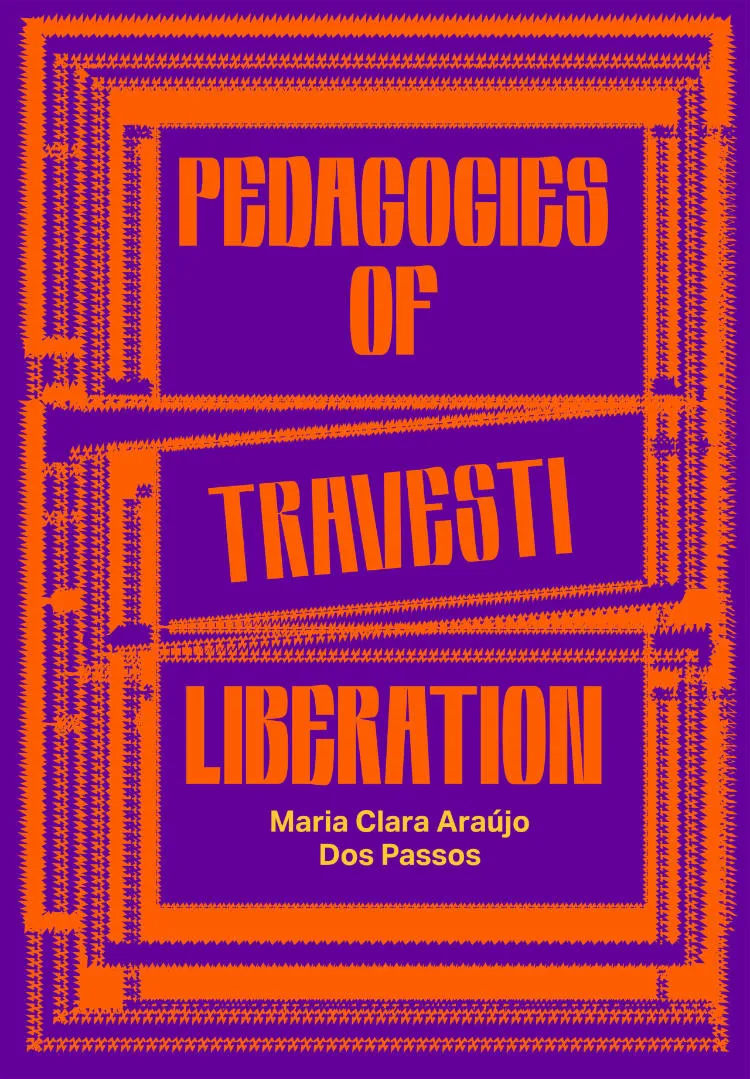
Cover of Pedagogies of Travesti Liberation

Archive Books

Pedagogies of Travesti Liberation

Maria Clara Araújo dos Passos

Essays €15.00

Maria Clara Araújo dos Passos examines the interplay of education, identity, and liberation in Brazil's travesti community.

In Pedagogies of Travesti Liberation, Maria Clara Araújo dos Passos critiques traditional pedagogical frameworks that marginalize gender nonconforming narratives and highlights the effects of systemic discrimination on travestis' psychosocial well-being. The book advocates for inclusive educational practices and emphasizes the need for affirmative curricula.
Newly translated from Portuguese, this work contributes towards connecting political struggles globally and navigating the complexities of translation—particularly of the term "travesti"—across various geographical and political contexts, featuring a conversation between Araújo dos Passos and translator Natália Affonso.

Maria Clara Araújo dos Passos (born 1996 in Recife) is a Brazilian Afro-transfeminist educator and sociologist, and an activist for LGBT rights.

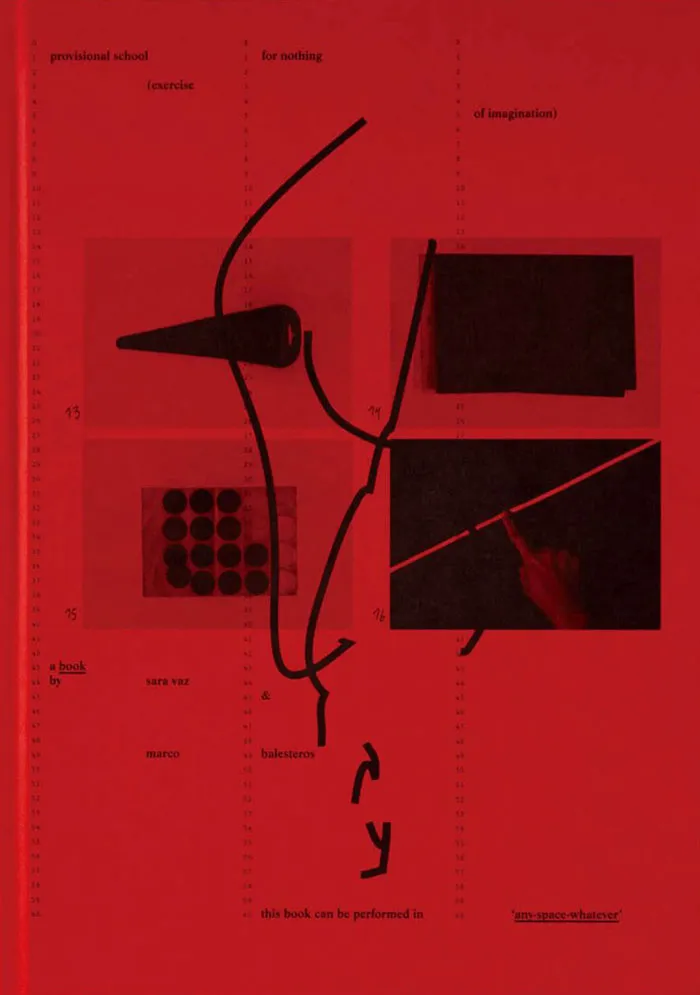
Cover of provisional school for nothing—exercise of imagination

Edições Provisórias

provisional school for nothing—exercise of imagination

Pedagogy €35.00

‘Provisional School for Nothing—exercise of imagination’ aims to explore forms of parallel education such as self-learning, self-organized schools, unschooling, inner schools, and more. This book is a choir of around 30 invited guests (artists, choreographers, dancers, graphic designers, writers, thinkers and so on). We use the word ‘choir’ since we decided to explore the concept of authorship. The book functions like a language score —comprising words, fragments, and loose ideas that develop throughout a series of conversations we’ve had with our guests via Zoom during the pandemic.

with Marco Balesteros Sara Vaz Alexandru Balgiu Ana Jotta Bráulio Amado Cracked Bolos Igor Dobricic Isabel Carvalho Ivan Martinez João Fiadeiro João dos Santos Martins] Karel Martens Maki Suzuki & Lppl Marco Bene Maria Duarte Marion Cachon Miguel Bonneville Nelson Guerreiro Olivier Lebrun Olga Mesa Francisco Ruiz de Infante Paul Elliman Paul Faure Pedro Barateiro Pedro Rogado Ricardo Nicolau Sara & André Sara Graça T.I.M.E. Tomás Cunha Ferreira Von Calhau! the missing person a man in silence

designed by Sara Vaz Marco Balesteros 

Cover of HUH why didn't I know this?

Self-Published

HUH why didn't I know this?

Egon Schoelynck

Performance €13.00

“Sometimes I find myself explaining to someone at 2 a.m. what a subsidy is. Or how train tickets become cheaper if you have the increased allowance – and what that is exactly. Or in which months you should email a cultural centre if you want to sell a performance. Then those people often say: “Huh, why didn’t I know this?” And: ‘Why isn’t all this just explained somewhere in simple words?’

So I started writing it myself. Because I had to figure these things out myself as a new creator, I can speak from experience. I know better than Kunstenpunt or Cultuurloket what a starting creator struggles with, because I’ve only been doing this for a few years myself. I can explain it better because some things in practice are quite different from the theory.”

Egon Schoelynck (he/him, 1996) is a Sunday child and theatre maker. His work is political-ish and can be found in black boxes, on paving stones and in collective collaborations. His artistic practice was supported by detheatermaker (’22-’25), where he explored, among other things, how to run a soap opera in a café without actors. Together with Runa Robbroeckx and Lennert De Vroey, he created KAK, an ecological shitshow (2025). He also solves global problems with punk songs and children’s instruments, under the name Middle Class Babypunk.