rile*books

Search books

Search books by title, author, publisher, keywords...

Cover of Pedagogies of Travesti Liberation

Archive Books

Pedagogies of Travesti Liberation

Maria Clara Araújo dos Passos

€15.00

Maria Clara Araújo dos Passos examines the interplay of education, identity, and liberation in Brazil's travesti community.

In Pedagogies of Travesti Liberation, Maria Clara Araújo dos Passos critiques traditional pedagogical frameworks that marginalize gender nonconforming narratives and highlights the effects of systemic discrimination on travestis' psychosocial well-being. The book advocates for inclusive educational practices and emphasizes the need for affirmative curricula.
Newly translated from Portuguese, this work contributes towards connecting political struggles globally and navigating the complexities of translation—particularly of the term "travesti"—across various geographical and political contexts, featuring a conversation between Araújo dos Passos and translator Natália Affonso.

Maria Clara Araújo dos Passos (born 1996 in Recife) is a Brazilian Afro-transfeminist educator and sociologist, and an activist for LGBT rights.

Published in 2025 ┊ 208 pages ┊ Language: English

recommendations

Cover of Encounters – Embodied Practices

Archive Books

Encounters – Embodied Practices

Sandhya Daemgen, Raphael Hillebrandt and 2 more

Conversations about embodied strategies of knowledge production and knowledge transmission based on the choreographic and curatorial practices of about fifteen international choreographers, performers, dramaturges and curators.

In the context of the numerous ethical-political challenges of the global present, actors from the dance and choreography scene both in Berlin and internationally talk about forms of knowledge production beyond the prevailing conception found in Western modernity. They counter the mind-body separation and the notion of a universality of knowledge with multiplicities of knowledge production that emerge with and from the reality of differently situated bodies.

What potential do embodied practices offer for emancipatory movements? How can community be created through these practices, and what responsibilities does this entail? What role does the body play in the preservation and transmission of knowledge?

In this publication, edited by the choreographers and curators Martha Hincapié Charry, Sandhya Daemgen, Raphael Moussa Hillebrand and Matthias Mohr; Lukas Avendaño, Wagner Carvalho, Sandhya Daemgen, Ismail Fayed, Alex Hennig, Raphael Moussa Hillebrand, Martha Hincapié Charry, Isabel Lewis, Matthias Mohr, Prince Ofori, Mother "Leo" Saint Laurent, Léna Szirmay-Kalos, Thiago Granato and July Weber conduct conversations about embodied strategies of knowledge production and knowledge transmission based on their respective choreographic and curatorial practices.

Cover of My Mother My Home

Archive Books

My Mother My Home

Chipo Chipaziwa

Performance €18.00

Who claims abstraction? What are the limits of abstraction? Are statelessness, dislocation and feelings of (un) belonging embodiments of an abstracted self that is in itself a work in progress? How could performance art—an artistic practice that places significant importance on presence and legibility of form—transgress into the realm of the abstract and the illegible in an effort to protect the artist’s likeness while shedding light on what it means to be in their body in relation to this world?

Chipo Chipaziwa’s My Mother My Home establishes itself as a query on the aspects of belonging and the artist’s own personhood that acts as the foundation of her practice. The question of where one’s personhood begins and ends within an artwork has appeared to be ever prevalent within the realm of visual art and is more relevant within the canon of performance art.

Writers: Chipo Chipaziwa, Denise Ferreira da Silva, Olumoroti George

Contributing artists: Margaret Joba-Woodruff, Sophia Lapres, and David Ezra Wang
Edited by Katrina Geotjen

Cover of How to Die – Inopiné

Archive Books

How to Die – Inopiné

Ashkan Sepahvand

Ecology €28.00

A transdisciplinary investigation and a choreographic performance, between Umeå and Oslo, about ecological grief, cultural panic, and a feeling of collapse.

How to Die – Inopiné is a performance and a practice. It thinks through, in an embodied manner, the prevailing contemporary moods of ecological grief, cultural panic, and collapse. As a performance in a theater or outdoors, an audience encounters five dancers who are constantly building, unbuilding, and rebuilding. Afterwards, stories are told around a bonfire. As a practice in the studio, school, or street, a group of dancers, artists, writers, and architects meet for a year of residencies between Oslo and Umeå. They host a working process and encounter external informants. The goal is to displace oneself into the unexpected. This publication, two years in the making, engages with the challenges of translating a choreographic process into the space of a book. It both documents the project's development as well as offering the reader-doer different modes of thinking-doing, from somatic practices to proposals for a curriculum. Experiments in writing, mapping, and moving are played with, all engaging with the question, "what is the future of displaced thinking?"

Published following the series of eponymous events held in Umeå, Oslo, Bergen, Trondheim and Reykjavik in 2019-2020.

Contributions by Harald Becharie, Mia Habib, Jassem Hindi, Asher Lev, Marie Kraft Selze, Namik Mačkić, Ingeborg Olerud, Anna Pehrsson, Ashkan Sepahvand, Nina Wollny.

Cover of Sustaining the Otherwise

Archive Books

Sustaining the Otherwise

Amal Alhaag, Selene Wendt

Non-fiction €25.00

Sustaining the Otherwise is a collaborative research and artistic project about restitution, reparation and transformation taking place in multiple locations over several years. Initiated and conceptualized by researchers and curators Amal Alhaag & Selene Wendt, it offers a space for artists, activists, scholars and writers to be in dialogue and to explore the topic of restitution in relation to both material and immaterial culture, through a program that frames restitution within the context of contemporary art practice.

Edited by Amal Alhaag & Selene Wendt

Featuring an introduction by Amal Alhaag & Selene Wendt as well as provocations, reflections, and essays by Barby Asante, Michael Barrett, Quinsy Gario, Sana Ginwalla, Aude Christel Mgba, Lennon Mhsishi, Ogutu Muraya, in addition to a sonic contribution by Robert Machiri. 

Cover of Things Bigger Than What Can Be Seen

Archive Books

Things Bigger Than What Can Be Seen

Oraib Toukan

Ecology €20.00

Things Bigger Than What Can Be Seen is a collection of Oraib Toukan’s essays, translated to Arabic for the first time. In close dialogue with Palestinian pedagogue Munir Fasheh on the topic of turbeh (local soil in Arabic), Toukan crafts a haptic perspective on images from what she terms their ‘soil grain’.

Cover of Beyond Caring – Para-hosting as Curatorial Escape

Floating Opera Press

Beyond Caring – Para-hosting as Curatorial Escape

Paul O'Neill

Non-fiction €15.00

"Para- hosting" as a cooperative methodology for arts institutions.
What can established art institutions learn from small-scale organizations' approaches to invitation, hosting, and publicness? In Beyond Caring: Para-hosting as Curatorial Escape, Paul O'Neill explores how new forms of invitation can reimagine host–guest relations and open escape routes from fixed institutional roles. Moving between speculation, critique, and proposition, the essay introduces "para- hosting" as a cooperative methodology of generosity and self-organization without absorption. For O'Neill, para-hosting is a form of escape that enables transformative possibilities beyond existing power structures within institutions and otherwise.

In the early 2010s, the idea of "the curatorial" arose after a short but intense debate about what it means to curate exhibitions. The books in the On the Curatorial series look at the consequences of that discussion today and ask: Do we need different curatorial tools to engage with deepening social, political, and ecological crises? The series allows earlier participants in the debate to reflect on how their concepts and practices have changed, while younger generations of curators explore the ongoing need for new conceptual approaches to curation.
The series is edited by Carolina Rito, who is professor of creative practice research at the Research Centre for Arts, Memory, and Communities, Coventry University, UK, and executive editor of Contemporary Journal.

Paul O'Neill is an Irish curator, artist, writer and educator. He is the Artistic Director of PUBLICS, a curatorial agency with a dedicated library, event space and reading room in Vallila Helsinki, since 2017.

Edited by Carolina Rito.
Contribution by Gerrie van Noord.

Cover of This Death is Not One

Bilna'es

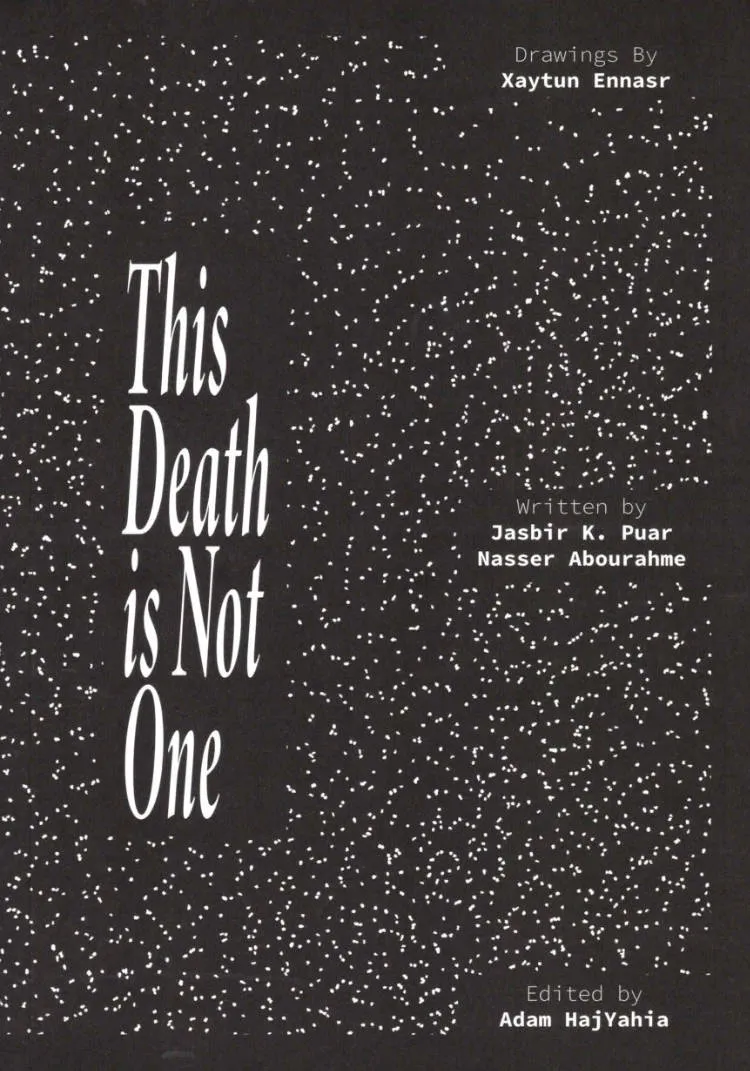
This Death is Not One

Jasbir K. Puar, Nasser Abourahme and 1 more

Essays €20.00

The publication of The Right to Maim by Jasbir K. Puar in 2017 was critical to advancing studies on disability and to further articulating how the body figures in the nexus of capacity and debility across racializing and extractive neoliberal lines. It offered a complex and rigorous anti-capitalist account of disability that is useful to both scholarly work and political and social organizing. However, despite its paramount contribution to scholarship on Palestine, delivered by its scathing analysis of the Israeli biopolitical policy—its right to maim—in how the injured Palestinian body is produced and reproduced, its reception was difficult, and hard to stomach. It cohered a political logic in writing before it was visibly evident on the ground. In the moment and aftermath of the Great March of Return (2018-19), Puar’s offerings became much harder to ignore, as the event crystallized a mass maiming campaign of Palestinian protesters inside the edges of the militarized borders of Gaza.

The occasion of this publication by Bilna’es marks the first translation into Arabic of the chapter “Will Not Let Die”: Debilitation and Inhuman Biopolitics in Palestine, alongside the postscript of The Right to Maim. Not simply a reissue of previously published work or a translation, This Death is Not One includes a new preface from Jasbir K. Puar revisiting the right to maim from within this moment of genocide in Gaza that interrogates the new vectors of living and dying under settler-colonialism, and how maiming, in fact, speaks of extermination; an introduction by Nasser Abourahme reflecting on the book’s stakes in the present and its reception in the past, alongside searing analysis of genocide in excess of the law, and what this reveals and forecloses in how we understand the juridical body and militancy in the wake of Zionism; and original drawings by Xaytun Ennasr that inscribe a relation between land and body mapped through cosmological patterns tracing the relation between martyrs, who are referred to as moons, and the moon, a symbol for martyrdom in Palestine.

Jasbir K. Puar is Distinguished Faculty of Arts Professor in the Social Justice Institute at the University of British Columbia, Extraordinary Professor in the Women’s and Gender Studies Department at the University of the Western Cape in Cape Town, South Africa, and Professor Emerita at Rutgers University where she was faculty in the Women’s, Gender, and Sexuality Studies Department for 23 years. Puar is the author of the award-winning books: The Right to Maim: Debility, Capacity, Disability (2017), and Terrorist Assemblages: Homonationalism in Queer Times (2007).

Nasser Abourahme is a writer and teacher, and is currently assistant professor at Bowdoin College. He’s the author of The Time beneath the Concrete: Palestine between Camp and Colony (Duke University Press, 2025), which was awarded the 2025 Palestine Book Award.

Xaytun Ennasr is an artist and designer. She works across experimental video games, paintings, prints, ceramics, installations, and text. She often uses science fiction, folklore, and radical softness as affective tools for revolutionary cultural production, specifically Palestinian liberation and sovereignty. Her work often deals with questions of land, cartography, transness, gender, and the living environment.

Drawings by Xaytun Ennasr

Translation to Arabic:

“Living in Genocide” by Jasbir K. Puar, translated by The Archilogue

“Our names, our remains” by Nasser Abourahme, translated by The Archilogue

The Right to Maim, Chapter 4: “Will not let die: Debilitation and Inhuman Biopolitics in Palestine ” and the The Right to Maim Postscript by Jasbir K. Puar, translated by Bekriah Mawasi
Cover of Terra Cosmica / Traces of Georealism

Tenement Press

Terra Cosmica / Traces of Georealism

Giovanbattista Tusa

Ecology €24.00

An ‘end-times’ philosophical enquiry in which the author argues with stones and geological time to compose a suite of interlinked fragments. An act of lapidary; a five-part antagonisation of the elements; an essay on representation, visualisation and prediction; an ecologue on ecology.

Our age is characterised by the increasing humanisation of a planet that is more and more subject to metaphoric representation and visualisation. 

The memorialisation, anthropomorphism, and narratological charge of time has birthed an intellectual industry in which the summation of history plays out like a hand of cards. A game in which retrospect and hindsight informs our present and sits us ever at the mercy of prediction and chance in a time increasingly defined by catastrophe, and as emergent crises affect every stratum of life and lived experience. We are currently witnessing a mutation of our thinking that disrupts the mythical imaginary that had hitherto confined viruses, climate change and atmospheric turbulence to an unalterable background in the all-too-human narrative of the struggle against nature.

Tusa’s Terra Cosmica / Traces of Georealism is the result of a series of lectures and essays—a quintet of pieces published over the course of a four-year period—that, woven together into a new collation of interlinked fragments, calls time on time to consider the new form of planetary realism resultant of this restructuring of the imagination. Tusa presents a cosmic remapping of our modes of thinking that assumes that our contemporary moment is absented from its representability, its history of representations, and all means of explanation, thus remaining open to a sense of its own infinity… Open to an encounter with that which remains absent and unknowable, with neither horizon nor memory available as any weathervane for comprehension and action. Tusa’s work is a scrutiny of our exosystemic condition; a suite of exploratory antagonisms on the need for a new philosophical perspectivism of time, of earth, and a new charter for the foundations of thought and thinking.

Cover of Paying Attention: Essays on Art and Culture

David Zwirner Books

Paying Attention: Essays on Art and Culture

Lynne Tillman

Essays €45.00

From award-winning novelist and cultural critic Lynne Tillman, Paying Attention is the first collection of essays devoted to her incisive, provocative, and singular reflections on art and culture.

Paying Attention gathers more than fifty of the best and varied examples of Lynne Tillman’s writings in reference to art and culture published over the course of forty years. In essays that operate outside typical categories or genres, Tillman reflects on forms including film, painting, photography, poetry, and fiction, as well as notions of fame, originality, embodied viewing and thinking, collective activity, aging, illness, American identity, cultural politics, modernity, strangeness, and time. Such is the stuff that relates art to life, and life to art.

Collected mainly from museum and gallery catalogues, artists’ books and monographs, her column in Frieze, and magazines including Aperture and Artforum, these meditations on artists and writers, in the broadest sense of these labels, collide as a portrait of our cultural moment. Tillman’s inventive use of language and lateral thought, her ability to evoke conditions of the larger world in often just two thousand words on a specific artwork or individual, make her one of the most significant critics of our time. As she acknowledges, in a piece on the artist Robert Gober, “In writing on art, words reach for other words, phrases, idioms, and through them more images and ideas leap out.” In her introduction, Elizabeth Schambelan notes that a hallmark of Tillman’s writing alongside artists is an “elegant rendering of complexity,” and in approaching Tillman’s body of work and thought, Schambelan herself imbricates the art, voice, and language of criticism.

Cover of Semi-Nomadic Debt-Ridden Bedouins

Lenz Press

Semi-Nomadic Debt-Ridden Bedouins

Basma al-Sharif

Essays €35.00

Semi-Nomadic Debt-Ridden Bedouins offers an in-depth look at nearly two decades of artistic output by the Palestinian artist and filmmaker Basma al-Sharif. Retracing her practice from recent works back to her earliest experiments, the book provides an original overview of how her visual language and conceptual concerns have evolved over time.

Basma al-Sharif's films and installations navigate the unstable terrains of displacement, colonialism, and representation—often shaped by the ongoing reality of the occupation of Palestine. Through a rich selection of images and curatorial essays, the monograph highlights the layered political and cinematic frameworks within which her works are embedded.

Also included are two newly commissioned literary contributions: a fictional piece by Karim Kattan that resonates with the themes of place and estrangement, and a conversation between al-Sharif and the artist Diego Marcon, in which they reflect on shared affinities, artistic processes, and their long-standing dialogue. Blurring the personal and the political, the real and the imagined, Semi-Nomadic Debt-Ridden Bedouins captures the complexity and urgency of al-Sharif's artistic journey.

Texts by Basma al-Sharif, Karim Kattan, Diego Marcon, et al.

Basma al-Sharif (born 1983 in Koweit) is a Palestinian artist working in cinema and installation. She developed her practice nomadically between the Middle East, Europe, and North America and is currently based in Berlin. Her practice looks at cyclical political conflicts and confronts the legacy of colonialism through satirical, immersive, and lyrical works.