rile*books

Search books

Search books by title, author, publisher, keywords...

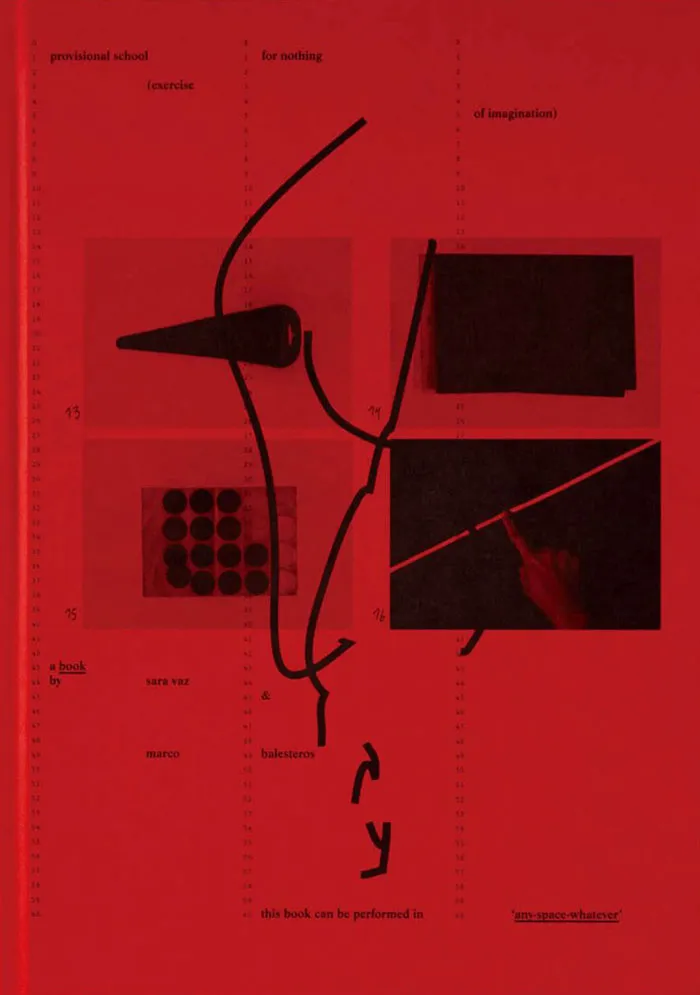
Cover of provisional school for nothing—exercise of imagination

Edições Provisórias

provisional school for nothing—exercise of imagination

€35.00

‘Provisional School for Nothing—exercise of imagination’ aims to explore forms of parallel education such as self-learning, self-organized schools, unschooling, inner schools, and more. This book is a choir of around 30 invited guests (artists, choreographers, dancers, graphic designers, writers, thinkers and so on). We use the word ‘choir’ since we decided to explore the concept of authorship. The book functions like a language score —comprising words, fragments, and loose ideas that develop throughout a series of conversations we’ve had with our guests via Zoom during the pandemic.

with Marco Balesteros Sara Vaz Alexandru Balgiu Ana Jotta Bráulio Amado Cracked Bolos Igor Dobricic Isabel Carvalho Ivan Martinez João Fiadeiro João dos Santos Martins] Karel Martens Maki Suzuki & Lppl Marco Bene Maria Duarte Marion Cachon Miguel Bonneville Nelson Guerreiro Olivier Lebrun Olga Mesa Francisco Ruiz de Infante Paul Elliman Paul Faure Pedro Barateiro Pedro Rogado Ricardo Nicolau Sara & André Sara Graça T.I.M.E. Tomás Cunha Ferreira Von Calhau! the missing person a man in silence

designed by Sara Vaz Marco Balesteros 

Published in 2025 ┊ 320 pages ┊ Hardcover ┊ Language: English

recommendations

Cover of Énergies

Même pas l'hiver

Énergies

Judith Hopf

Sculpture €24.00

Les sculptures et les films de Judith Hopf sont alimentés par des réflexions sur les relations que les êtres humains entretiennent avec la production et la technologie. Pour Énergies, sa première exposition monographique en France qui eut lieu conjointement à Paris à Bétonsalon et au Plateau, Frac Ile-de-France, l’artiste s’est concentrée sur cet élément invisible dont la quête accompagne notre quotidien et nos activités, produit par la conversion de ressources naturelles en puissance. Ce catalogue réunit des reproductions de dessins inédits, un entretien avec l’artiste et un texte critique de Tom Holert qui fait retour sur vingt années de travail.

Judith Hopf's sculptures and films are fuelled by reflections on the relationship human beings have with production and technology. For Énergies, her first solo exhibition in France, held jointly in Paris, at Bétonsalon and Plateau, Frac Ile-de-France, the artist focused on this invisible element whose quest accompanies our daily lives and activities, produced by converting natural resources into power. This catalog features reproductions of previously unpublished drawings, an interview with the artist and a critical text by Tom Holert, looking back over twenty years of work.

Textes / Texts
- François Aubart, Xavier Franceschi et Émilie Renard, "À propos d’énergie, d’amour et de chansons : conversation avec Judith Hopf"
- Tom Holert, "Changements de rythme : La méthodologie énergétique de Judith Hopf"

- François Aubart, Xavier Franceschi et Émilie Renard, "On Energy, Love, and Songs: Conversation with Judith Hopf"
- Tom Holert, "Changing Pace: Judith Hopf’s Energetic Methodology"

Traduction / Translation
Jean-François Caro
Louise Ledour

Typesetting : Olivier Lebrun

Cover of Peau d’Ana

Daisy Editions

Peau d’Ana

Ana Jotta, Alice Dusapin and 2 more

Monograph €22.00

A long conversation about the work and life of Portuguese artist Ana Jotta, accompanied by 60 previously unpublished photographs of her homes (in Brazil, Morocco, and Zanzibar) and her years in theater in the late 1970s.

“Peau d’Ana” is a conversation with the Portuguese artist Ana Jotta (1946), conducted in January 2024 by Alice Dusapin, Martin Laborde, and Baptiste Pinteaux in the Lisbon apartment that Ana has occupied for over forty years. Through the history of both this unique place and the various other homes in which she has lived — Tangier, Madeira, Brazil, and the Portuguese countryside — Ana Jotta mischievously and playfully invites us to revisit fragments of her life. She discusses her childhood, her work as an actress and set designer, her first exhibitions in the mid-1980s, and her life in the studio. She talks about the importance of pleasure and frustration, her love of painting and literature, and the role of the irrational in her work. She shares her dislike of families, her friendships with artists and other animals, and the detours necessary for finding, and preserving, the energy essential for work… and for sleep. She disarms with the precision of her words, which describe a solitary, demanding, and profoundly vivid existence where mediocrity has no place. The interview, published in French and English, is accompanied by some sixty previously unpublished photographs and documents.

Cover of Choquer le monde à mort – Elles sont de sortie – Pascal Doury – Bruno Richard

Editions L'Amazone

Choquer le monde à mort – Elles sont de sortie – Pascal Doury – Bruno Richard

Bruno Richard, Pascal Doury and 1 more

"Elles sont de sortie" is the title of a periodic publication launched in 1977 by Pascal Doury and Bruno Richard. The plural and feminine form of the enigmatic phrase "elles sont de sortie," chosen almost by chance, announces a protean work and often collective experience. From its origins to the most recent iterations, including Doury's more confidential individual trajectory after "Elles sont de sortie," Choquer le Monde à Mort traces five decades of a corpus of nearly three hundred publications. It addresses some of the most emblematic editorial works, as well as others that remain unpublished, alongside ambitious and sometimes scandalous exhibitions, few of which are documented.

This work is the result of several years of research, enriched by numerous firsthand interviews, and unfolds in three parts: a chronology and analysis of a singular and marginal artistic history, works and iconographic documents, and an anthology bibliography. Together, these elements reveal the complexity of an editorial object with porous boundaries, both in its forms and its contents, oscillating between graphzine, artist book, poetry collection, and personal journal. Its ramifications, status, and legacy retrospectively reveal the importance of a discreet yet seminal work.

Thus, "Elles Sont de Sortie" also serves as an opportunity to revisit the paths of two aesthetic and provocative artists, deeply devoted to their art and true free spirits in an art world often too narrow for them. It immerses us in a plethora of works that are intimate and raw, as well as subtle and refined, all in service of a project that, in Doury's words, aims to "shock the world to death."

Edited by Tiphanie Blanc, Jonas Delaborde, Anna Lejemmetel.
Contribution by Anna Lejemmetel.

Cover of 17 Movements

Damaged Goods

17 Movements

Jozef Wouters

17 Mouvements collects traces of a project that Decoratelier - the workspace and arts platform of Jozef Wouters - did in the fall of 2022 around the ‘5 blocs’ area in Brussels (Rempart Des Moines/Papenvest).

When Nuit Blanche invited them to build a gym, Camille Thiry and other Decoratelier associates did not want to design another generic muscle cage. Together with the neighbourhoods inhabitants, they built 17 distinct movement spaces, each tailor-made to an individual’s size, needs, dreams and aches. The gym equipment has meanwhile been removed from public space, but this eponymous book (ed. by Jozef Wouters) combines notes and reflections (language: French) by Camille with beautiful photography by Enzo Smits, documenting the ingenious and unique negotiations that were a part of this collaboration.

Cover of Aisopika Aesopica

Ariel Ink

Aisopika Aesopica

Rūta Junevičiūtė

The bilingual book ‘Aesopica’ documents and extends Rūta Junevičiūtė’s research on the Aesopian language and the influence of political censorship to contemporary collective body, first presented in 2020 as the eponymous solo exhibition at the National Gallery of Art and as a permanent outdoor installation at the Rupert Art Center, Vilnius. 

Taking as a starting point the historical phenomenon of Aesopian language, which was widespread in Lithuanian culture during the Soviet era, and in parts of the Russian Empire as early as the 19th century, Junevičiūtė aims to investigate the interrelationship between generations, the gray zones of collective identity creation and the processes of (un)censoring the archives of our bodies.

Aesopian language – a term coined after Ancient Greek fabulist Aesop (gr. Aísōpos), is a type of cryptic communication system, where a text has several layers of meaning often contradictory to each other and which seek to convey official and subversive hidden meanings simultaneously. It is usually employed under conditions of omnipresent state censorship to communicate officially forbidden or taboo subjects and opinions. As a system it contains three members – an author, a censor, and a reader. It uses various modes of circumlocution and euphemisation, innuendo and poetic paraphrasing, which can also be seen as an aesthetic style. It has been advocated for artistic benefits as poetics of omissions, concealment, and travesty. On the other hand, it has been criticized as a sign of conformity and humiliation. In Lithuania, after the fall of the Soviet Union, it has been popularly regarded as a position of dissent, but such an interpretation received criticism from contemporary scholars. “Such a mode of expression is probably as old as censorship itself” – a historian told us.

Text contributors: Alfonsas Andriuškevičius, Edgaras Gerasimovičius, Rūta Junevičiūtė, Goshka Macuga, Anastasia Sosunova, Grėtė Šmitaitė, Tomas Venclova, Ana Vujanović

Language editors: Dangė Vitkienė, Aira Niauronytė, Gemma Lloyd

Translators: Alexandra Bondarev, Erika Lastovskytė, Justinas Šuliokas, Mantė Zagurskytė-Tamulevičienė, Aistis Žekevičius.

Illustrations: Rūta Junevičiūtė.

Cover of The Mollino Set

Rollo Press & Cabinet Books

The Mollino Set

Lytle Shaw

Photography €18.00

New York-based professor Lytle Shaw journeys to Italy in this adventurous exploration of the life and work of architect, designer, and photographer Carlo Mollino (1905–1973). In 1933 the young Mollino received a commission from Mussolini’s regime for his first building: an administrative centre in Piedmont. Later works include furniture and interior design, a book on photography, and an asymmetrical car that raced at Le Mans in 1955.

The book centres around Shaw’s realisation that this prolific talent’s conflicted legacy offers a unique window on the role that post-war Italian politics and culture played in the country’s reimagining of itself as a victim, rather than a proponent, of fascism.

Cover of Bulletin B – Issue 2

Giselle's Books

Bulletin B – Issue 2

Maria Jooyoung

Contributions by Jerry Ahn, Han Ok-hee, Han Soon-ae, Lilian Gonzalez, Kim Jeon-seon, Miss Lee, Lee Jeong-hee, Hansen Oh, Yun Park, Seonha Park, Sun Hyejeong, Wang Gyu-won.

Bulletin B is a bilingual editorial project gathering artistic and cultural productions from Korea and its diasporas, with a focus on queer and womxn voices. Borrowing the spirit of an unofficial newsletter, it surfaces when it needs to; assembling poetry, prose, and cultural fragments across time. 

Rooted in translation as a practice attentive to power, history, and silenced voices, Bulletin B reconstructs fragmented lineages and constellations of reference through irregular acts of dissemination and exchange, tracing how narratives move between languages, contexts, and material forms.