rile*books

Search books

Search books by title, author, publisher, keywords...

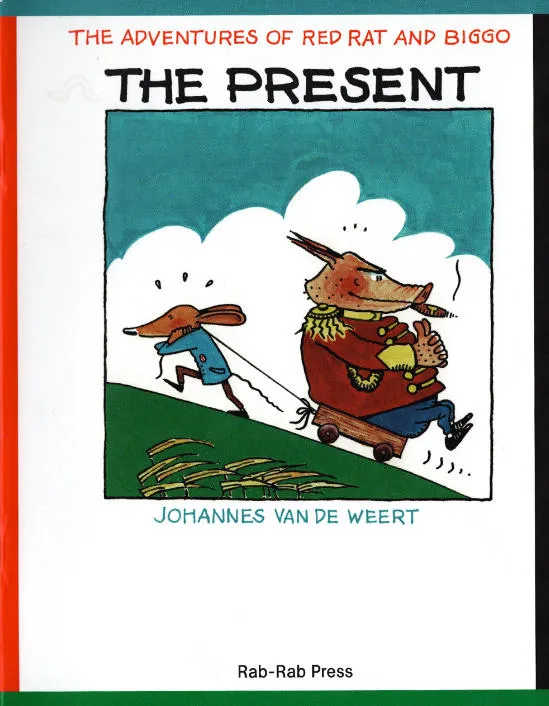
Cover of The Adventures of Red Rat and BIGGO – The Present

Rab-Rab Press

The Adventures of Red Rat and BIGGO – The Present

Johannes van de Weert

€12.00

A children's book by Johannes van de Weert, a veteran of the punk underground (Rondos, The Ex, Red Rat, Raket).

The Adventures of Red Rat and BIGGO – The Present is a remake of Bram konijn en Piet de muis [Bram the Rabbit and Piet the Mouse], a 1982 children's book by Johannes van de Weert, a veteran of the Dutch punk underground who played with Rondos and The Ex, and who was the force behind Red Rat and Raket editions.
The Present is a 2010 remake telling the story of a bully pig who terrifies a poor rat on a daily basis. After a while, the rat falls ill with fear and has to stay in bed. The lonely, evil pig has no one to play with and becomes depressed. The pig gives the rat a present—a bunch of beautiful flowers—and all is well. Now the two can play together.
The 2010 remake, featuring different characters and intended for a North Korean audience, was never published. The 2025 English version opens with an introduction by Van de Weert, telling a bizarre story of a failed political career and an absurd vaudeville class struggle behind the seemingly harmless educational children's book.

Johannes van de Weert was a cartoonist active in the Rotterdam punk and squatter's movements of the 1980s. He was a singer with the punk band De Rondos and he started self-publishing small comic booklets in the late 1970s. He created his character "Redrat" for the fanzine Raket in 1980. The character soon became an icon for the squatter's movement.

Published in 2026 ┊ 32 pages ┊ Language: English

recommendations

Cover of About Narration – Materials, Comments, Interventions

Rab-Rab Press

About Narration – Materials, Comments, Interventions

Ingemo Engström, Harun Farocki

Published in collaboration with Harun Farocki Institut, this book unpacks About Narration [Erzählen], a 1975 essay film directed by Ingemo Engström and Harun Farocki.

Edited and introduced by Sezgin Boynik and Tom Holert, this book focuses on About Narration [Erzählen] directed by Ingemo Engström and Harun Farocki.
It includes the film's script alongside the historical documents related to its making and Farocki's previously unpublished theoretical and programmatic essay on the film. The publication also includes a retrospective essay by Ingemo Engström on the film's political and artistic background.

Volker Pantenburg's detailed elaboration of the conditions of its making, alongside Boynik and Holert's concluding remarks, further contextualizes the film. The interview with Cathy Porter on Larisa Reisner, a heroine of About Narration, gives an overview of the life of a militant writer who inspired Engström and Farocki.

Edited and introduced by Sezgin Boynik and Tom Holert.

Cover of Wanting Something Completely Different – 111 Vignettes of Left-Wing Figures, Themes, Films, and Writers

Rab-Rab Press

Wanting Something Completely Different – 111 Vignettes of Left-Wing Figures, Themes, Films, and Writers

Jairus Banaji

Non-fiction €20.00

A collection (montage) of biographies and themes written by Jairus Banaji.
Wanting Something Completely Different discusses a range of political figures, themes, directors and writers in a series of brief, evocative descriptions ('vignettes') aimed at laying out a vision of a modern, cosmopolitan left that can think creatively about the world we live in. The political figures include both thinkers and activists from a wide range of backgrounds—from Frantz Fanon and the Palestinian novelist Ghassan Kanafani to the theologian Dietrich Bonhoeffer and the murdered Russian journalist Anna Politkovskaya. The themes range equally widely from the death of Walter Benjamin (reconstructed here from a remarkable documentary on the same theme) and the slaying of Pasolini to the work of British Marxist Perry Anderson, or the corrupt nature of India's leading corporate groups, or the outstanding contributions of Italian and U.S. Black feminists to feminist theory. And under the rubrics which discuss film and literature, there is the same striving for diversity and depth.

The vignettes collected in this Rab-Rab book first circulated on Facebook over some seven years or more and are reproduced here with a new introduction and extensive bibliographical references and notes.

Jairus Banaji is a historian and revolutionary Marxist activist. He received the Isaac and Tamara Deutscher Memorial Prize in 2011. His academic work has ranged widely across sources and languages, with major books on Late Antiquity and commercial capitalism as well as numerous papers and articles.

Cover of Rab-Rab, Issue 5

Rab-Rab Press

Rab-Rab, Issue 5

Rab-Rab

Periodicals €27.00

The fifth issue of Rab-Rab: Journal of Political and Formal Inquiries in Art includes stories about nation traitors, fierce masses, socialist women struggles, love-forms, psychedelic counter-revolutionaries, workers unions, Brecht fiddlers, jazz surrealism, Soviet trains, and anti-fascism.

Among the contributors to the fifth issue are Anna Thew, Yehuda Safran, Peter Gidal, Cana Bilir-Meier, David Black, Marjo Liukkonen, Alejandro Pedregal, Peter Hallward, Minna Henriksson, and Jyrki Siukonen.

It has also two extensive dossiers. One dedicated to Franklin Rosemont is presented by Joe Feinberg and is introducing some unpublished and difficult to find texts parallel with writings of T-Bone Slim and Joe Hill. The other dossier on Robert Linhart is presented by Tevfik Rada, and it includes a translation of a chapter from Linhart's book on productivism, an article against Western bourgeois dissidents, and an interview with him.

Cover of Iliazda at the Birthday Party – Autobiographical Lecture, 1922

Rab-Rab Press

Iliazda at the Birthday Party – Autobiographical Lecture, 1922

Iliazda

The English translation of Zdanevich's Dadaist autobiographical lecture in Paris in 1922, where he adopts the name Iliazda. In this entertaining lecture, the achievements of the avant-garde is presented as a combination of zaum, polymorphous sexuality, aleatory forms and scatological interpretation of culture.

The second volume of the bie bao series presents a eulogy entitled Iliazda at the Birthday Party, a pseudo-autobiographical lecture delivered by Ilya Zdanevich in Paris in 1922. It reports on Zdanevich's artistic and political adventures up until then. Along with an autobiography full of self-admiration, in this lecture Zdanevich gives an interpretation of his zaum dramas inspired by Freudianism, and humorously describes a colourful image of the Russian microcosm in Montparnasse. 

Additionally, this second volume also includes Iliazd's letter to Ardengo Soffici from 1964, where one can read, in the most unambiguous terms, about Zdanevich's positions against war, imperialism, and all forms of nationalism. Subtitled 50 Years of Russian Futurism, the letter to Soffici presents us with an altogether new Zdanevich—a "fellow traveller" in both leftist and avant-garde circles. As well as the extended introduction and extensive annotations, the texts are further contextualised with Johanna Drucker's visual presentation of the birth of the Iliazd cult.

The bie bao series will include eight publications, covering many layers of Zdanevich's rich theoretical and artistic output. Each volume consists of a bio-bibliographical introduction, a commentary, a translation with annotations, and artistic intervention.

Iliazd (Ilya Zdanevich, 1894-1975) was a Russian poet, designer, typographer, theoretician, art critic, and publisher, close to the avant-garde circles and one of the promoters of Futurism in Russia, author of a poetic work, drama written in zaum abstract poetic trans-sense or "transrational" language, and novels.

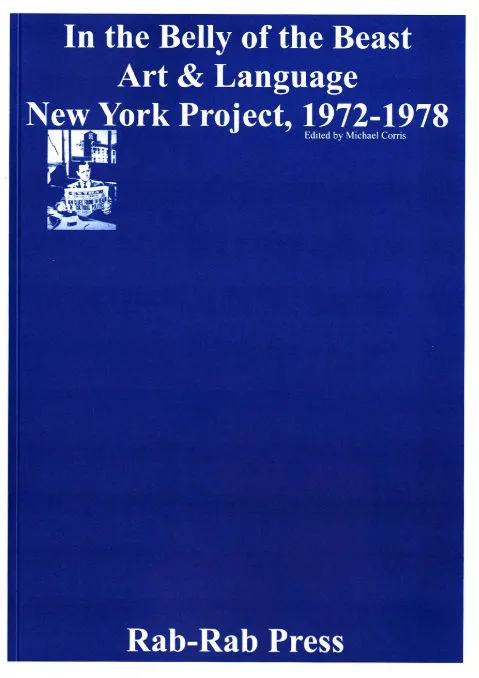
Cover of In the Belly of the Beast – Art & Language New York Project 1972-1978

Rab-Rab Press

In the Belly of the Beast – Art & Language New York Project 1972-1978

Art & Language

Edited by Michael Corris, the expanded edition of In the Belly of the Beast: Art & Language New York Project 1972-1978 is a survey of the tumultuous years of the political Conceptualism in the mid-seventies New York.

Artists have always experimented with politics, either by organizing themselves or uniting in support of a broader political movement. Today, "activist art" is taught in universities, supported by foundations, and featured in museums and international exhibitions. Is this the only possible way?

In the Belly of the Beast tells a different story, of the work of politically engaged artists and the conflicts they experienced. It is the history of artists wishing to continue working within the boundaries of the artworld and those who were intent on establishing new ideological and class relationships with activists to build a political party.

During the 1970s in New York, the Art & Language collective pioneered institutional critique; published a Marxist-influenced journal; agitated against racism and sexism in museums; challenged the cultural imperialism of international exhibitions; and forged a framework for a socialist organization of artists. This new edition includes previously unpublished documents illuminating the contradictions and disputes that lay at the center of the organization and practices of Art & Language and left-wing groups, such as the Anti-Imperialist Cultural Union and the Artists' Meeting for Cultural Change, mobilizing artists in New York at the time.

The new and expanded edition of In the Belly of the Beast features an extensive interview with Michael Corris, who annotated a collection of previously unavailable documents from the period, including manuscripts, pamphlets, transcripts, and letters.

Art & Language is the name of a group of English artists who choose to work collectively, and the title of a magazine that they founded in 1968. Proposing a critical analysis of the relations between art, society, and politics, Art & Language marks, even in its name, the importance of the “textual turning point” in the 1960s.

Since 1976, Art & Language's project has continued, through Mel Ramsden and Michael Baldwin, with the literary and theoretical collaboration of Charles Harrison. Working with very varied mediums, from painting to rock, these co-founders of Conceptual art remain, even today, attached to observing the consequences of what they themselves call the “depressing collapse of modernism.”

Cover of Retour

Doubleyoutee Publishing

Retour

Tato Greve

Poetry €14.00

Retour is a book featuring a collection of drawings made on train journeys between Belgium and the Netherlands. It combines hand-written typography and train interiors, subtly highlighting cultural differences forming the countries’ border. 

Cover of WITCHES

Midnight Mass Press & Heretic House

WITCHES

G.B. Jones

Enchanted €37.00

A collection of portraits by original riot grrrl, filmmaker, and zine queen, G.B. Jones. All of them witches – from the silverscreen, woodlands, and the streets.

Featuring provocative essays by Caroline Azar, Paul P., Leafshimmer, Jenna Danchuk, Blake Baron Ray, and Scott Treleaven – each exploring how witches have been perceived, presented, and portrayed in popular culture. “Realer than real, stranger than fiction.” 

PRAISE FOR G.B. JONES WITCHES

Witches by G.B. Jones is a summoning spell posing as a book, a paper potion like the potion Nicky gives Gillian in Bell, Book and Candle. It draws me to it and to what’s in it, Jones’ divine drawings of the witches we both worship, the witches of TV and film and true life. I go to it gladly. I go to it gayly. I pore over it and prize it and purr like Pyewacket.

Derek McCormack, author of Castle Faggot

G.B. Jones is the original Foxy Genius. Her zines, drawings, music, and Super 8 films inspired both the Queer zine explosion and the Riot Grrrl movement of the 90s. Witches sees G.B. once again crafting her magic.

— Kathleen Hanna, singer, writer, artist, and front-woman of the bands Bikini Kill and Le Tigre

With her illustrated procession of witches, post-punk icon G.B. Jones acts as medium to a dazzling diversity of disrupters from across screen history, as well as a pantheon of real-life hellraisers, from Sybil Leek and Rosaleen Norton to Vali Myers and beyond – all woven through with astute commentary by a host of countercultural collaborators. A captivating book; I was certainly under its spell.

— Kier-La Janisse, author of House of Psychotic Women

Cover of Aisopika Aesopica

Ariel Ink

Aisopika Aesopica

Rūta Junevičiūtė

The bilingual book ‘Aesopica’ documents and extends Rūta Junevičiūtė’s research on the Aesopian language and the influence of political censorship to contemporary collective body, first presented in 2020 as the eponymous solo exhibition at the National Gallery of Art and as a permanent outdoor installation at the Rupert Art Center, Vilnius. 

Taking as a starting point the historical phenomenon of Aesopian language, which was widespread in Lithuanian culture during the Soviet era, and in parts of the Russian Empire as early as the 19th century, Junevičiūtė aims to investigate the interrelationship between generations, the gray zones of collective identity creation and the processes of (un)censoring the archives of our bodies.

Aesopian language – a term coined after Ancient Greek fabulist Aesop (gr. Aísōpos), is a type of cryptic communication system, where a text has several layers of meaning often contradictory to each other and which seek to convey official and subversive hidden meanings simultaneously. It is usually employed under conditions of omnipresent state censorship to communicate officially forbidden or taboo subjects and opinions. As a system it contains three members – an author, a censor, and a reader. It uses various modes of circumlocution and euphemisation, innuendo and poetic paraphrasing, which can also be seen as an aesthetic style. It has been advocated for artistic benefits as poetics of omissions, concealment, and travesty. On the other hand, it has been criticized as a sign of conformity and humiliation. In Lithuania, after the fall of the Soviet Union, it has been popularly regarded as a position of dissent, but such an interpretation received criticism from contemporary scholars. “Such a mode of expression is probably as old as censorship itself” – a historian told us.

Text contributors: Alfonsas Andriuškevičius, Edgaras Gerasimovičius, Rūta Junevičiūtė, Goshka Macuga, Anastasia Sosunova, Grėtė Šmitaitė, Tomas Venclova, Ana Vujanović

Language editors: Dangė Vitkienė, Aira Niauronytė, Gemma Lloyd

Translators: Alexandra Bondarev, Erika Lastovskytė, Justinas Šuliokas, Mantė Zagurskytė-Tamulevičienė, Aistis Žekevičius.

Illustrations: Rūta Junevičiūtė.

Cover of The Sniper in the Brain

Nero Editions

The Sniper in the Brain

Jacopo Pagin

Upside-down trees with roots reaching toward the cosmos, glasses, pitchers, transparent vessels, and bodies blending human and animal, male and female features populate Jacopo Pagin’s works. These figures reveal themselves in their decadent and symmetrical being, caught within a web of references centered on the evocative power of the gaze.

The first monograph dedicated to Jacopo Pagin, designed and edited by Ismaël Bennani and Orfée Grandhomme and featuring a critical contribution by Alessandra Franetovich, brings together over 200 drawings and paintings to explore the visionary, obsessive, and hypnotic qualities of the artist’s work and its profound connections with exotic, mediumistic, and new-age practices.

The book is co-published with Make Room, Los Angeles.

Cover of Sforzando - Pastels 2020 - 2022

Goswell Road

Sforzando - Pastels 2020 - 2022

David West

At midday, March 17th, 2020, Macron’s government decided to place France in suspended animation. Total confinement. The first in a series of strict debilitating lockdowns to combat the spiralling Covid-19 pandemic. This first confinement lasted 55 days. It ended on 11th May 2020. The first part of a dramatic trilogy.

One month in, in April 2020, David West picked up a box of pastels that used to belong to his mother. He had had them for many years but never used them. New to the medium, locked in his Paris studio, he sets himself to the task. Naturally, violence ensues. Folk horror. Animals are disembowelled. Faceless sexualised female bodies perform. Screaming faces educate. Covered figures stand motionless. Shadows. Hooded beings populate. Stabbing, scratching, fading, softening, sforzando. Crescendo. Schadenfreude.

Occasional respite comes when West ventures outside - andante - but the externalised screaming pushes him back in. Hagazussa. Ghosts from West’s past, real and unreal, appear and disappear, figures and shapes, compositional arcs, a slimy snaking emerald hand parts the waves for colour to gush forth a new language verde fosforescente, worm purple, rosa shocking, vermillion, cobalt, ultra-black.

This book reproduces a small selection of some 300 works, in chronological order, in an attempt to document time, evolution, revolt, epiphany and joy. Joy in colour, horror, form, symphony, and finally, West’s visions of a new utopia. Marcato. Decrescendo.

Softcover (21cm x 29.7cm)
100 Pages
50 copies
Signed and numbered by David West