rile*books

Search books

Search books by title, author, publisher, keywords...

Cover of One hundred and six EROTIC short stories

Extra Extra

One hundred and six EROTIC short stories

€27.50

To be erotic is to be alive. In this collection of erotic short stories, desire and imagination meet in stairwells, apartments, bars and glances that linger just a little longer. Commissioned for and first published in Extra Extra magazine, these unique stories range from vibrant encounters of mere minutes to hours of simmering tension.

Carefully curated and unapologetic in its imagination, it’s an invitation into a literary space shaped by lust and longing.

One Hundred and six erotic short stories contains erotic stories by Obe Alkema, Karin Amatmoekrim, Mischa Andriessen, Sarah Arnolds, Simone Atangana Bekono, Gerbrand Bakker, Maria Barnas, Leonieke Baerwaldt, Persis Bekkering, Abdelkader Benali, Hannah van Binsbergen, Marion Bloem, Fiep van Bodegom, Daan Borrel, Charlotte van den Broeck, Saskia de Coster, Eelco Couvreur, Daniël Dee, Nikki Dekker, Maxime Garcia Diaz, Don Duyns, Rob van Essen, Edwin Fagel, Mira Feticu, Moya De Feyter, Andy Fierens, Gamal Fouad, Johan Fretz, Steff Geelen, Maureen Ghazal, Arnon Grunberg, Esha Guy Hadjadj, Thomas Heerma van Voss, Mariken Heitman, Tom Hofland, Philip Huff, Auke Hulst, Nicole Kaandorp, Asha Karami, Maite Karssenberg, Mensje van Keulen, Emy Koopman, Falun Ellie Koos, Willemijn Kranendonk, Selin Kuşçu, Rachida Lamrabet, Jordi Lammers, Wietske Leenders, Sandro van der Leeuw, Sun Li, Gilles van der Loo, Hannah Chris Lomans, Alma Mathijsen, Kiriko Mechanicus, Jens Meijen, Lars Meijer, Carmien Michels, Kaweh Modiri, Roelof ten Napel, Richard de Nooy, Joost Oomen, Jamal Ouariachi, Iduna Paalman, Gustaaf Peek, Elvis Peeters, Froukje van der Ploeg, Marja Pruis, Julius Reynders, Hannah Roels, Astrid H. Roemer, Martin Rombouts, Daniël Rovers, Alfred Schaffer, Marijke Schermer, Koen Sels, Vamba Sherif, Frank Siera, Louise Souvagie, Yentl van Stokkum, Florence Tonk, Elfie Tromp, Joost Vandecasteele, Dominique van Varsseveld, Annelies Verbeke, Peter Verhelst, Wytske Versteeg, Daniël Vis, Dirk Vis, Sven Vitse, Maria Vlaar, Marwin Vos, Nadia de Vries, Niña Weijers, Han van Wieringen, Romy Day Winkel, Maartje Wortel, Pete Wu, Kira Wuck, Mia You, and Ivo Victoria

Published in 2026 ┊ 552 pages ┊ Language: English

recommendations

Cover of All My Dead Jesters

Tenement Press

All My Dead Jesters

Nadia de Vries

Poetry €22.00

All My Dead Jesters is an assembly of select poems previously published in de Vries’ first two English language collections—Dark Hour and I Failed to Swoon (Dostoyevsky Wannabe, 2018 and 2021 respectively). These old works have been lightly revised for republication, and are paired with poems drawn from a manuscript-in-process to institute an autotelic kaleidoscope of some ten years worth of work in verse. 

De Vries’ poems are spare, terse and epigrammatical—a barroom Bashō—dedicated to the glimmer of a compact glance; the chance, glamour and negative capability of a passing thought; and the slow drip of liquid crystal as colours our present. All My Dead Jesters is a torch song for our ‘poor subjectivity,’  a slow dance with sour times, a ‘[steering] away from [the] gratuitous provocation’ that litters our contemporary outlook. ‘Her competence as a poet lies in her ability to translate visceral vulnerability’ for the page (The Kelvingrove Review / University of Glasgow), as she patchworks a heroic ‘poetry without [a] hero, a blanket leaving you colder somehow, [...] the map of a world we like to think we know’ [CA Conrad].

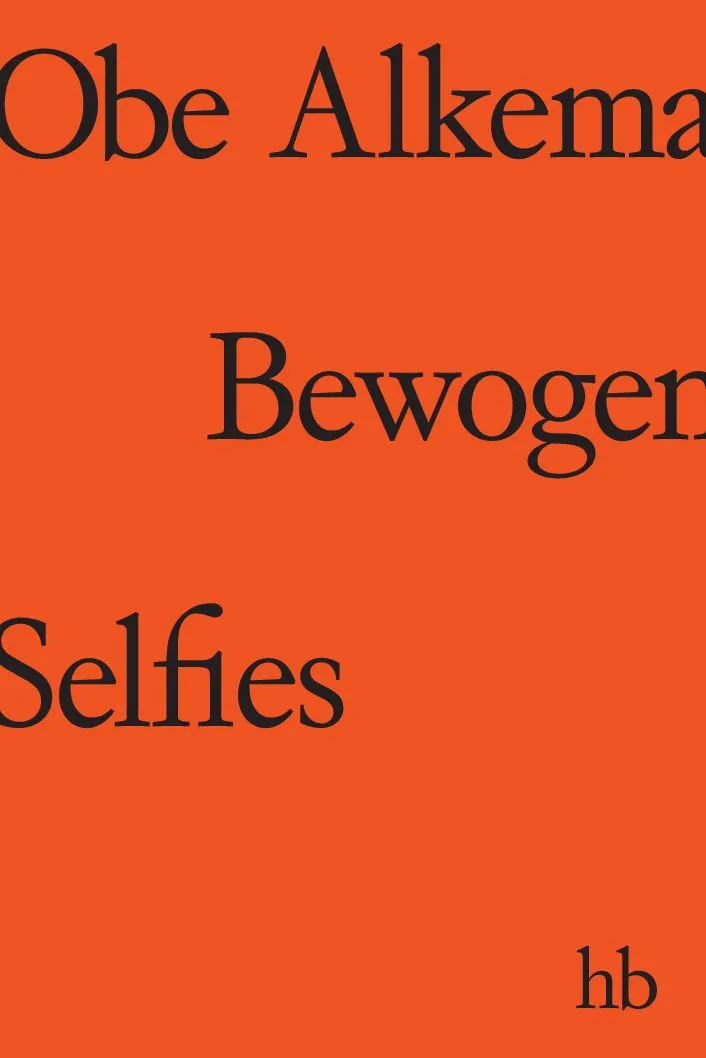
Cover of Bewogen selfies

het balanseer

Bewogen selfies

Obe Alkema

Fiction €24.50

In Bewogen selfies onderzoekt Obe Alkema de verhouding tussen landschap en herinnering. Wat treft hij aan bij terugkeer naar belangrijke plaatsen uit zijn geheugen? Wat herinnert hij zich niet, maar Google wel? Is er een gedenkschrift te puren uit zijn metadata?

Memoires, rechtstreeks verteld en met omwegen, uit eerste hand en van horen zeggen. Archieven en herinneringen eisen spreektijd, houden het niet meer droog of worden tot spreken gebracht. Wat hebben ze eigenlijk te melden? Ze lopen helemaal leeg, net als Alkema zelf. Een leven zoals zovele, poedelnaakt en geretoucheerd, vol zin en onzin.

Cover of My Kevin, My Paris

Self-Published

My Kevin, My Paris

Obe Alkema

In the fall of 2017, Obe Alkema got acquainted with the American poet Kevin Killian, first at the New Narrative conference at UC Berkeley, then at the Poets & Critics Symposium in Paris that was all about his poetry. A year and a half later, Alkema traveled back to Paris, this time as a participant of a writing residency. He was there to research the landscape of memory, but more than he expected and initially realized, Kevin’s death the previous month (June 2019) affected his return. Besides inevitable, mourning and remembering became obsessions for Alkema, as he shows in ‘My Kevin, Our Paris’, a memoir about Kevin Killian (1952–2019), but especially about his Kevin and their Paris.

Cover of ¶#2: Bundle theory

OUTLINE

¶#2: Bundle theory

Romy Day Winkel

For #2 in the ¶ (Pilcrow)-series Romy Day Winkel has approached collecting, or hoarding, as an aesthetic of patience. Through her selection of Wikipedia-articles she looks at what happens when objects, magical or otherwise, are all put together. If it is impossible, and perhaps even uninteresting, to know when a collection or archive is finished, how does one start to hoard impatiently

¶#2 consists solely of texts and images found on the online collaborative platform Wikipedia. ¶#2 is assembled by Romy Day Winkel, designed by Tjobo Kho and Wouter Stroet, edited by Jan-Pieter ‘t Hart and published by OUTLINE.

Cover of Cyclamen

Tenement Press

Cyclamen

Alix Chauvet

Poetry €25.00

A debut collection from the poet, artist and designer, a suite of unfaithful translations/transversions of works drawn from Baudelaire’s Les Fleurs du mal / Flowers of Evil, a bunch of flowers in decay, pressed and frayed, ‘a flock of pockmarked words.’

Through these creative ‘translations’ of Charles Baudelaire, Alix Chauvet—artist, designer, poet—refuses fidelity in favour of flirtation: her ‘flowers of evil’ line Amsterdam’s canals, drink from the same rainclouds as Rachel Ruysch’s bewitching bouquets, sprout through peat, and are tended by a distinctly feminist and nomadic sensibility. Chauvet—akin to Olive Moore, Sean Bonney and Lisa Robertson—takes the nineteenth-century French decadent as a contemporary accomplice for aesthetic and linguistic misbehaviour. Walter Benjamin once wrote of Baudelaire that he is ‘der geheime Architekt der Moderne,’ and in Chauvet’s hands, those foundations are made porous, unbuilt into cast shadows, into ribbons, into veins streaming across the page. Accompanied by scans of the French poems and Chauvet’s shadow photography, what Cyclamen ultimately offers us is a regenerative rewilding of the English language: a wondrous terrain ringed by vines of unruly syntax and dotted with the fruit of words refusing domestication by any single tongue. Mia You

Alix Chauvet is a Swiss-French poet and graphic designer based in Amsterdam, taking pleasure in the possibilities of translation. She received her BA in Graphic Design from the Gerrit Rietveld Academie (Amsterdam, 2020), and has since been working independently and in collaboration with contemporary artists. Investigating the relationships between language and body, intimacy and collectivity, past and contemporary, her hybrid practice covers a wide range of visual and linguistic experiments from artist’s book design to experimental translation. Her method is rooted in decelerating the creative process through the use of analogue and unprofitable techniques such as cut-outs, letterpress, linocut, handwriting and painting. Chauvet’s poetic approach follows the same logic, prioritising English over her mother tongue as a way to revise language with both critical detachment and a degree of identification. Her poems have appeared in literary magazines such as Blackbox Manifold, and Cyclamen is her debut collection.

Cover of Information Age

Joyland Editions

Information Age

Cora Lewis

Fiction €18.00

The narrator of Information Age is a journalist at an online news site reporting on technology, the economy, and politics in the late 2010s. The rate of increasingly short news cycles shapes her working life and her personal life, as she assumes the role of reporter while talking with engineers, analysts, wonks, artists, writers, musicians, friends, family, and lovers. Told in vignettes and dialogue—overheard and divulged—Information Age is spare, funny, and attentive, a playful blurring of public and private life.

Cora Lewis is a writer and reporter whose fiction has appeared at The Yale Review, Joyland Magazine, Epiphany, and elsewhere. She currently works at the Associated Press in New York, and she previously worked at BuzzFeed News. She lives in Brooklyn near Sunset Park.

Cover of Impossible Dreams

Daisy Editions

Impossible Dreams

Pati Hill

Fiction €15.00

Pati Hill's cult novel, available for the first time since 1976.

Impossible Dreams was Pati Hill's last published novel, released in 1976 after it was partially published two years earlier in the Carolina Quarterly under the title "An Angry French Housewife." Hill tells the story of Geneviève, a middle-aged woman whose life is turned upside down when she unexpectedly falls in love with her neighbor, Dolly. Mixing anecdotes with existential thoughts, the novel describes the gradual disruption of the heroine's daily life. Almost every chapter (the length of which varies from a single sentence to no more than three pages) is accompanied by a xerograph of a photograph, selected by Hill with permission from its maker. The resulting combination of text and image constitutes her most ambitious attempt to produce a work in which "the two elements fuse to become something other than either."

This novel is also one of the most incisive examples of Hill's writing—dry and impartial, yet managing to capture the contradictory feelings of her characters. In a letter addressed to the photographer Eva Rubinstein asking for reproduction rights, she writes: "My book is about a woman with a little girl and a husband who falls in love with a woman and a little girl and a husband and loses them all, just like in your mirror. It doesn't sound very cheerful but it is mainly funny."

Daisy, an independent publishing house, releases a facsimile of the out-of-print work that, after almost 50 years since its initial publication, has become a coveted collector's item.

"Impossible Dreams charmed me with its droll and irreverent tone when it was first published. Hill's use of embedded photographs was unexpected and transgressive for its me. Brilliant!"
Anne Turyn, photographer, educator and founding editor, Top Stories

Pati Hill (1921, Ashland, Kentucky – 2014, Sens, France) left behind a litterary and artistic output spanning roughly 60 years . After a short but dazzling career as a model, between 1951 and 1962 she wrote a dozen short stories—several of which were published in George Plimpton's prestigious literary journal, The Paris Review—and five books which earned her real critical recognition. Hill published One Thing I Know in 1962 after giving birth to her first and only daughter. She was then forty-one years old, and would later claim to have decided at that time to "stop writing in favour of housekeeping.''

Edited by Ana Baliza and Baptiste Pinteaux.

Cover of Sun of an Ignored Putrid Productivity

BookBoi*

Sun of an Ignored Putrid Productivity

Bárbara Acevedo Strange, Eva Tatjana Stürmer

Fiction €10.00

Sun of an Ignored Putrid Productivity is a speculative novel about the influence of artificial intelligence and accelerating technological progress on our human interactions. The dialogical script is based on personal reflections and pop-cultural, scientific and philosophical references from the beginnings of cybernetics to more recent voices. Randomly generated, constructed and quoted contents cannot be distinguished from each other. The borderline between fact and fiction becomes blurred. What is left is a flickering effect, disorientation, which reflects our perception of reality under conditions of never-ending information overflow.