rile*books

Search books

Search books by title, author, publisher, keywords...

Cover of It begins in your bank and extends to your throat

Self-Published

It begins in your bank and extends to your throat

Cecilie Fang

€10.00

This text begins with the mishearing of a word. It starts from the place of inconvenience and unravels a hearing not contained within one fixed conversation. A hearing that has been expanded into a writing that begins in your bank and extends to your throat when its language heard writes itself into and onto the muscles.

It begins in your bank and extends to your throat ruminates on how digital algorithms turn words into capital, disciplining language and the body. Its writing explores how search engines link profitability to vocabularies and how productivity dictates posture, raising whether we can separate language and our bodies from economic structures.

Published in 2024 ┊ 23 pages ┊ Language: English

recommendations

Cover of A Psalm for the Third Wind

Self-Published

A Psalm for the Third Wind

Damien Troadec

Book: 11.7 × 18 cm
Book and Glove: 13.5 × 31.5 cm

Presented in a monster glove

Three broken halves of one god walk a city that wants them dead
Their bodies speak in static hunger and rust
Something follows breathing through their mouths
Read it Bleed from it


In A Psalm for the Third Wind, a film script written from 3 perspectives, Damien Troadec is aiming to address in parallel narrative the struggle of having multiples inner voices and the danger of following their distinct desires. One question is raised without any light at the end of the tunnel, confronting the reader to a conflict : THE COMFORT OF MISERY OR THE PAIN OF CHANGE ?

Cover of Hechtmappen bieden geen soelaas

Self-Published

Hechtmappen bieden geen soelaas

Tato Greve

Poetry €18.00

Hechtmappen bieden geen soelaas is wat overbleef na een vakantiejob waarbij de taakinhoud vooral bestond uit het verwijderen van nietjes uit verouderde documenten. Deze weken waren de bron voor fascinaties voor ongemakkelijke stiltes, gesprekken in liften, de diefstal van fluorescerende pennen en een ontplofte ventilator. 

Cover of Postmortem issue 1

Self-Published

Postmortem issue 1

Marina Mardas, François Peyroux and 1 more

Periodicals €42.00

How can we define and document our present? 

Postmortem is a sensitive yet critical metaphor for a world suspended between collapse and reinvention—a diary of the now. Drawing together writers and artists from Europe and the SWANA region, this issue locates areas of tension that define our era. Far from a mere dialogue between regions, it exposes the inner and outer fractures of Western hegemony, unearthing shared emotions. 

From reclaiming histories and narratives in the Arab world to deconstructing digital spaces as arenas of control and resistance—even exposing systemic exclusions embedded in blood donation policies—contributors reveal these tensions as a fertile terrain for dialogue and reflection. 

Through critical essays, narrative writing, poetry, interviews, and contemporary art, the concept of Postmortem unfolds an in-between state where death and rebirth occur simultaneously. Across three interwoven chapters—Metaconnexion, Dissociation, and Fragmentation—the issue engages radically with body politics, othering, post-orientalism, surveillance, decoloniality, freedom, and resistance. 

Both a chronicle and a hybrid object where text, design, and image interact, Postmortem archives a world in flux. Rather than prognosticate, it dissects the present as the essential site for reimagining our future. 

Contributors : Sara El-Jazara, François Peyroux, Nadine Makarem, Soukaina Melhaoui, Louise Mervelet, Manon Schaefle, Marina Mardas, Irina Breitenstein, Amer Al-Dakar

Cover of sex and place vol 2

Self-Published

sex and place vol 2

Adriano Wilfert Jensen, Andrea Zavala Folache

sex and place is a series of workshops and publications exploring score-based and semi-anonymous writing as a tool for articulating shared concerns.

Vol 2 ‘discores’ is written by Kexin Hao, Luca Soudant, HaYoung, Andrea Zavala Folache & Adriano Wilfert Jensen. Five strangers are stuck in changing boots next to each other and decide to embark on an intimate conversation starting from the question: “What is troubling your sexuality at the moment?”.

The ‘sex and place’ series is part Domestic Anarchism, a project devoted to coalition-building beyond biological, chosen, or national conceptions of family. Dance serves as a set of tools and knowledge that can be applied beyond “the spectacle” to collectively study, write, and move. 

Andrea Zavala Folache and Adriano Wilfert Jensen are choreographers and they co-parent three-year-old Penélope Cleo. Andrea and Adriano use dance and choreography to think about the distribution of care and solidarity beyond ‘the family’, and in turn consider how such a distribution could inform their dance practice. Inevitably themes like sex, economy, gender, and class get activated. But also notions such as prefiguration, anarchism, clitoridian* thinking, zones of non-domination and coalition building. They see dance as a knowledge that can be applied to different practices. Some of these include: co-habitations, score based writing and dancing, self-organised study groups and publications, workshops and dance performances. 

Cover of Stili Drama XIII-XXI / La Giostra di Lulu XLI-XLIV

Self-Published

Stili Drama XIII-XXI / La Giostra di Lulu XLI-XLIV

STILI DRAMA

The materials collected in the publication have been developed departing from the documentation, transcription and translation of textual, visual, sculptural and audio materials produced between March and November 2021 for STILI DRAMA. 

STILI DRAMA is an open-ended episodic para-cinematographic project, which functions as a spontaneous expression of MRZB research. STILI DRAMA XVIII-XXI and LA GIOSTRA DI LULU XLI-XLIV are the two first fragments of the work.

Language: English, Italian
Edition of 100 copies

Cover of I presumed possession, my language, my loss

Self-Published

I presumed possession, my language, my loss

Cecilie Fang

In I presumed possession, my language, my loss, I begin in third person to write about what it means to lose a mother tongue, and about how that loss is never natural but engineered: by state assessments, border conditions, and a free market of articulation. I write about language as transaction—what you gain in the language of power at the cost of becoming inarticulate in the language of origin. I write about the monolingual paradigm as a political demand rather than a natural inheritance, about standardization as a form of border-drawing, and about the grief of hearing the people you love measured as insufficient. The text moves between the personal and the structural, between a grandmother forgetting and a language policy forbidding. It is about what we lose, and about what we have learned to accept as acceptable to lose.

Cecilie Fang is an anti-disciplinary artist and writer from China and Denmark, based in Amsterdam. Generated through writing, her process-oriented work unfolds across performance, publication, material micro-performativity, and installation.

Cover of this simulation sux

Domain

this simulation sux

Jr Ting Ding, DeForrest Brown Jr.

Essays €20.00

this simulation sux is a collection of speculative essays and personal observations commissioned by global cultural institutions and local counterculture zines between February 2020 and April 2021.

"During the moment of pause brought on by the initial lockdown, we chose to write as a form of self care and mediated therapy; writing, for us, is a way to process, orient, and grasp for a moment of clarity in the ever changing media and cultural landscape. In this informational era, in which our attention is in very high demand, the amount of content we are expected to consume is endless. Beset with political unrest, economic uncertainty, and waning emotional bandwidth, we have become datapoints in the vast and saturated marketplace presented to us as “society.”

[...]

Flânerie, the French term describing the act of walking and observing, became a part of our daily ritual; we lapped the outer edges of the island of Manhattan and exploring various neighborhoods during the peak of the pandemic. The images presented on this book’s jacket were captured on these walks, documenting the absurdities of everyday life in this fraying simulation. Personal, anecdotal narratives of an imagined reality are represented through the images, which are placed alongside our speculative observations derived from historical data.

We hope that these writings can provide others with prose and information that can be applied like an antidotal balm to treat our communal ailment of future shock."

—Ting Ding 丁汀 & DeForrest Brown, Jr. 

Cover of Re-Enchanting the World

PM Press

Re-Enchanting the World

Silvia Federici

In this edited collection of work spanning more than 20 years, Silvia Federici provides a detailed history and critique of the politics of the commons from a feminist perspective. In her clear and combative voice, Federici provides readers with an analysis of some of the key issues in contemporary thinking on this subject. Drawing on rich historical research, she maps the connections between the previous forms of enclosure that occurred with the birth of capitalism and the destruction of the commons and the "new enclosures" at the heart of the present phase of global capitalist accumulation.

Considering the commons from a feminist perspective, this collection argues that women and reproductive work are crucial to both our economic survival and the construction of a world free from the capitalist hierarchies. Federici is clear that the commons should not be understood as happy islands in a sea of exploitative relations—but rather autonomous spaces from which to challenge the existing organization of life and labor.

Cover of Oriental Cyborg

Essay Press

Oriental Cyborg

Aditi Kini

Essays €15.00

Who is the Oriental Cyborg? asks Aditi Kini in this collection of notes, jokes, and queries into the provenance of a creature designed for labor, 3-D printed in the technoscientific post-colonies, modeled on old automata. Race is a technology, that we know, and technology can be raced — so why inquire into this at all? Perhaps this, the Oriental Cyborg, is a fantasy more than a memory, or an echo more than a form — or just an essayist’s extraction of personal anguish and humor from globalist decay.

Taking on the form of historical analysis / lyrical essay / documentary poem / experimental buzzword / positionality statement, this chapbook and its titular character might still be an elusive mystery even after reading.

“’What is a ghost but a person removed from corporeality?’ This is one among layers of questions Aditi Kini poses in Oriental Cyborg, a lyrical excavation into survival in the era of techno racial capitalism, and its “deleting touch” that so easily voids—reduces to faceless services—the exploited individuals performing various acts of techno-labor. A grieved searching drives this hybrid essay, which feels urgent and necessary as threats from AI grab headlines. This work compels us to see our culture’s love affair with technological progress as a means for continued colonization and domination. It also reminds us, and celebrates, that those erased don’t stay silent forever. We privileged may not be able to hear them yet, but those who are listening know. They roar.” — Allison Cobb

“In the mirror of Aditi Kini’s Oriental Cyborg, I become the monster—a hopeless automaton, an intelligence stripped of roar. With titanium-threaded theory, Kini radiantly stitches together the ideal Asian working machine. Get your own Oriental cyborg today: super dazzling and sexy, historically embroidered, an oracular truth who never tires, never complains, forever mute, what perfection!” — Lily Hoàng

Aditi Kini is an undisciplined writer. They’ve done both NYC and the MFA (at UC San Diego). They were a finalist/alternate for the 2020-22 Jerome Award for Literature. They edit Lumpenpockets, “a nonquarterly sick rag.” Read their words in Hayden’s Ferry Review, The Rumpus, Denver Quarterly, The New York Times, and elsewhere. They’re at work on multiple projects, all at once. They are blessed with two dogs, Lucy the Happy and Charly Kong, who make life worth living.

Cover of The Autobiography of a Language

Futurepoem

The Autobiography of a Language

Mirene Arsanios

Poetry €22.00

Here the mirror image of the almost hallucinatory, heart-rending loss of the familiar is literary defamiliarization. Arsanios both mourns and blasts apart the notion of the mother tongue, reminding us that for each “mother tongue” at least another tongue is silenced. Desire propels her genre-defying writing, which grief notwithstanding still manages to tongue languages, and that is her genius. — Mónica de la Torre

Mirene Arsanios is the author of the short story collection The City Outside the Sentence (Ashkal Alwan). She has contributed essays and short stories to e-flux journal, Vida, The Brooklyn Rail, The Rumpus, and Guernica, among others. Arsanios co-founded the collective 98weeks Research Project in Beirut and is the founding editor of Makhzin, a bilingual English/Arabic magazine for innovative writing. She teaches at Pratt Institute and holds an MFA in Writing from the Milton Avery Graduate School for the Arts at Bard College. Arsanios currently lives in New York where she was a 2016 LMCC Workspace fellow, and an ART OMI resident in fall 2017. With Rachel Valinsky, she coordinated the Friday night reading series at the Poetry Project from 2017–19.

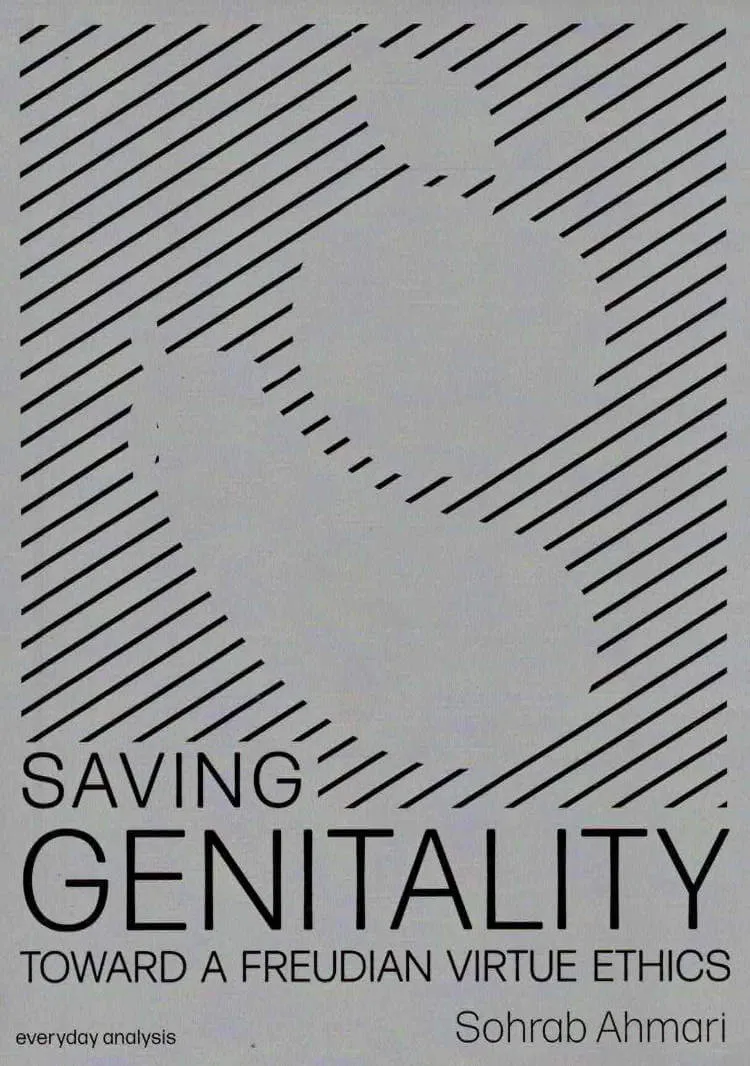
Cover of Saving Genitality: Toward A Freudian Virtue Ethics

Everyday Analysis

Saving Genitality: Toward A Freudian Virtue Ethics

Sohrab Ahmari

Essays €9.00

Western societies have dismantled many of the prohibitions that ringfenced errant sexual drives in Freud’s time. The psychoanalytic project describes people caught between two fundamental and contradictory principles: One a relentless sexual drive, the libido; the other our species’ collective need for social order and harmony. Part of this harmony, for true Freudians, is embedded in the binary mutuality of men’s and women’s bodies, which remains indispensable for society to reproduce itself, even in our sexually liberated age. In this essay, Ahmari revisits the idea of ‘genitality’ arguing that perhaps the "heteronormative" orthodox Freudians were right about some things after all.