rile*books

Search books

Search books by title, author, publisher, keywords...

Cover of Postmortem issue 1

Self-Published

Postmortem issue 1

Marina Mardas ed., François Peyroux ed., Tariq Emam ed.

€42.00

How can we define and document our present? 

Postmortem is a sensitive yet critical metaphor for a world suspended between collapse and reinvention—a diary of the now. Drawing together writers and artists from Europe and the SWANA region, this issue locates areas of tension that define our era. Far from a mere dialogue between regions, it exposes the inner and outer fractures of Western hegemony, unearthing shared emotions. 

From reclaiming histories and narratives in the Arab world to deconstructing digital spaces as arenas of control and resistance—even exposing systemic exclusions embedded in blood donation policies—contributors reveal these tensions as a fertile terrain for dialogue and reflection. 

Through critical essays, narrative writing, poetry, interviews, and contemporary art, the concept of Postmortem unfolds an in-between state where death and rebirth occur simultaneously. Across three interwoven chapters—Metaconnexion, Dissociation, and Fragmentation—the issue engages radically with body politics, othering, post-orientalism, surveillance, decoloniality, freedom, and resistance. 

Both a chronicle and a hybrid object where text, design, and image interact, Postmortem archives a world in flux. Rather than prognosticate, it dissects the present as the essential site for reimagining our future. 

Contributors : Sara El-Jazara, François Peyroux, Nadine Makarem, Soukaina Melhaoui, Louise Mervelet, Manon Schaefle, Marina Mardas, Irina Breitenstein, Amer Al-Dakar

Published in 2025 ┊ 400 pages ┊ Language: English, French

recommendations

Cover of From Palestine to "Xinjiang": Forced Labour and Capitalist rule

Self-Published

From Palestine to "Xinjiang": Forced Labour and Capitalist rule

Zines €12.00

For a long time, Israel and the West, led by Europe and the United States, have used hasbara and neoliberal discourses to hide their colonial plunder of Palestine, while today China and Russia are also whitewashing their own imperialist practices by aligning themselves with authoritarin government and projecting an image of leading resistence to western hegemony. 

This publication analyzes the structural similarities and differences between forced labor and capital exploitation of Palestinians and Uyghurs from left-wing perspective. The author hopes to dispel the myth of campism and call for inter-racial/-ethnic/-national proletarian solidarity against oppression of colonization, capital and totalitarianism. 

Cover of Angst

Self-Published

Angst

Benedikt Bock

Poetry €22.00

In 1942, butcher Heinrich Angst started to set up his own business in Zurich. Today, Angst AG operates the municipal abattoir and supplies catering businesses and butchers throughout the canton. Angst is a book documenting an installation with 50 used and framed sausage wrapping papers presented at Fondation Fernet Branca in Saint Louis, France. On the other hand the book is gathering 50 systemically relevant poems surrounding writing, everyday life as a dance with obligation and panic, a society without children, fear as a fundamental quality of life and hopefulness to bury fear together. 

Cover of sex and place vol 2

Self-Published

sex and place vol 2

Adriano Wilfert Jensen, Andrea Zavala Folache

sex and place is a series of workshops and publications exploring score-based and semi-anonymous writing as a tool for articulating shared concerns.

Vol 2 ‘discores’ is written by Kexin Hao, Luca Soudant, HaYoung, Andrea Zavala Folache & Adriano Wilfert Jensen. Five strangers are stuck in changing boots next to each other and decide to embark on an intimate conversation starting from the question: “What is troubling your sexuality at the moment?”.

The ‘sex and place’ series is part Domestic Anarchism, a project devoted to coalition-building beyond biological, chosen, or national conceptions of family. Dance serves as a set of tools and knowledge that can be applied beyond “the spectacle” to collectively study, write, and move. 

Andrea Zavala Folache and Adriano Wilfert Jensen are choreographers and they co-parent three-year-old Penélope Cleo. Andrea and Adriano use dance and choreography to think about the distribution of care and solidarity beyond ‘the family’, and in turn consider how such a distribution could inform their dance practice. Inevitably themes like sex, economy, gender, and class get activated. But also notions such as prefiguration, anarchism, clitoridian* thinking, zones of non-domination and coalition building. They see dance as a knowledge that can be applied to different practices. Some of these include: co-habitations, score based writing and dancing, self-organised study groups and publications, workshops and dance performances. 

Cover of A take away cup and a cloud

Self-Published

A take away cup and a cloud

Oda Brekke

Essays €10.00

A take away cup and a cloud is an essay written alongside the dance performance Seems to be by Denise Lim and Stina Ehn. It plays with a variety of containers–the list form being one. By mixing a personal with a historical gaze it traces the trajectory of mundane commodities and  the replacement of material with imaterial objects brought about to the everyday by technical progress. 

Cover of Ferrara Deux (Faits Divers)

Self-Published

Ferrara Deux (Faits Divers)

Ivan Cheng

Fiction €19.00

faits divers are the various reports in a news bulletin, miscellaneous human interest stories, theorised by Roland Barthes as ‘total’ and ‘immanent’ information.

ferrara deux (faits divers) scrolls around the discovered corpse of a talented street musician named Landau, mangled and sealed into vacuum bags in the walk-in of a modern Italian-American restaurant. Street performance is content for an attention economy, playing on authenticities and profiting from recognition.

In this debut novel, artist Ivan Cheng reconfigures recent performance texts into an approximation of a murder mystery.

Cover of Les sous-communs – Planification fugitive et étude noire

Brook

Les sous-communs – Planification fugitive et étude noire

Stefano Harney, Fred Moten

A political and aesthetic critique of racial capitalism and modes of social experimentation in the form of resistance to the colonial commons.

Stefano Harney (born 1962) is Honorary Professor at The Institute of Gender, Race, Sexuality and Social Justice at the University of British Columbia and a Visiting Critic at Yale School of Art. He has held teaching positions in New York, Leicester, London, and Singapore. He now teaches at the Dutch Art Institute. An interdisciplinary scholar, his research spans (the intersections of) social sciences, arts and humanities, as well as the fields of business and management.

Preface by Jack Halberstam.
Collective translation (original title: The Undercommons: Fugitive Planning & Black Study, Minor Compositions, 2013).

Graphic design: Sophie Demay & Maël Fournier-Comte (In the Shade of a Tree).
 
published in February 2022
 
French edition
12,5 x 19,5 cm (softcover)
208 pages

Cover of BFTK — Issue 4: On Translation, Transmission & Transposition

Bricks from the Kiln

BFTK — Issue 4: On Translation, Transmission & Transposition

Andrew Walsh‐Lister, Matthew Stuart and 2 more

Periodicals €23.00

Bricks from the Kiln is an irregular journal edited by Andrew Lister and Matthew Stuart, sometimes with guest editors, that presents graphic design and typography as disciplines activated by and through other disciplines and lenses such as language, archives, collage, and more. It borrows its title from the glossary notes of Ret Marut’s "Der Ziegelbrenner," which was the ‘size, shape and colour of a brick’, and ran for 13 issues between 1917 and 1921.

The latest installment, "#4: On Translation, Transmission & Transposition," was published as an event (and now) a publication, with events at London College of Communication, Burley Fisher Books & Pig Rock bothy, Socttish National Gallery of Modern Art, and Inga (in November, 2019).

GREENING
Helen Marten
(front / back flaps)

JOY & HAPPINESS, FIDELITY
& INTIMACY IN TRANSLATION
Sophie Collins
(pp.4–13)

PLANETARY TRANSLATION
Don Mee Choi
(pp.15–19)

TRANSLATION AND A LIPOGRAM:
OR, ON FORMS OF AGAIN-WRITING
AND NO- (OR NOT THAT-) WRITING
Kate Briggs
(pp.23–33)

UNHOMING (1 of 4):
FOLLOWING HÖLDERLIN’S ‘HEIMAT’
Phil Baber
(pp.35–47)

SNOW WHITE AND THE WHITE
OF THE HUMAN EYEBALLS
Joyce Dixon
(pp.51–62)

ALTAMIRALTAMIRALTAMIRA
Florian Roithmayr
(pp.65–116)

LEVEL UP, LEVEL DOWN
Jen Calleja
(pp.119–124)

TRANS.MISSION [A.DIALOGUE]:
A JAVASCRIPT FOR THREE VOICES
J.R. Carpenter
(pp.127–134)

THE MECHANISATION OF ART
Edgar Wind
(glosses / annotations / insertions by
Natalie Ferris & Bryony Quinn)
(pp.137–144)

UNHOMING (2 of 4)
Phil Baber
(p.147)

COMMISSION FOR A NOIR MOVIE
B IN THE BAY OF BISCAY
Rebecca Collins
(pp.151–157)

UNHOMING (3 of 4)
Phil Baber
(pp.150–162)

EVERY CONTACT LEAVES A TRACE;
TRANSCRIBING OSTEON
Naomi Pearce
(pp.165–170)

HOW DOES A WORK END?
Karen Di Franco
(pp.173–193)

METONYMY Op.1 & Op.2
James Bulley
(pp.197–201)

AFRIKAN ALPHABETS EXTENDED
Saki Mafundikwa
(pp.204–207)

SUSAN HILLER: 1983
Natalie Ferris
(pp.209–217)

EVERY TELLING HAS A TALING /
EVERY STORY HAS AN ENDING
Matthew Stuart
(pp.220–233)

GRAPHIC PROPRIOCEPTION
James Langdon
(pp.235–254)

UNHOMING (4 of 4)
Phil Baber
(pp.257–263)

TUNNELLING AND AGGREGATING
FOR DESIGN RESEARCH
Bryony Quinn (text) &
Peter Nencini (images)
(pp.265–272)

LET IT PERCOLATE:
A MANIFESTO FOR READING
Sophie Seita
(pp.275–280)

288 pgs, 22.4 × 17 cm, Softcover, 2020

Cover of Heatwave #2

Self-Published

Heatwave #2

Periodicals €17.00

 In an era when many “radical” theorists were seeking out the peaceable expression of politics in “everyday utopias,” Joshua Clover stressed that politics was always, at root, a fiery confrontation with the powers that be. To these ends, he not only helped bring together a new generation of young communists but also pushed them to engage directly with the rising tide of class conflict, understanding full well that the street and the shopfloor are the true classrooms of the partisan.

Heatwave is, in a sense, an attempt to embody this spirit at a larger scale. Like Joshua, we hope to serve as an engine of engagement, linking our readers to their own history and to one another. Like Joshua, we adopt a principle of ecumenicism, refusing the false dividing lines inherited from the long dissolution of the last global communist movement. At the same time, like Joshua, we also insist on a theoretically rigorous approach that invokes the real complexity of revolutionary theory and history, actively seeks evidence for its claims, and engages in good faith with opposing positions. And, like Joshua, we maintain that the partisan project is inherently incendiary, requiring confrontation with the rulers of the world, rather than gradualist compromise or secessionist retreat. Finally, communism requires an unambiguous commitment to internationalism. Although our project is currently anglophone, we recognize that elaborating a partisan politics requires learning from the self-activity of the dispossessed at the global scale.

The name "Heatwave" echoes that of an old Situationist magazine ("Britain's most incandescent journal" of 1966), but with added urgency in an era where every summer is the hottest on record. While the statistical certainty of catastrophe is inescapable, "revolt" names many species of conflagration, including that peculiar variety we call communism. We must sift through the ashes to find it.

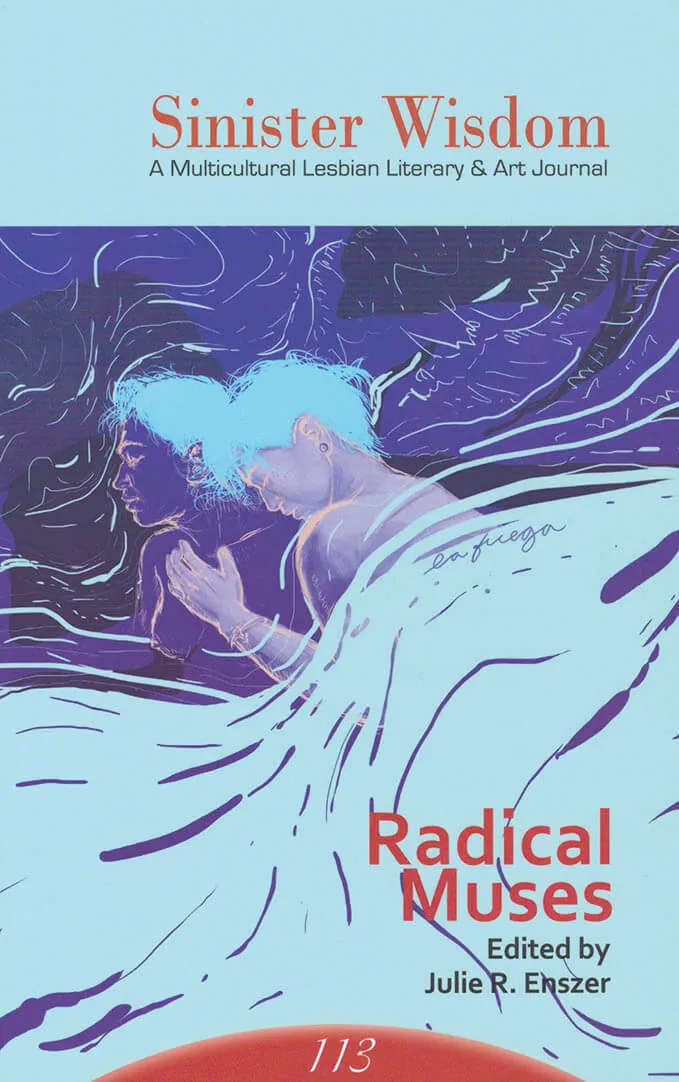
Cover of Radical Muses (Sinister Wisdom nr. 113)

Sinister Wisdom

Radical Muses (Sinister Wisdom nr. 113)

Julie R. Enszer

Sinister Wisdom 113: Radical Muses features an eclectic array of contemporary poetry, prose, and art by lesbians from around the world, including new work by: Andrea Assaf, Tara Shea Burke, Cheryl Clarke, Marina Chirkova, Estela González, Barbara Haas, Nancy E. Lake, Vi Khi Nao, H. Ní Aódagaín and much more!

Cover of Starship 20

Starship Magazine

Starship 20

Henrik Olesen, Ariane Müller

Contributors to Starship № 20:

Rosa Aiello, Terry Atkinson, Tenzing Barshee, Gerry Bibby, Mercedes Bunz, David Bussel, Jay Chung, Eric D. Clark, Caleb Considine, Hans-Christian Dany, Albert Dichy, Nikola Dietrich, Martin Ebner, Ruth Angel Edwards, Stephanie Fezer, Jean Genet, Simone Gilges, Julian Göthe, Michèle Graf, Selina Grüter, Ulrich Heinke, Toni Hildebrandt, Beatrice Hilke, Karl Holmqvist, Stephan Janitzky, G. Peter Jemison, Charlotte Johannesson, Julia Jost, Julia Jung, Jakob Kolding, Nina Könnemann, Lars Bang Larsen, Anita Leisz, Norman Lewis, Elisa R. Linn, Sebastian Lütgert, Vera Lutz, Chloée Maugile, Robert McKenzie, Ariane Müller, Christopher Müller, Robert M. Ochshorn, Henrik Olesen, Kari Rittenbach, Nina Rhode, Ulla Rossek, Cameron Rowland, Mark von Schlegell, Ryan Siegan Smith, Philipp Simon, Valerie Stahl Stromberg, Josef Strau, Vera Tollmann, Eleanor Ivory Weber, Camilla Wills, Amelie von Wulffen and Florian Zeyfang.

"This is the 20th issue of Starship and we are proud and very happy to present it, and mainly want to thank all the artists, the contributors, the columnists, and the people who helped us gather images of exhibitions past, and gave us texts from books not yet published. Starship never starts with a clear concept about its future content, or what could be called a theme, but always with a sort of attentive interest. The theme may develop through its columnists—we now think it is easy to distinguish lines of thoughts, images, and texts answering each other. But it surely does so out of this editorial interest that wanders, and finds, and collects, is enthusiastic about artworks, and texts, and people, and then, well, brings this all together in a magazine. This was our working mode during the past year, and the responsiveness of those who regularly write for Starship (the columnists) has shown us that out there others are involved in thoughts that run very much in parallel. It is a strange form, a magazine like this, not getting funded, appearing irregularly, but still following a sort of conventional form that shows its consistency. It is at its core an excess of producing something that might prove itself valuable and liberating in the future."
—Ariane Müller, Henrik Olesen