rile*books

Search books

Search books by title, author, publisher, keywords...

Cover of German Theater 2010–2022

Inventory Press

German Theater 2010–2022

Calla Henkel, Max Pitegoff

€45.00

Calla Henkel and Max Pitegoff: German Theater 2010–2022 is the first monograph on the work of the artist duo Calla Henkel (b. 1988, Minneapolis, MN) and Max Pitegoff (b. 1987, Buffalo, NY). Their manifold practices play out, live test, and fictionalize the mechanisms that shape creative communities. Chronicling over a decade of production in Berlin, the book is organized around the influential bar and theater spaces they ran there: Times Bar (2011–12), New Theater (2013–15), Grüner Salon at the Volksbühne (2017–18), and TV Bar (2019–22), and includes an interview with curator Fabrice Stroun and essays by David Bussel and Patrick Armstrong. Henkel and Pitegoff's photographs, plays, writing, and films address the complexity of collective action, painting a deadpan picture of the social and economic systems that sustain communal exchanges and their eminently fragile autonomy.

Edited by Fabrice Stroun
Design by Dan Solbach

Language: English

recommendations

Cover of Clara Istlerová: a Life Among Letters

Inventory Press

Clara Istlerová: a Life Among Letters

Anežka Minaříková, Clara Istlerová

Clara Istlerová: A Life Among Letters is the first publication in the United States to delve into the design landscape of the former Czechoslovakia through the lens of Czech designer Clara Istlerová (born 1944). A trailblazer in her field, Istlerová was one of the few women in the male-dominated field of Czech typography. This publication introduces readers to Istlerová’s renowned book designs, particularly highlighting the analog processes she utilized to create one of the most influential books on Czech architecture, Švácha, Rostislav. From Modernity to Functionalism (Odeon, 1985).

The publication features an intimate interview with Istlerová conducted by editor Anežka Minaříková, accompanied by work from Istlerová’s personal archive alongside discussions detailing her creative process. Offering a vivid portrayal of an era where design was a tangible, labor-intensive endeavor carried out in close collaboration with typesetters and printers, the publication unveils the Czech design narrative of the twentieth century to English-speaking readers, highlighting Istlerová’s lasting impact and central role.

Design by Anežka Minaříková and Marek Nedelka

Cover of Cyberfeminism Index

Inventory Press

Cyberfeminism Index

Mindy Seu

Hackers, scholars, artists and activists of all regions, races and sexual orientations consider how humans might reconstruct themselves by way of technology.

When learning about internet history, we are taught to focus on engineering, the military-industrial complex and the grandfathers who created the architecture and protocol, but the internet is not only a network of cables, servers and computers. It is an environment that shapes and is shaped by its inhabitants and their use.

The creation and use of the Cyberfeminism Index is a social and political act. It takes the name cyberfeminism as an umbrella, complicates it and pushes it into plain sight. Edited by designer, professor and researcher Mindy Seu (who began the project during a fellowship at the Harvard Law School's Berkman Klein Center for the Internet & Society, later presenting it at the New Museum), it includes more than 1,000 short entries of radical techno-critical activism in a variety of media, including excerpts from academic articles and scholarly texts; descriptions of hackerspaces, digital rights activist groups, bio-hacktivism; and depictions of feminist net art and new media art.

Contributors include: Skawennati, Charlotte Web, Melanie Hoff, Constanza Pina, Melissa Aguilar, Cornelia Sollfrank, Paola Ricaurte Quijano, Mary Maggic, Neema Githere, Helen Hester, Annie Goh, VNS Matrix, Klau Chinche / Klau Kinky and Irina Aristarkhova.

Cover of Anna Oppermann: Drawings

Inventory Press

Anna Oppermann: Drawings

Anna Oppermann

Surreal, psychedelic riffs on domestic objects from a trailblazing feminist artist. 

From her beginning in the mid-1960s through the early '70s, German artist Anna Oppermann (1940-1993) - best known for her encyclopedic, immersive installations - created an astonishing series of surreal, almost psychedelic drawings that quietly explode the private space of the home, and her experience within it. These early drawings contribute to a feminist reentering of spheres traditionally associated with women, casting everyday objects as symbolic, consequential protagonists: houseplants sprawl to take over the picture plane, windows and mirrors provide views into other worlds and tables display drawings that themselves open out into new domestic scenes. By placing her own body—her knees, arms, the back of her head—as reference points in the work, Oppermann emphasizes the gendered realms of the home and the relationships that we form to our private spaces.

This volume gathers these drawings and early installations in an English-language publication for the first time.

Cover of Teddy Sandoval and the Butch Gardens School of Art

Inventory Press

Teddy Sandoval and the Butch Gardens School of Art

C. Ondine Chavoya, David Evans Frantz

Published to accompany the artist’s first retrospective exhibition, Teddy Sandoval and the Butch Gardens School of Art examines the work of the inventive yet overlooked Teddy Sandoval, a central figure in Los Angeles’s queer and Chicanx artistic circles. Sandoval was known for producing subversive and playful artworks in a range of media that explored the codes of gender and sexuality, particularly conceptions of masculinity.

This publication surveys Sandoval’s work alongside other queer, Latinx, and Latin American artists whose practices profoundly resonate. This expansive catalogue features essays by C. Ondine Chavoya, David Evans Frantz, Raquel Gutiérrez, and Mari Rodríguez Binnie, as well as biographical entries on other artists featured in the exhibition, including Félix Ángel, Myrna Báez, Álvaro Barrios, Ester Hernández, Hudinilson Jr., Antonio Lopez, María Martínez-Cañas, Marisol, and Joey Terrill.

Design by Content Object
Co-published by Inventory Press, Williams College Museum of Art, Vincent Price Art Museum, and Independent Curators International

Cover of == #2 (edition)

Capricious

== #2 (edition)

Matt Keegan

First launched in 2012, and published by mfc michèle didier (micheledidier.com), == is a small-run arts publication, edited by Matt Keegan. ==#2, 2015, is designed by Su Barber and published in an edition of 500 by Capricious Publishing. Barber and Keegan worked together on North Drive Press (northdrivepress.com) between 2005-2010, and this publication shares a variety of traits with NDP.

==#2 is a non-thematic arts publication contained in a box with a 96-page bound volume featuring artist-to-artist interviews, texts, and transcriptions. Six loose multiples are also included.

Contributors include: Sam Anderson, Uri Aran, Fia Backström, Darren Bader, Judith Barry, Stefania Bortolami, Daniel Bozhkov, Milano Chow, Anna Craycroft, Lucky DeBellevue, Cristina Delgado, Haytham El-Wardany, Jake Ewert, Vincent Fecteau, Corrine Fitzpatrick, Harrell Fletcher, Rachel Foullon, Aurélien Froment, Kenny Greenberg, Calla Henkel, Leslie Hewitt, Jaya Howey, Adelita Husni-Bey, Iman Issa, Ruba Katrib, Jill Magid, Jo Nigoghossian, Aaron Peck, Max Pitegoff, David Placek, Olivia Plender, Lisa Robertson, Andrew Russeth, Amy Sillman, Diane Simpson, Greg Parma Smith, Jessica Stockholder, Martine Syms, and Anicka Yi.

Cover of Unbidden Tongues #9: Potty Mouth

Unbidden Tongues

Unbidden Tongues #9: Potty Mouth

Violet Bartley

Unbidden Tongues #9: Potty Mouth is a collection of what could be described as concrete poetry, written over the past two years by our niece Violet Bartley, now aged five. Typed at a computer and sent exclusively via e-mail, the poems stand as clear evidence of a person in the beginnings of grasping (at) language. Throughout, characters are repeated uninterrupted until margins break them, keys pushed down by a finger not yet strong enough to lift itself up.

Over the years, as her written vocabulary grew and these attempts at communication slowly stacked up into the collection printed here, Violet delivered poem after poem within which different mutations of the word ‘poo’ were uttered in type: poo, poobum, bum poo, ipoo, poop. While simple, often illegible and definitely isolated utterances (she never replies when you send a poem back in turn), they are decipherable examples of someone learning defiance through language.

Cover of Sketchbook 1-10

Birthday, Felony & Fuss

Sketchbook 1-10

Antoinette d’Ansembourg

“Sketchbook 1-10” with Antoinette d’Ansembourg bundles a complete collection of pocket sketches created between 2020 and 2023, stretched across ten different notebooks. These sketches, despite their two-dimensionality, form the mainstay of her sculptural output, offering a glimpse into the intimate process behind her stately installations.

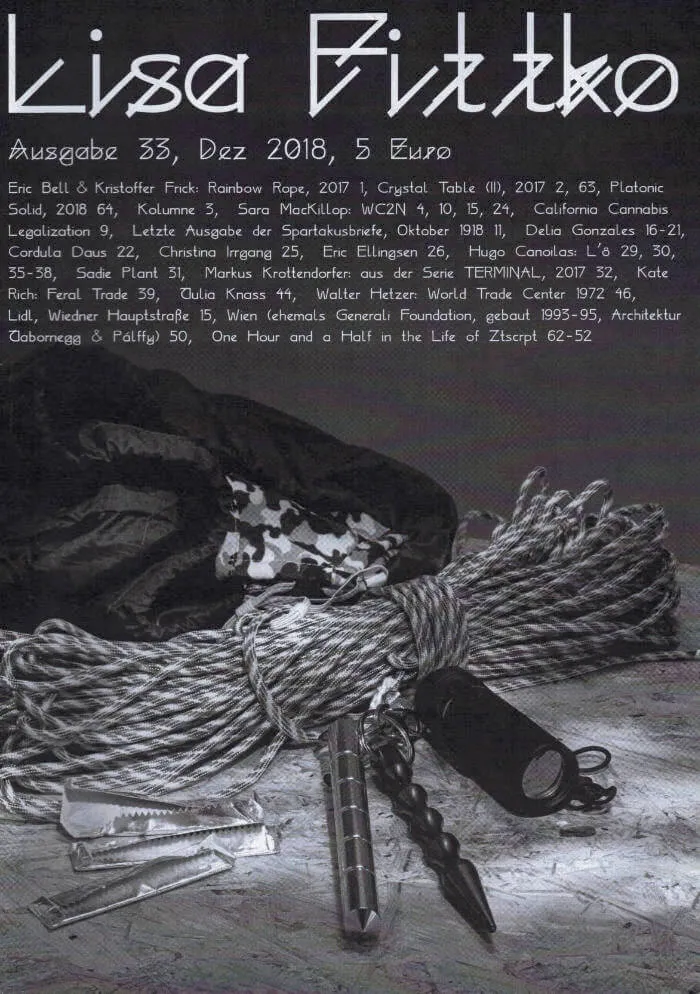
Cover of ztscript 33 : Lisa Fittko

ztscript

ztscript 33 : Lisa Fittko

ztscript

Typeface by Bea Schlingelhoff, from the Project "Women against Hitler"

Eric Bell & Kristoffer Frick: Rainbow Rope, 2017 1, Crystal Table (II), 2017 2, 63, Platonic Solid, 2018 64, Kolumne 3, Sara MacKillop: WC2N 4, 10, 15, 24, California Cannabis Legalization 9, Letzte Ausgabe der Spartakusbriefe, Oktober 1918 11, Delia Gonzales 16-21, Cordula Daus 22, Christina Irrgang 25, Eric Ellingsen 26, Hugo Canoilas: L’ô 29, 30, 35-38, Sadie Plant 31, Markus Krottendorfer: aus der Serie TERMINAL, 2017 32, Kate Rich: Feral Trade 39, Julia Knass 44, Walter Hetzer: World Trade Center 1972 46, Lidl, Wiedner Hauptstraße 15, Wien (ehemals Generali Foundation, gebaut 1993-95, Architektur Jabornegg & Pálffy) 50, One Hour and a Half in the Life of Ztscrpt 62-52