rile*books

Search books

Search books by title, author, publisher, keywords...

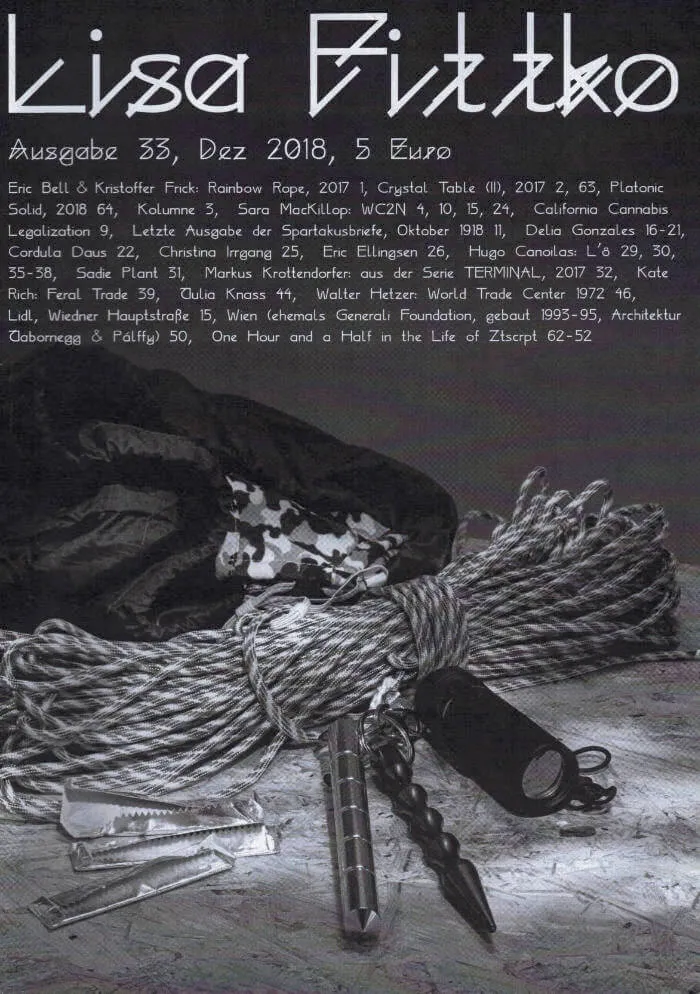
Cover of ztscript 33 : Lisa Fittko

ztscript

ztscript 33 : Lisa Fittko

ztscript

€5.00

Typeface by Bea Schlingelhoff, from the Project "Women against Hitler"

Eric Bell & Kristoffer Frick: Rainbow Rope, 2017 1, Crystal Table (II), 2017 2, 63, Platonic Solid, 2018 64, Kolumne 3, Sara MacKillop: WC2N 4, 10, 15, 24, California Cannabis Legalization 9, Letzte Ausgabe der Spartakusbriefe, Oktober 1918 11, Delia Gonzales 16-21, Cordula Daus 22, Christina Irrgang 25, Eric Ellingsen 26, Hugo Canoilas: L’ô 29, 30, 35-38, Sadie Plant 31, Markus Krottendorfer: aus der Serie TERMINAL, 2017 32, Kate Rich: Feral Trade 39, Julia Knass 44, Walter Hetzer: World Trade Center 1972 46, Lidl, Wiedner Hauptstraße 15, Wien (ehemals Generali Foundation, gebaut 1993-95, Architektur Jabornegg & Pálffy) 50, One Hour and a Half in the Life of Ztscrpt 62-52

Language: English

recommendations

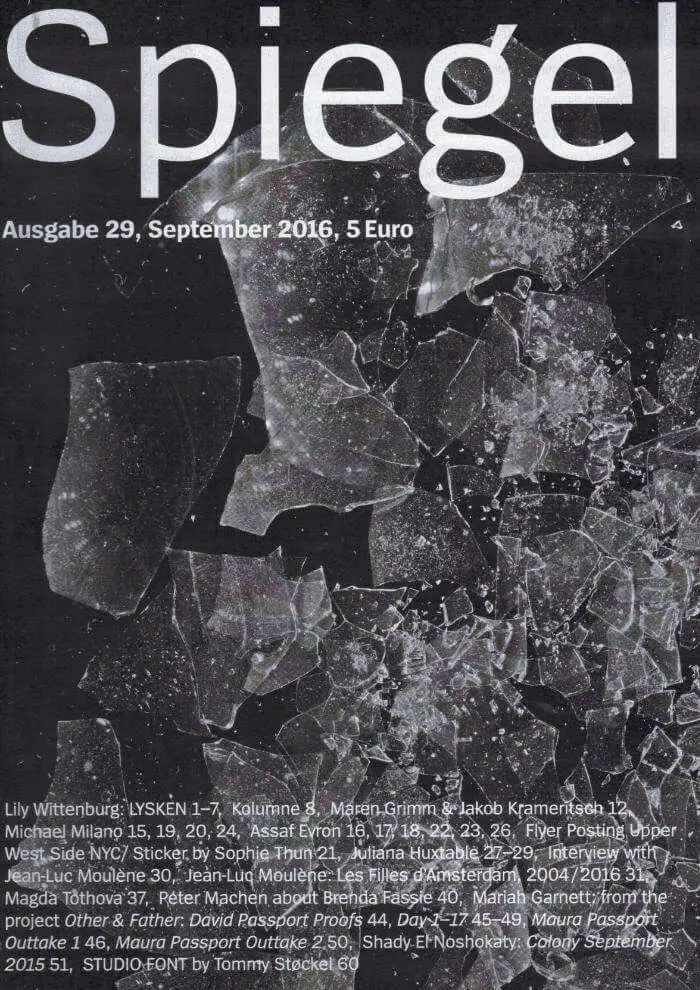
Cover of ztscript  29 : Spiegel

ztscript

ztscript 29 : Spiegel

ztscript

This issue uses the font designed for german news magazine Spiegel by amazing Lucas de Groot. The color poster is part of the full print of the series “Les Filles d’Amsterdam” by photographer Jean-Luc Moulène. It is the first time this series is printed in book form and in an exclusive interview the artist tells the story of that work.

Contributors: Lily Wittenburg, Maren Grimm & Jakob Krameritsch, Michael Milano, Assaf-Evron, Sophie Thun, Juliana Huxtable, Interview with Jean-Luc Moulène, poster by Jean-Luc Moulène, Magda Tóthová, Peter Machen on Brenda Fassie, Mariah Garnett, Shady El NoshokatyTommy Støckel

Cover of Unbidden Tongues #9: Potty Mouth

Unbidden Tongues

Unbidden Tongues #9: Potty Mouth

Violet Bartley

Unbidden Tongues #9: Potty Mouth is a collection of what could be described as concrete poetry, written over the past two years by our niece Violet Bartley, now aged five. Typed at a computer and sent exclusively via e-mail, the poems stand as clear evidence of a person in the beginnings of grasping (at) language. Throughout, characters are repeated uninterrupted until margins break them, keys pushed down by a finger not yet strong enough to lift itself up.

Over the years, as her written vocabulary grew and these attempts at communication slowly stacked up into the collection printed here, Violet delivered poem after poem within which different mutations of the word ‘poo’ were uttered in type: poo, poobum, bum poo, ipoo, poop. While simple, often illegible and definitely isolated utterances (she never replies when you send a poem back in turn), they are decipherable examples of someone learning defiance through language.

Cover of My Mother My Home

Archive Books

My Mother My Home

Chipo Chipaziwa

Performance €18.00

Who claims abstraction? What are the limits of abstraction? Are statelessness, dislocation and feelings of (un) belonging embodiments of an abstracted self that is in itself a work in progress? How could performance art—an artistic practice that places significant importance on presence and legibility of form—transgress into the realm of the abstract and the illegible in an effort to protect the artist’s likeness while shedding light on what it means to be in their body in relation to this world?

Chipo Chipaziwa’s My Mother My Home establishes itself as a query on the aspects of belonging and the artist’s own personhood that acts as the foundation of her practice. The question of where one’s personhood begins and ends within an artwork has appeared to be ever prevalent within the realm of visual art and is more relevant within the canon of performance art.

Writers: Chipo Chipaziwa, Denise Ferreira da Silva, Olumoroti George

Contributing artists: Margaret Joba-Woodruff, Sophia Lapres, and David Ezra Wang
Edited by Katrina Geotjen

Cover of Épopées Célestes / Epopee celesti

Éditions Empire

Épopées Célestes / Epopee celesti

Gustavo Giacosa, Barbara Safarova

A veritable panorama of Art Brut at an international level, through 180 works selected from Bruno Decharme's collection.

Art brut has never ceased to shake up the history of art and nourish minds resistant to norms as it questions classic notions of art and creation as well as those relating to the normal and the pathological. But who are they, these artists of a special kind, witnesses to another world, strangers to stylistic trends and influences? They stay—or are kept—away from the culture of fine art as well as the codes and places that constitute it such as schools, academies, museums, art fairs, etc.

Featuring A.C.M., Noviadi Angkasapura, Anselme Boix-Vives, Marie Bodson, Giovanni Bosco, Gustavo Enrique Buongermini, Aloïse Corbaz, Fleury-Joseph Crépin, Egidio Cuniberti, Henry Darger, Fernand Desmoulin, Janko Domsic, Dong-Hyun Kim, Jaime Fernandes, Eugen Gabritschevsky, Pietro Ghizzardi, Madge Gill, Paul Goesch, Jorge Alberto Hernández Cadi, Paul Humphrey, Zdeněk Košek, Joseph Lambert, Gustave Pierre Marie Le Goarant de Tromelin, Augustin Lesage, Pascal Leyder, Alexander Pavlovitch Lobanov, Ramon Losa, Dwight Mackintosh, Lázaro Antonio Martínez Durán, Mettraux, Edmund Monsiel, John Bunion Murray, Iwona Mysera, Koji Nishioka, Masao Obata, Jean Perdrizet, M. Pierron, Photographies Spirites, Miloslava Ratzingerová, Marco Raugel, Achilles G. Rizzoli, Leopold Strobl, Harald Stoffers, Mose Tolliver, Melvin Way, Scottie Wilson, Adolf Wölfli, Anna Zemánková, Carlo Zinelli, Unica Zürn.

Cover of Praise House

Archive Books

Praise House

Adama Delphine Fawundu

Building on the notion of ‘praise,’ Adama Delphine Fawundu frames this book as a celebration of life. She honors the stories whispered to her by her mother; she adorns her body in her grandmother’s textile work; she elevates the memory of various named and unnamed Black women of the diaspora and documents the iconic small Civil War era styled white wooded praise house on a patch of land off the side of a road in South Carolina not far from Beaufort creating an intimate body of work of color photography of an interconnected history.

This book about female figures—grandmothers, mothers, daughters, artists, caregivers, storytellers, and cooks—explores a range of emotions that consume us about family life and history. It is both an art book
and a memoir. Viewing it brings us face to face with known and unknown cultures and introduces us to various art practices shared, taught, and learned through the African diasporic traditions. Fawundu connects to the self through history, joy, and beauty and offers the reader ways to navigate fear based on migration and loss. It is a gift, too, as it allows us to imagine alongside the artist.

Adama Delphine Fawundu is an artist based in Brooklyn, NY of Mende, Bubi, and Krim descent.
Through photography, video, textile-based sculptural forms, and performance, she creates embodied entities inspired by Indigenous knowledge systems and spiritual retentions across time and space. She co-authored the book MFON: Women Photographers of the African Diaspora. She is an Assistant Professor of Visual Arts at Columbia University.

Edited by Chiara Figone

Contributions by Mistura Allison, Berette S Macaulay, Niama Sandy, Bonaventure Soh Bejeng Ndikung, Deborah Willis

Cover of Mousse #93

Mousse Publishing

Mousse #93

Periodicals €16.00

Andrew Berardini on Artificial Intelligence; Pepón Osorio; Arash Nassiri; Gloria E. Anzaldúa; Marcela Guerrero speaks with C. Ondine Chavoya; Daisy Lafarge; Dani Blanga Gubbay; Davide Stucchi speaks with Alex Bennett; Luca Lo Pinto on Hanuman Editions; Reynaldo Rivera & Abdellah Taïa; Jungle Books...

This issue comes with different covers, randomly distributed.