rile*books

Search books

Search books by title, author, publisher, keywords...

Cover of Diversity of Aesthetics

Common Notions

Diversity of Aesthetics

Jose Rosales ed., Andreas Petrossiants ed.

€20.00

Critical conversations and reflections about lessons learned at the intersection of social movements and artist production. 

Diversity of Aesthetics collects powerful and timely conversations among leading cultural critics, artists, and organizers to connect the threads between some of the most pressing social struggles and conflicts of our time: policing, war, borders and migration, economic crisis. 

Across three themes—infrastructure, migration, and riots—militant thinkers, artists, educators, and others discuss aesthetic production, forms of social organization, modes of struggle against gendered and racialized capitalism, and revolutionary theory. Common to all three conversations is a commitment to rethinking the relationship between forms of critique and forms of struggle undertaken by collective social practices, offering lessons for tactics, strategies, and practices.

With contributions by Claire Fontaine, Iman Ganji, Saidiya Hartman, Vicky Osterweil, Andreas Petrossiants, Christina Sharpe, Stevphen Shukaitis, Michael Rakowtiz, Shellyne Rodriguez, Jose Rosales, Rinaldo Walcott, Andreas Petrossiants, Jose Rosales

Andreas Petrossiants is a writer and associate editor of e-flux journal. His work has appeared in Historical Materialism, Social Text, New Inquiry, AJ+ Subtext, Frieze, Bookforum.com, Roar Magazine, the Verso blog, the Brooklyn Rail, Hyperallergic. He is a PhD candidate in performance studies at NYU where he is researching anti-eviction, squatting, and tenants’ movements as they relate to the production of social space.

Jose Rosales is an independent researcher and journalist based in Lisbon, Portugal. His work has appeared in e-flux notes, Lumpen: A Journal of Poor and Working Class Writers, and has contributed a chapter called “Communism As the Riddle Posed to History” in Double Binds of Neoliberalism (2022).

Published in 2025 ┊ 176 pages ┊ Language: English

recommendations

Cover of Everything for Everyone: An Oral History of the New York Commune, 2052-2072

Common Notions

Everything for Everyone: An Oral History of the New York Commune, 2052-2072

M.E. O'Brien, Eman Abdelhadi

Fiction €18.00

By the middle of the twenty-first century, war, famine, economic collapse, and climate catastrophe had toppled the world's governments. In the 2050s, the insurrections reached the nerve center of global capitalism—New York City. This book, a collection of interviews with the people who made the revolution, was published to mark the twentieth anniversary of the New York Commune, a radically new social order forged in the ashes of capitalist collapse.

Here is the insurrection in the words of the people who made it, a cast as diverse as the city itself. Nurses, sex workers, antifascist militants, and survivors of all stripes recall the collapse of life as they knew it and the emergence of a collective alternative. Their stories, delivered in deeply human fashion, together outline how ordinary people's efforts to survive in the face of crisis contain the seeds of a new world.

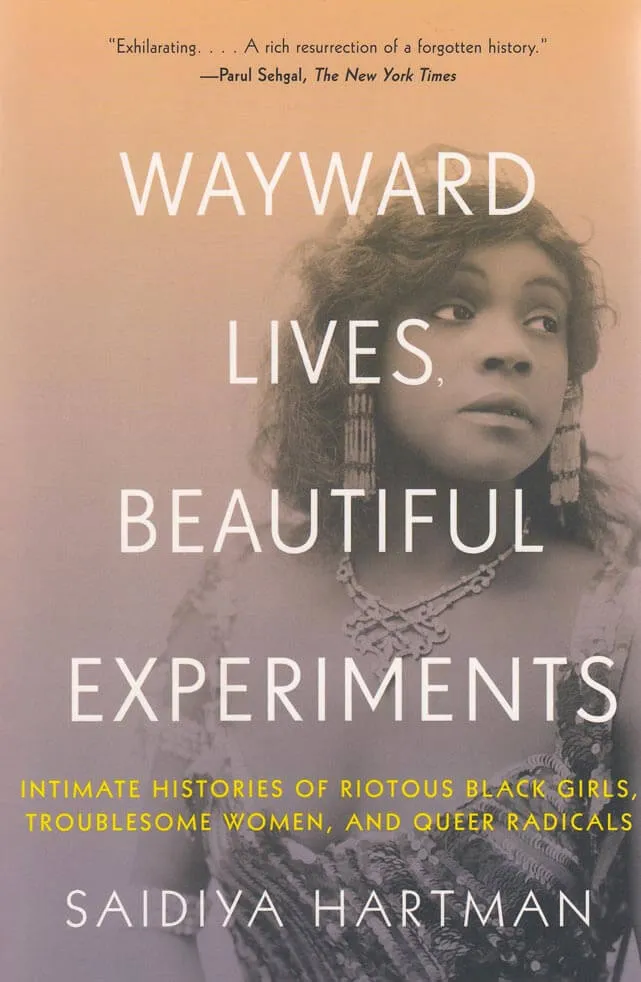
Cover of Wayward Lives, Beautiful Experiments

W. W. Norton & Company

Wayward Lives, Beautiful Experiments

Saidiya Hartman

Wayward Lives, Beautiful Experiments examines the revolution of black intimate life that unfolded in Philadelphia and New York at the beginning of the twentieth century. In wrestling with the question of what a free life is, many young black women created forms of intimacy and kinship indifferent to the dictates of respectability and outside the bounds of law. They cleaved to and cast off lovers, exchanged sex to subsist, and revised the meaning of marriage. Longing and desire fueled their experiments in how to live. They refused to labor like slaves or to accept degrading conditions of work. Here, for the first time, these women are credited with shaping a cultural movement that transformed the urban landscape. Through a melding of history and literary imagination, Wayward Lives, Beautiful Experiments recovers these women's radical aspirations and insurgent desires.

Cover of Ordinary Notes

Picador

Ordinary Notes

Christina Sharpe

A singular achievement, Ordinary Notes explores profound questions about loss and the shapes of Black life that emerge in the wake. In a series of 248 notes that gather meaning as we read them, Christina Sharpe skillfully weaves artifacts from the past—public ones alongside others that are poignantly personal—with present realities and possible futures, intricately constructing an immersive portrait of everyday Black existence. The themes and tones that echo through these pages—sometimes about language, beauty, memory; sometimes about history, art, photography, and literature—always attend, with exquisite care, to the ordinary-extraordinary dimensions of Black life.

At the heart of Ordinary Notes is the indelible presence of the author’s mother, Ida Wright Sharpe. “I learned to see in my mother’s house,” writes Sharpe. “I learned how not to see in my mother’s house . . . My mother gifted me a love of beauty, a love of words.” Using these gifts and other ways of seeing, Sharpe steadily summons a chorus of voices and experiences to the page. She practices an aesthetic of "beauty as a method,” collects entries from a community of thinkers toward a “Dictionary of Untranslatable Blackness,” and rigorously examines sites of memory and memorial. And in the process, she forges a brilliant new literary form, as multivalent as the ways of Black being it traces.

Cover of Initiales #05 — Andrea Fraser

École nationale supérieure des beaux-arts de Lyon

Initiales #05 — Andrea Fraser

Claire Moulène, Emmanuel Tibloux

Periodicals €15.00

Le cinquième numéro de la revue d'art et de recherche « rétro-prospective » est consacré à l'artiste et performeuse Andrea Fraser, figure clé de l'art des années 1990 et 2000 et du courant de la « critique institutionnelle » (une monographie complétée par une grande enquête sur l'espace critique réalisée auprès d'une cinquantaine d'artistes, critiques et philosophes internationaux).

Avec contributions de Kader Attia, Eva Barto, Sophie Bonnet-Pourpet, Marie de Brugerolle, Gregory Buchert, Daniel Buren, Marie Canet, Gregory Castéra, Inès Champey, Thierry Chancogne, Claire Fontaine, François Cusset, Judith Deschamps, Paul Devautour, Philippe Durand, Joao Enxuto & Erica Love, Andrea Fraser, Nicolas Frespech, Dora García, Romain Grateau, Emmanuel Guez, Thomas Hirschhorn, Aliocha Imhoff & Kantuta Quirós, Béatrice Josse, Franck Larcade, Ju Huyn Lee, Sven Lütticken, Fabrice Mabime, Bartomeu Mari, Chus Martínez, Gwenael Morin, Claire Moulène, Jean-Luc Moulène, Yan Moulier Boutang, Vincent Normand, François Pain, Gerald Petit, Anne Querrien, Thierry Raspail, Sinziana Ravini, Delphine Reist & Laurent Faulon, Christophe de Rohan Chabot, Phillippe Roux, Jean-Baptiste Sauvage, Thomas Schlesser, Ida Soulard, Fabien Steichen, Michel Surya, Emmanuel Tibloux, Vier 5, Ulf Wuggenig, Italo Zuffi.

Cover of À perte de mère – Sur les routes atlantiques de l'esclavage

Brook

À perte de mère – Sur les routes atlantiques de l'esclavage

Saidiya Hartman

Saidiya Hartman traces the history of the Atlantic slave trade by recounting a journey she took along a slave route in Ghana. Following the trail of captives from the hinterland to the Atlantic coast, she reckons with the blank slate of her own genealogy and vividly dramatizes the effects of slavery on three centuries of African and African American history.

Saidiya Hartman, professor of English and comparative literature at Columbia University, is a scholar of African American literature and cultural history.

Preface by Maboula Soumahoro.

Translated from the English (American) by Maboula Soumahoro (original title: Lose Your Mother. A Journey Along The Atlantic Slave Route, Farrar, Straus and Giroux, 2007).

Cover of Self-portrait

Divided Publishing

Self-portrait

Allison Grimaldi Donahue, Carla Lonzi

Non-fiction €17.00

Recorded and transcribed throughout the 1960s, Carla Lonzi’s Self-portrait ruptures the narration of post-war modern art in Italy and beyond. Artmaking struck Lonzi as an invitation to be together in a ‘humanly satisfying way’, and this experiment in art-historical writing is a testament to her belief. Lonzi abolishes the role of the critic, her own, seeking change over self-preservation by theorising against the act of theorising.

The life and work of Carla Lonzi (1931–1982) is inseparable from the cultural, political, and social history of Italy in the decades following the Second World War; she occupies a singular position, which today merits reevaluation. A reputed art critic of the 1960s artistic scene, both friend and collaborator of such figures as Carla Accardi, Luciano Fabro, Giulio Paolini, and Jannis Kounellis, she wrote “Autoportrait” in 1969, a “love letter” to the artists and to creation, but also a farewell chorus to art criticism and the art world. The following year she founded Rivolta Femminile, an active feminist collective, thus becoming the central figure of Italian feminism.

Interviews with Carla Accardi, Getulio Alviani, Enrico Castellani, Pietro Consagra, Luciano Fabro, Lucio Fontana, Jannis Kounellis, Mario Nigro, Guilio Paolini, Pino Pascali, Mimmo Rotella, Salvatore Scarpita, Guilio Turcato, Cy Twombly.

Afterword by Claire Fontaine.
Translated by Allison Grimaldi Donahue.

978-1916425088
105 b&w illustrations
21.6 x 13.9 cm
364 p.
Paperback
November 2021

Cover of Re-Enchanting the World

PM Press

Re-Enchanting the World

Silvia Federici

In this edited collection of work spanning more than 20 years, Silvia Federici provides a detailed history and critique of the politics of the commons from a feminist perspective. In her clear and combative voice, Federici provides readers with an analysis of some of the key issues in contemporary thinking on this subject. Drawing on rich historical research, she maps the connections between the previous forms of enclosure that occurred with the birth of capitalism and the destruction of the commons and the "new enclosures" at the heart of the present phase of global capitalist accumulation.

Considering the commons from a feminist perspective, this collection argues that women and reproductive work are crucial to both our economic survival and the construction of a world free from the capitalist hierarchies. Federici is clear that the commons should not be understood as happy islands in a sea of exploitative relations—but rather autonomous spaces from which to challenge the existing organization of life and labor.

Cover of Brutalism

Duke University Press

Brutalism

Achille Mbembe

In Brutalism, eminent social and critical theorist Achille Mbembe invokes the architectural aesthetic of brutalism to describe our moment, caught up in the pathos of demolition and production on a planetary scale.

Just as brutalist architecture creates an affect of overwhelming weight and destruction, Mbembe contends that contemporary capitalism crushes and dominates all spheres of existence. In our digital, technologically focused era, capitalism has produced a becoming-artificial of humanity and the becoming-human of machines. This blurring of the natural and artificial presents a planetary existential threat in which contemporary society’s goal is to precipitate the mutation of the human species into a condition that is at once plastic and synthetic.

Mbembe argues that Afro-diasporic thought presents the only solution for breaking the totalizing logic of contemporary capitalism: repairing that which is broken, developing a new planetary consciousness, and reforming a community of humans in solidarity with all living things.