"be good"
"be good"

Faux Pas
Essays on art-making, abstraction, humor, not-knowing, awkwardness and more, from one of New York’s most influential and popular painters and teachers
Since the 1970s, Amy Sillman—a beloved and key figure of the New York art scene—has developed a singular body of work that includes large-scale gestural paintings blending abstraction with representation, as well as zines and iPad animations.
Over the past decade, Sillman has also produced stimulating essays on the practice of art or the work of other artists: for example, reevaluating the work of the abstract expressionists with a queer eye; elaborating on the role of awkwardness and the body in the artistic process; and discussing in depth the role and meanings of color and shape. Featuring a foreword by Lynne Tillman, Faux Pas is the first book to gather a significant selection of Sillman’s essays, reviews and lectures, accompanied by drawings, most of them made specially for the book.
Faux Pas aims at revealing the coherence and originality of Sillman’s reflection, as she addresses the possibilities of art today, favoring excess over good taste, wrestling over dandyism, forms over symbols, with as much critical sense as humor. As Jason Farago notes in the New York Times, "Sillman is in a thin crowd (with, let’s say, Andrea Fraser, Hito Steyerl, Matias Faldbakken, David Salle) of artists who can really write. The evidence is in Faux Pas ... her writings display the same good humor and intelligence of her best paintings."
Based in New York City, Amy Sillman (born 1955) is an artist whose work consistently combines the visceral with the intellectual. She began to study painting in the 1970s at the School of Visual Arts and she received her MFA from Bard College in 1995. Her work has been exhibited internationally, including at the Whitney Biennial in 2014; her writing has appeared in Bookforum and Artforum, among other publications. She is currently represented by Gladstone Gallery, New York.

F.R. David - Correctional Facility
F.R.DAVID is a typographical journal, dealing with the organisation of reading and writing in contemporary art practises. The 20th issue, “Correctional Facility” is edited by Will Holder paying attention to difference; and transformations between
accident⎱design 249
acorn⎱oak 293–94, 297–98
adult⎱child 95, 139, 207, 308
alphabetic⎱postliterary 3
alphabetic⎱postalphabetic 3, 5
alphabetic⎱analphabetic 5
analytic⎱linguistic 298
ankh⎱kiss
angles⎱angels 162
aristocrat⎱ass 12
ass⎱man 28
aye⎱eye 160
bad⎱good 130
(outstandingly⎱remarkably)
before⎱after 19, 49, 51, 158,
201, 263, 305
bitter⎱sweet 65, 163, 217
both⎱and 8, 119, 123, 160, 173, 180, 245, 292, 298
cart⎱horse 2, 9
coming into being⎱passing away 318
communism⎱democracy 319
composition⎱improvisation
163, 168, 170
concrete⎱abstract 288
dark⎱light 43, 64, 127, 223,
261, 300, 309, 316
diegetic⎱non-diegetic 145, 193
dropped out⎱drop doubt 160
either⎱or 6, 14, 39, 43, 54, 85, 119, 120, 132, 195, 223, 249, 288
emotional⎱intellectual 297
enthusiastic⎱tempered 13, 78, 205
ἕν καἰ τὀ πᾶν⎱one and all 224
everything⎱fragment 33, 138
everything⎱all things 218–22
experience⎱attention 39, 40, 65, 254–5
green⎱blue 127
high modernism⎱post-structuralist⎱postmodernism 165
radical modernism⎱modernism⎱
postmodernism 4, 164–66
I⎱sigh 160
image⎱word 6, 72, 316–18
Isis⎱Isis 226
jar⎱jars 76, 158, 159
left⎱right 7, 28, 127, 217
meaningful⎱meaningless 258
oak (a⎱ok) 290, 293–94, 297–98
orality⎱textuality 3, 264
phoneme⎱letter 180
phonetic⎱ideogrammatic 297
shit⎱gold †
signal⎱noise 39, 40, 65, 254–55
sweat⎱tears 292
tail⎱bell-rope 151, 154
thesis⎱antithesis 322
written⎱unwritten 158, 296–97
vowel⎱consonant 180–82, 292
we are⎱we ain’t 93
white pawn⎱white pawn 224
word⎱world 8, 12, 138, 160, 165, 166, 180, 183, 260, 265, 287, 298, 300, 315, 317
writing⎱nature 27, 44, 83, 120,
121, 126, 166, 183, 198, 203,
219–20, 252, 297, 318–19

Beautiful Aliens: A Steve Abbott Reader
Beautiful Aliens: A Steve Abbott Reader is a landmark collection representing the visionary life's work of beloved Bay Area luminary Steve Abbott. It brings together a broad cross-section of literary and artistic work spanning three decades of poetry, fiction, collage, comics, essays, and autobiography, including underground classics like, Lives of the Poets and Holy Terror, rare pieces of treasured ephemera, and previously unpublished material, representing a survey of Abbott's multivalent practice, as well as reinforcing his essential role within the contemporary canon of queer arts.
"Holy Terror is good reading, well written and extremely knowledgeable about the subject of magic black and white. In fact, all magic is both."—William Burroughs
"All of us who knew the late Steve Abbott will now be happy that the stone has rolled back, to reveal the amazing accomplishment of Beautiful Aliens, poet Jamie Townsend's masterful take on Steve's multigenre work. Prose, poetry, journalism, the essay, the comic book, the novel: Steve was driven to try his hand at all these categories, excelling more often then you'd think possible. It's time that people knew a genius (of sorts) once lived at the corner of Haight and Ashbury." — Kevin Killian
Steve Abbott (1943-1992) was a poet, critic, editor, novelist and artist. Abbott was raised in Lincoln, Nebraska, graduated from the University of Nebraska, and attended Emory University where he was an organizer for Atlanta's Gay Liberation Front and the gay lib editor at the underground paper The Great Speckled Bird. Abbott moved to San Francisco in 1974 where he became was a frequent contributor to local publications, including The Advocate, The Sentinel, and the Bay Area Reporter. He was also one of the founding editors of the literary arts newsletter Poetry Flash and the publisher/editor of the literary journal Soup. Steve wrote a number of books of poetry and prose during the 1980s and early 90s including: "Wrecked Hearts", "Stretching the Agape Bra", "Lives of the Poets", "Holy Terror", "Skinny Trip to a Far Place", and "View Askew: Postmodern Investigations", a book that collects Steve's essays from The San Francisco Sentinel, The Advocate, and the arts journal Mirage. He was active in various reading series and discussion groups in the Bay Area, including Cloud House and Small Press Traffic, and, in 1981, he co-organized the historic Left/Write conference. Steve was also a respected critic and the first to use the term "New Narrative" to describe the work of contemporaries including Bruce Boone and Robert Glück. Abbott died of complications due to AIDS on December 2, 1992. His novel The Lizard Club was published posthumously. Jamie Townsend is a genderqueer poet, publisher, and editor living in Oakland, California. They are half-responsible for Elderly, a publishing experiment and persistent hub of ebullience and disgust. They are the author of several chapbooks including, most recently, Pyramid Song (2018) as well as the full-length collection SHADE (2015). An essay on the history of the New Narrative magazine Soup was published in The Bigness of Things: New Narrative and Visual Culture (2017).
Published December 2019.

Movement Research Performance Journal
Issue #54 - Spatial Practice
Movement Research announces Issue 54 of its publication, the Movement Research Performance Journal. Continuing to experiment with approaches that engage contemporary choreography and performance through the medium of print—poem, prose, image, interview and a wide range of formats give form to critical and self-reflexive discourses and material histories. Movement Research Performance Journal acts as a site of convergence between publication, editors, writers, designers, and artists to consider the place of dance, performance, and choreography in relation to the contemporary moment.
For MRPJ54: Spatial Practice, guest editor, artist Alan Ruiz invited contributors to examine the ongoing legacy of neoliberalism and the cultural production it engenders, specifically focusing on the relation between bodies and the built environment. Contributors have explored the contexts and histories in which we dwell, create, and coexist to interrogate how space is produced both as material and ideology during the hyper-development and hyper-exploitation of the urban environment, predominantly in New York City. Spatial Practice asks: how does this impact the bodies that labor and move to keep the kinetic machine of “progress” moving? Contributions offer multiple perspectives—through a variety of genres—on the ways in which the political project of neoliberalism has, in part, shaped the designation and use of public space as well as enthroned the philanthropic class and the cultural institutions associated with them. Alongside the consolidation of wealth and power, neoliberalism’s underlying insistence on individualism has also reinforced and normalized the braided conditions of capitalist exploitation, structural racism, and patriarchal domination. Unraveling this logic allows us to collectively imagine alternatives to the prevailing systems of property, dispossession, ableism, and incarceration that parcelize existence.
Contributions from:
Critical Resistance, Alan Ruiz, Lluís Alexandre, Casanovas Blanco, Julie Tolentino and Sadia Shirazi, Kaegan Sparks, Martha Rosler, Suzanne Stephens, Joshua Lubin-Levy, Lo-Yi Chan and Tim Hartung, Olive McKeon, Alice Sheppard, Biba Bell, Erik Thurmond, BRANDT : HAFERD, V. Mitch McEwen and Olivier Tarpaga, Sarah Oppenheimer, Jimmy Robert and Mario Gooden, Dominic Cullinan, Angela Davis J. Bouey and Melanie Greene, Lisa Nelson, Diana Crum, Kristopher, K.Q. Pourzal, Jess Barbagallo, John Hoobyar and Simon Asencio, Layla Zami, Cristiane Bouger, Daria Faïn and Marjana Krajač, Germaine Acogny, Helmut Vogt and André Zachery, Milka Djordevich and Tim Reid, Melanie Maar.

Mercado Livre
Wisrah Villefort’s overarching research focuses on the nonhuman, digital matter, synthetic polymers, prosthetics and their markets.
The ongoing hypermedia work Mercado Livre begun in 2017, is dependent on the viewer performing online, accessing the platform via Instagram. Villefort collects images from online marketplaces based in the Global South, outside of the West, including AliExpress (China) and Mercado Livre (Argentina) for the content. Mercado Livre, besides being the title of the work and the platform, is also the term for the neoliberal principle of the “free market”, in which goods’ prices supposedly regulate themselves.
This book accompanies his exhibition, THE MOUTH OF THE GIFTED HORSE, dissecting Mercado Livre through the eyes of the show, focussing on inter-species relationships and non-human prosthetics, featuring a text written by Villefort during his recent research residency at Pivô, São Paulo, entitled 'Notes on Masks, Gloves and Muzzles: Beyond the Fault of Epimetheus'.

The City We Became
Three-time Hugo Award-winning and New York Times bestselling author N.K. Jemisin crafts her most incredible novel yet, a story of culture, identity, magic, and myths in contemporary New York City. In Manhattan, a young grad student gets off the train and realizes he doesn't remember who he is, where he's from, or even his own name. But he can sense the beating heart of the city, see its history, and feel its power. In the Bronx, a Lenape gallery director discovers strange graffiti scattered throughout the city, so beautiful and powerful it's as if the paint is literally calling to her. In Brooklyn, a politician and mother finds she can hear the songs of her city, pulsing to the beat of her Louboutin heels. And they're not the only ones. Every great city has a soul. Some are ancient as myths, and others are as new and destructive as children. New York? She's got six.
N. K. Jemisin is the first author in history to win three consecutive Best Novel Hugo Awards, all for her Broken Earth trilogy. Her work has also won the Nebula, Locus, and Goodreads Choice Awards. She has been a reviewer for the New York Times Book Review, and an instructor for the Clarion and Clarion West writing workshops. In her spare time, she is a gamer and gardener, and she is also single-handedly responsible for saving the world from King Ozzymandias, her dangerously intelligent ginger cat, and his phenomenally destructive sidekick Magpie.
Published March 2020

In The Shadow Of Forward Motion
David Wojnarowicz's In the Shadow of Forward Motion was originally published as a photocopied zine/artist's book to accompany an exhibition of the same name at PPOW Gallery in 1989. Despite its meager print run of just 50 copies, the publication has garnered a legendary status, and for good reason.
In it we find, for the first time, Wojnarowicz's writing and visual art, two mediums for which he is renowned, playing off each other in equal measure. We glimpse the artist's now iconic mixed-media works, with motifs of ants, locomotives, money, tornados and dinosaurs, juxtaposed with journal-like texts or "notes towards a frame of reference" that examine historical and global mechanisms of power symbolized through the technology of their times.
Wojnarowicz uses the fractured experience of his day-to-day life (including dreams, which he recorded fastidiously) to expose these technologies as weapons of class, cultural and racial oppression. The artist's experience living with HIV is a constant subject of the work, used to shed light on the political and social mechanisms perpetuating discrimination against not only himself, but against women and people of color, who faced additional barriers in their efforts to receive treatment for the illness. Rooted in the maelstrom of art, politics, religion and civil rights of the 1980s, the book provides a startling glimpse into an American culture that we have not yet left behind. Félix Guattari provides an introduction.
Painter, photographer, writer, filmmaker, performance artist, songwriter and activist, David Wojnarowicz was born in Redbank, New Jersey, in 1954 and died of AIDS in New York in 1992. The author of five books—most famously Close to the Knives: A Memoir of Disintegration—Wojnarowicz attained national prominence as a writer and advocate for AIDS awareness, and for his stance against censorship.

Whore Foods
Collecting and expanding pieces from her seminal newsletter detailing the inner and outer sexual life of a grocery store cashier, LA WARMAN'S WHORE FOODS is a guaranteed feast for sore thighs. Now available in raw pulp paperback form for the first time. Cleanup in Aisle 4.
"She made fun of the construction workers for not being white, for not knowing time like she knows time and I can’t say “That’s racist” because I am on the job. I am getting paid not to speak. I am getting paid to open up my body to you but not reveal it. The way I put my eyes down when you fight with your husband in line. To shit my pants only a little so you can’t see. The smell of watercress, pineapple, rice, and shit. She’s in my line again asking me if I eat ass.
Yes, sometimes.
Saw a good ass, saw a real good ass."
LA Warman is a poet and performer. She is the founder of GLASS PRESS, a publisher of art and poetry on flash drives. Warman has had work in shows at MOCA Cleveland, ICA Philadelphia, Time-Based Art Festival, General Public Collective, Flying Object, A.T.M. Gallery, and Open Engagement. Her chapbooks How to Become a Lesbian and THE CAVE THE CHURCH THE BEDROOM THE MALL were published by Inpatient Press and After Hours Ltd. Warman wrote and directed a 12 hour text and movement performance piece, Break, that premiered at Deli Gallery in 2018. She teaches Erotica classes online at LAWarman.com and in Brooklyn.

Decolonizing Non-Violent Communication
Decolonizing NVC is a workbook stocked with activities, exercises, and ideas to explore our relationship to communication, our bodies, and each other. Using a trauma-informed approach, this workbook encourages readers to deepen our emotional vocabularies so that we can work towards a more enlivened, healthy interdependence.
Written by meenadchi. Edited by Nicole Kelly. Design by MJ Balvanera. Infographics by Hana Ward. Binding by WCCW Staff & Cynthia Navarro of Tiny Splendor.
Typeset in Sofia Pro by Olivier Gourvat from Monstardesign and Agentur Regular by Good Type Foundry.
First edition published March, 2019, edition of 200.
Second edition published in April, 2021, edition of 5000.
Third ediition published November 2023, edition of 3000.
Published by CO—Conspirator Press with the support of the Women’s Center for Creative Work. Printing by Nadinne Natalia, Lindsey Lee Eichenberger, and Cynthia Navarro at the Women’s Center for Creative Work.

Detour/Détours (Hotel Cordel No. 1)
Cécile Menon, Dominic Jaeckle and 1 more
Detour/Détours imagines debt as a language game: as a broken pun; a break in a journey; a play on value and the meaning of money as it changes hands. Or in terms of Guy Debord’s détournement — as a debt reimagined through the integration of old works into something new.
The word debtor owes etymologically to the old French deteur. But — moving into English — its first appearance dates back to the early 13th century and — sounded out as dettur, dettour or detour — debt can be read as an elaboration on the mottled intimations of a detour with a little poetic license. A detour is a deviation, a digression; a play on our various senses of direction. Exploring the will, want or need to take the long way around — and seeking to bastardize and scrutinize our relationship with (and conceptualization of) a statement of debt — here we have a set of searching works that critique all our methods of repayment. Participating authors were given free rein to produce a piece of writing in response to these ideas, and the works included herein — five first English-language translations and five original texts — wind their way around the weight of the word ‘debt’ in ten attempts to reroute its meaning.
Questions of Worth by Noémi Lefebvre, translated by Natascha Lasorak and Sophie Lewis
Silent B by Lauren Elkin
A Problem of the Greek Type by Mathieu Larnaudie, translated by Adrian Nathan West
Emotional Debt/Speed of Recovery Matrix by Selma Dabbagh
Debt Night by Preti Taneja
The Pastoral Calculation by Sandra Lucbert, translated by Jessica Spivey
The Debt Collector by Jen Calleja
Unknown Soldier by Nicolas Bouyssi, translated by Amanda DeMarco
Good Relations by Joanna Walsh
Out of Debt by Thomas Clerc, translated by Jeffrey Zuckerman
Edited by Emmanuel Bouju, Dominic Jaeckle & Cécile Menon
Limited Edition of 300 copies
180 x 120, paperback, 78 pages

F.R. David - Very Good
F.R.DAVID is a typographical journal, dealing with the organisation of reading and writing in contemporary art practises. The 19th issue, “very good*” is edited with Paul Abbott. Like music, the issue’s “theme” is better off unaccounted for, and up in the air, like a flock of birds (creatures who feature heavily), circling around performance, listening bodies, given time, and loving relations.
The nineteenth issue of ‘F.R.DAVID’ is edited by Will Holder and Paula Abbott, and will serve as a reader for “We can still see the horizon (and it’s curved)”, a summer residency in Scotland led by the editors. It includes a surprising array of contributions from writer Jorge Luis Borges, journalist and writer Italo Calvino, composer Hugo Cole, literary critic and theorist Barbara Herrnstein Smith, percussionist Milford Graves, philosopher Michel Serres, novelist and essayist Wilson Harris, poet Bernadette Mayer, composer and music theorist Harry Partch, pianist and poet Cecil Taylor, and several others.
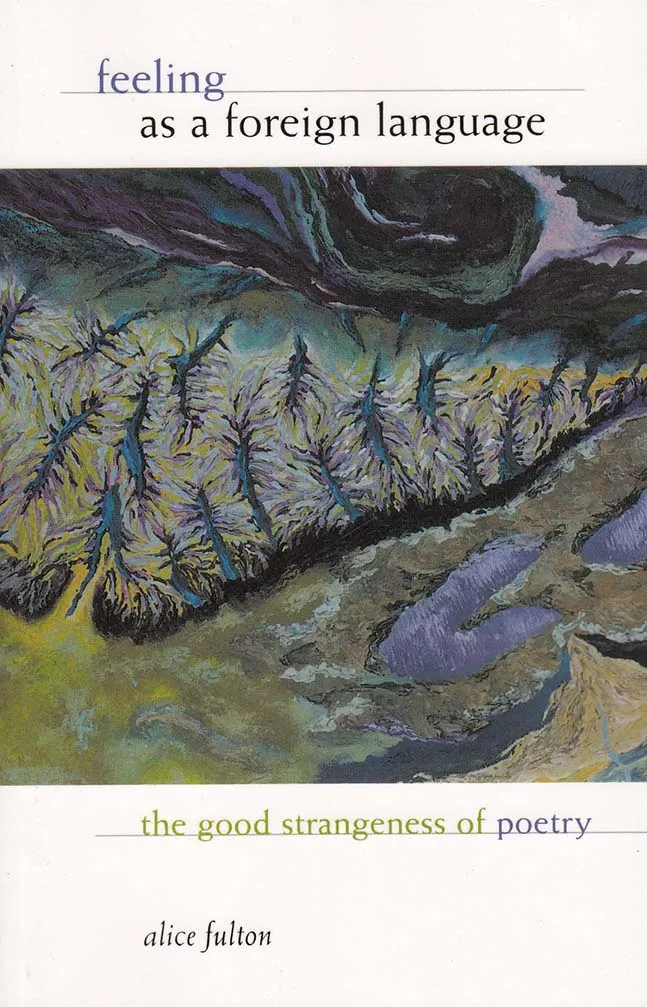
Feeling as a foreign language
In Feeling as a Foreign Language, poet and critic Alice Fulton considers poetry's uncanny ability to access and recreate emotions so wayward they go unnamed. How does poetry create feeling? What are fractal poetics?
In a series of provocative, beautifully written essays concerning "the good strangeness of poetry," Fulton contemplates the intricacies of a rare genetic syndrome, the aesthetics of complexity theory, and the need for "cultural incorrectness." She also meditates on electronic, biological, and linguistic screens; falls in love with an outrageous 17th-century poet; argues for a Dickinsonian tradition in American letters; and calls for a courageous poetics of "inconvenient knowledge."

of sirens, body & faultlines
of sirens, body & faultlines is a book of prophecy against this Brexit era, rising from a post-2008 London, where crisis and austerity meet the vanity projects of the super-rich. Committed to the immediacy of a present that is precarious and under surveillance, of sirens... attends to queer, transfeminist and people of colour counter-memories and histories. It seeks new expressions of desire and modes of breath, pushing against the gravities that would rather these lives and worlds disappear.
While arguing with the radio may seem futile, syntax, punctuation, grammar and the page must still all be mobilised to help create new conditions of possibility – for collectivity, for poetry to speak. Raha’s exceptional, experimental, queer lyric mobilises all aspects of language to reveal contradictions of capitalism and defuse populist rhetoric. This is a writing of city life against the flows to capital; labouring bodies speaking back to the demands of work and the fictions of xenophobic politicians. It concerns herstory, transfeminism, collectivity; the everyday of South East London, transformation and decolonisation, through counter-memories, anti-memoir, and a trans poetics.
"Nat Raha has written some of the most exciting poetry of the last decade. Transfeminist, communist, revolutionary – with great quickness and nimble intensity, her syllables and survival codes dash through police-lines as high-level transmissions signalling absolute solidarity, insisting that other lives are still possible. Originally published as a series of home-made pamphlets that seemed to come as much from post-punk zine culture as from avant-garde poetics, it's good to see them gathered here in one place for the first time and as a body of evidence of a culture of struggle. These poems do not merely comment on that struggle, but emerge from within it. They are poems that break open a space in which to think through what has happened, who we have been, and what has been done to us. These are fearsome times. Raha writes poetry that acknowledges that fear and refuses to flinch in the face of it, which is in itself an act of the fiercest solidarity." – Sean Bonney

F.R. David - All distinctions are mind, by mind, of mind
F.R.DAVID is a typographical journal, dealing with the organisation of reading and writing in contemporary art practises.
This issue, “All distinctions are mind, by mind, of mind”, has a split personality, allowing comparative readings between left/ right, good/ bad, manic/ depressive.