Books
Books

Disobedience
Published to accompany the artist's retrospective at the Kunstmuseum St. Gallen (September 2025–March 2026), this comprehensive monograph offers a detailed overview of the work of Dutch artist Jacqueline de Jong. Designed by Sabo Day and edited by Melanie Bühler, curator of the exhibition, this publication spans De Jong's entire artistic journey of from her editorial activities and bold figurative paintings of the 1960s to her "Billiards" series in the 1970s, and her latest series of the 2020s that reflect the current state of the world.
It features new essays by Karen Kurczynski (Professor of History of Art and Architecture at the University of Massachusetts Amherst), Emily LaBarge (writer and critic), Tiana Reid (Assistant Professor of English at York University), Paul Bernard (Director of Kunsthaus Biel), as well as an as-yet-unpublished conversation with the artist and McKenzie Wark (writer and theoretician).
Organized through six sections entitled "Disobedience," "Publishing," "Chaos," "Pop," "Play," and "Politics," all lavishly illustrated, it underlines the challenging approach to art and life developed by De Jong formally, visually, and conceptually from the early 1960s until 2024.
Edited by Melanie Bühler
Texts by Emily LaBarge, Gianni Jetzer, Jacqueline de Jong, Karen Kurczynski, McKenzie Wark, Melanie Bühler, Paul Bernard, Tiana Reid.

The Circle: Chronologie pour une constellation
A visual and text based investigation led by Moroccan artist Bouchra Khalili during many years following the traces left by the Mouvement des travailleurs arabes, a group fighting for the rights of the Arab workers in France at the turn of the 1970s.
Khalili focused her attention on the theatre groups Al Assifa and Al Halaka who were created in this political environment. The publication unfolds from The Circle (2023), a video installation shown for the first time at the 15th Sharjah Biennale (2023), at Macba (2023) and at the Luma Foundation (in Arles in 2023-2024 and Zurich in 2025).
The book is published in conjunction with Bouchra Khalili's exhibitions as guest visual artist of the Festival d'Automne in Paris in 2025.
Texts by KJ Abudu, Bouchra Khalili, Mohamed Amer Meziane, Abdellali Hajjat ; interviews with Saïd Bouziri, Hedi Akkari, Smaïne Idri, Mustapha Mohammadi, Philippe Tancelin, Mia Radford, Lucas Yahiaoui.

How to Tell When We Will Die: On Pain, Disability, and Doom
The long-awaited essay collection from one of the most influential voices in disability activism that detonates a bomb in our collective understanding of care and illness, showing us that sickness is a fact of life.
In the wake of the 2014 Ferguson riots, and sick with a chronic condition that rendered them housebound, Johanna Hedva turned to the page to How do you throw a brick through the window of a bank if you can’t get out of bed? It was not long before this essay, “Sick Woman Theory”, became a seminal work on disability, because in reframing illness as not just a biological experience but a social one, Hedva argues that under capitalism—a system that limits our worth to the productivity of our bodies—we must reach for the revolutionary act of caring for ourselves and others.
How to Tell When We Will Die expands upon Hedva’s paradigm-shifting perspective in a series of slyly subversive and razor-sharp essays that range from the theoretical to the personal—from Deborah Levy and Susan Sontag to wrestling, kink, mysticism, death, and the color yellow. Drawing from their experiences with America’s byzantine healthcare system, and considering archetypes they call The Psychotic Woman, The Freak, and The Hag in Charge, Hedva offers a bracing indictment of the politics that exploit sickness—relying on and fueling ableism—to the detriment of us all.
With the insight of Anne Boyer’s The Undying and Leslie Jamison’s The Empathy Exams, and the wit of Samantha Irby, Hedva’s debut collection upends our collective understanding of disability. In their radical reimagining of a world where care and pain are symbiotic, and our bodies are allowed to live free and well, Hedva implores us to remember that illness is neither an inconvenience or inevitability, but an enlivening and elemental part of being alive.

The Autobiography of H. LAN Thao Lam
Situated between memoir, social criticism, and conceptual art, The Autobiography of H. Lan Thao Lam is an incisive response to a modernist classic and an affecting exploration of the poetics and politics of our times. "We are supposed to know where we are with biography and autobiography, they are the literary equivalents of the portrait and the self-portrait," writes Jeanette Winterson about Gertrude Stein's 1932 classic, The Autobiography of Alice B. Toklas. By narrating her own story from the perspective of her partner, Stein invented a literary form that was both intimate and uncanny, blurring lines of authority and identity as it winds through a story of two women living and loving together through a tumultuous moment in history. Almost a century later, experimental filmmaker and artist Lana Lin has resurrected Stein's project to tell another story of queer love, life, and artistic collaboration in a differently discordant age. At heart a candid chronicle of her partner Lan Thao's life journey from Vietnam during the war and her own troubled history as a gender-queer Taiwanese American, Lin's Autobiography draws in subjects as varied as photography, tropical fruit, New York real estate, and queer theorist Eve Sedgewick's eyeglasses, weaving a landscape of living that is also a critical investigation of race and gender in our time.
Lana Lin is a writer, artist, and filmmaker based in New York and Connecticut. She is the author of the book Freud's Jaw and Other Lost Objects: Fractured Subjectivity in the Face of Cancer and film and video works including The Cancer Journals Revisited. Her various works and collaborative projects (with Lan Thao Lam as "Lin + Lam") have exhibited at festivals and art and educational spaces throughout the world, including the Museum of Modern Art, Whitney Museum, and New Museum, New York; The National Gallery of Art, Washington, D.C.; Gasworks, London; the Taiwan International Documentary Festival and Taiwan Film and Audiovisual Institute, New Taipei City; Arko Art Center, Korean Arts Council, Seoul; and the 2018 Busan Biennale. Having had three years of psychoanalytic training before dropping out, she sometimes still dreams of becoming a psychoanalyst one day.

Real Estate Portfolio
Real Estate Portfolio by Claire Barrow
7 panel concertina + covers / total of 16 pages
9.6 × 14 cm folded / 98 cm extended
Riso 250gsm recycled offset exterior, litho 135gsm recycled offset interior
Glassine sleeve, digitally printed on the front & back
Self-published edition of 300, signed by the artist
Constructed in the UK (£0.016 per cm²)
The zine was drawn in one session using the right wrong hand.

Civilization #7
Richard Turley, Lucas Mascatello
The occasionally-published broadsheet Civilization was founded in New York in 2018 by Richard Turley, Lucas Mascatello, and Mia Kerin. Its origin was as a response to New York City life, but has now transformed into an art project that gathers language, overheard conversations, secret recordings transcribed by rapid-capture software to produce a dense, rhythmic assemblage of texts from both public and private spaces alike. As a result, Civilization’s design texture has found fans in the fashion world, leading to collaborations with Calvin Klein and Junya Watanabe.
The publication has also enjoyed contributions from a wide array of artists, writers and personalities including: Aaron Maine, Alis Atwell, Amos Poe, Amalia Ulman, Aria Dean, Alicia Novella Vasquez, Bill Drummond, Biz Sherbert, Babak Radboy, Carly Busta, Darcie Wilder, Echo Wu, Ella Plevin, Eric Johnson, Honor Levy, Iris Luz, Mel Ottenberg, Isabelle Rea, Joey LaBeija, Jordan Barse, Lovefoxx, Maddie Quinn, Patrick McMullan, Rachel Rabbit White, Sybil Prentice, Thom Bettridge, and Zans Brady Krohn.

Nine Ways to Cry
Cecilia Pavón, Jacob Steinberg
Cecilia Pavón has been a defining figure of the Argentine cultural scene since the 1990s. She is the author of over 10 volumes of poetry, 3 short story collections, and an anthology of blog posts, and was co-founder of the legendary art gallery and publishing press Belleza y Felicidad. Nine Ways to Cry collects Cecilia Pavón’s complete poetry published from 1999 to 2012 in one bilingual volume for the first time, including A Hotel With My Name, Licorice Candies, and other beloved classics.
Prefaced by a loving foreword from contemporary US poet Dorothea Lasky, this collection serves as the definitive introduction to the poetry of a living legend. She currently lives in Buenos Aires.

University of California Press
The Totality for Kids
The Totality for Kids is the second collection of poems by Joshua Clover. This volume takes as its subject the troubled sleep of late modernity, from the grandeur and failure of megacities to the retreats and displacements of the suburbs. The power of crowds and architecture commingles with the alienation and idleness of the observer, caught between “the brutal red dream/Of the collective” and “the parade/Of the ideal citizen.” The book’s action takes place in these gaps, “dead spaces beside the endlessly grieving stream.” The frozen tableau of the spectacle meets its double in the sense that something is always about to happen. Political furies and erotic imaginings coalesce and escape within a welter of unmoored allusions, encounters, citations, and histories, the dreams possible within the modern’s excess of signification—as if to return revolutionary possibility to the regime of information by singing it its own song.

University of California Press
Screen Writings
"Ask audience to cut the part of the image on the screen that they don't like. Supply scissors."—Yoko Ono, Tokyo, June 1964
A dazzling range of unconventional film scripts and texts, many published for the first time, make up Scott MacDonald's newest collection. Illustrated with nearly 100 film stills, this fascinating book is at once a reference work of film history and an unparalleled sampling of experimental "language art." It contributes to the very dissipation of boundaries between cinematic, literary, and artistic expression thematized in the films themselves. Each text and script is introduced and contextualized by MacDonald; a filmography and a bibliography round out the volume.
This is a readable—often quite funny—literature that investigates differences between seeing and reading. Represented are avant-garde classics such as Hollis Frampton's Poetic Justice and Zorns Lemma and Morgan Fisher's Standard Gauge, and William Greaves's recently rediscovered Symbiopsychotaxiplasm: Take One. Michael Snow turns film loose on language in So Is This; Peter Rose turns language loose on theory in Pressures of the Text.
Some of the most influential feminist filmscripts of recent decades—Laura Mulvey and Peter Wollen's Riddles of the Sphinx, Su Friedrich's Gently Down the Stream, Trinh T. Minh-ha's Reassemblage, Yvonne Rainer's Privilege—confirm this book's importance for readers in gender and cultural studies as well as for filmmakers and admirers of experimental writing, independent cinema, and the visual arts in general.

Unfit
Ariana Harwicz, Jessie Mendez Sayer
A bracing novel that asks how far we would go for the ones we love—and what we would do to destroy the ones we hate.
Lisa has lost custody of her young twin boys. Caught between the French legal system’s sluggish bureaucracy and her sinister, scheming in-laws, she’s alone and lost, an Argentine migrant in rural France picking grapes for a pittance, only allowed to see her children in supervised visits once a month. Scapegoated and outcast, destitute and desperate, Lisa decides to take radical action: early one morning, she sneaks into her in-laws’ farmhouse, takes back her children, sets the barn ablaze, and makes her escape.
What follows is a white-knuckled road trip that explores human beings pushed to the edge. Clearly, Lisa is not in her right mind, and as Harwicz deftly mingles a chorus of contradictory voices into her very unreliable narration, the reader comes to regard the protagonist with an unsettling mixture of sympathy and suspicion. Written in savage, chiseled prose, Unfit shoots off, a gripping chase that questions all our assumptions—and points out our hypocrisies— about motherhood, custody rights, love, violence, anti-semitism, and migration. The latest novel by the acclaimed author of Die, My Love (soon to be adapted to a film starring Jennifer Lawrence), Unfit is addictively terrifying, savagely sophisticated, and shockingly brilliant.
Translated from Spanish by Jessie Mendez Sayer

Nymph: A Novel
A young woman from a long line of assassins, lives her life with the ardent mission to avoid the trappings of any enduring romantic love, while keeping one on the pursuit of an untimely death for herself.
Not yet thirty, Bathory, or 'Bat' to those near to her, has assembled a peculiar Model, sex worker, linguist and scholar of Latin. But nothing in her lively job history employs the singular traits she inherited from her strange family, chief among them an uncanny ability to sidestep seemingly certain death(s). An appropriate atavistic instinct, for someone from a long line of assassins and spies. Her clan are assassins of a romantic bent, her parents issuing theories on love galore. However Bat is set on swerving any enduring romantic loves, and she's set on dying young. Now, if she could only avoid that one alluring figure from her father's past.
A thriller, a love story, and a dynamic examination of class, violence and connection. The images we make to share and those we strive to conceal, alienation and salvation, magic and technology, LaCava's bold new novel is propelled by the compelling violence one can seed in contradiction.

Atelier E.B 2026 Calendar
Atelier E.B's 2026 calendar is dedicated to the duo's spectacular window displays (2019-2025). These exhibitions feature garments from their fashion label arranged by professional window dressers—integrating the shopping experience into the exhibition context.
Atelier E.B (Edinburgh Bruxelles) is the company name under which designer Beca Lipscombe and artist Lucy McKenzie develop their joint projects.

Clipping 1: Coming of Age
Federica Notari, Natasha Rijkhoff
For Clipping I: Coming of Age, editors Federica Notari and Natasha Rijkhoff compiled fragments from the events and gatherings held during the ongoing two-year collaboration between the Nieuwe Instituut’s Through Sounds project and the Rewire Festival. This co-curated, two-part programme explored the social and affective infrastructures of sound and music.
The theme of Coming of Age emerged from a desire to explore processes of becoming, not as a single transition, but as an ongoing iterative state. In this context, music acts as a connective tissue, bridging isolated experiences and communal infrastructures to form networks of shared meaning and distribution. Tracks become social objects: they carry stories, spark interactions and transform spaces.
The publication features written contributions by Emily Moore, Federica Notari, Katía Truijen and Natasha Rijkhoff. It is edited by Federica Notari and Natasha Rijkhoff, designed by Catherine Hu and Cleo Tsw, and printed and bound by No Kiss.

Holy Smoke
Why they said, “Your real name is Anon,” I’ll never know ... But now that I have a name, I know I must write ... I’m scared, but feel it is time to be really bad.
Republished for the first time since its 1979 release, in a new revised edition, Holy Smoke is an account of the frenzy and paranoia of United States politics refracted through one individual’s psyche. With her theme of a child disappeared – and all that that phrase carries with it – Howe captures the chaos of reality in her salient mix of poetry and prose. Readers will find it hard to believe that this book, which gives fresh sense to the demand for universal human rights, was written in the last century.
At once evocative and subtly incisive, Howe’s writing seems almost like a new language, a language that has been in hiding. She can make the familiar haunting and the ordinary a provocation. She has written some of the remarkable books of her time. —Adam Phillips
A wonder of acid wit and Americana, Holy Smoke turns grief into a game and chaos into canticles. Bricolage at its best: incisive, inventive and intimate. It’s the exact work I needed in my life. —Navid Sinaki
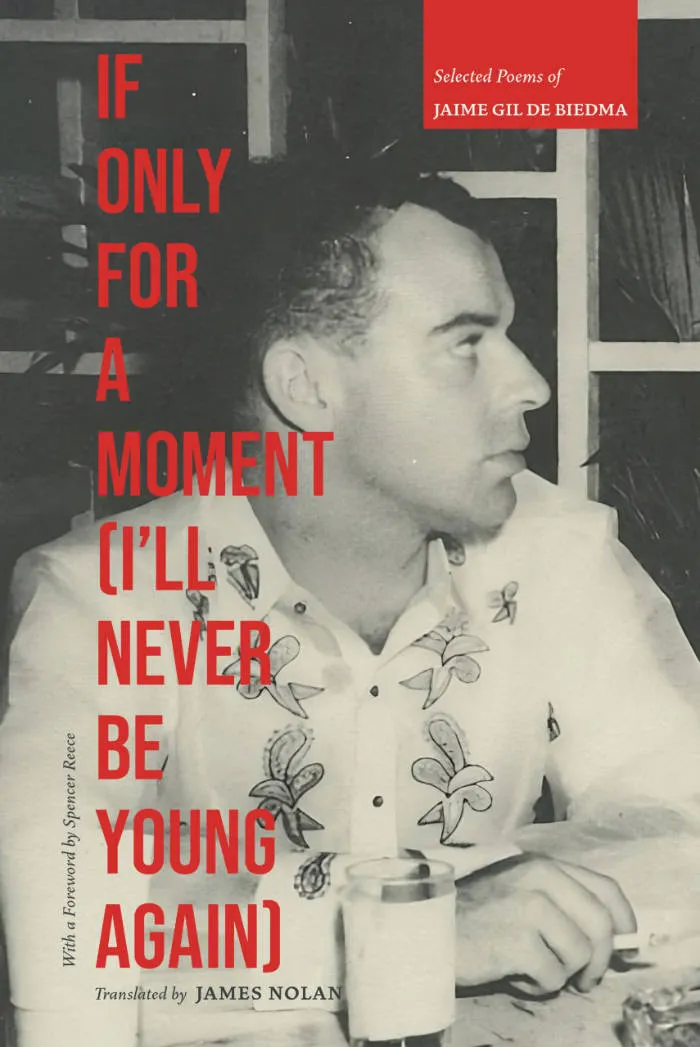
If Only For a Moment (I’ll Never Be Young Again)
Jaime Gil de Biedma, James Nolan
Jaime Gil de Biedma is the most original and influential among the poets known as the ‘50’s Generation in Spain, and is considered the greatest Spanish poet to emerge in the second half of the 20th century. His life and literary career were bracketed almost entirely by the rise and fall of Generalissimo Francisco Franco, notorious for the suppression of literature. Born in 1929, Gil de Biedma was six years old when García Lorca was murdered in Granada at the outbreak of the Civil War, and his collected poems, Las personas del verbo, first appeared in 1975, the year Franco died. What is surprising is that Gil de Biedma was a leftist, homosexual poet from the Catalan capitol, Barcelona – all of Franco’s favorite things – who not only published books of autobiographical poetry in Spain but was known as a poet of social conscience as well as erotic lyricism. Like other Spanish poets of his time, he chose his words carefully. Gil de Biedma died of AIDS in 1990.
If Only For a Moment (I’ll Never Be Young Again) consists of an extensive bilingual selection of Gil de Biedma’s poetry, including all of his most well-known work. The book additionally consists of a Foreword by Spencer Reece, Jaime Gil de Biedma’s short essay “I wanted to be the poem,” and two different essays on Gil de Biedma and the art of translation by James Nolan, the volume’s translator.

Mr. Outside
During a time of restricted movement, the narrator of Mr Outside visits his reclusive father Thomas who is packing up to move into a care home. As father and son grapple with the task, long-buried conflicts resurface. Thomas, a poet and former radical priest, slips between affection and fear, while the narrator struggles to find the words he’s been holding back. Yet amidst confusion and grief, moments of humour and connection emerge, as both men discover new ways to listen.
Told through a striking combination of text and image, Klaces’ distilled novel explores the stories we tell about our lives, intimacy in crisis, and the fragile line between reality and delusion. Based on the life of his own father, Mr Outside is poignant, profound, and unexpectedly funny; a tender meditation on endings, the limits of understanding, and the act of letting go.

Palestine is everywhere
‘Palestine is everywhere because it names a political subject of radical universal emancipation,’ writes teacher and writer Nasser Abourahme. In Palestine is everywhere, writers, thinkers, poets and artists map the Palestinian struggle for freedom and its global resonances.
Vital dispatches from Gaza, essays, poems, protest chronicles, images and letters from prison reflect upon resistance, solidarity and the right to self-determination. Amid a world-historical moment marked by unknowability and loss, this collection offers essential reading for those interested in Palestinian liberation.
This collection is edited by Skye Arundhati Thomas, with contributions from Alaa Abd El-Fattah, Nasser Abourahme, Amal Al-Nakhala, Muhammad Al-Zaqzouq, Maisara Baroud, Ahmed Bassiouny, Houria Bouteldja, Anees Ghanima, Sahar Khalifeh, Laleh Khalili, Lujayn, Mira Mattar, Lina Meruane, Mohammed Mhawish, Nahil Mohana, Rahul Rao, Nasser Rabah, Adam Rouhana, Ahmad Zaghmouri.
Co-published by TBA21.
All royalties from this project will be donated to Medical Aid for Palestinians (MAP) and The Arab Group for the Protection of Nature (APN).

Stars at Midday –نجوم الضُهر
Stars at Midday –نجوم الضُهر is a personal diary in which the artist and filmmaker Noor Abed compiles visual and poetic notes from the production phase of her film A Night We Held Between, filmed in Palestine in 2023 with family and friends.
Like the film, the book interweaves narrative fragments, song and diaristic observations, creating a fusion of natural and composed sequences of movement, of documentary and fictional elements.
Through a choreography of bodies, sites, stories, and temporalities, Abed’s work prompts contemplation on the manifestations of social action and resistance in everyday life.

The Infinite Now
In The Infinite Now, Taras Gembik crafts an intimate meditation on solitude, faith, and the search for meaning, ten years in the making. Moving between Ukraine and Poland, these twenty-five poems trace a decade-long journey of self-discovery.
Through stark winter evenings and quiet conversations, Gembik's verses explore ancient and universal questions of existence and identity: the nature of God, the comfort of walls and communion with others, the circular path of memory. The collection transforms everyday moments into profound reflections on love, displacement, how to build community, and the possibility of finding home in transience.
Taras Gembik (born Kamin-Kashyrskyi, 1996, lives in Warsaw, Poland) is a poet, curator, performer, and activist. He is the curator of the public programme at Zachęta National Gallery of Warsaw, where in 2024 he also curated, together with Joanna Kordjak, Siergiej Parajanov's retrospective. Since 2018, he has worked with the Museum of Modern Art in Warsaw to provide a platform for refugees and those afflicted by the homelessness crisis. After Russia's invasion of Ukraine in 2022, he co-created the Sunflower Solidarity Community Centre, praised in an extensive profile in Frieze Magazine, as part of a dossier on "Forms of Resistance".

Local Ecology – Kastellorizo
Jochen Lempert brings his signature blend of scientific sensitivity and poetic vision to the remote Greek island of Kastellorizo.
Known for his black-and-white photographs and background in biology, Lempert turns his lens to the subtle presences of animal, vegetal, and mineral life on this isolated Mediterranean outpost.
Through a series of quietly observational images, Lempert documents the island's micro-ecologies with a field biologist's care and an artist's attunement to form and chance. As always, he eschews dramatic framing and post-production, relying on natural light, analog processes, and an acute sense of timing.
What emerges is a slow, intimate portrait of a place, where natural history and everyday life are entangled, where the ephemeral and the enduring coexist. Not only a record of a particular geography, Local Ecology. Kastellorizo delves into themes of observation, belonging, and the delicate ecosystems that support life in isolated places.
The photographs included in this publication were taken in the summer of 2019 during a residency at La Società delle Api in Kastellorizo, Greece, based on an idea by Cristiano Raimondi.
Jochen Lempert (born 1958 in Moers) is a German photographer. Trained as a biologist specializing in dragonflies, he began his career as a photographer in 1989, at the age of 31, developing an artistic practice based on this scientific heritage, marked by images of nature where the animal and vegetal go hand in hand.

This Household of Earthly Nature: An Essay: A Year, a Life, a Country, a Global Network
In This Household of Earthly Nature poet and poetic essayist Cody-Rose Clevidence delves into the far reaches of our planet, from homestead to information theory, from ancient history to global economics to possible futures, connecting all things; Walmart, shipping lanes, what it means to have family, friends and memories, to labor, love, to ways of knowing, and all of us together inside these vast and shifting networks. Rooted firmly in the Anthropocene, in the fragmented and information-dense internet-connected world and also in their own rural daily life, this essay-poem charts a mind grappling with what it means to be alive now, in this particular time in our planet's and our species' evolution, from the domestication of the first grain to whatever is inevitably coming next.

Blackout
Spring 2020. During lockdown in a mountain village with his partner and young child, Yann Chateigné Tytelman becomes haunted by the presence of his dead father. Provoked by memories of him, of their laconic relationship and of the class antagonisms that emerged between them – the father was a manual labourer while his son ‘turned his back’ and entered the art world – Chateigné Tytelman starts writing letters, piles of them, which have as their subject that most mystical, most incomprehensible of phenomena: silence.
Condensed into a series of short fragments, Blackout interweaves the letter to the father with the observations of an art theorist who surveys with precision the occurrences and experiences of silence in painting, music, literature and philosophy.

Moral Abdication: How the World Failed to Stop the Destruction of Gaza
How most Western governments and elites have supported the destruction of Gaza and silenced voices calling for the rights of Palestinians.
Providing a record of the first six months of the war waged by the Israeli army after the 7 October attacks and drawing on a rich range of international sources, Didier Fassin examines how most Western governments have acquiesced in and often contributed to the destruction, by the Israeli army, of Gaza, its homes, infrastructures, hospitals, institutions of education, and civilian population. To justify their support and prevent criticism, they have provided an official version of the events, adopting the Israeli narrative. It was largely taken up by mainstream media, which ignored the experiences and perspectives of Palestinians. Dissenting voices were silenced. A policing of language and thought was imposed. Censorship and self-censorship became normalized.
To call for a ceasefire or to demand the respect of humanitarian law was enough to prompt the ever-ready accusation of antisemitism. Exploring the multiple dimensions of the extreme inequality of lives between the two sides of the conflict and analyzing the complex geopolitical, economic and ideological stakes that underlie it, Fassin intends to constitute an archive of this moral abdication. In his view, the abandonment of the values and principles proclaimed by Western elites to be foundational will leave a deep scar in the history of the world.

Aunonomic Reasoning
Precipitous philosophies. Synaptic-nerve narrations. Syntactic spirals. Hyper-coiled horizons. Will Alexander’s mental range has arrived. An anomalous scripting of the word “automatic,” Aunonomic Reasoning is a whirlwind of lingual torrents triggered by creative mishearing that at once exposes the occupations of orthodox surrealism, summons a voice for the scathed populace of imperial affliction, and forges new paths of phonetic potentiality to mend semantic injury. Pushing prosaic margins beyond their boundaries, these texts take on the etymological condition of the essay as “attempt” with iridescent siege, prepositional frenzy, paratactic provocation, noetic disreckoning, and a critical demand to dismantle: all of which signatures of Alexander’s unilateral poetic innovations.