Books
Books
English editions

The Completion
In The Completion, legendary philosopher Franco 'Bifo' Berardi offers his analysis of cognitive automation and artificial intelligence. Of the possible worlds imagined in Silicon Valley and in the media discourse around tech boosterism, none will likely materialise. Instead, the unpredictable will intervene in the future of predictive technology.
In this new edition, in a new venture for Everyday Analysis, Berardi's essay is accompanied by an introduction by Alfie Bown and a series of artworks and illustrations, new and historic- from Borges's labyrinths to the I-ching - offering a reading experience in the spirit of Berardi's work.
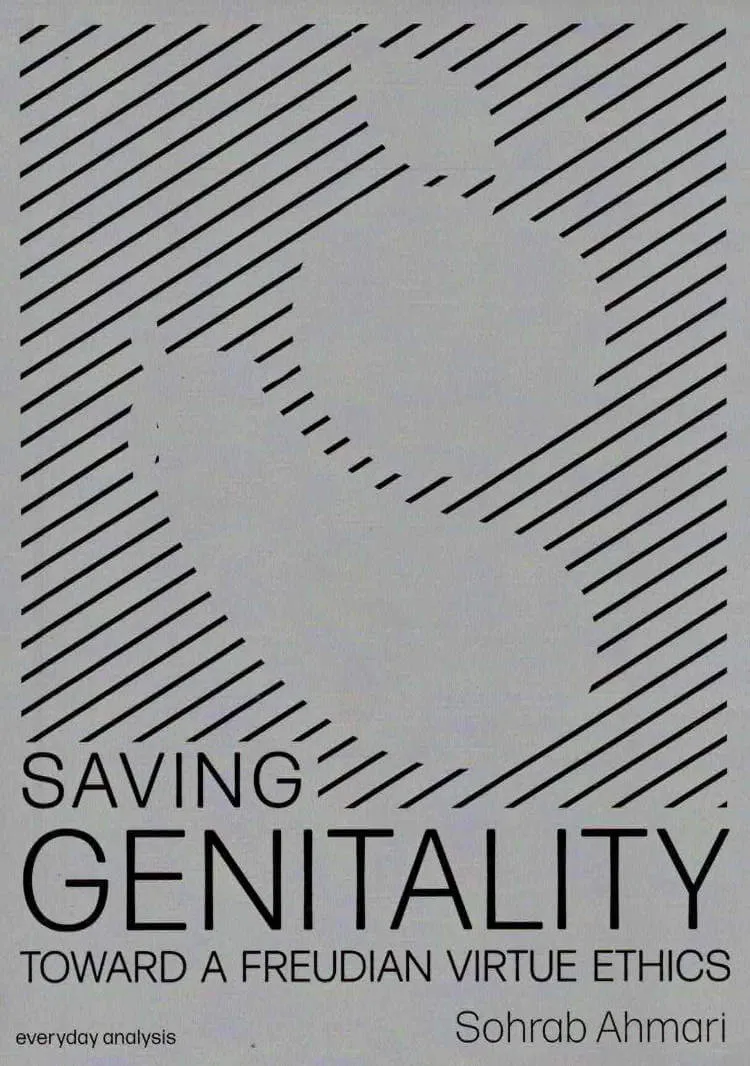
Saving Genitality: Toward A Freudian Virtue Ethics
Western societies have dismantled many of the prohibitions that ringfenced errant sexual drives in Freud’s time. The psychoanalytic project describes people caught between two fundamental and contradictory principles: One a relentless sexual drive, the libido; the other our species’ collective need for social order and harmony. Part of this harmony, for true Freudians, is embedded in the binary mutuality of men’s and women’s bodies, which remains indispensable for society to reproduce itself, even in our sexually liberated age. In this essay, Ahmari revisits the idea of ‘genitality’ arguing that perhaps the "heteronormative" orthodox Freudians were right about some things after all.

Whitney Museum of American Art
Edges of Ailey
Alvin Ailey is one of the most celebrated choreographers of the twentieth century. The creator of iconic works such as Blues Suite, Revelations, and Cry, he is widely recognized for the dance company he founded in 1958 when he was just twenty-seven years old. Ailey imagined and cultivated a platform for modern dance through his innovative repertoire, interdisciplinary sensibility, and support of dancers and choreographers. This expansive volume situates Ailey within a broader social, creative, and cultural context, looking at the artists who influenced and collaborated with him, the spaces and scenes he frequented, the dynamic themes within his dances, and how his vision and work changed contemporary dance.
Essays by artists, scholars, and critics cover topics ranging from the Black church, the South, and the Great Migration to nightclubs, musical influences, and queerness. With more than four hundred images including photographs of works Ailey choreographed, archival materials such as notebooks, sketches, letters, and never-before-published behind-the-scenes photos, and conversations about the legacy of the company with Sylvia Waters, Judith Jamison, and Masazumi Chaya as well as several contemporary dancers and scholars, this study offers an unprecedented full picture of one of the twentieth century’s leading artists and the way his work continues to inspire today’s generation of dancers.
Contributions by Horace D. Ballard, Harmony Bench, Kate Elswit, Aimee Meredith Cox, Thomas F. DeFrantz, Malik Gaines, Jasmine Johnson, Joshua Lubin-Levy, Uri McMillan, Ariel Osterweis, J Wortham, CJ Salapare, Kyle Abraham, Claire Bishop, Masazumi Chaya, Brenda Dixon-Gottschild, Jennifer Homans, Judith Jamison, Sylvia Waters, Jamila Wignot and Jawole Willa Jo Zollar

Twenty Bookmarks
Twenty Bookmarks is a result of Production & Workflow class of Graphic Design Department at the Royal Academy of Fine Arts Antwerp, Ba1 Class of 2026.

Eselsohren Dog Ears
"The impossible takes a little longer. [pen scribbling]"
Presented at Kransen in Borgerhout, 1—3 March 2024, with an exhibition titled Dog Ears and a remote reading by fellow-Stockholmian artist Dave Allen.

Katalog 2
Assembled and copied by Jan Matthé at Permeke Library Antwerp, September—October 2022. Edited at Kransen, printed in Borgerhout in an edition of 200, bound by De Wrikker in Berchem. Released on the occasion of Permeke draait door met Risiko Press, Sunday 27 November 2022 at Permeke Library, with readings and performances by Tina Schott, Jóhanna Kristbjörg Sigurðardóttir, Stefanie Alexandra, Sis Matthé, Ria Pacquée, Jan Matthé, Clodagh Kinsella and Roman Hiele. Thanks to Christel Kumpen for the invitation, Allon McKaye for the Saturday and Toni Matthé for the unicorn with a heartshaped tail.

Manifest ( ) gathered angry woman loving
Chiara Di Luca, Emma Burel and 2 more
Words gathered from The Carrier Bag Theory of Fiction (Ursula K. Le Guin, 1986), Natural Enemies of Books (MMS, 2020), Non credere di avere dei diritti (Libreria delle donne di Milano, 1987), Dada Cannibalistic Manifesto (Francis Picabia, 1920) and WITCH (Rebecca Tamás, 2019). A first version of this poem/pamphlet was made in the context of See What I Mean, a workshop by Phil Baber at Antwerp’s Royal Academy of Fine Arts, october 2024.

Discomania
A young woman discovers that dancers at a local discotheque are being driven to acts of insane violence.
“The place was full of swarming, pugnacious, dangerous missellneous reptile's… Teenager's everywhere pounded their way on top of each other crazily strangling, biting and slashing each other's with broken glass, smashed records or sharpened blades… ”
16-year-old Jennifer Gibbons (1963–1993) wrote Discomania in 1980, alongside her twin sister June-Alison, who was also writing her own novel, The Pepsi Cola Addict, in the bedroom that they shared.
Jennifer offered Discomania to the same English vanity press who would publish June-Alison's book, but Discomania was turned down for being “too violent, too sexual, and too futuristic.”
Long thought to have been lost or destroyed, June-Alison had in fact preserved the typescript of this unique, furious, funny, and strange novel, which we present with her blessing, alongside additional texts from June-Alison, and editors David Tibet and Ania Goszczyńska.

Postmortem issue 1
Marina Mardas, François Peyroux and 1 more
How can we define and document our present?
Postmortem is a sensitive yet critical metaphor for a world suspended between collapse and reinvention—a diary of the now. Drawing together writers and artists from Europe and the SWANA region, this issue locates areas of tension that define our era. Far from a mere dialogue between regions, it exposes the inner and outer fractures of Western hegemony, unearthing shared emotions.
From reclaiming histories and narratives in the Arab world to deconstructing digital spaces as arenas of control and resistance—even exposing systemic exclusions embedded in blood donation policies—contributors reveal these tensions as a fertile terrain for dialogue and reflection.
Through critical essays, narrative writing, poetry, interviews, and contemporary art, the concept of Postmortem unfolds an in-between state where death and rebirth occur simultaneously. Across three interwoven chapters—Metaconnexion, Dissociation, and Fragmentation—the issue engages radically with body politics, othering, post-orientalism, surveillance, decoloniality, freedom, and resistance.
Both a chronicle and a hybrid object where text, design, and image interact, Postmortem archives a world in flux. Rather than prognosticate, it dissects the present as the essential site for reimagining our future.
Contributors : Sara El-Jazara, François Peyroux, Nadine Makarem, Soukaina Melhaoui, Louise Mervelet, Manon Schaefle, Marina Mardas, Irina Breitenstein, Amer Al-Dakar

The Villain’s Dance
Fiston Mwanza Mujila, Roland Glasser
Full of wit, music, and a rollicking cast of characters, The Villain’s Dance shows Fiston Mwanza Mujila is back with a bang.
Zaire. Late nineties. Mobutu’s thirty-year reign is tottering. In Lubumbashi, the stubbornly homeless Sanza has fallen in with a trio of veteran street kids led by the devious Ngungi. A chance encounter with the mysterious Monsieur Guillaume seems to offer a way out . . . Meanwhile in Angola, Molakisi has joined thousands of fellow Zairians hoping to make their fortunes hunting diamonds, while Austrian Franz finds himself roped into writing the memoirs of the charismatic Tshiamuena, the “Madonna of the Cafunfo Mines.” Things are drawing to a head, but at the Mambo de la Fête, they still dance the Villain’s Dance from dusk till dawn.

Season of the Swamp
New Orleans, 1853. A young Zapotec exile from Mexico named Benito Juárez disembarks at a fetid port city at the edge of a swamp. Years later, he will become the first indigenous head of state in the postcolonial Americas, but now he is as anonymous and invisible as any other migrant to the roiling and alluring city.
Accompanied by a small group of fellow exiles who plot their return and hoped-for victory over the Mexican dictatorship, Juárez immerses himself in the city, which absorbs him like a sponge. He and his compatriots work odd jobs, fall victim to the cons and confusions of a strange young nation, succumb to the hallucinations of yellow fever, and fall in love with the music and food all around them. But unavoidable, too, is the stark trade in human beings.
With the extraordinary linguistic play and love of popular forms that have characterized all of Herrera’s fiction, Season of the Swamp is a magnificent work of speculative history, a love letter to the city of New Orleans and its polyglot culture, and a cautionary statement that informs our understanding of the world we live in.

Autobiography of Cotton
Cristina Rivera Garza, Christina MacSweeney
A novel about how cotton workers transformed the Mexico-US borderlands, by a Pulitzer Prize–winning author.
In 1934, a young José Revueltas traveled to Tamaulipas to support the cotton workers’ strike in Estación Camarón, which became the basis of his landmark novel, Human Mourning. In her own groundbreaking novel, Autobiography of Cotton, Cristina Rivera Garza recounts her grandparents’ journey from mining towns to those same cotton fields as it intersects with Revueltas’s life in a vivid and evocative history of cotton cultivation along the Mexico-US border.
Through archival research and personal narrative, Rivera Garza chronicles the way cotton transformed the borderlands by reconstructing the cotton workers’ strike and reveals how cycles of deprivation and ecocide persist across generations. Deeply personal and politically acute, Rivera Garza crafts a new kind of border novel that tells how a brittle land radically altered her grandparents’ lives and the territories they helped develop. An intimate fictionalization, Autobiography of Cotton reveals a rich social history of agricultural colonization, labor activism, environmental degradation, and cross-border migration.

Marlie Mul
Marlie Mul (b. 1980 in Utrecht, the Netherlands; lives and works in Brussels) is characterized by a strong material awareness, spatial thinking, and an ongoing engagement with conditions of labor, systems of value, and forms of collectivity. Her practice foregrounds a sustained interest in sculptural concerns, direct engagement with materials, and processes of layering, transformation, meaning and re-meaning across multiple levels of articulation. Central to this is a continuous process of familiarizing herself and working with new materials and practices, which are repeatedly extracted from their conventional contexts and expanded into new bodies of work. These are, in turn, accompanied and reframed by other materials as well as by more social formats of production and presentation.
The first comprehensive monograph on Marlie Mul’s work is published on the occasion of her solo exhibition Das Budget (2025) at Kunsthaus Glarus. It offers a comprehensive chronological overview of key bodies of work from the early 2000s to the present and, through a richly illustrated index, unfolds a complex structure of contexts, collaborations, and modes of production. The publication includes new contributions by Annie Goodner, Lili Reynaud-Dewar and Frank Wasser, a dialogue between the artist and the editor, as well as numerous reprints of texts that have accompanied Mul’s work over the years, including writings by the artist herself.

New Infinity
New Infinity is an experimental novella that follows a woman as she lives and dreams her way through the philosophical implications of autoimmune disease. Met by a labyrinth of closing doors, she searches for meaning and connection among fragmented realities and failed relationships, finding infinitude in the healing process of bibliomancy.
Bára Hladík’s New Infinity is a glittering cross-genre debut. Weaving surrealist stories with meditative poetics, Hladík invites you into a dream world of degenerative illness, left disordered by the failures of ableism, medical professionals, and late-stage capitalism. Here, everything runs on sick time. Where physical health and financial resources grow scarce, the restorative possibilities of queer love, divination, and self-reclamation grant a defiant, yet often tenuous, abundance. Alive with Hladík’s boundless insight and wit, New Infinity is a powerful addition to the collective body of disability literature.
“New Infinity is the most incredible fiction. It explodes the boundaries of this form so as to get to the heart of important truths about the phenomenon of physical pain and of human existence itself. While Bára Hladík’s story draws from a personal experience of survival through a struggle unlike any other, it is an entirely universal tale. In taking us into the most intimate spaces of suffering and narrating a story of a woman navigating a true labyrinth, Hladík shows us a way to face life, with the uncertainties it presents to us all. This novel is at once a profoundly moving story, a brilliant act of creativity, and an existential philosophy. It’s a book I will keep close, so as to revisit— for the thrilling inspiration of its liberated uses of form and style, as well as to learn from Hladík’s honest language, her resilient sense of humour, and her ability to capture the surreal beauty of being alive at all. I felt like I was reading Franz Kafka crossed with a fully unconstrained Anne Carson. I haven’t been so impacted by a book in a long time. It has changed my ways of seeing, feeling, and thinking about what it means to be alive.”
— Molly Lynch
“Bára Hladík’s debut book is a blend of poetry and prose that seeks to make sense of a world that is flagrantly hostile and impatient with bodies that neither perform nor conform to the manic impatience of capitalist acceleration. An honest, vibrant, and very real account of a young writer finding a voice.”
– Sina Queyras, writer, editor, professor, curator
Bára Hladík is a Czech-Canadian writer, editor and multimedia artist. Born in Ktunaxa Territory, she began her literary studies in the Creative Writing program at Capilano University in 2011. Her work can be found in Briarpatch Magazine, THIS Magazine, Contemporary Verse 2, Carte Blanche, EVENT Mag, Hamilton Arts and Letters, Bed Zine, Empty Mirror, Cosmonauts Avenue and elsewhere.

knot body
Bringing together poetry, essay, and letters to “lovers, friends and in-betweens,” Eli Tareq El Bechelany-Lynch confronts the ways capitalism, fatphobia, ableism, transness, and racializations affect people with chronic pain, illness, and disability. knot body explores what it means to discover the limits of your body, and contends with what those limitations bring up in the world we live in.
knot body was shortlisted for the QWF First Book Prize. Their second collection of poetry, The Good Arabs (Metonymy Press), won the 2022 Grand Prix du Livre de Montréal.
“For me, the power of knot body stems from its courage and unique voice in writing the ache, the ache of chronic pain, the ache of faulty diagnoses and bodily misreadings, and, equally, the ache for honest answers on how to love each other in all our dignity. Eli Tareq El Bechelany-Lynch is an artist and philosopher of talent, generosity, and heart.” – David Chariandy, author of Brother (Penguin Random House)
“In this moment, when trans, racialized and disabled bodies are met with violent and polarizing commentary within the public sphere, Eli Tareq El Bechelany-Lynch offers us the uninterrupted intimacy of knot body. As self-communional as Kiese Laymon’s Heavy and Terese Marie Mailhot’s Heart Berries, they amplify and queer the epistolary memoir genre. Each letter is emotionally and thematically complete and, too, each letter decidedly speaks to the next. Readers may ruminate on the sharp and sensual inquiry offered by each individual letter, or read cover-to-cover and be present to the gorgeously-engaged, call-and-response quality of knot body as a whole.” – Amber Dawn, author of My Art is Killing Me (Arsenal Pulp Press)
“knot body is such a generous tapestry of tenderness—a collection that brilliantly utilizes the direct address in a way that is not universal, but still beautifully communal. I reached the end of this collection and breathed in a newer, better world.” – Hanif Abdurraqib, author of A Fortune for Your Disaster (Tin House)
Eli Tareq El Bechelany-Lynch is a queer Arab poet living in Tio’tia:ke, unceded Kanien’kehá:ka territory (Montreal). Their work has appeared in The Best Canadian Poetry 2018 anthology, GUTS, carte blanche, the Shade Journal, The New Quarterly, Arc Poetry Magazine, Room Magazine, and elsewhere. They participated in the Banff Centre’s ‘Centering Ourselves’ BIPOC residency, and they were longlisted for the CBC Poetry Prize in 2019. Their second collection of poetry, The Good Arabs, was published by Metonymy Press in 2021.

Wanderlust
Soufiane Ababri's sketchbooks.
Soufiane Ababri (b. 1985, Rabat) is a Moroccan artist based in France. His protean work (drawings, installations, performances) explores questions of gender, homosexuality, racism and colonialism.

Night Night Fawn
From the author of Confessions of the Fox comes a novel in which a yenta on her deathbed gives an unrepentant account of all her failures—including her child.
“Jordy Rosenberg might be one of our most fearless living novelists. There are no half-measures in his work, just big ideas and living characters and gorgeous sentences and metafictional panache and surprise after heart-stopping surprise. Night Night Fawn is extraordinary.”—Carmen Maria Machado, author of In the Dream House
In a cluttered rent-controlled apartment in the middle of Manhattan, Barbara Rosenberg is terminally ill, high on opioids, and writing the story of her life. She has opinions about her smutty late husband, her career as the receptionist for a disreputable plastic surgeon, her glory days as an accomplished jazzerciser, and her failed aspirations to be a film noir actress. But what she really wants to talk about are unhinged thoughts on gender, Karl Marx, Zionism, and her two great disappointing loves: an estranged trans son and a long-lost best friend whose betrayal haunts Barbara still. As she descends further into delirium and illness, Barbara finds herself in a nightmare from which she cannot escape, and her circumstances put her on a crash course with these intimates—or are they avenging nemeses?—once again.
Part novel, part someone’s mother’s unauthorized memoir—all diatribe, gutter schtick, and deranged manifesto, Night Night Fawn is a ferociously candid account of intergenerational conflict.

CARA Center for Art, Research and Alliances
Judith Namala: A Novella
Judith Namala: A Novella, Serubiri Moses’s fiction debut, is an experiment in adaptation, storytelling, and translation as fictocriticism. Set in Uganda between the late 1970s and early 2000s, the book follows the domestic dramas of Judith Namala, a Black maid, and Esther Nambi, her Black madam.
Unfolding across short vignettes, Moses’s innovative prose attends to the silences and opacities that mark the distances—and forced proximities—between two characters whose tense relationship is defined by class and social hierarchy. Hovering at the surface of these quiet scenes of servitude, the narrator offers an enigmatic model of interiority—grasped only in passing, where psychic geographies confront and sometimes, surprisingly, mirror one another.
Drawing on cultural artifacts, art, film, and his own translation of lyrics from a Luganda popular music songbook, Moses spins a story of housework and labor that reaches across forty years of Ugandan history. Written in a unique style informed by oral tradition, folklore, criticism, and reportage, Judith Namala: A Novella is an intimate, domestic portrait that embraces the poetics of metaphor.
Judith Namala is a cinematic dressing-down of airs and manners: a collision of tradition, ritual, and other social parameters revealed through imperatives or hauntings. In a series of lyric portraits riffing off echoes of Annie John and Sula, poet-writer-curator Serubiri Moses exercises his multitalented explorations of text and artifacts, each image operating almost like a fetish. Here, the elite and extracted, the rural and cosmopolitan, are juxtaposed in suffocations of domesticity.
—Ladan Osman
Through its innovative structure combining rich storytelling, history, and the writer’s own commentary, Judith Namala tells the story of a household in Uganda in which a young woman from the rural areas is employed as a maid. The story reveals the depth of injustice at the household level, where one woman’s child is abandoned, whilst the children of an elite Kampala household are over-mothered.
—Sitawa Namwalie
Serubiri Moses is a Ugandan curator and writer living in New York City. He is the author of two poetry books, THE MOON IS READING US A BOOK and You Who Suffer Because You Love, Love Still More (pântano books, 2023 and 2025). His fiction has appeared in Lolwe and Ursula. Moses is a contributing editor at e-flux journal, and teaches at Hunter College and the Center for Curatorial Studies, Bard College. This is his first novel.
Editor: Rachel Valinsky
Copy Editor: Re’al Christian
Designer: Stoodio Santiago da Silva, Bárbara Acevedo

Campism Divides Struggles: How Iranians and Palestinians Forced into Opposition
In this interview, Palestine solidarity activists form the Chinese diaspora speak with Iranian activists in exile about the uprising that took place in Iran in January 2026, comparing notes about resistance to various forms of authoritarianism.

Testimony From A West Bank Village: ‘Illegal Life’ Under Occupation
Resistance dispatch 002
In 2024, the documentary No Other Land, co-produced by Palestinian and Jewish activists from Masafer Yatta drew internattional attention at film festivals, bringing the long-standing occupation, demolitions, and violence in the region into broader public view.
The starting point of this publication emerged from an impromptu decision to draw a family tree covering roughly five hundred villagers of Umm al-Kheir. The author follows two threads simultaneously: one traces verifiable institutional and geographic transformations, tracking how a community is systematically rendered illegal through planning regimes and court rulings; the other comes from lived encounters, oral testimony, and the moments when people entrusted me with their names, their kinship ties, and their past.
Printed by Bleed Print

A Letter from a Tehran Prison
This story was written by a Chinese activist/writer about her arrest and detention during the waves of resistance in China in late 2022. To evade censorship, she disguised it as a translation—told through the voice of an Iranian Kurdish woman amid the “Woman, Life, Freedom” uprising happening at the same time.
After fleeing China, the author reclaimed the story through footnotes—uncovering hidden meanings and restoring its Chinese context. What first read as an Iranian story became, on re-reading, a coded Chinese narrative. Iran stood as both real and metaphorical—a displaced symbol, through which the interconnected struggles in different movements echoed.
The two waves of reading, months apart, became part of the story’s form. This “non-nonfiction” reveals a paradox: in China, truth must appear as fiction or elsewhere to be told—making the fiction more real than reality itself.
Two years later, the piece was translated “back” into Persian by an Iranian Kurdish activist. And now, it arrives here, in this zine of tripped, layered languages.
Author: Wu Qin
English Translation: Aaris WOO and Yixi
Farsi Translation: Somayeh Rostampour
Visual & Layout: Maoyi, If A, Hu Jiamin
Interior illustrations: Hu Jiamin
Published by Tofu Stand (Tofulogy 002)

Afterimage No. 11, Sighting Snow
The independent British film journal Afterimage published thirteen issues between 1970 and 1987. International in scope, it surveyed the many forms of radical cinema during an extraordinary period of film history. Having emerged in the wake of post-1968 cultural and political change, Afterimage charted contemporary developments with special issues on themes such as the avant-garde, Latin American cinema and visionary animation, and also looked back at early film pioneers. It published many of the leading critics of the period and vitally provided a forum for filmmakers’ writings and manifestos.

I presumed possession, my language, my loss
In I presumed possession, my language, my loss, I begin in third person to write about what it means to lose a mother tongue, and about how that loss is never natural but engineered: by state assessments, border conditions, and a free market of articulation. I write about language as transaction—what you gain in the language of power at the cost of becoming inarticulate in the language of origin. I write about the monolingual paradigm as a political demand rather than a natural inheritance, about standardization as a form of border-drawing, and about the grief of hearing the people you love measured as insufficient. The text moves between the personal and the structural, between a grandmother forgetting and a language policy forbidding. It is about what we lose, and about what we have learned to accept as acceptable to lose.
Cecilie Fang is an anti-disciplinary artist and writer from China and Denmark, based in Amsterdam. Generated through writing, her process-oriented work unfolds across performance, publication, material micro-performativity, and installation.

Trophy Logic
We stand at the edge of the world’s mercy, as subjects destined to fall. Instead, we posit: what might unfurl when we discard the uniform of the individual, and instead orient towards tinkering with the fluctuating dynamics of desire, value, infrastructure, touch, and language. Don’t be fooled, for the dynamics are brittle. Unrestricted interplay has a limit, and method is to be found at its rim. That a tangible or decorative item may serve as recognition or evidence of merit might somehow become a logic of itself. This publication presents a collection of explorations of excess, limitation, dehydrated thought, proclivity, sublimation, debauchery, and the narrowly-defined. Indeed, the subject is destined to fall, but ultimately does not! As we reckon with the illegibility of merit, we are beckoned to reconsider our relationship to one another, the unseen settings of nostalgia, the monolithic, and the stifling hold that comes not from the absence of violence, but the sheer overabundance of it. The winner just might take it all,but we’re all destined to some sort of trophy.
with Brandon Chow, Jody Aikman, Kessy Paller-Bain, Maximilian Pellizzari, Milda Valiulytė, António Manso, Preto Macarena, Magaña Villar, Sara Vallis, Cecilie Jensen, Iris Verge Ferrer, Mia You, Mehmet Süzgün, Emma Adjari, gervaise alexis savvias, Emanuella Cunt, Greta þorkelsdóttir. Designed by Miglė Lukoševičiūtė