Poetry
Poetry

Cough Drop Circus
Josheph Dunkerley, Holly Miles
This collection of 20 poems by young poets Holly Miles and Joseph Dunkerley sheds a glimpse into the bizarre journey of two isolated souls in a time of global crisis. Read along in this 24 page zine as they chart their unique perspectives of the worldwide COVID-19 pandemic!

Red Doc
"Some years ago I wrote a book about a boy named Geryon who was red and had wings and fell in love with Herakles. Recently I began to wonder what happened to them in later life. Red Doc> continues their adventures in a very different style and with changed names. To live past the end of your myth is a perilous thing." Anne Carson
Anne Carson was born in Canada and has been a professor of Classics for over thirty years. Her awards and honors include the Lannan Award, the Pushcart Prize, the Griffin Trust Award for Excellence in Poetry, and fellowships from the Guggenheim and MacArthur Foundations.

exit ambition
Exit Ambition is a catalogue of practices, documents, videos, and other projects - virtual & actual. The book operates as an incomplete index of a series of installations, instructions, anti-plays, performance scores, descriptions, etc.
Jake Reber lives and works in Buffalo, NY, where he co-curates hystericallyreal.com.

When My Body Was A Clinched Fist
"Back in the day when KRS-One intoned —The Bridge is over!— he did not prefigure a poet from Queens of the fierce attitude and intellectual magnitude of Enzo Silon Surin. WHEN MY BODY WAS A CLINCHED FIST gives the Heisman to such a refrain with lyrical power-packing poetics that settles the score with a succinct— Not! No the Bridge is not over, for Surin's Queens is alive and well and under the gaze of a master observer who eulogizes lives that though at times are battered have always mattered.
Enzo Silon Surin's poems get you caught up in the deeply personal experiences of growing and visceral all-encompassing knowing from an acute witness of every breath and follicle of Black life from palm trees, sand and sea to street corner projects, suburban houses and fistfuls of black water. Surin writes about the confused and disconnected, trigger happy wannabes trapped by outdated notions of masculinity, the cracked head crackheads all held in the clutch of society's clinched fist through which the trauma that comes with being of color, addicted, broke, lost and tossed, is itself a clinched fist of black bodies caught in the Russian nesting doll America's clinched fists make.
WHEN MY BODY WAS A CLINCHED FIST is an elegy for 'the premature exits.' It is a blues for the black-on-black black and blue. Surin yields his pen like a microscopic scalpel whereby an autopsy of possibility is performed to un-clinch the remarkable bone gristle poetry in these unflinching heart-wrenching pages."—Tony Medina
Enzo Silon Surin, Haitian-born poet, educator, speaker, publisher and social advocate, is the author of two chapbooks, A Letter of Resignation: An American Libretto (2017) and Higher Ground. He is the recipient of a Brother Thomas Fellowship from The Boston Foundation and is a PEN New England Celebrated New Voice in Poetry. Surin's work gives voice to experiences that take place in what he calls "broken spaces" and his poems have appeared in numerous publications including Crab Orchard Review, Origins, Transition Magazine/Jalada, Interviewing the Caribbean, jubilat, Soundings East, The BreakBeat Poets: New American Poetry in the Age of Hip-Hop, and sx salon. Surin holds an MFA in Creative Writing from Lesley University and is currently Professor of English at Bunker Hill Community College and founding editor and publisher at Central Square Press. His debut full-length poetry collection is WHEN MY BODY WAS A CLINCHED FIST (Black Lawrence Press, 2020).

Malibongwe: Poems from the Struggle by ANC Women
In the late 1970s, Lindiwe Mabuza, a.k.a. Sono Molefe, sent out a call for poems written by women in anc camps and offices throughout Africa and the world. The book that resulted, published and distributed in Europe in the early 1980s, was banned by the apartheid regime.
Authorised by the editor, this re-issue of Malibongwe re-establishes a place for women artists in the history of South Africa's liberation. These are the struggles within the Struggle: a book that records the hopes and fears, the drives and disappointments, and the motivation and resilience of women at the front lines of the battle against apartheid. Here we see the evidence, too often airbrushed out of the narratives of national liberation, of a deep and unrelenting radicalism within women; of a dream of a South Africa in which not only freedom reigned, but justice too.

Near, At
Near, At follows the inherent strangeness of one’s consciousness as it observes and comes into contact with the physical world. A sustained exploration of language, capitalism, gender, and nature, Near, At traverses and measures the movement of silence against the movement of thought and its pauses. Divided into five parts, each with its own form, and followed by a series of ongoing love poems called MY CHRISTOPHER POEMS, this debut collection is slow to assume but quick to adjust. Rooted in both the traditional and the experimental, it asks just how little of ourselves we can be.
"Jennifer Soong’s collection displays her nuanced understanding of how the philosophical-treatise-as-poem can birth an emotional and embodied intelligence, placing her in a line of affinity with contemporary writers such as Lyn Hejinian, Lisa Robertson and Anne Boyer. Simultaneously, Soong accomplishes something utterly unexpected in 2019: she casts a harpoon into the New England landscape poem – long linked to the genteel, the male, the WASP – and brings it vibrant and expansive into the twenty-first century. Certain poetry collections are written to be 'of the moment,' but a collection such as Near, At is written to give pace to those moments, with each carefully placed word a further step taken by the poet and reader together. Come near, these poems tell us, and we feel we’ll arrive at exactly the time and place we need to be."
—Mia You

Dear Angel of Death
Half poems, half prose, Dear Angel of Death braids intimate and public thinking about forms of togetherness. Is one woman a mother, a person in an artworld, a "black"? What imaginary and real spirits are her guides? The title essay proposes disinvestment in the idea of the Music as the highest form of what blackness "is" and includes many forms: philosophical divergence on the problem of folds for black life, a close reading of Nathaniel Mackey's neverending novel From a Broken Bottle Traces of Perfume Still Emanate, and an impassioned defense-cum-dismissal of contemporary hip hop's convergence with capitalism. - publishers note.
Simone White is the author of DEAR ANGEL OF DEATH (Ugly Duckling Presse), OF BEING DISPERSED (Futurepoem), and House Envy of All the World (Factory School), and the chapbooks Unrest (Ugly Duckling Presse) and Dolly (with Kim Thomas; Q Avenue). Recent poems and prose have appeared in BOMB, New York Times Book Review, Harper's, and Frieze. In 2017, she received the Whiting Award for poetry. She teaches at the University of Pennsylvania and lives in Brooklyn.

Wretched Strangers
In response to surges of violent British nationalism and political paranoia around borders, and to related social and ethical crises, JT Welsch and Ágnes Lehóczky have assembled an anthology to mark the vital contribution of non-UK-born writers to this country’s poetry culture. Wretched Strangers brings together innovative writing from around the globe, celebrating the irreducible diversity such work brings to ‘British’ poetry. While documenting the challenges faced by writers from elsewhere, these pieces offer hopeful re-conceptions of ‘shared foreignness’ as Lila Matsumoto describes it, and the ‘peculiar state of exiled human,’ in Fawzi Karim’s words.
The book is published by Boiler House Press to commemorate the anniversary of the June 2016 EU Referendum and in solidarity through struggles ongoing and to come. Proceeds will be donated to charities fighting for the rights of refugees.
Alireza Abiz • Astrid Alben • Tim Atkins • Andre Bagoo • Veronica Barnsley • Khairani Barokka • Leire Barrera-Medrano • Katherine E. Bash • Áine Belton • Caroline Bergvall • Sujata Bhatt • Rachel Blau DuPlessis • Fióna Bolger • Ben Borek • Andrea Brady • Serena Braida • Wilson Bueno • James Byrne • Kimberly Campanello • J.R. Carpenter • Mary Jean Chan • che • Matthew Cheeseman • Iris Colomb • Giovanna Coppola • Anne Laure Coxam • Sara Crangle • Emily Critchley • Ailbhe Darcy • Nia Davies • Tim Dooley • Benjamin Dorey • Angelina D’Roza • Katherine Ebury • Dan Eltringham • Ruth Fainlight • Kit Fan • León Felipe • Alicia Fernández • Veronica Fibisan • Steven J Fowler • Livia Franchini • Ulli Freer • Anastasia Freygang • Kit Fryatt • Monika Genova • Geoff Gilbert • Peter Gizzi • Chris Gutkind • Cory Hanafin • Edmund Hardy • David Herd • Jeff Hilson • Áilbhe Hines • Alex Houen • Anthony Howell • Nasser Hussain • Zainab Ismail • Maria Jastrzębska • Lisa Jeschke • Evan Jones • Loma Sylvana Jones • Maria Kardel • Fawzi Karim • Kapka Kassabova • Özgecan Kesici • Mimi Khalvati • Robert Kiely • Michael Kindellan • Igor Klikovac • Ágnes Lehóczky • Éireann Lorsung • Patrick Loughnane • John McAuliffe • Aodán McCardle • Niall McDevitt • Luke McMullan • Christodoulos Makris • Ethel Maqeda • Lila Matsumoto • Luna Montenegro • Stephen Mooney • Ghazal Mosadeq • Erín Moure • Vivek Narayanan • Cristina Navazo-Eguía Newton • Alice Notley • Terry O’Connor • Wanda O’Connor • Gizem Okulu • Claire Orchard • Daniele Pantano • Astra Papachristodoulou • Fani Papageorgiou • Richard Parker • Sandeep Parmar • Albert Pellicer • Pascale Petit • Adam Piette • Jèssica Pujol Duran • Alonso Quesada • Ariadne Radi Cor • Nat Raha • Nisha Ramayya • Peter Robinson • William Rowe • Lisa Samuels • Jaya Savige • Ana Seferovic • Sophie Seita • Seni Seneviratne • Timea Sipos • Zoë Skoulding • Irene Solà • Samuel Solomon • Agnieszka Studzinska • James Sutherland-Smith • George Szirtes • Rebecca Tamás • Harriet Tarlo • Shirin Teifouri • Virna Teixeira • David Toms • Sara Torres • Kinga Toth • Claire Trévien • David Troupes • Arto Vaun • Juha Virtanen • J. T. Welsch • David Wheatley • Elżbieta Wójcik-Leese • Jennifer Wong • Isaac Xubín • Jane Yeh

a queer anthology of wilderness
Featuring Zoe Leonard, Eileen Myles, Jimmy DeSana, Princess Julia, Olivia Laing, Simon Costin, Timothy Thornton, Mary Manning and many more. Published 2020.
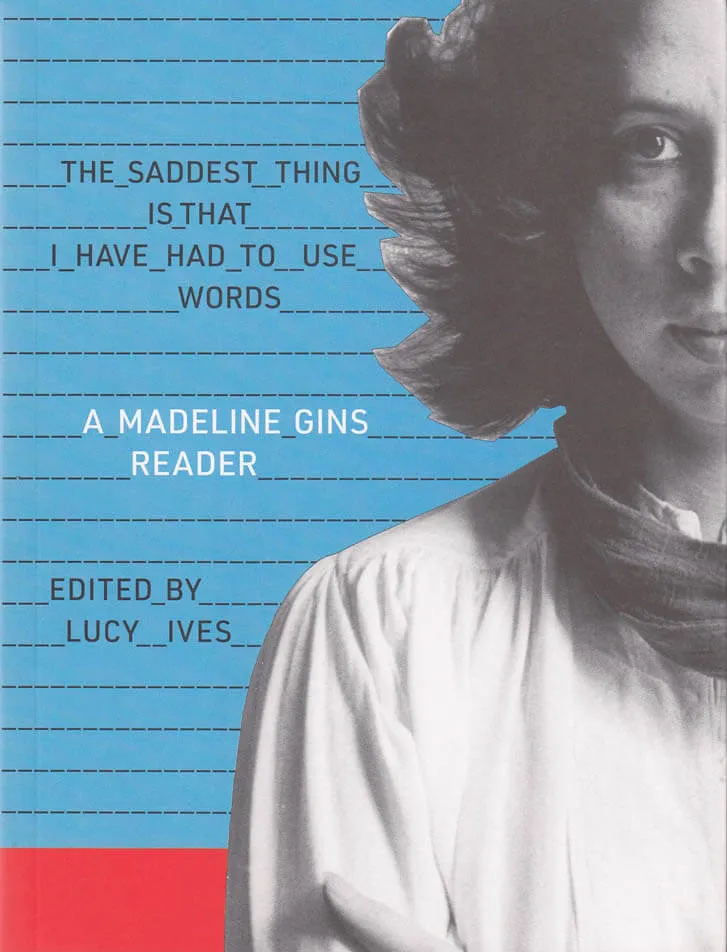
The Saddest Thing Is That I Have Had to Use Words: A Madeline Gins Reader
Poet, philosopher, speculative architect and transdisciplinary artist, Madeline Gins is well known for her collaborations with her husband, the artist Arakawa, on the experimental architectural project Reversible Destiny, in which they sought to arrest mortality by transforming the built environment. Yet, her own writings — in the form of poetry, essays, experimental prose and philosophical inquiries — represent her most visionary and transformative work. Like Gertrude Stein before her, Gins transfigures grammar and liberates words. Like her contemporaries in conceptual art, her writing is attuned to the energized, collaborative space between reader and page.
The Saddest Thing Is That I Have Had to Use Words: A Madeline Gins Reader is a revelatory anthology, edited and with an introduction by the writer and critic Lucy Ives. It brings never-before-published poems and essays together with a complete facsimile reproduction of Gins' 1969 masterpiece, WORD RAIN (or A Discursive Introduction to the Intimate Philosophical Investigations of G, R, E, T, A, G, A, R, B, O, It Says), along with substantial excerpts from her two later books What the President Will Say and Do!! (1984) and Helen Keller or Arakawa (1994). Long out of print or unpublished, Gins' poems and prose form a powerful corpus of experimental literature, one which is sure to upend existing narratives of American poetics at the close of the 20th century.
Edited by Lucy Ives.
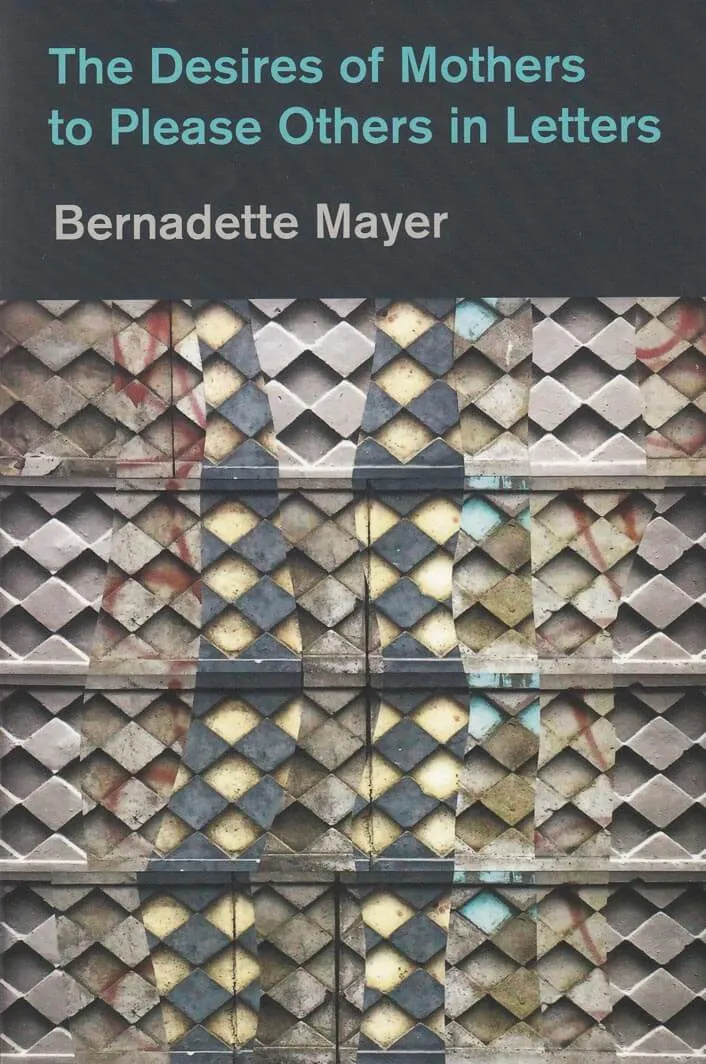
The Desires of Mothers to Please Other in Letters
A reissue of Bernadette Mayer's classic fugitive intergenre text. Endlessly inclusive, The Desires of Mothers to Please Others in Letters, first published in 1994 and long out of print, evokes the complexity of real persons as it simultaneously reinvents multiple genres: epistle, prose poem, and memoir.
Written between 1979 and 1980 while pregnant with her third child, Mayer extends her imaginative letters into meditations for us all on life as it is lived in real time, with its responsibilities and manifold desires. Fierce, lyrical, intimate, and wise, both new and familiar readers, both mothers and non–mothers, will find this book beckoning again and again to offer delicious writing, timely information, consolation, and advice.
With Introduction by Laynie Browne.
Unleashed
05/09/04 Now she is blogging. Now she is sitting on the black couch listening to the sirens wail and the rain fall. Now she is thinking of oysters. Now she is wondering why this is worth sharing. Now she is thinking, how decipher what is worth reading? Who is to say? Sifters. She thinks we have become a nation of sifters. So began a three-year experiment in blogging. An experiment begun for many reasons—a way for an expat to keep in touch with fellow Canadian writers and artists, a way to come to terms with the increasing relevance of the internet in literary lives, and a way to figure out why, after decades of gains, women writers are still grossly underrepresented in critical dialogues.
With an afterword by Vanessa Place.

The Hundreds
Kathleen Stewart, Laurent Berlant
In The Hundreds Lauren Berlant and Kathleen Stewart speculate on writing, affect, politics, and attention to processes of world-making.
The experiment of the one hundred word constraint, each piece is one hundred or multiples of one hundred words long, amplifies the resonance of things that are happening in atmospheres, rhythms of encounter, and scenes that shift the social and conceptual ground.
What's an encounter with anything once it's seen as an incitement to composition? What's a concept or a theory if they're no longer seen as a truth effect, but a training in absorption, attention, and framing?
The Hundreds includes four indexes in which Andrew Causey, Susan Lepselter, Fred Moten, and Stephen Muecke each respond with their own compositional, conceptual, and formal staging of the worlds of the book.

On Pillow Talk

The Faggots and Their Friends Between Revolutions
The Faggots and Their Friends Between Revolutions is a beloved queer utopian text written by Larry Mitchell with lush illustrations by Ned Asta, published by Calamus Press in 1977. Part-fable, part-manifesto, the book takes place in Ramrod, an empire in decline, and introduces us to the communities of the faggots, the women, the queens, the queer men, and the women who love women who are surviving the ways and world of men.
This new edition will feature essays from performance artist Morgan Bassichis, who adapted the book to music with TM Davy in 2017 for a performance at the New Museum, and activist filmmaker Tourmaline.

The Poeticians

Magenta Soul Whip
Lisa Robertson writes poems that mine the past, its ideas, its personages, its syntax, to construct a lexicon of the future. Her poems both court and cuckold subjectivity by unmasking its fundament of sex and hesitancy, the coil of doubt in its certitude. Reading her laments and utopias, we realize that language, whiplike, casts ahead of itself a fortuitous form. The form brims here pleasurably with dogs, movie stars, broths, painting's detritus, Latin and pillage.
Erudite and startling, the poems in Lisa Robertson's Magenta Soul Whip, occasional works written over the past fifteen years, turn vestige into architecture, chagrin into resplendence. In them, we recognize our grand, saddened century.


Economy as Intimacy (vol.1)
A series of choreopoems by Eric Peter. Published at the occasion of 'Assemblages of Intimacy' a group exhibition in a Tale of a Tub, Rotterdam in 2018.

Ecodeviance
A series of 23 (Soma)tic poetry rituals and resulting poems by CAConrad. Poetry rituals such as riding escalators and showing photographs of himself to strangers asking, “Excuse me, have you seen this person?” In another he pollinates flowers for security cameras, exclaiming, “I’M A POLLINATOR, I’M A POLLINATOR!” One was written with a ghost, another by stargazing to build his own constellations. (Soma)tic rituals are a practice of unorthodox steps aimed at breaking us out of the quotidian and into a more political and physical spiritual consciousness of The New Wilderness.

A Sand Book
Deadpan, epic, and searingly charismatic, A Sand Book is at once relatable and out-of-this-world. In poems tracking climate change, bystanderism, state murder, sexual trauma, shopping, ghosting, love, and the transcendent shock of prophecy, A Sand Book chronicles new dimensions of consciousness for our strange and desperate times. What does the destruction of our soil have to do with the weather in the human soul? From sand in the gizzards of birds to the iridescence on the surface of spilt oil, from sand storms on Mars to our internet-addicted present, from the desertifying mountains of Haiti to Sandy Hook to Hurricane Sandy to Sandra Bland, A Sand Book is both a travelogue and a book of mourning.

The Men
The Men explores a territory between the poet and a lyric lineage among men. Following a tradition that includes Petrarch's Sonnets, Dante's work on the vernacular, Montaigne, and even Kant, Robertson is compelled towards the construction of the textual subjectivity these authors convey-a subjectivity that honors all the ambivalence, doubt and tenderness of the human. Yet she remains angered by the structure of gender these works advance, and it is this troubled texture of identity that she examines in The Men.

Nilling
NILLING: PROSE is a sequence of five loosely linked prose essays about noise, pornography, the codex, melancholy, Lucretius, folds, cities and related aporias: in short, these are essays on reading.
"I have tried to make a sketch or a model in several dimensions of the potency of Arendt's idea of invisibility, the necessary inconspicuousness of thinking and reading, and the ambivalently joyous and knotted agency to be found there. Just beneath the surface of the phonemes, a gendered name rhythmically explodes into a founding variousness. And then the strictures of the text assert again themselves. I want to claim for this inconspicuousness a transformational agency that runs counter to the teleology of readerly intention. Syllables might call to gods who do and don't exist. That is, they appear in the text's absences and densities as a motile graphic and phonemic force that abnegates its own necessity. Overwhelmingly in my submission to reading's supple snare, I feel love."

Xeclogue
First issued by Tsunami Editions in 1993, XECLOGUE is an exploration of the pleasures of the pastoral poetry from a late-twentieth-century feminist perspective. Robertson, the Governor General's Award finalist, plays in a neo-classical landscape with equal doses of iconoclasm and erudition. This new and revised edition is sure to win new devotees for her rich and exuberant work.