Performance
Performance

The Trial
The Trial is an extensive publication chronicling the decade-plus-long evolution of one of Rossella Biscotti's seminal works, focusing on the trials of members of the revolutionary left-wing movement Autonomia Operaia in the early 1980s, an emblematic judicial drama of Italy's Years of Lead.
The core of the book is the English transcription of a six-hour audio piece, originally composed from hundreds of hours of the trial's archival recordings broadcast by Radio Radicale. Edited like a theatrical script, The Trial becomes a polyphonic narrative that foregrounds the political voices of defendants in opposition to the structure and language of the legal machine: prosecutors, judges, lawyers. The transcript is accompanied by critical texts by Michael Hardt, Daniel Blanga Gubbay, and Giovanna Zapperi, as well as a conversation between the artist and philosopher Antonio Negri, one of the trial's key defendants. It investigates how political memory is carried, translated, and embodied across time.
Featuring visual documentation and multilingual excerpts from performances staged across various institutions and countries, this publication traces the work's ongoing reactivation through translation, collaboration, and context-specific interventions.

The Stuart Sherman Papers
This collection of poetry, prose, and other texts is the first publication dedicated to the writing of the late performance, video, and visual artist Stuart Sherman.
The Stuart Sherman Papers presents a selection of facsimile reproductions from his archive at New York University's Fales Library. This collection of entries is not exhaustive but conveys the diversity in Sherman’s writing, which used the ever-expanding vocabulary of the English language as a plastic material to study the abundance of meaning that can be derived through playing with combinations, order, and proximity of words. The texts reproduced here leave his edits, scribbles, and notes to self intact, presenting the page as Sherman last engaged with it.
With text contributions by Sally Banes, Mark Bradford, Michiel Huijben, and Nicholas Martin. Photographs by Nathaniel Tileston and Paolo Rapalino.
Editor: Michiel Huijben
Graphic design: Loes Verstappen
Copy editing: Harriet Foyster
Lithography: Marc Gijzen
Stuart Sherman (1945–2001) was a New York-based artist best known for his performances and video, but working in a variety of visual and literary media. He performed, exhibited, and lectured throughout the United States, Europe, and Asia. Sherman died of AIDS in San Francisco in September 2001.

Répondeur
Slow Reading Club (SRC) is a semi-fictional reading group initiated and run by Bryana Fritz and Henry Andersen. Since 2016, in numerous contexts, they have rehearsed alternatives to the kinds of reading they were taught in school, actively suppressing semantic content through strobe lights, strange postures, sociality, and toxins. Operating at the contact zones between reader and text, text and text, reader and reader, they attempt to build a practice from within the unstable space of reading itself.
Répondeur is an extensive account of SRC’s practice in collective reading sessions, exhibitions, and textual bootlegging. Imagined as a scroll, with a rhyme structure and typesetting by Will Holder, the book brings together facsimiles of SRC readers, a wide-ranging interview by Alicja Melzacka, new texts by Joyelle McSweeney and Bill Dietz, and visual work and translations by SRC. These discrete elements are interwoven into a complex, shimmering whole, delighting in the ruptures and elisions of one text’s move into the next.

Jennifer Lacey & Nadia Lauro – Dispositifs chorégraphiques
Un essai consacré au travail de la chorégraphe et danseuse Jennifer Lacey et de la plasticienne et scénographe Nadia Lauro, qui rend compte de l'univers visuel des deux artistes au travers de nombreuses illustrations.
Dans cet essai, Alexandra Baudelot s'attache à saisir l'ensemble des œuvres co-écrites par la chorégraphe Jennifer Lacey et la plasticienne et scénographe Nadia Lauro, en observant de quelle manière elles s'architecturent les unes aux autres pour constituer des extensions inédites d'une forme artistique vers une autre.
Elle les observe à la manière de parcours envisagés comme des supports d'expériences cherchant à déborder constamment ses propres cadres de représentation. Ceci afin de saisir les politiques mises en jeu pour penser le corps, sa place dans un environnement fictif ou quotidien, son impact dans les enjeux chorégraphiques contemporains et ses liens avec notre époque.
L'espace de cet essai se prête également à l'univers visuel des deux artistes qui se livrent ici à un jeu de construction entre l'exploration d'images d'archive, de déclinaisons de projets inédits et périphériques aux pièces publiques, d'illustrations, et d'exposition d'un portfolio de dessins.
Originaire de New York, la chorégraphe et danseuse Jennifer Lacey est établie à Paris. Depuis 1991, elle a développé son propre travail chorégraphique qui a été présenté aux États-Unis (P.S. 122, The Kitchen) et en Europe (Klapstuk Festival, Vienna Festival, Danças na Cidade, Biennale d'art contemporain de Lyon, Big Torino). Depuis qu'elle réside en France, elle a créé et présenté plusieurs œuvres : $Shot (Lacey / Lauro / Parkins / Cornell), Châteaux of France no. 2 et no. 3, un projet conçu en collaboration avec Nadia Lauro, et Prodwhee!, une série de courts modules. En 2002, elle a été accueillie en résidence aux Laboratoires d'Aubervilliers. Jennifer Lacey a collaboré à différents projets avec de nombreux artistes : Loïc Touzé, Boris Charmatz, Emmanuelle Huynh, Benoît Lachambre, Catherine Contour et Latifa Laâbissi. Elle développe actuellement ses créations au sein de l'association Megagloss.
Nadia Lauro est artiste visuelle et scénographe basée à Paris. Elle développe son travail dans divers contextes et conçoit des environnements, des installations visuelles et des costumes pour différents projets chorégraphiques. Outre Jennifer Lacey, elle collabore notamment avec les chorégraphes Ami Garmon, Vera Montero, Benoît Lachambre, Frans Poelstra, Barbara Kraus, figures de la danse contemporaine en Europe. En 1998, elle fonde avec l'architecte paysagiste Laurence Crémel l'association Squash Cake Bureau – scénographie et paysage au sein de laquelle elle conçoit des installations paysagères et du mobilier urbain. Elle a également créé la scénographie de plusieurs défilés de mode.

On Dangerous Ground
Vaginal Davis offers insights into her collaborative practice of making music in art-punk bands in Los Angles and Berlin.
The artist Vaginal Davis certainly moves on dangerous ground with her transgressive shuffling of gender and genre boundaries. The self-described "sexual repulsive" co-founded several art/punk bands in her expansive 40-year-plus career, namely Afro Sisters, ¡Cholita!, Pedro, Muriel & Esther (PME), black fag and Tenderloin. As a writer and "Whoracle et Delphi", Ms. Davis turns her quirky hairy eyeball to the collective practice of making music in the saucy underground scenes of Los Angeles and Berlin. In their contributions, longtime comrades and collaborators Bibbe Hansen (artist and Warhol Silver Factory habitué) and Felix Knoke (guest performer for The Hidden Cameras and band member of Tenderloin) rave about joint performances and rehearsals, divulging sacred secrets and rifts. Bruce "Judy" LaBruce, Glen Meadmore and Lisa "Suckdog" Carver make surprise guest appearances, along with images from live performance spectacles The White to Be Angry, Trust Fund, Interracial Dating Game, We're Taking Over, Afro De Sade and Camp/Anti-Camp: A Queer Guide to Everyday Life.
Edited by Jenny Schlenzka and Julia Grosse.
Texts and works by Vaginal Davis, Bibbe Hansen, Felix Knoke.
Published on the occasion of Vaginal Davis's exhibition at Gropius Bau, Berlin, in 2025.
Vaginal Davis is a Berlin-based American intersexed artist, queer icon of art and music. Vaginal Davis herself is a living work of art: a performer, writer and creator of iconic zines; a visual artist, experimental filmmaker; a self-proclaimed Blacktress and drag terrorist, a gossip columnist, influential socialite, educator and countercultural renegade. Since the late 1970s, her oeuvre has pushed the boundaries of art, music and performance. Inspired by the militancy of the Black Panthers’ pursuit of social justice in the United States, she named herself after feminist and Black Power activist Angela Davis.

Lives Shaping Works Making Life
Xavier Le Roy, Giulia Casartelli and 2 more
24 transcribed public conversations led by Xavier Le Roy with artists and cultural workers, creating a space where Le Roy's work meets the experiences of his guests.
Lives Shaping Works Making Life is a collection of 24 transcribed public conversations titled Practices: Strategies and Tactics, led by Xavier Le Roy and hosted by the Institute for Applied Theater Studies in Giessen between November 2022 and November 2024. These dialogues bring together artists and cultural workers creating a space where Xavier Le Roy's work engages in conversation with the experiences of each guest. Each encounter follows the same set of 14 questions—printed on the book's cover—which serve as a flexible framework guiding the conversations. Through the careful editing of Giulia Casartelli, Daniel Cordova, and Livia Andrea Piazza, these conversations have been transformed into vivid, polyphonic texts that invite further reflection and offer a point of departure for expanding the dialogue beyond the original live encounters.
Conversations with Antonia Baehr, Matthias Mohr, João Fiadeiro, Herbordt / Mohren, Carolina Mendonça, Rolf Michenfelder, Ana Vujanović, Bojana Cvejić, Joana Tischkau, Giulia Casartelli, Susanne Zaun & Judith Altmeyer, Florence Lam, Olivia Hyunsin Kim, Jorge Alencar & Neto Machado, Rabih Mroué, Ruth Geiersberger, Swoosh Lieu, Arkadi Zaides, Valeria Graziano, Mette Edvardsen, Mala Kline, Sarah Parolin, Andros Zins-Browne, Rose Beermann.

Movement Research Performance Journal
Issue #60 - Gender Disarray
Kay Gabriel, Amalle Dublon and 2 more
Under the direction of four contributing editors—Amalle Dublon, Kay Gabriel, Keioui Keijaun Thomas, and Anh Vo— we’ve assembled a new body of work by mostly trans and queer artists reflecting on the keyword “gender” and its relation to contemporary performance. Their work moves across multiple genres of writing, from analytic essays to poetry to performance scripts.
“Read My Lips” is a phrase that will be familiar to longtime readers of the Movement Research Performance Journal—so familiar that the mere reference will bring to mind an image posted by the artist collective GANG, an image that lies at the heart of one of the journal’s most spectacular moments. Issue #3, with its focus “Gender Performance,” was published in 1991 amid that era’s Culture Wars, receiving almost immediately negative reception from government officials (the NEA threatened to withdraw funding from Movement Research) and many members of the dance community (who considered Issue #3 to be deliberately provoking the so-called “war,” intentionally taking a political position that some worried might comprise future funding of the field). In the thirty-three years since its publication, Issue #3 has developed a patina familiar to many artist-activist histories that are looked upon with romance and nostalgia, often by those for whom that history is only a fantasy (rather than a lived experience).

My Mother My Home
Who claims abstraction? What are the limits of abstraction? Are statelessness, dislocation and feelings of (un) belonging embodiments of an abstracted self that is in itself a work in progress? How could performance art—an artistic practice that places significant importance on presence and legibility of form—transgress into the realm of the abstract and the illegible in an effort to protect the artist’s likeness while shedding light on what it means to be in their body in relation to this world?
Chipo Chipaziwa’s My Mother My Home establishes itself as a query on the aspects of belonging and the artist’s own personhood that acts as the foundation of her practice. The question of where one’s personhood begins and ends within an artwork has appeared to be ever prevalent within the realm of visual art and is more relevant within the canon of performance art.
Writers: Chipo Chipaziwa, Denise Ferreira da Silva, Olumoroti George
Contributing artists: Margaret Joba-Woodruff, Sophia Lapres, and David Ezra Wang
Edited by Katrina Geotjen

As If They Had A Spirit: the practice of Pontus Pettersson
As If They Had A Spirit is the first comprehensive monograph of artist Pontus Pettersson. Using drawing and narration, the book expands on Pettersson’s sculptural, poetic and choreographic practice through the accounts and fabulations of long term collaborators. As If They Had A Spirit centers the acts of re-membering, re-telling and re-tracing as situated methods for documenting and studying the protracted and evolving nature of process-based artistic practices.
Recounted and drawn by Linnea Hansander, Robert, Malmborg, Diana Orving, Karina Sarkissova, Sandra Lolax, Stina Nyberg, Anna Koch, Peter Mills, Anna Efraimsson and Galerie (Simon Asencio & Adriano Wilfert Jensen)
Edited and redrawn by Galerie (Simon Asencio & Adriano Wilfert Jensen)
Editing assistance Izabella Borzecka
Published by Galerie, Int
Co-publisher & Distibribution: PAM, Stockholm
As If They Had A Spirit was made possible with generous support by the Swedish Arts Council, Weld, MDT and PAM

Jill Johnston in Motion
Performer, activist, and writer Jill Johnston was a major queer presence in the history of dance and 1970s feminism. She was the first critic to identify postmodernism’s arrival in American dance and was a fierce advocate for the importance of lesbians within feminism. In Jill Johnston in Motion, Clare Croft tracks Johnston’s entwined innovations and contributions to dance and art criticism and activism. She examines Johnston’s journalism and criticism—in particular her Village Voice columns published between 1960 and 1980—and her books of memoir and biography. At the same time, Croft attends to Johnston’s appearances as both dancer and audience member and her physical and often spectacular participation at feminist protests. By bringing together Johnston’s criticism and activism, her writing and her physicality, Croft emphasizes the effect that the arts, particularly dance, had on Johnston’s feminist thinking in the 1970s and traces lesbian feminism’s roots in avant-garde art practice.

The Essential Jill Johnston Reader
Jill Johnston began the 1960s as an influential dance columnist for the Village Voice and by the start of the next decade she was known as a keen observer of postmodern art and lesbian feminist life who challenged how dance, art, and women can and should be seen. The Essential Jill Johnston Reader collects dozens of pieces of her writing from across her career. These writings—many of which appeared in the Village Voice and the New York Times—survey the breadth of her work, braiding together her thinking, writing, and activism.
From personal essays, travel writing, and artist profiles to dance and visual art reviews as well as her infamous series of columns for the Voice in which she came out as a lesbian, these pieces demonstrate the evolution of her philosophies and writing style. Illustrating how Johnston drew on lessons from dance to reconsider what it means to be a woman, this collection brings a fascinating and brilliant voice of American arts criticism, radical feminism, and gay liberation back to contemporary audiences.

Dance First Think Later
An encounter between dance and visual arts.
Dance First Think Later - The Thinking Body between Dance and Visual Arts follows on from the exhibition-festival Dance First Think Later - An Encounter between Dance and Visual Arts, presented in Geneva in summer 2020, documenting it with a wealth of iconography and enriching it with a critical, theoretical and historical perspective on the works and the project. Commissioned texts are devoted to the 22 artists, written by authors active in museums, festivals, art schools, independent critics and artists.
The biennial event Dance First Think Later explores the converging fields between dance, performance, visual arts and moving images. Arta Sperto, which is organising and producing the exhibition-festival and publishing the book, is developing a cross-disciplinary approach that combines the operating mechanisms of the visual and performing arts, and the respective characteristics of museums/art centres and theatres/festivals. This approach is motivated by the need to support artists whose cross-disciplinary practices come up against the way in which culture is still largely organised by field, whether in terms of cultural policies, institutions, funding or the media. Starting with the works themselves, the book offers food for thought on cross-disciplinary approaches to the contemporary arts.
With / around Halil Altindere, Alexandra Bachzetsis & Julia Born, Pauline Boudry & Renate Lorenz, Alex Cecchetti, Clément Cogitore, Dara Friedman, Gerard & Kelly, Marie-Caroline Hominal, Lenio Kaklea, La Ribot, Pierre Leguillon, Xavier Le Roy, Klara Lidén, Melanie Manchot, Olivier Mosset & Jacob Kassay, Samuel Pajand, Christodoulos Panayiotou, Alexandra Pirici, Julien Prévieux, Marinella Senatore, Gregory Stauffer, Barbara Wagner & Benjamin de Burca.

An Archive of Feelings
In this bold new work of cultural criticism, Ann Cvetkovich develops a queer approach to trauma. She argues for the importance of recognizing—and archiving—accounts of trauma that belong as much to the ordinary and everyday as to the domain of catastrophe. An Archive of Feelings contends that the field of trauma studies, limited by too strict a division between the public and the private, has overlooked the experiences of women and queers. Rejecting the pathologizing understandings of trauma that permeate medical and clinical discourses on the subject, Cvetkovich develops instead a sex-positive approach missing even from most feminist work on trauma. She challenges the field to engage more fully with sexual trauma and the wide range of feelings in its vicinity, including those associated with butch-femme sex and aids activism and caretaking.
An Archive of Feelings brings together oral histories from lesbian activists involved in act up/New York; readings of literature by Dorothy Allison, Leslie Feinberg, Cherríe Moraga, and Shani Mootoo; videos by Jean Carlomusto and Pratibha Parmar; and performances by Lisa Kron, Carmelita Tropicana, and the bands Le Tigre and Tribe 8. Cvetkovich reveals how activism, performance, and literature give rise to public cultures that work through trauma and transform the conditions producing it. By looking closely at connections between sexuality, trauma, and the creation of lesbian public cultures, Cvetkovich makes those experiences that have been pushed to the peripheries of trauma culture the defining principles of a new construction of sexual trauma—one in which trauma catalyzes the creation of cultural archives and political communities.

Time has fallen asleep in the afternoon sunshine
Appendix #2 - How to organize a library
Mette Edvardsen, Léa Poiré and 1 more
The Appendixes #1–4 is an editorial series by Mette Edvardsen, Léa Poiré and Victoria Pérez Royo that developed out of the project Time has fallen asleep in the afternoon sunshine. For a two-year residency at Les Laboratoires d’Aubervilliers* (2022–23), they came together as a small work group, shaping the work process, hosting presentation formats and making this publication series on paper as four cahiers.
The cahiers comprise a collection of commissioned texts and contributions created for this context, selected documents and traces from work sessions and encounters organized during their residency, texts read together and republished for this occasion, a collection of references, notes in progress, unfinished thoughts and loose fragments – on paper, between pages.
The Appendixes are organized around four themes: (1) The gesture of writing, (2) How to organize a library, (3) Orality and (4) Translation. In addition to being published on paper, the editorial series also consisted of other formats of presentations, exchanges and meetings organized as workshops, fieldwork, performances, conferences, collective readings and oral publications, taking place during their residency at Les Laboratoires d’Aubervilliers and in the vicinity.

sex and place vol 2
Adriano Wilfert Jensen, Andrea Zavala Folache
sex and place is a series of workshops and publications exploring score-based and semi-anonymous writing as a tool for articulating shared concerns.
Vol 2 ‘discores’ is written by Kexin Hao, Luca Soudant, HaYoung, Andrea Zavala Folache & Adriano Wilfert Jensen. Five strangers are stuck in changing boots next to each other and decide to embark on an intimate conversation starting from the question: “What is troubling your sexuality at the moment?”.
The ‘sex and place’ series is part Domestic Anarchism, a project devoted to coalition-building beyond biological, chosen, or national conceptions of family. Dance serves as a set of tools and knowledge that can be applied beyond “the spectacle” to collectively study, write, and move.
Andrea Zavala Folache and Adriano Wilfert Jensen are choreographers and they co-parent three-year-old Penélope Cleo. Andrea and Adriano use dance and choreography to think about the distribution of care and solidarity beyond ‘the family’, and in turn consider how such a distribution could inform their dance practice. Inevitably themes like sex, economy, gender, and class get activated. But also notions such as prefiguration, anarchism, clitoridian* thinking, zones of non-domination and coalition building. They see dance as a knowledge that can be applied to different practices. Some of these include: co-habitations, score based writing and dancing, self-organised study groups and publications, workshops and dance performances.
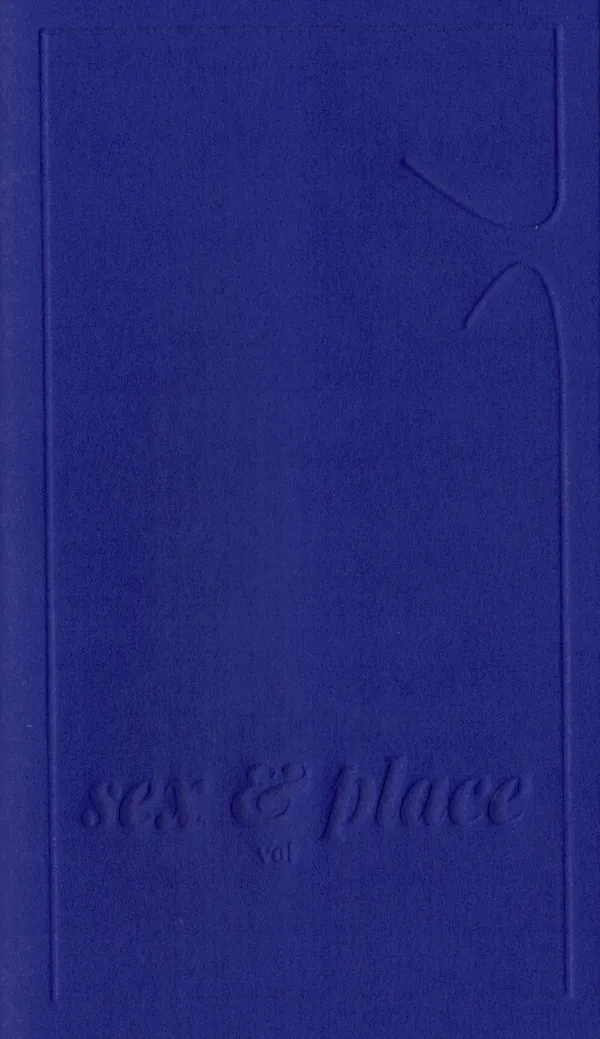
sex and place vol 1
Adriano Wilfert Jensen, Andrea Zavala Folache
sex and place is a series of workshops and publications exploring score-based and semi-anonymous writing as a tool for articulating shared concerns.
Vol. 1 ‘preliminiaries’ is written by Andrea Zavala Folache and Adriano Wilfert Jensen. In the midst of (learning) child care, (unlearning) performance and (experimenting with) sex, the publication interweaves three registers of writing as analogies and interruptions of each other.
The ‘sex and place’ series is part Domestic Anarchism, a project devoted to coalition-building beyond biological, chosen, or national conceptions of family. Dance serves as a set of tools and knowledge that can be applied beyond “the spectacle” to collectively study, write, and move.
Andrea Zavala Folache and Adriano Wilfert Jensen are choreographers and they co-parent three-year-old Penélope Cleo. Andrea and Adriano use dance and choreography to think about the distribution of care and solidarity beyond ‘the family’, and in turn consider how such a distribution could inform their dance practice. Inevitably themes like sex, economy, gender, and class get activated. But also notions such as prefiguration, anarchism, clitoridian* thinking, zones of non-domination and coalition building. They see dance as a knowledge that can be applied to different practices. Some of these include: co-habitations, score based writing and dancing, self-organised study groups and publications, workshops and dance performances.

Time has fallen asleep in the afternoon sunshine
Appendix #3: Orality
Victoria Pérez Royo, Léa Poiré and 1 more
Time has fallen asleep in the afternoon sunshine Appendix #3 Orality includes contributions by Simon Asencio, Bruno De Wachter, Peter Szendy, Clara Amaral, Itziar Okariz, Jude Joseph, Léa Poiré and Mette Edvardsen.
Time has The Appendixes #1–4 is an editorial series by Mette Edvardsen, Léa Poiré and Victoria Pérez Royo that developed out of the project Time has fallen asleep in the afternoon sunshine. For a two-year residency at Les Laboratoires d’Aubervilliers* (2022–23), they came together as a small work group, shaping the work process, hosting presentation formats and making this publication series on paper as four cahiers.
The cahiers comprise a collection of commissioned texts and contributions created for this context, selected documents and traces from work sessions and encounters organized during their residency, texts read together and republished for this occasion, a collection of references, notes in progress, unfinished thoughts and loose fragments – on paper, between pages.
The Appendixes are organized around four themes: (1) The gesture of writing, (2) How to organize a library, (3) Orality and (4) Translation. In addition to being published on paper, the editorial series also consisted of other formats of presentations, exchanges and meetings organized as workshops, fieldwork, performances, conferences, collective readings and oral publications, taking place during their residency at Les Laboratoires d’Aubervilliers and in the vicinity.
The Appendixes is the work that continues, material that adds on, some of it perhaps too long or too detailed, unfit or unfinished. The four themes that their research is formulated around originate in specific experiences and questions from the practices of Time has fallen asleep in the afternoon sunshine (2010 – ongoing), and also the large publication on the project ‘A book on reading, writing, memory and forgetting in a library of living books’ (2019). The research was both a means of exploring these themes in greater depth and also of bringing them into contact with other artists and researchers working on similar or related subjects. The Appendixes offered them both the contexts and the pretexts for things to happen (in time, in space, on paper).
The Appendixes #1–4, published in these cahiers, do not present an overview or a summary of all of the activities and presentations that took place during the two years at Les Laboratoires d’Aubervilliers. What these cahiers offer is a space in which to hold some thoughts together and to share them in this form. It is one more step along the way, extending the research and work already begun and that will now continue.

Juggling (Practices)
In Juggling , Stewart Lawrence Sinclair explores the four-thousand-year history and practice of juggling as seen through his life as a juggler. Sinclair—who learned to juggle as a child and paid his way through college by busking—shares his experiences of taking up juggling after an episode of suicidal ideation, his time juggling on the streets, and ultimately finding comfort in juggling during the COVID-19 pandemic. In many ways, this is a book about loss and recovery. From his own juggling story to clowns braving military checkpoints in Bosnia and Rwanda to perform in refugee camps to contemporary avant-garde performances, Sinclair shows how the universal language of juggling provides joy as well as a respite from difficulties during hard times.

The Haitian Chronicles
The Haitian Chronicles is a graphic and brutal history of the Haitian Revolution told across three plays. It is the final work by the influential and groundbreaking playwright Douglas Turner Ward (1930-2021) and the first play of his to be published in several decades. Though much of his earlier work has been short one-act satires, The Haitian Chronicles takes place across three long plays: The Rise of Toussaint L'Ouverture, The Fall of Toussaint L'Ouverture, and the one-man drama, Dessalines.
The Haitian Chronicles is an example of Ward's political commitment to satirizing, dramatizing, and revealing the structures of white supremacy throughout the history of this so-called civilization. His first play, Star of Liberty, written at 19 years of age, was based the life of Nat Turner and the slave revolt he led. With The Haitian Chronicles, Ward returns to armed Black rebellion, taking as its subject matter the first and only slave revolt to successfully establish a free state. It is a self-consciously ambitious work of astounding narrative and theatrical scope, featuring over 80 speaking roles and logistically demanding production design. The narrative onslaught chronicling the disgusting brutality of colonial French society and the bloody force it took to overthrow it overwhelms the reader and challenges one to question the structures on which society is built and the violence it continues to perpetuate.
Ward was one of the central, driving forces of the Black Theater movement in the United States. After moving to New York in 1948, he became immersed in the radical political scene in Harlem, writing for The Daily Worker, and studying as an actor. He served as understudy to Sidney Poitier in A Raisin in the Sun, and began a long friendship with fellow actor Robert Hooks. In 1966, Hooks helped produce Ward’s double bill Happy Ending / Day of Absence. Following the success of these plays, Ward was asked to write an editorial for the New York Times in 1966. His article, titled "American Theatre: For Whites Only?", surveyed the ubiquitous, stifling racism of the American theatre and was widely circulated, earning Ward further recognition for his political and theatrical work. With funding from the Ford Foundation, Ward and Hooks, together with Gerald Krone, founded the Negro Ensemble Company (NEC) in 1967. Writing and directing for the NEC over the next several decades, Ward worked with icons such as Paul Carter Harrison, Gus Edwards, Leslie Lee, Errol Hill, Charles Fuller, Derek Walcott and Wole Soyinka. He directed dozens of plays throughout his career including Song of the Lusitanian Bogey, The River Niger and Pulitzer Prize-winning A Soldier’s Play. Ward continued to write until his death in 2021– The Haitian Chronicles is the result of over four decades of work, a superb series of plays by an inimitable writer and artist.
Boo-Hooray proudly placed the Douglas Turner Ward Archive at Emory University’s Stuart A. Rose Manuscript, Archives and Rare Book Library in 2017. The Archive includes many working drafts of the numerous plays Ward directed and wrote, manuscript materials, and correspondence with other icons of the Black Arts.
The Haitian Chronicles was a winner of the AIGA 50 Books & 50 Cover Award for the work of book designer Martha Ormiston.

A Book Knot Book
A Book Knot Book is a 208 pages long performance, the first from the research and publishing initiative Body Text. In this study of language in action systems of meaning-making crash, sparkle and swoon. In a playful voice over A Book Knot Book self-reflects on the materialities and choreographies of publishing, reading and writing. With guest stars in fragments; Monique Wittig, Yvonne Rainer, Cristina Rivera Garza, Amiri Baraka, Will Rawls, David Abram, Thich Nhat Hanh and more.
Edited and designed by Sara Kaaman. Published with the support of Stockholm University of the Arts.

Protoplasmic Flow
One of artist Jenna Sutela's regular collaborators, Physarum polycephalum, is often referred to as a natural computer. This yellow, ‘many-headed’ slime mold is an ancient, decentralized, autonomous organism that processes data without a nervous system, operating via communities of coordinated nuclei that demonstrate advanced spatial intelligence. If the slime mold cannot find the resources it needs, it hibernates until better conditions arise; theoretically, it is immortal. Over the years, Sutela has, for example, ingested the slime mold in her performances as a form of artificial intelligence, letting its hive-like behavior program her own.
Sutela's work for Samara reactivates this line of work, delivering co-existence with the slime mold to people's homes in the form of a dried sample of Physarum polycephalum as well as related performative instructions. Inside the box, the audience receives everything necessary to grow slime mold at home, and witness the behaviour of this fascinating organism. With the set of performative instructions, Jenna Sutela proposes the ways of co-existing and engaging with Physarum polycephalum.
Jenna Sutela works with words, sounds, and other living media, such as Bacillus subtilis nattō bacteria and the “many-headed” slime mold Physarum polycephalum. Her audiovisual pieces, sculptures, and performances seek to identify and react to precarious social and material moments, often in relation to technology. Sutela's work has been presented at museums and art contexts internationally, including Guggenheim Bilbao, Moderna Museet, and Serpentine Galleries. She is a Visiting Artist at The MIT Center for Art, Science & Technology (CAST) in 2019-21.
Protoplasmic Flow contains everything required to activate the slime mold in a location of your choosing.
Duration: take all the time that you need
Language: Instructions are in English and Italian.

Raven Chacon: A Worm’s Eye View From a Bird’s Beak
Stefanie Hessler, Katya García-Antón and 1 more
A career-spanning catalogue featuring excerpts from Raven Chacon’s scores, musical prompts, and drawings interspersed with full-color documentation and descriptive texts of installations, sculptures, and performances. Raven Chacon is a composer and artist creating musical experiences that explore relationships among land, space, and people.
In an experimental practice that cuts across the boundaries of visual art, performance, and music, Chacon breaks open musical traditions and activates spaces of performance where the histories of the lands the United States has encroached upon can be contemplated, questioned, and reimagined. In 2022, Raven Chacon became the first Native American to win the Pulitzer Prize for Music, and was awarded a prestigious MacArthur “genius” fellowship in 2023.
Texts by Raven Chacon, Lou Cornum, Aruna D'Souza, Candice Hopkins, Anthony Huberman, Ingir Bål Nango, Marja Bål Nango, Dylan Robinson & Patrick Nickleson, Eric-Paul Riege, Sigbjørn Skåden, Ánde Somby.
Foreword by Katya García-Antón and Stefanie Hessler.

Time has fallen asleep in the afternoon sunshine
Appendix #1: The gesture of writing
Victoria Pérez Royo, Léa Poiré and 1 more
The Appendixes #1-4 is an editorial series by Mette Edvardsen, Léa Poiré and Victoria Pérez Royo that came out of the project Time has fallen asleep in the afternoon sunshine. For a two-year residency at Les Laboratoires d'Aubervilliers (2022-23), they came together as a small work group, shaping the work process, hosting presentation formats and making the publication series on paper as four cahiers.
The cahiers comprise a collection of commissioned texts and contributions created for this context, selected documents and traces from work sessions and encounters organized during the residency, texts read together and republished for this occasion, a collection of references, notes in progress, unfinished thoughts and loose fragments - on paper, between pages.
p 5-7 Almost on my way to you
p 8-10 Presque en route vers toi
Laía Argüelles Folch
p 12-13 Exercise in translation of Breve ensayo sobre la carta (Brief essay on the letter) by Laía Argüelles Folch
p 14-15 Exercice de traduction de Breve ensayo sobre la carta (Bref essai sur la lettre) de Laía Argüelles Folch
Quim Pujol, Paula Caspão, Simon Asencio, Pascal Poyet, Mette Edvardsen, Léa Poiré, Victoria Pérez Royo & Laía Argüelles Folch
p 16-17 Like a dinosaur upon awakening
p 18-19 Comme un dinosaure au réveil
Pascal Poyet
p 20-23 Is she a translator?
p 24-27 Est-elle traductrice?
Olivia Fairweather
p 28-29 New edition revised by my author
p 30-31 Nouvelle édition revue par mon auteur
Léa Poiré
p 32 Notes from a translation in progress
p 33 Notes d'une traduction en cours
Kate Briggs
p 34-37 Mothers & tongues
p 38-41 Langues (maternelles)
Mette Edvardsen
p 42-43 Collective reading of Finnegans Wake by James Joyce
p 44-45 Lecture collective de Finnegans Wake de James Joyce
Dora García and readers, et les lecteur·rices
p 46-49 Notes for a talk that did not happen
p 50-53 Notes pour une conférence qui n'a pas eu lieu
Olivia Fairweather
p 54-65 Meticulous comparison of two books with their versions rewritten from memory, excerpts from a work document
Comparaison méticuleuse de deux livres avec leurs versions réécrites de mémoire, extraits d'un document de travail
Julián Pacomio & Ángela Millano

A take away cup and a cloud
A take away cup and a cloud is an essay written alongside the dance performance Seems to be by Denise Lim and Stina Ehn. It plays with a variety of containers–the list form being one. By mixing a personal with a historical gaze it traces the trajectory of mundane commodities and the replacement of material with imaterial objects brought about to the everyday by technical progress.