Painting
Painting

First Meeting
Santiago de Paoli, Martina Panelli
First Meeting is the first monograph on Argentinian artist Santiago de Paoli. Covering de Paoli’s oeuvre from his early, experimental projects to his most recent explorations, the book delves into his innovative approach of painting on unconventional materials, from plaster to bread, felt to canvas, aluminum to wool, and socks to fur. It features newly commissioned essays by Fernanda Brenner, and Mariano Mayer, as well as a conversation between Christian Rattemeyer and the artist.
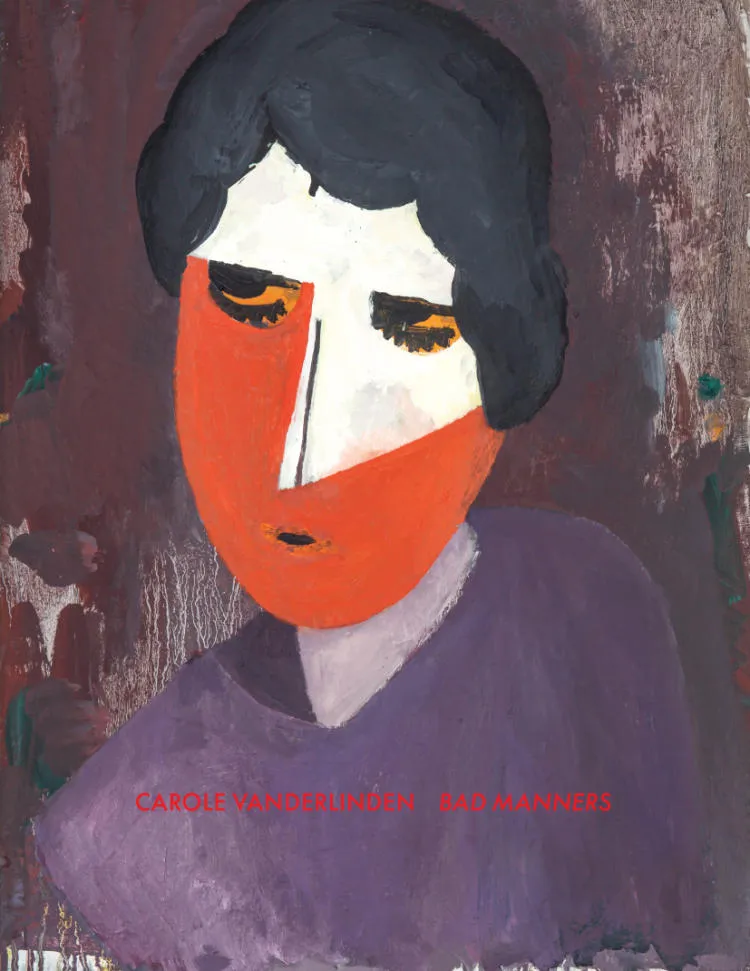
Bad Manners
Carole Vanderlinden's first monograp covers over a decade of the artist's practice. It gathers close to 200 paintings and works on paper, alongside texts by Belgian novelist Jean-Philippe Toussaint, essays by curators Ann Hoste, Ory Dessau, and Hans den Hartog Jager, as well as a conversation between musician and composer Joëlle Léandre and Vanderlinden.
Born 1973 in Brussels, Carole Vanderlinden has been developing a highly improvisational, rich artistic practice since the mid-1990s. While her work is primarily focused on painting (often using thick, hand-mixed oil paints), it regularly encompasses drawing, watercolor, collage, and small objects. Vanderlinden's practice is famously unhampered by the constraints of a single style. Her work nimbly blurs the line between figuration and abstraction, reacting intuitively to the rhythm, color, and possibilities of her medium rather than adhering to a single signature aesthetic.

Local Warming
For Sebastian Black, 2020 was a year like no other: a pandemic; three exhibitions; a move to Los Angeles; a presidential election; a baby, too. Local Warming is Black's tale of it all, as recorded in his diary.
One million years ago, when I started making the paintings compiled here, I was listening to lots of audiobooks and recorded philosophy lectures. It was the winter of 2019, my paintings were about this and about that, and every brushstroke drifted safely over a net of ideas. I was gathering a list of things that I knew to be true because I was sick of having nothing to say when people asked me to explain myself. Then a professor, who to me is now a holy exegete, said that difference precedes identity as the substance of reality. I'd been eavesdropping on YouTube as he taught a continuing-ed class on Deleuze for a claque of narrative therapists. Difference before identity. I couldn't grasp the idea— only touch it. That's okay, said the professor, as though speaking directly to me, the point of thinking isn't to grasp things that are true but rather to prod things that are interesting. — Sebastian Black
Sebastian Black is an artist/writer. He was born in New York City in 1985. He lives and works in Los Angeles.

Friends and Family
This first monograph includes all of Van der Stokker's murals and most of her drawings.
In an interview in this collection of Van der Stokker's wall paintings and drawings, John Waters says, 'Millions of teenage girls have drawings that are good, but no one ever tells them that they are'. Van der Stokker celebrates teenage girlishness, and has since 1983 found both immense support and immense rejection within the art world community. Includes interviews with Van der Stokker and a complete presentation of her works in situ, printed on full-page spreads on quality mat paper.
Dutch-born van der Stokker (1954, Hertogenbosch), active artist-gallery owner on the East Side of New York in the 80's, now lives between Amsterdam and New York. She developed pictorial murals with happy candy-coated slogans that incited acid sarcasm from her contemporaries.
Texts by Anne Pontégnie, Éric Troncy, John Waters/Charles Esche, Mirjam Westen, Amy Kellner.

Profusione
A comprehensive overview of the unique work of the Italian artist born in 1931 and "discovered" late on the international scene, with numerous texts and an interview.
Published after the eponymous exhibition at Consortium Museum, Dijon, April 26th – September 8th 2024.
Born in Naples, Italy, in 1931, Isabella Ducrot is a young artist with a young career. Like many women of her generation, she moved into art after raising her children. Her formative years were marked by continuous travels with her late husband, during which they amassed hundreds of Persian miniatures and rare antique textiles of many kinds.
Contributions by Franck Gautherot & Seungduk Kim, Verena Lueken, Tobias Pils, Tschabalala Self, Andrea Viliani, Miranda Fengyuan Zhang.

I Am the Century
This publication aims to provide a critical and profound reading of Alice Neel's humanism, constructing a journey through her artistic and personal life. The book includes texts by academics and artists, enriched by an extensive number of illustrations, archival photographs and documents.
Alice Neel: I Am the Century accompanies the first major retrospective in Italy dedicated to the US artist Alice Neel (1900–1984), presented by Pinacoteca Agnelli, Turin. Conceived as both a critical and a narrative journey, this publication offers an in-depth exploration of Neel's artistic and personal life, expanding on the exhibition through a rich selection of essays and visual material. It brings together sixty works reproduced in dialogue with archival documents, highlighting Neel's role as a pioneer and one of the most important painters of the twentieth century. Contributions by curators, scholars, and artists—including Kelly Richman-Abdou, Jennifer Higgie, Mira Schor, and Annie Sprinkle—provide multiple perspectives on Neel's practice, situating her radical approach to portraiture within broader artistic, social, and political contexts.
Merging realism with surrealism and empathy with unflinching clarity, Neel captured the psychological and emotional depth of her sitters. The publication emphasizes her capacity to chronicle life's stages and relationships—childhood and adulthood, sexuality and intimacy, community and political consciousness—through works that continue to resonate with contemporary audiences. Positioning Neel as both artist and witness, I Am the Century underscores her enduring humanism and her singular vision of the "human comedy," offering readers a comprehensive entry point into a body of work that is still influencing new generations of artists.
Born in 1900 in Merion Square, Pennsylvania, Alice Neel lived in Philadelphia and Havana before settling in New York (where she lived until her death in 1984), becoming part of the social milieu of the Harlem neighbourhood. She painted figuratively throughout her life, often using the people "around her" as subjects, models and muses. For Neel, this meant portraying both the residents of Harlem as well as strangers, friends and intellectuals who often shared her proximity to the Communist Party. A figurative painter in an era dominated by Abstract Expressionism, Neel developed remarkable and radical new ways of representing the human body in painting, such as with her celebrated nudes of pregnant women.. The introspective aspect of Neel's work, her ability to capture the essence of her subjects and their souls, has made her today one of the most appreciated and respected artists of the twentieth century.
Neel's work has been the subject of retrospectives at the Metropolitan Museum of Art in New York, the Guggenheim Museum Bilbao and the Centre Pompidou in Paris. It forms part of the permanent collections of institutions such as the Art Institute of Chicago; the Hirshhorn Museum and Sculpture Garden in Washington, D.C.; the Metropolitan Museum of Art; Moderna Museet in Stockholm; the Museum of Contemporary Art in Los Angeles; the Museum of Fine Arts in Houston; the Museum of Modern Art in New York; the National Gallery of Art in Washington, D.C.; the Philadelphia Museum of Art; Tate Modern in London; the Walker Art Center in Minneapolis, Minnesota; and the Whitney Museum of American Art in New York.
Edited by Sarah Cosulich and Pietro Rigolo.
Texts by Sarah Cosulich, Jennifer Higgie, Kelly Richman-Abdou, Pietro Rigolo, Mira Schor, Annie Sprinkle.

Ding Dong Bell
Ding Dong Bell is an invitation to cross the threshold into a world that belongs not only to the imagination, but also to the concrete possibility of a different way of inhabiting reality. In this space, details weave together landscapes and reveal characters, hinting at unexpected encounters in a continuous search for shapes and textures, in a chromatic immersion and a sequence of perspectives on a syncretic and archaic world, on an alchemical pictorial practice, where the complex figurative iconography of living beings and cosmic constellations is progressively enriched with tonal stratifications and semantic density.
The collection of paintings outlines universes in which plants, animals, human beings, and subtle presences coexist outside any pre-established hierarchy. The forms cross each other lymphatically and transform without ever being fully accomplished, metamorphically generating a visual ecosystem based on the continuous exchange of substances and the visceral mixture of matter. In this fluid chorus, everything is constantly redefined in the process of becoming, yet without losing its identity. What emerges is a symbolic horizon that becomes a universal hope: an invitation to living beings, witnesses of contemporaneity, to cultivate mutual respect and nurture a providential alliance, where the different planes of existence vibrate in resonance.
The titles of the works, inspired by traditional English nursery rhymes, and the accompanying texts take the form of ancient and surreal chants, capable of evoking both the childhood of the world and its possible future. Their language, closer to illuminated manuscripts than to linear narration, constructs a vivid imaginary world in which whirlwinds and impulses evoke the idea of original totality: at the end of this long succession of worlds, everything seems to tend towards a single, shared substance of being.
Barbara Cammarata (born in 1977) lives and works in Catania (Sicily).

Disobedience
Published to accompany the artist's retrospective at the Kunstmuseum St. Gallen (September 2025–March 2026), this comprehensive monograph offers a detailed overview of the work of Dutch artist Jacqueline de Jong. Designed by Sabo Day and edited by Melanie Bühler, curator of the exhibition, this publication spans De Jong's entire artistic journey of from her editorial activities and bold figurative paintings of the 1960s to her "Billiards" series in the 1970s, and her latest series of the 2020s that reflect the current state of the world.
It features new essays by Karen Kurczynski (Professor of History of Art and Architecture at the University of Massachusetts Amherst), Emily LaBarge (writer and critic), Tiana Reid (Assistant Professor of English at York University), Paul Bernard (Director of Kunsthaus Biel), as well as an as-yet-unpublished conversation with the artist and McKenzie Wark (writer and theoretician).
Organized through six sections entitled "Disobedience," "Publishing," "Chaos," "Pop," "Play," and "Politics," all lavishly illustrated, it underlines the challenging approach to art and life developed by De Jong formally, visually, and conceptually from the early 1960s until 2024.
Edited by Melanie Bühler
Texts by Emily LaBarge, Gianni Jetzer, Jacqueline de Jong, Karen Kurczynski, McKenzie Wark, Melanie Bühler, Paul Bernard, Tiana Reid.

The Sniper in the Brain
Upside-down trees with roots reaching toward the cosmos, glasses, pitchers, transparent vessels, and bodies blending human and animal, male and female features populate Jacopo Pagin’s works. These figures reveal themselves in their decadent and symmetrical being, caught within a web of references centered on the evocative power of the gaze.
The first monograph dedicated to Jacopo Pagin, designed and edited by Ismaël Bennani and Orfée Grandhomme and featuring a critical contribution by Alessandra Franetovich, brings together over 200 drawings and paintings to explore the visionary, obsessive, and hypnotic qualities of the artist’s work and its profound connections with exotic, mediumistic, and new-age practices.
The book is co-published with Make Room, Los Angeles.

CARA Center for Art, Research and Alliances
Art Notes, Art
Since the 1970s, Cynthia Hawkins has investigated the potentials of abstract painting. While often beginning a work or series with a predetermined concept or strategy, Hawkins’s process-oriented practice simultaneously embraces the improvisational to create a systemized space for her continually evolving vocabulary. From 1979 to 1981, important early years in the elaboration of her work, Hawkins documented these developments in a journal. A record of routine and the everyday, the journal also gathers sketches, notes for new and in-progress works, and responses to contemporary art and criticism, bringing the artist’s process, experimentation, and reflections on materials, formalism, abstraction, and figuration into relief.
Art Notes, Art also offers a picture of the burgeoning Black-owned gallery scene in 1970s and ‘80s New York that Hawkins was an important participant in—including Cinque Gallery, Kenkeleba Gallery, and Just Above Midtown, where she had her first solo exhibition in 1981–as well as the women artists’ circle she was an active member of, which hosted weekly shares, critiques, exchange, and amplification of each others’ work. An important glimpse into Hawkins’s creative process and artistic community, Art Notes, Art is richly illustrated with works by the artist produced during this key period–some of which are now lost–photographs and ephemera, and a visual archive of contemporaneous work by her peers.
Editor: Ananth Shastri
Managing Editor: Rachel Valinsky

Superior and Inferior
Superior and Inferior presents a facsimile reprint of Italian abstract artist and feminist Carla Accardi's provocatory publication Superiore e Inferiore and the first ever English translation of the full text.
"In this book, I have bought together the transcripts of dialogues I recorded on tape in three girls' classes from the first, second and third year of a state middle school. For having proposed this unauthorised activity, I was dismissed from teaching in the light of a formal complaint". – Carla Accardi introducing her book Superiore e Inferiore, 1972.
First published in 1972 by Carla Accardi, the book Superiore e Inferiore features discussions among girls at a middle school—all between 10 and 13—about society's discriminatory behaviour towards women. They also commented the Manifesto of the revolutionary feminist group Rivolta Femminile—collectively written by Accardi, art critic and feminist activist Carla Lonzi, and Elvira Banotti—which first appeared posted on city walls in Rome in July 1970. For having discussed sex-related issues with pupils, Accardi was fired and permanently suspended from teaching. (Her letter of dismissal issued by the Italian Ministry of Education forms part of the introduction to the book.) Along the lines of Pasolini's Comizi d'Amore (Love Meetings), Accardi's own voice is secondary in the book, giving way to the thoughts, narratives, opinions, and debates expressed among girls on the role of women and girls, family conflicts and intimate relations.
Carla Accardi (1924–2014) was an Italian abstract painter associated with the Arte Informale and Arte Povera movements, and a founding member of the Italian art groups Forma (1947) and Continuità (1961). She experimented with different forms of art, such as black and white painting and Sicofoil. During the late 1970s, she became part of the feminist movement with critic Carla Lonzi. Together, they founded Rivolta femminile in 1970, one of Italy's first feminist groups. Accardi's first solo exhibition in the United States was in 2001 at MoMA PS1.

Sleigh Ride
In Sleigh Ride, a kinetically wondrous prose tale from poet Joe Fletcher, a father and his convalescing son plunge in carpentered, stallion-drawn sleigh slashing through lush forest, advancing through a sequence of diorama-like settings. The books ten chapters are interspersed with gouache collages by Kraków artist Mikołaj Moskal (REMMUS), rooted and riverine, functioning as curtains swept aside to reveal each chapter of Fletcher’s exhilarating nocturne.
There was a sleigh: jet black and gleaming.
The long steel runners curved at their termini like arabesques of ice. It was too dark to clearly discern the design on its side, but it was intricate, ornate, suggestive of cuneiform and the minarets of Cairo. Two orange lanterns mounted above the driver’s chair were each encircled by a cloud of gnats and moths. Draped in fabulously embroidered saddlecloths, Ajax and Hector stomped the earth.
Given that the only exit from the cellar was the door, hardly wider and taller than a man, I marveled at how father could have extracted his creation from his smithy and pointed it at the forest. But I said nothing as I climbed unaided onto the purple velvet couch.

REMMUS
When living things bloom & molder all in a heartskip, when they expand toward death, this is what worms hear.
Artist’s book of paintings by Mikołaj Moskal: gouache, archival paper elements, simple & meaningful captions. REMMUS is a graft of Podlasie earth-water-sky and Mikołaj’s pigments, heart, and intuition. Designed in close collaboration with graphic artist and designer Kaja Gliwa.
The paintings are bracketed by a poem each by Kuba Niklasiński (“Flows | Flaws”) and Stefan Lorenzutti (“What Worm Heard”), handwritten by Mikołaj in English and Polish.

Antonio Obá: Rituals of Care
Antonio Obá: Rituals of Care traces the practice of the Brazilian artist since 2016, offering a broad survey of his recent work, dwelling on the recurring motifs and iconographic sources that feed the complex imagery of his painting. Extensively illustrated, the book returns the richness of Obá's paintings, with enlargements on some of the details woven into the pictorial texture that, in addition to showing his masterful technique, make certain elements of his visual vocabulary stand out.
The conversation between Andrea Bellini and Antonio Obá that opens the book offers the opportunity to learn, through the artist's voice, about the key passages of his research, and to examine his diverse cultural references—from the Baroque of Minas Gerais to traditional Chinese painting, from Rembrandt to the Catholic ex-votos—until we discover the Obá's civic vocation, of painting as a spiritual practice.
The two essays commissioned for the occasion analyze the complexity of these layered signifiers. Lorraine Mendes's essay "Every Boy Is a King" offers an in-depth analysis of Obá's religious syncretism. It suggests an interpretation of its layered symbols, particularly the sankofa and the deity Exú, both of which pay tribute to the artist's West African roots. Above and beyond the specific cultural contexts of this iconography, the author emphasizes the universal value of Obá's work, its evocative, transformative, dynamic power, which—like music or dance—knows no national boundaries or barriers.
Larry Ossei-Mensah's essay "Embodiment: The Art of Antonio Obá" investigates the complex cultural legacy that is intertwined with the artist's practice, connected to his Afro-Brazilian roots, to the social and political realities of the Black diaspora, and to Christian, Candomblé, and Umbanda traditions. In addition to examining the context in which Obá's work is rooted, the author situates it within a galaxy of artists who have focused on questions of identity, often using their own bodies as tools of social and cultural critique.
Completing the book is a chronology, compiled by Sara De Chiara, tracing the artist's formative years and exhibition history, accompanied by rich documentary materials.
Published on the occasion of Antonio Obá: Rituals of Care, the first mid-career survey in Europe dedicated to the Brazilian artist, curated by Andrea Bellini, at the Centre d'Art Contemporain Genève, in 2025.
Antonio Obá (born 1983 in Ceilândia, Brazil) lives and works in Brasília. His multifaceted practice encompasses painting, sculpture, photography, installation, video, and performance. His œuvre interrogates and subverts historical representations, reappropriating spiritual practices and stigmas of racism. Obá endeavors to reclaim his African heritage in a societal framework that has historically sought to dilute Black culture. His works therefore confront the violence inflicted over centuries upon African-Brazilian traditions and communities with new narratives.

Dreaming Water
Dreaming Water is the most thorough monograph dedicated to the work of Chilean artist Cecilia Vicuña to date. Vicuña coined the term “Arte Precario” in the mid-1960s as a new category for her works composed of debris and structures that disappear in the landscape, and which also include her quipus (“knot” in Quechua), envisioned as poems in space.
Dreaming Water brings together over 200 works—including paintings, drawings, screenprints, collages, textiles, videos, photographs, installations, poetry, artist books and performances—created throughout the artist’s remarkable career. It also features several stimulating texts—a lengthy epistolary piece by curator and editor Miguel A. López as well as new essays by anthropologist Elizabeth A. Povinelli, curator Catherine de Zegher and art historian José de Nordenflycht. Vicuña herself contributes two texts, reflecting on her drawings from the “Palabrarmas” project and the activism of the group Artists for Democracy, which she cofounded in 1974. A rousing conversation between Vicuña, anthropologist Marisol de la Cadena and curator Camila Marambio also figures in the book, blending the artist’s voice with those who are experts in fields pertinent to her practice.

Adagio For Color Fields
Chris Korda (b.1962) is an American antinatalist activist, techno musician, software developer, multimedia artist and founder of the Church of Euthanasia. For the past 30 years, her work has spanned avant-garde performance, happenings, culture- jamming, photography, video, audio and so much more - though her work as an engineer, coder and software developer remains less known to the general public.
This book posits that her software and coding work are linked to her more well-known activist and music work, informing and reforming each other for over 30 years, inhabiting up until now parallel timelines that have been closening over the decades, honing in on a common creative goal: to reveal her as she should be revered, as an Inventor-Artist.
“Any outcome is inevitably shaped by the tools used to achieve it. In industrial civilization, most people use the same standardized tools and therefore achieve similarly standardized outcomes. But imagine discovering a tool for making tools. The outcomes are now limited only by toolmaking skills. This is how computer programming changed my life.”
She refers to her generative artworks, audio and visual, as kinetic sculptures. Working in collaboration with her algorithms, she does not use the machine as a ‘servant’ but rather:
“I invite them into the creative space as equals. They have abilities that I don’t have, and I also have abilities that they don’t have, so we complement each other. They supply speed and precision, I supply desire and intuition, and what emerges is greater than the sum of the parts.”
Thus, on the occasion of the exhibition of the same name, we dedicate this book to Korda’s generative audio-visual synesthetic work 'Adagio For Color Fields' (2023) - a piece that breaks the silence - using it as a lens to bring into focus Korda’s work as an innovative Inventor-Artist.

That's Me!
David Hoyle (b.1962, Blackpool, United Kingdom) is a performance and visual artist. His work over the last 30+ years has referenced gender, politics, identity, mental health issues and the ongoing fight for equality.
Hoyle came to prominence in the ‘90s as The Divine David, a kind of anti-drag queen whose lacerating social commentary – targeting both bourgeois Britain and the materialistic-hedonistic gay scene, which he called, “the biggest suicide cult in history” – was offset by breathtaking instances of self-recrimination and even self-harm. Following a couple of outré late-night Channel 4 TV shows and a part in the movie Velvet Goldmine, directed by Todd Haynes, Hoyle killed off The Divine David, during a spectacular show at the Streatham International Ice Arena in 2000 and retreated to Manchester for “a period of reflection”.
He returned to television screens in 2005 in Chris Morris’ Nathan Barley, then began performing live again, under his own name. Hoyle’s biting satire, bravura costumes, wicked comic timing, and compelling charisma remained intact.
Hoyle is also a prolific painter often painting in his live shows. His paintings are deeply personal, and tackle the same themes as his performances, incorporating domestic waste, flyers, newspapers, magazines, wrapping paper, and more, which reinforce his disdain for the ruling-class bourgeoisie.
This is the first book dedicated to Hoyle’s paintings, offering an edited selection of works made between 2010 and 2022. At Hoyle’s request, all of the works are published undated: thus, emphasising their timelessness, timeliness, relevance, and urgency to the desperate age in which we now find ourselves!

Painting Photographs
TBW Books is pleased to announce the publication of Painting Photographs, a new book by Creative Growth Art Center artist Alice Wong. Wong's bold interpretation of vintage vernacular photographs breathes new life into family album kitsch and cliché shots of plants and landscapes, transforming them into a hyper-color plane of vivid abstraction. Using paint markers to enhance and obscure the formal qualities of appropriated imagery, Wong's hand brings energy to each underlying image, recalibrating the viewer's eye and sparking appreciation for otherwise still compositions. With fluid mark-making and a striking approach to color-blocking, Wong's craft merges with the photographic process to create work that feels at once of times past and completely contemporary.
Creative Growth Art Center is the oldest and largest nonprofit art studio for artists with developmental disabilities in the United States. Since 1974, Creative Growth has played a significant role in increasing public interest in the artistic capabilities and achievements of people with disabilities, providing a professional studio environment for artistic development, gallery exhibition and representation.

To Be Other-Wise
Published in conjunction with the eponymous exhibition at Gladstone Gallery, NYC, this book beautifully gathers pictures of the latest series of paintings by Amy Sillman – and, yeah, reproductions of the full series of 74 amazing works on paper, UGH for 2023 – “Torsos” and “Words” – where marks become membres become shapes become letters become layers bodies become shades – a diagram of time, “a broader contemplation of transformation and temporal fluidity”!
With an essay by Felix Bernstein titled, “AMY SILLMAN’S DIALECTICAL JACULATIONS”

The Glover Group – A Los Angeles Story
A portrait of the cohesive community of women artists in Frogtown, Los Angeles, including Ruby Neri, Hilary Pecis, Megan Reed, Lily Stockman, and Austyn Weiner.
The Glover Group: A Los Angeles Story narrates the journey of an extraordinary group of artists who have nurtured their unique artistic voices within the same studio complex in Frogtown, Los Angeles. The Glover Group includes Ruby Neri, Hilary Pecis, Megan Reed, Lily Stockman, and Austyn Weiner, a coincidental yet cohesive community of women artists sharing a unique bond through their interconnected workspace.
This catalog, designed to document their collaborative exhibition held at MASSIMODECARLO in Milan during July and August 2023, features interviews to the artists by Cecilia Alemani, Alison M. Gingeras, Justine Ludwig, Marta Papini, and Heidi Zuckerman, together with photographs by Tracy Nguyen.
Contributions by Ruby Neri & Alison M. Gingeras, Hilary Pecis & Cecilia Alemani, Megan Reed & Marta Papini, Lily Stockman & Heidi Zuckerman, Austyn Weiner & Justine Ludwig.

Birthday
Bridget Mullen is the ruler of an unruly roost. Between 2021 and 2023, she gave birth to forty-seven paintings, each twelve-by-nine inches: kin ugly and cute, monstrous, fleshy, repulsive, droopy-eyed, and sneering as they cross the universal threshold into the no less frightening world that awaits. Birthday reunites Mullen's uncanny litter alongside a conversation between the artist and Lucas Blalock.
The paintings in New York-based artist Bridget Mullen's Birthday series utilize two distinct parameters to guide the creation of the iterative works: a vertical orientation at an intimate scale of 12 x 9 inches and a visualization of perhaps the ultimate creative act—the moment of birth. Through this consistent scale and thematic hyper focus, the artist employs endless formal variations in composition, color, and paint application. The result is a series of paintings that share a common structure yet champion individuality.
Contrasting colors provoke a visible tension, one that is at times compressed and, in other moments, elastic. Suddenly, abstract shapes come into focus as human anatomies, capable of expressing emotion. Undulating lines of various thicknesses and layered colors squeeze together, revealing peculiar faces and gestures that emerge from a central point. The repetition of thin lines creates a visual stutter of pigment, alluding to the passage of time or rapid movement.
The works in Birthday build on Mullen's practice, combining color, decisive mark-making, intuition, and experimentation to conjure psychedelic configurations. Sculptural dimensionality and flatness, representation and abstraction, and solidity and fluidity, serve not as dichotomies within these works, but as two complementary halves of a whole. Together, the forms and figures of the Birthday series are imbued with a sense of life, pregnant with agency and potential.

Family Picture
An essay in the form of painting studies - including persons, dogs, a frog, a hoofed animal, fish, hare, trees and plants.

William Scott
Covering the past thirty years of William Scott's practice, this monograph offers the largest comprehensive selection of paintings, drawings, masks and architectural models, as well as an unique insight on his creative and transformative approach.
Published on the occasion of Malmö Konsthall William Scott's exhibition at Mälmo Konsthall en 2022.
William Scott (born 1962 in San Francisco) has developed his own artistic practice while working at Creative Growth, an art center in Oakland where people with development disabilities are given the opportunity to work and advance creatively as artists. Combining image and text, his colourful paintings tie in stylistically with current popular culture. Scott's vividly graphic and highly detailed paintings, drawings, and sculptures explore the intersections of community, cultural memory, faith, and science fiction. "Rebirth" is a constant subject for the artist, who reimagines the social topography of his native San Francisco as well as new, interstellar organizations. His portraits depict family members and neighbors, and celebrate Black actors, musicians, and civil rights leaders. For Scott, painting is a transformative as well as a documentary tool; a way to re-craft his personal narrative and even undertake extraordinary acts.
Edited by Nicola Wright
Texts by Carson Cole Arthur, Nana Biamah-Ofosu, Helen Delaney, Tom di Maria, Simona Dumitriu, Nathan Hamelberg, Kathleen Henderson, Matthew Higgs, William Scott, Nicola Wright

The All Night Movie
Created by Mary Heilmann in 1999, The All Night Movie beautifully wraps a memoir inside of a monograph, creating an artist book in which each page is designed as though it were a painting. The artist delicately utilizes color, text, candid photographs, reproductions of paintings, and song lyrics that unfold seamlessly to create an immersive visual experience. Heilmann has described the book as “the story of my life, told in words, painted images and photographs.”
Across eight chapters, Heilmann recounts her life, from childhood in California through New York in the 1990s, providing intimate insight into the development of her work, friendships, and formative life experiences. Snapshots by the artist and others provide a portrait of Heilmann’s evolving artistic community, which included Gordon Matta-Clark, Pat Hearn, Dicky Landry, Jack Pierson, Keith Sonnier, Pat Steir, William Wegman, and Jackie Winsor, among others. And this is just the first half of the book. Included with the artist’s memoir is an essay by Jutta Koether and a survey of paintings from 1972-1999. This highly revered and extremely scarce publication was co-designed with Mark Magill and is reproduced here as a facsimile edition. The All Night Movie was originally published by Hauser & Wirth and Offizin Verlag.
Mary Heilmann was born in San Francisco in 1940. She studied at the University of California at Santa Barbara, San Francisco State University and the University of California at Berkeley before moving to New York in 1968. Heilmann began her career creating sculpture before quickly pivoting into abstract painting once on the East Coast, experimenting with bright colors and unusual geometries that bridge two-dimensional and three-dimensional elements. She has been the recipient of the Anonymous Was a Woman Foundation Award as well as a Guggenheim Foundation award.