LGBTQI+
LGBTQI+

The Nancy Reagan Collection
THE NANCY REAGAN COLLECTION is a response to growing up queer and trans under the rise of HIV-AIDS. Crossing genres and generations, this performance novel remixes the AIDS archive through an ever-spiraling politics and aesthetics of mourning. Alternating chapters offer up a narrative throughline composed of hallucinogenic episodes from the perspective of a nameless, grieving protagonist in the midst of the global carnage of the Reagan dynasty. Part revenge, part fantasy, the book experiments with poetic practices that challenge conceptions of memory and morality, activism and escapism, grief and beauty.
Maxe Crandall is a poet, playwright, and director. He is the author of the chapbooks Emoji for Cher Heart (Belladonna*, 2015) and Together Men Make Paradigms (Portable Press @ Yo-Yo Labs, 2014), and is the founder of the theater company Beautiful Moments in Popular Culture, which produces a poets theater series at the Stud in San Francisco. He has received fellowships from the Poetry Project, Poets House, Lambda Literary, and the Millay Colony for the Arts. Maxe is a lecturer in the Feminist, Gender, and Sexuality Studies Program at Stanford University.

The Power of Adrienne Rich: A Biography
The first comprehensive biography of Adrienne Rich, feminist and queer icon and internationally revered National Book Award winning poet.
Adrienne Rich was the female face of American poetry for decades. Her forceful, uncompromising writing has more than stood the test of time, and the life of the woman behind the words is equally impressive. Motivated by personal revelations, Rich transformed herself from a traditional, Radcliffe-educated lyric poet and married mother of three sons into a path-breaking lesbian-feminist author of prose as well as poetry. In doing so, she emerged as both architect and exemplar of the modern feminist movement, breaking ranks to denounce the male-dominated literary establishment and paving the way for the many queer women of letters to take their places in the cultural mainstream. Drawing on a wealth of unpublished materials, including Rich's correspondence and in-depth interviews with numerous people who knew her, Hilary Holladay digs deep into never-before-accessed sources to portray Rich in full dimension and vivid, human detail.

The Sense of Brown
The Sense of Brown is José Esteban Muñoz's treatise on brownness and being as well as his most direct address to queer Latinx studies. In this book, which he was completing at the time of his death, Muñoz examines the work of playwrights Ricardo Bracho and Nilo Cruz, artists Nao Bustamante, Isaac Julien, and Tania Bruguera, and singer José Feliciano, among others, arguing for a sense of brownness that is not fixed within the racial and national contours of Latinidad.
This sense of brown is not about the individualized brown subject; rather, it demonstrates that for brown peoples, being exists within what Muñoz calls the brown commons—a lifeworld, queer ecology, and form of collectivity. In analyzing minoritarian affect, ethnicity as a structure of feeling, and brown feelings as they emerge in, through, and beside art and performance, Muñoz illustrates how the sense of brown serves as the basis for other ways of knowing and being in the world.
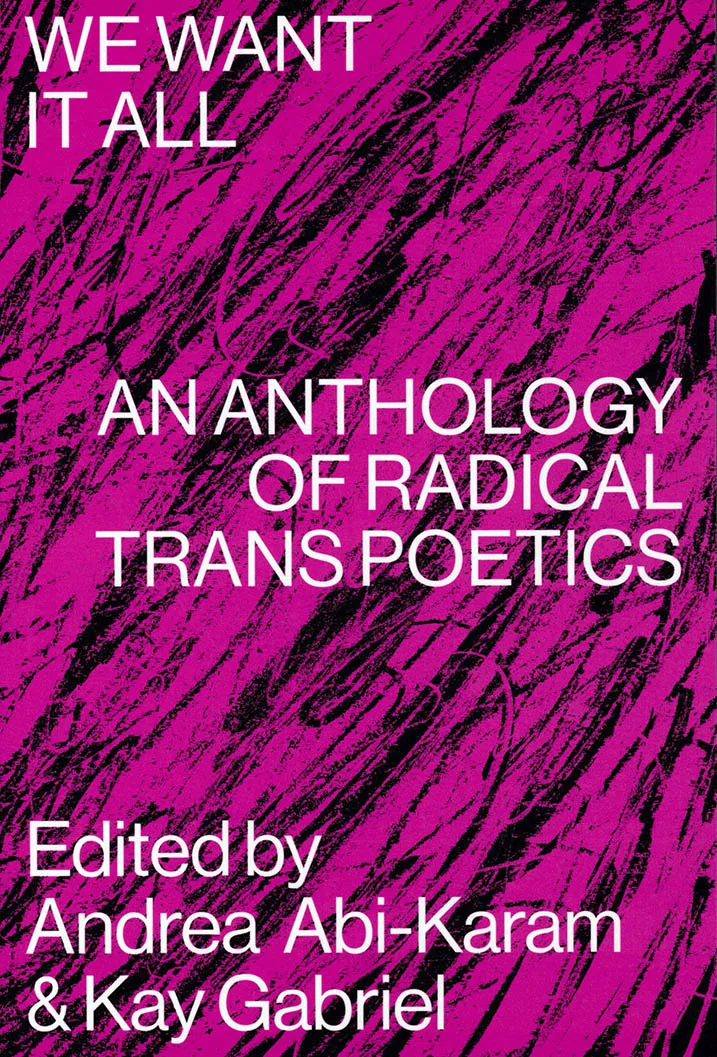
We Want It All: An Anthology of Radical Transpoetics
An anthology of formally inventive writing by trans poets against capital and empire.
With texts by: Andrea Abi-Karam, New York City Sam Ace, South Hadley, MA Bahaar Ahsan, Berkeley, CA jasper avery, Philadelphia, PA Ari Banias, Berkeley, CA Jo Barchi, Chicago, IL Joss Barton, St. Louis, MO Levi Bentley, Philadelphia, PA Jessica Bet, Baltimore, MA Rocket Caleshu, Los Angeles, CA Ching-in Chen, Seattle, WA listen chen, Vancouver, BC Faye Chevalier, Philadelphia, PA Cody-Rose Clevidence, Arkansas Miles Collins-Sibley, Easthampton, MA Valentine Conaty, New York City CA Conrad, Philadelphia, PA Jimmy Cooper, Rochester, MI Maxe Crandall, Oakland, CA José Díaz, Boston, MA Aaron El Sabrout, New Mexico Ian Khara Ellasante, Lewiston, ME Caelan Ernest, New York City, NY NM Esc, San Diego, CA joshua jennifer espinoza, Los Angeles, CA Logan February, Ibadan, Nigeria Ray Filar, Brighton, UK Nora Collen Fulton, Montreal, Canada Kay Gabriel, New York City Callie Gardner, Cardiff, Wales Jesi Gaston, Chicago, IL Harry Josephine Giles, Edinburgh, Scotland Aeon Ginsberg, Baltimore, MD Caspar Heinemann, Berlin, Germany Kamden Hilliard, Greenville, SC Stephen Ira, New York City Cyrée Jarelle Johnson, New York City Peach Kander, New York City Jayson Keery, Western, MA Evan Kleekamp, Los Angeles, CA Noah LeBien, New York City Ty Little, Richmond, VA Zavé Martohardjono, New York City Amy Marvin, Philadelphia, PA Natalie Mesnard, New York City Bianca Rae Messinger, Iowa City, IA Liam O'Brien, New York City Xandria Phillips, Madison, WI Rowan Powell, Santa Cruz, CA Nat Raha, Edinburgh, Scotland Holly Raymond, Philadelphia, PA Jackie S, New York City Trish Salah, Toronto, Canada Raquel Salas Rivera, Philadelphia, PA Mai Schwartz, New York City Kashif Sharma-Patel, London, UK Julian Talamantez Brolaski, Oakland, CA Charles Theonia, New York City Jamie Townsend, Oakland, CA Nora Treatbaby Laurel Uziell, London, UK Rachel Franklin Wood, Boulder, CO Clara Zornado Akasha-Mitra xtian w. and Anaïs Duplan, NYC.
Kay Gabriel is a poet and essayist. She's the author of Elegy Department Spring / Candy Sonnets 1 (BOAAT Press, 2017), the recipient of fellowships from Lambda Literary and the Poetry Project, and recently completed her PhD at Princeton University.
Andrea Abi-Karam is an arab-american genderqueer punk poet-performer cyborg, writing on the art of killing bros, the intricacies of cyborg bodies, trauma & delayed healing. Their chapbook, THE AFTERMATH (Commune Editions), attempts to queer Fanon's vision of how poetry fails to inspire revolution. Andrea's first book, EXTRATRANSMISSION (Kelsey Street Press, 2019), is a poetic critique of the U.S. military's role in the War on Terror.

Empire of the Senseless
Originally published in 1988, Empire of the Senseless marked a turning point in Acker's wild, inimitable style. Considered one of her more accessible works, here Acker candidly addresses her lifelong obsessions: childhood and trauma, language and sexuality, criminality and corruption, oppression and rebellion.
Abhor (part human, part robot) and her lover Thivai (a pirate) traverse Paris in a dystopian future, in search of a mysterious drug that Thivai needs in order to maintain his ability to love. Navigating the chaotic city, they encounter mad doctors, prisoners, bikers, sailors, tattooists, terrorists, and prostitutes, while a band of Algerian revolutionaries take over, and the C.I.A. plots to thwart them all.
Sexually explicit, graphically violent, Empire of the Senseless resists the desensitizing of cultural consciousness and the disintegration of interpersonal communication. A timeless, prescient parable, it speaks profoundly to our social and political history as well as our present reality.

An Apartment on Uranus
A “dissident of the gender-sex binary system” reflects on gender transitioning and political and cultural transitions in technoscientific capitalism.
Uranus, the frozen giant, is the coldest planet in the solar system as well as a deity in Greek mythology. It is also the inspiration for uranism, a concept coined by the writer Karl Heinrich Ulrich in 1864 to define the “third sex” and the rights of those who “love differently.” Following Ulrich, Paul B. Preciado dreams of an apartment on Uranus where he might live beyond existing power, gender and racial strictures invented by modernity. “My trans condition is a new form of uranism,” he writes. “I am not a man. I am not a woman. I am not heterosexual. I am not homosexual. I am not bisexual. I am a dissident of the gender-sex binary system. I am the multiplicity of the cosmos trapped in a binary political and epistemological system, shouting in front of you. I am a uranist confined inside the limits of technoscientific capitalism.”
This book recounts Preciado's transformation from Beatriz into Paul B., but it is not only an account of gender transitioning. Preciado also considers political, cultural, and sexual transition, reflecting on issues that range from the rise of neo-fascism in Europe to the technological appropriation of the uterus, from the harassment of trans children to the role museums might play in the cultural revolution to come.

Neotenica
A slippery novel set in the Bay Area of the early aughts, where femininity, race, and class tangle together.
Neotenica is a novel of encounters: casual sex, arranged-marriage dates, cops, rowdy teenagers, lawyers, a Sapphic flirtation, a rival, a child, and two important dogs. At the center of it are Young Ae, a Korean-born ballet dancer turned PhD student, and her husband, a Korean-American male who inhabits an interior femininity, neither transgender nor homosexual, but a strong, visceral femininity nonetheless. This novel is an adrenaline-filled ride sliding across the surface of desire and chance through the quotidian turned playful.

We Both Laughed in Pleasure
Drawn from Lou Sullivan’s meticulously kept journals, this landmark book records the life of arguably the first publicly gay trans man to medically transition.
We Both Laughed In Pleasure: The Selected Diaries of Lou Sullivan narrates the inner life of a gay trans man moving through the shifting social, political, and medical mores of the second half of the 20th century. Sullivan kept comprehensive journals from age eleven until his AIDS-related death at thirty-nine. Sensual, lascivious, challenging, quotidian and poetic, the diaries complicate and disrupt normative trans narratives. Entries from twenty-four diaries reveal Sullivan’s self-articulation and the complexity of a fascinating and courageous figure.
Edited by: Ellis Martin and Zach Ozma
Introduction by: Susan Stryker

Nightwood
Nightwood, Djuna Barnes' strange and sinuous tour de force, "belongs to that small class of books that somehow reflect a time or an epoch" (Times Literary Supplement). That time is the period between the two World Wars, and Barnes' novel unfolds in the decadent shadows of Europe's great cities, Paris, Berlin, and Vienna—a world in which the boundaries of class, religion, and sexuality are bold but surprisingly porous.
The outsized characters who inhabit this world are some of the most memorable in all of fiction—there is Guido Volkbein, the Wandering Jew and son of a self-proclaimed baron; Robin Vote, the American expatriate who marries him and then engages in a series of affairs, first with Nora Flood and then with Jenny Petherbridge, driving all of her lovers to distraction with her passion for wandering alone in the night; and there is Dr. Matthew-Mighty-Grain-of-Salt-Dante-O'Connor, a transvestite and ostensible gynecologist, whose digressive speeches brim with fury, keen insights, and surprising allusions. Barnes' depiction of these characters and their relationships (Nora says, "A man is another persona woman is yourself, caught as you turn in panic; on her mouth you kiss your own") has made the novel a landmark of feminist and lesbian literature.

a queer anthology of wilderness
Featuring Zoe Leonard, Eileen Myles, Jimmy DeSana, Princess Julia, Olivia Laing, Simon Costin, Timothy Thornton, Mary Manning and many more. Published 2020.
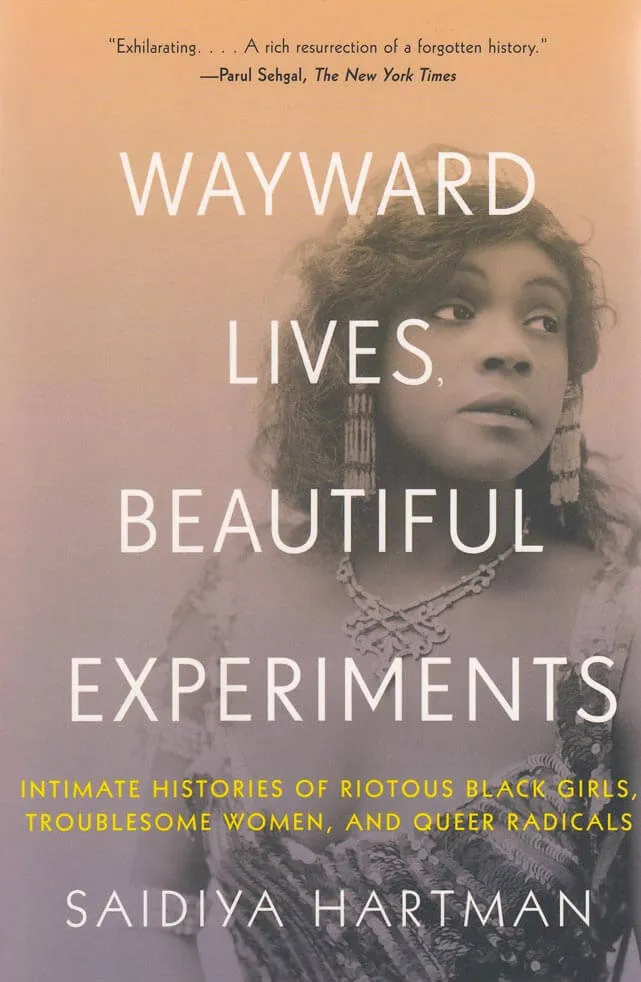
Wayward Lives, Beautiful Experiments
Wayward Lives, Beautiful Experiments examines the revolution of black intimate life that unfolded in Philadelphia and New York at the beginning of the twentieth century. In wrestling with the question of what a free life is, many young black women created forms of intimacy and kinship indifferent to the dictates of respectability and outside the bounds of law. They cleaved to and cast off lovers, exchanged sex to subsist, and revised the meaning of marriage. Longing and desire fueled their experiments in how to live. They refused to labor like slaves or to accept degrading conditions of work. Here, for the first time, these women are credited with shaping a cultural movement that transformed the urban landscape. Through a melding of history and literary imagination, Wayward Lives, Beautiful Experiments recovers these women's radical aspirations and insurgent desires.
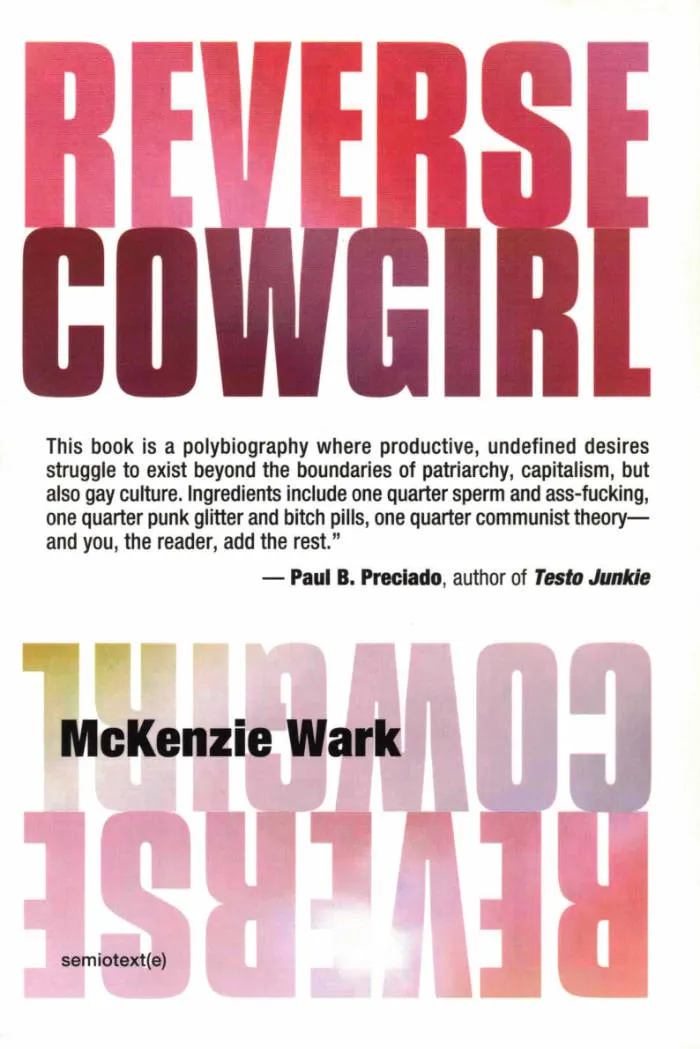
Reverse Cowgirl
McKenzie Wark invents a new genre for another gender: not a memoir but an auto-ethnography of the opacity of the self.
Another genre for another gender.
What if you were trans and didn't know it? What if there were some hole in your life and you didn't even know it was there? What if you went through life not knowing why you only felt at home in your body at peak moments of drugs and sex? What if you expended your days avoiding an absence, a hole in being? Reverse Cowgirl is not exactly a memoir. The author doesn't, in the end, have any answers as to who she really is or was, although maybe she figures out what she could become.
Traveling from Sydney in the 1980s to New York today, Reverse Cowgirl is a comedy of errors, chronicling the author's failed attempts at being gay and at being straight across the shifting political and media landscapes of the late twentieth century. Finding that the established narratives of being transgender don't seem to apply to her, Wark borrows from the genres of autofiction, fictocriticism, and new narrative to create a writing practice that can discover the form of a life outside existing accounts of trans experience: an auto-ethnography of the opacity of the self.

The Faggots and Their Friends Between Revolutions
The Faggots and Their Friends Between Revolutions is a beloved queer utopian text written by Larry Mitchell with lush illustrations by Ned Asta, published by Calamus Press in 1977. Part-fable, part-manifesto, the book takes place in Ramrod, an empire in decline, and introduces us to the communities of the faggots, the women, the queens, the queer men, and the women who love women who are surviving the ways and world of men.
This new edition will feature essays from performance artist Morgan Bassichis, who adapted the book to music with TM Davy in 2017 for a performance at the New Museum, and activist filmmaker Tourmaline.