Fiction
Fiction

Bloodchild and Other Stories
A perfect introduction for new readers and a must-have for avid fans, this New York Times Notable Book includes "Bloodchild," winner of both the Hugo and the Nebula awards and "Speech Sounds," winner of the Hugo Award.
Appearing in print for the first time, "Amnesty" is a story of a woman aptly named Noah who works to negotiate the tense and co-dependent relationship between humans and a species of invaders. Also new to this collection is "The Book of Martha" which asks: What would you do if God granted you the ability—and responsibility—to save humanity from itself?
Like all of Octavia Butler's best writing, these works of the imagination are parables of the contemporary world. She proves constant in her vigil, an unblinking pessimist hoping to be proven wrong, and one of contemporary literature's strongest voices.

The pedestrian
Emerging from the dark ecology between lullaby and ghost story, The pedestrian meanders down a labyrinth of divinatory time where crimes demand a more defective detective. To conjure the source of this text’s trauma, the poet becomes a ritual detective, tracing the wound by its shadow. Meaning emerges through distortion and echo—courting what cannot be seen head-on to create a haunted grammar of grief. An ill pastoral of displacement, The pedestrian turns domestic spaces into underworlds, the body of the exiled child into a prophetic threshold—it listens as much as it speaks, attuned to forces beyond itself.
The pedestrian is a map to a terrain of shards and shadows. While reading it, I felt lost only to the land of the normative, a lush fugitivity. I traveled far with, because of, and in this book. Hsiung trusts in the politics of decomposition, making syntaxes that have been distorted by grief, and thus sharpened to what cannot be colonially extracted. Writers like this know that grammar, vocabulary, and the sentence itself are haunted, so they write not to exorcise or cure this condition of its ghosts, but to make a place for them to live, a place they belong.
— Johanna Hedva

The Ultraviolet Catastrophe
Legal-high addict, gaming enthusiast, and principal shareholder of AstroLabs™, Lex Rameses, has recently discovered—and purchased—Proserpina: a planet with a near-identical ecosystem to Earth’s. Yet, although his humanistic, hipster pretensions mean that many people admire him, there is still one thing standing in the way of his space-colonization program: as of yet, there is no way to travel to Proserpina safely.
Enter a cast of mad scientists, Astro–Marxists, a neurorobotic AI hivemind, an extinction anxiety addict, the victims of an interrelated crypto-currency gaming scam, and a seemingly endless succession of ravers and gamers in search of the ultimate hallucinogenic, carcinogenic, neü-space-age high…
The Ultraviolet Catastrophe is raucous, hilarious, irreverent, and wildly smart, taking aim at techno-salvation fantasies, startup culture, and the eternal humiliation of having a body under the ridiculous conditions of late capitalism. Finlay's new novel is as unexpected and unique as all of her work. Read it now.
— Elvia Wilk, author of Oval and Death by Landscape

The Gangsters
Hervé Guibert’s novel The Gangsters opens at the front door of a Paris townhouse inhabited by the narrator’s elderly great-aunts, Suzanne and Louise. The narrator, distracted by a health crisis and his pursuit of an ambivalent lover, arrives to find suspicious renovation work taking place. But even after the great-aunts confess to being intimidated and extorted, neither he nor the incompetent police can stop the ongoing larceny.
Readers of Guibert’s writing may already recognize the narrator (also named Hervé) and his great-aunts from the groundbreaking photo-novel Suzanne and Louise. As Guibert explained in a 1988 interview, “I started The Gangsters three days after discovering the events of which my great-aunts were victims, and I wrote the book in ten days. The story continued while I was writing and after I had finished.”
Like his other books, The Gangsters is a work of autofiction. Here, he uses the crime-novel format to explore universal motifs, such as cruelty, desire, and mortality. “When I disappear,” Guibert continued, “I will have said it all. I will have striven to reduce this distance between the truths of experience and writing.”

Time Also Will Make It Interesting: Selected Journals
The selected journals of trans, mixed-race artist and dyke erotica writer Red Jordan Arobateau.
Best known for his erotic lesbian fiction, Red Jordan Arobateau was also a prolific painter who maintained and self-published a journal for roughly twenty years, documenting his experiences at the “abject bottom” of life in the US. Edited and introduced by poet and scholar Cameron Awkward-Rich with a foreword by Michelle Tea and paintings by Arobateau, Time Also Will Make It Interesting captures Arobateau’s life as a young dyke in the criminalized cultures of 1950s-60s gay bars of Chicago and New York; his transition from dyke to trans man in late 1990s San Francisco; and his return to painting and an unfolding spirituality within that rapidly gentrifying city.
Queerly messy, ornery, and stuffed with Arobateau’s wisdom, this volume is what he might have called, “a novel combined with a journal—da novel/journal! Taking all the liberty in the world! A domain where verse can be inserted, dreams recorded, my everyday political rants printed out, combined with my forté—fiction! All under one binding & title!”
Foreword by Michelle Tea.

A Series Of Attempts #3: Loving Women aka Le Poney
"We didn’t have anything & we hadn’t seen much. So, naturally we understood less & felt owed something. We weren’t entirely wrong, though. It was 2011."
Part archival remix, part recruitment manual, this pamphlet’s cast of BAD HORSEY GIRLS will teach you how to neigh, dance and flirt until the vampires come home. A Series of Attempts #3 opens with Jordan/_Hell’s new manifesto ☆ LOVING WOMEN ★, that takes the Nomadic Sisters 1976 publication by the same name as a departure point. From here, ★ LE PONEY ☆ then follows a string of lesbian ponies through a dimensional split. A dimensional split that looks suspiciously like the L.A./Parisian+ queer scene… (͠≖~≖ ͡ )
About the author:
Jordan/_ Hell is a Black trans(2s) artist, writer, & scholar. Hell is the author of CONSTANT VIOLINS (Arcadia Missa, 2021) & AUTOLINGO DIDACTICA (Monitor Press, 2023), amount others. Hell’s writing has been internationally published in multiple languages in press, interdisciplinary projects, & exhibitions by Kunstverein Grafschaft Bentheim (DE), Arcadia Missa Gallery & Publishing (UK), Monitor Books (UK), Real Review (UK), Soft Opening (UK), Mousse Magazine (DE), 032c (DE), Rosie’s Disobedient Press (UK), Sticky Fingers Publishing (UK), The Bittersweet Review (UK), Pratt Institute’s The Felt (US), & others. Hell studied at Hochschule für Bildende Künste–Städelschule (DE) & Cooper Union School of Art (US). Currently, Hell is a doctoral candidate in the School of the Arts at Queen Mary University of London.

Murder
Murder is Danielle Collobert’s first novel. Originally published in 1964 by Éditions Gallimard while Collobert was living as a political exile in Italy, this prose work was written against the backdrop of the Algerian War. Uncompromising in its exposure of the calculated cruelty of the quotidian, Murder’s accusations have photographic precision, inculpating instants of habitual violence.
Born in Rostrenen in 1940, Danielle Collobert left Bretagne for Paris at the age of eighteen where she worked in an art gallery and self-published her first poems in a book entitled Chants des guerres (1961). Both of Collobert’s parents, and her aunt, who survived deportation to Ravensbrück, were members of the Résistance during World War II. Herself a supporter of Algerian independence, Collobert joined the FLN (the Algerian National Liberation Front), precipitating her exile in Italy, during which time she completed work on Meurtre, first published in 1964 by Éditions Gallimard with the unwavering support of Raymond Queneau. She worked for Révolution africaine, a short-lived journal created at the end of the Algerian war. Collobert’s extensive travels, to Czechoslovakia, Indonesia, Bolivia, Ecuador, Venezuela, Mexico, Spain, Greece, Egypt, etc., did not prevent her from becoming a member of the group formed around Jean-Pierre Faye and the journal, Change. Her other works include Dire I et II (1972), a radio play the following year, Polyphonie, aired by France Culture, Il donc (1976) and Survie (1978). Upon her return from a trip to New York, Danielle Collobert took her own life in a hotel in Paris on her thirty-eighth birthday. Her complete works, in two volumes, edited by Françoise Morvan, augmented by several unpublished texts, were published by P.O.L. in 2005. Collobert’s works available in English include In the Environs of a Film (Litmus Press, 2019), Notebooks, 1956-1978 (Litmus Press, 2003) and It Then (O Books, 1989).
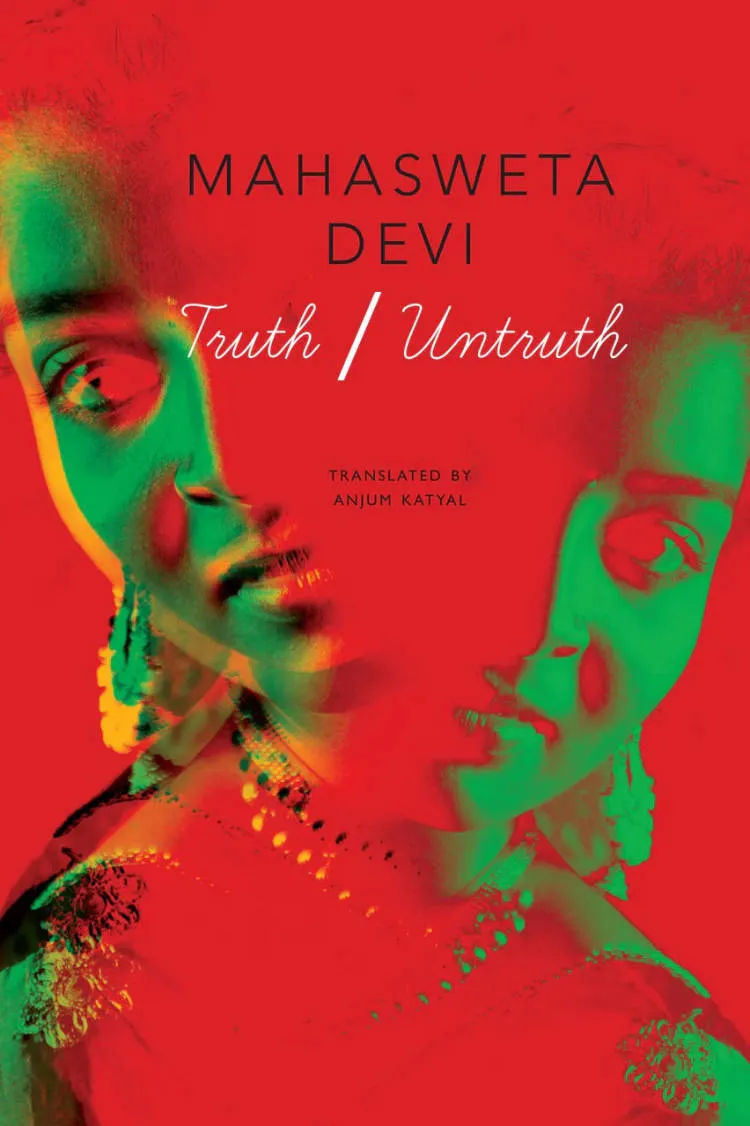
Truth / Untruth
A trenchant, darkly humorous, and unsentimental look at Calcutta society.
Set in Calcutta in the mid-1980s, Truth/Untruth is a fast-paced thriller built around the death of the pregnant Jamuna—a maid in a newly affluent residential apartment complex—and Arjun, the upwardly mobile businessman who seduced her. Packed with a cast of colourful characters, this novel is a trenchant, darkly humorous, and unsentimental look at the different segments of Calcutta society: from the middle-class culture vultures to the unscrupulous ‘promoter’ class and the domestic helpers and slum goons who form an intrinsic part of the city’s life. All are implicated in a complex web of guilt and bizarre twists and turns. Sex, lies, death—the great modernist themes—run like a thread through this book, exposing societal greed, lust, corruption, and moral hypocrisy with a sardonic tone that spares none. An unusual novel by an author who is otherwise known for her hard-hitting activist-feminist stories, Truth/Untruth underlines the exploitative vicious cycle that defines urban relations between the haves and have-nots.
‘Although not of the margins herself, Devi was accomplished in writing from the margins [ . . . ] However, it is indeed worth it if you are looking for an exhilarating social commentary and biting satire that remains relevant today. Devi also reflects the jargon and dialects of the lower classes as deftly as the peculiarities of upper-class speech patterns. A feat of this work is Katyal’s ability to mediate these multiple registers, rewarding the reader with sharp writing that is at once funny, sardonic, and darkly pleasurable to read.‘—Jack Greenbert, Cha: An Asian Literary Journal.

Discomania
A young woman discovers that dancers at a local discotheque are being driven to acts of insane violence.
“The place was full of swarming, pugnacious, dangerous missellneous reptile's… Teenager's everywhere pounded their way on top of each other crazily strangling, biting and slashing each other's with broken glass, smashed records or sharpened blades… ”
16-year-old Jennifer Gibbons (1963–1993) wrote Discomania in 1980, alongside her twin sister June-Alison, who was also writing her own novel, The Pepsi Cola Addict, in the bedroom that they shared.
Jennifer offered Discomania to the same English vanity press who would publish June-Alison's book, but Discomania was turned down for being “too violent, too sexual, and too futuristic.”
Long thought to have been lost or destroyed, June-Alison had in fact preserved the typescript of this unique, furious, funny, and strange novel, which we present with her blessing, alongside additional texts from June-Alison, and editors David Tibet and Ania Goszczyńska.

The Villain’s Dance
Fiston Mwanza Mujila, Roland Glasser
Full of wit, music, and a rollicking cast of characters, The Villain’s Dance shows Fiston Mwanza Mujila is back with a bang.
Zaire. Late nineties. Mobutu’s thirty-year reign is tottering. In Lubumbashi, the stubbornly homeless Sanza has fallen in with a trio of veteran street kids led by the devious Ngungi. A chance encounter with the mysterious Monsieur Guillaume seems to offer a way out . . . Meanwhile in Angola, Molakisi has joined thousands of fellow Zairians hoping to make their fortunes hunting diamonds, while Austrian Franz finds himself roped into writing the memoirs of the charismatic Tshiamuena, the “Madonna of the Cafunfo Mines.” Things are drawing to a head, but at the Mambo de la Fête, they still dance the Villain’s Dance from dusk till dawn.

Season of the Swamp
New Orleans, 1853. A young Zapotec exile from Mexico named Benito Juárez disembarks at a fetid port city at the edge of a swamp. Years later, he will become the first indigenous head of state in the postcolonial Americas, but now he is as anonymous and invisible as any other migrant to the roiling and alluring city.
Accompanied by a small group of fellow exiles who plot their return and hoped-for victory over the Mexican dictatorship, Juárez immerses himself in the city, which absorbs him like a sponge. He and his compatriots work odd jobs, fall victim to the cons and confusions of a strange young nation, succumb to the hallucinations of yellow fever, and fall in love with the music and food all around them. But unavoidable, too, is the stark trade in human beings.
With the extraordinary linguistic play and love of popular forms that have characterized all of Herrera’s fiction, Season of the Swamp is a magnificent work of speculative history, a love letter to the city of New Orleans and its polyglot culture, and a cautionary statement that informs our understanding of the world we live in.

Autobiography of Cotton
Cristina Rivera Garza, Christina MacSweeney
A novel about how cotton workers transformed the Mexico-US borderlands, by a Pulitzer Prize–winning author.
In 1934, a young José Revueltas traveled to Tamaulipas to support the cotton workers’ strike in Estación Camarón, which became the basis of his landmark novel, Human Mourning. In her own groundbreaking novel, Autobiography of Cotton, Cristina Rivera Garza recounts her grandparents’ journey from mining towns to those same cotton fields as it intersects with Revueltas’s life in a vivid and evocative history of cotton cultivation along the Mexico-US border.
Through archival research and personal narrative, Rivera Garza chronicles the way cotton transformed the borderlands by reconstructing the cotton workers’ strike and reveals how cycles of deprivation and ecocide persist across generations. Deeply personal and politically acute, Rivera Garza crafts a new kind of border novel that tells how a brittle land radically altered her grandparents’ lives and the territories they helped develop. An intimate fictionalization, Autobiography of Cotton reveals a rich social history of agricultural colonization, labor activism, environmental degradation, and cross-border migration.

New Infinity
New Infinity is an experimental novella that follows a woman as she lives and dreams her way through the philosophical implications of autoimmune disease. Met by a labyrinth of closing doors, she searches for meaning and connection among fragmented realities and failed relationships, finding infinitude in the healing process of bibliomancy.
Bára Hladík’s New Infinity is a glittering cross-genre debut. Weaving surrealist stories with meditative poetics, Hladík invites you into a dream world of degenerative illness, left disordered by the failures of ableism, medical professionals, and late-stage capitalism. Here, everything runs on sick time. Where physical health and financial resources grow scarce, the restorative possibilities of queer love, divination, and self-reclamation grant a defiant, yet often tenuous, abundance. Alive with Hladík’s boundless insight and wit, New Infinity is a powerful addition to the collective body of disability literature.
“New Infinity is the most incredible fiction. It explodes the boundaries of this form so as to get to the heart of important truths about the phenomenon of physical pain and of human existence itself. While Bára Hladík’s story draws from a personal experience of survival through a struggle unlike any other, it is an entirely universal tale. In taking us into the most intimate spaces of suffering and narrating a story of a woman navigating a true labyrinth, Hladík shows us a way to face life, with the uncertainties it presents to us all. This novel is at once a profoundly moving story, a brilliant act of creativity, and an existential philosophy. It’s a book I will keep close, so as to revisit— for the thrilling inspiration of its liberated uses of form and style, as well as to learn from Hladík’s honest language, her resilient sense of humour, and her ability to capture the surreal beauty of being alive at all. I felt like I was reading Franz Kafka crossed with a fully unconstrained Anne Carson. I haven’t been so impacted by a book in a long time. It has changed my ways of seeing, feeling, and thinking about what it means to be alive.”
— Molly Lynch
“Bára Hladík’s debut book is a blend of poetry and prose that seeks to make sense of a world that is flagrantly hostile and impatient with bodies that neither perform nor conform to the manic impatience of capitalist acceleration. An honest, vibrant, and very real account of a young writer finding a voice.”
– Sina Queyras, writer, editor, professor, curator
Bára Hladík is a Czech-Canadian writer, editor and multimedia artist. Born in Ktunaxa Territory, she began her literary studies in the Creative Writing program at Capilano University in 2011. Her work can be found in Briarpatch Magazine, THIS Magazine, Contemporary Verse 2, Carte Blanche, EVENT Mag, Hamilton Arts and Letters, Bed Zine, Empty Mirror, Cosmonauts Avenue and elsewhere.

Night Night Fawn
From the author of Confessions of the Fox comes a novel in which a yenta on her deathbed gives an unrepentant account of all her failures—including her child.
“Jordy Rosenberg might be one of our most fearless living novelists. There are no half-measures in his work, just big ideas and living characters and gorgeous sentences and metafictional panache and surprise after heart-stopping surprise. Night Night Fawn is extraordinary.”—Carmen Maria Machado, author of In the Dream House
In a cluttered rent-controlled apartment in the middle of Manhattan, Barbara Rosenberg is terminally ill, high on opioids, and writing the story of her life. She has opinions about her smutty late husband, her career as the receptionist for a disreputable plastic surgeon, her glory days as an accomplished jazzerciser, and her failed aspirations to be a film noir actress. But what she really wants to talk about are unhinged thoughts on gender, Karl Marx, Zionism, and her two great disappointing loves: an estranged trans son and a long-lost best friend whose betrayal haunts Barbara still. As she descends further into delirium and illness, Barbara finds herself in a nightmare from which she cannot escape, and her circumstances put her on a crash course with these intimates—or are they avenging nemeses?—once again.
Part novel, part someone’s mother’s unauthorized memoir—all diatribe, gutter schtick, and deranged manifesto, Night Night Fawn is a ferociously candid account of intergenerational conflict.

CARA Center for Art, Research and Alliances
Judith Namala: A Novella
Judith Namala: A Novella, Serubiri Moses’s fiction debut, is an experiment in adaptation, storytelling, and translation as fictocriticism. Set in Uganda between the late 1970s and early 2000s, the book follows the domestic dramas of Judith Namala, a Black maid, and Esther Nambi, her Black madam.
Unfolding across short vignettes, Moses’s innovative prose attends to the silences and opacities that mark the distances—and forced proximities—between two characters whose tense relationship is defined by class and social hierarchy. Hovering at the surface of these quiet scenes of servitude, the narrator offers an enigmatic model of interiority—grasped only in passing, where psychic geographies confront and sometimes, surprisingly, mirror one another.
Drawing on cultural artifacts, art, film, and his own translation of lyrics from a Luganda popular music songbook, Moses spins a story of housework and labor that reaches across forty years of Ugandan history. Written in a unique style informed by oral tradition, folklore, criticism, and reportage, Judith Namala: A Novella is an intimate, domestic portrait that embraces the poetics of metaphor.
Judith Namala is a cinematic dressing-down of airs and manners: a collision of tradition, ritual, and other social parameters revealed through imperatives or hauntings. In a series of lyric portraits riffing off echoes of Annie John and Sula, poet-writer-curator Serubiri Moses exercises his multitalented explorations of text and artifacts, each image operating almost like a fetish. Here, the elite and extracted, the rural and cosmopolitan, are juxtaposed in suffocations of domesticity.
—Ladan Osman
Through its innovative structure combining rich storytelling, history, and the writer’s own commentary, Judith Namala tells the story of a household in Uganda in which a young woman from the rural areas is employed as a maid. The story reveals the depth of injustice at the household level, where one woman’s child is abandoned, whilst the children of an elite Kampala household are over-mothered.
—Sitawa Namwalie
Serubiri Moses is a Ugandan curator and writer living in New York City. He is the author of two poetry books, THE MOON IS READING US A BOOK and You Who Suffer Because You Love, Love Still More (pântano books, 2023 and 2025). His fiction has appeared in Lolwe and Ursula. Moses is a contributing editor at e-flux journal, and teaches at Hunter College and the Center for Curatorial Studies, Bard College. This is his first novel.
Editor: Rachel Valinsky
Copy Editor: Re’al Christian
Designer: Stoodio Santiago da Silva, Bárbara Acevedo

The Vivisectors
A reclusive graduate student is forced into a friendship that destabilizes her life in this surreal, allegorical romance.
In a famed but crumbling university city overrun by nature, where power is held in a fragile balance between academics and a contingent of rogue gardeners, the reclusive narrator of The Vivisectors spends her days propping up the career of her needy and fraudulent professor boss. Then a controversy ruptures her careful routine: Adam, a contrarian student and an obsession of the boss, comes into heated conflict with a young professor, with both men claiming discrimination. The crisis subsumes the university, though the narrator is unmoved—not even the attempted suicide of her estranged mother has been enough to dispel her lack of engagement with the world. But when her boss commands her to befriend Adam, the narrator finds herself both caught up in the events threatening to tear the city apart and increasingly drawn to the alluring student at the heart of it all.
Coursing with icy suspense and told with violent precision, The Vivisectors is a new kind of love story for an age of deteriorated communication. With the unsparing style and intellectual ambition that made her award-winning debut The Doloriad a celebrated provocation, Missouri Williams holds a mirror up to humanity’s most intimate contradictions and reflects them back through a novel of profound, spiky spiritual reckoning.

Beloved
Staring unflinchingly into the abyss of slavery, this spellbinding novel transforms history into a story as powerful as Exodus and as intimate as a lullaby.
Sethe, its protagonist, was born a slave and escaped to Ohio, but eighteen years later she is still not free. She has too many memories of Sweet Home, the beautiful farm where so many hideous things happened. And Sethe's new home is haunted by the ghost of her baby, who died nameless and whose tombstone is engraved with a single word: Beloved. Filled with bitter poetry and suspense as taut as a rope, Beloved is a towering achievement by Nobel Prize laureate Toni Morrison.

University of California Press
Gertrude Stein: Selections
Gertrude Stein, Joan Retallack
This selection of Gertrude Stein's work is taken from the period between 1905 and 1936, when the iconic modernist poet was engaged in an astounding number of still-surprising literary experiments, whose innovations continue to influence all the arts. Editor Joan Retallack has chosen complete texts or selections that lend themselves to a clarified vision of Stein's oeuvre.
In her brilliant introduction, Retallack provides the historical and biographical context for Stein's lifelong project of composing a "continuous present," an effort which parallels many of the most important technological and scientific developments of her era—from moving pictures to Einstein's revision of our understanding of space and time. Retallack also addresses persistent questions about Stein's work and the best way to read it in our contemporary moment. In suggesting a performative "reading poesis" for these works, Retallack follows Stein's dictum by arguing that to actively experience the work is to enjoy it, and to enjoy it is to understand it.
TEXTS
Melanctha (excerpt, from Three Lives, 1905)
The Making of Americans (excerpt, 1911)
Picasso (1911)
Flirting at the Bon Marche (1911)
Bon Marche Weather (1911)
Orta or One Dancing (excerpt, 1912)
Susie Asado (1912)
Tender Buttons: Objects, Food (1913)
Scenes from the Door (from Useful Knowledge, 1918)
Photograph (1920)
A Movie (1920)
An Elucidation (1923)
If I Told Him, A Completed Portrait of Picasso (1923)
Fourteen Anonymous Portraits (1923)
Are There Arithmetics (1923)
Business in Baltimore (1925)
Composition as Explanation (1926)
Patriarchal Poetry (excerpt, 1927)
Sentences and Paragraphs (from How to Write, 1930)
History or Messages from History (1930)
We Came. A History (1930)
Stanzas in Meditation (excerpt, 1932)
Lecture I (from Narration, 1934)
Identity a Poem (1935)
What Are Master-pieces and Why Are There So Few of Them (1936)
DOCUMENTS
“With Apologies to Gertrude Stein,” newspaper advertisement
Two love notes from Stein to Toklas (n.d.): “Dear dainty
delicious darling” and “Ir/Re/Sis/Ti /Belle”
Virgil Thomson, Letter to Gertrude Stein (May 30, 1933)
“Stein Opera Sung by All-Negro Cast,” New York Times (February 9, 1934)
Thornton Wilder, Introduction to Narration (1935)

Brickmakers
Oscar Tamai and Elvio Miranda, the patriarchs of two families of brickmakers, have for years nursed a mutual hatred, but their teenage sons, Pájaro and Ángelito, somehow fell in love. Brickmakers begins as Pájaro and Marciano, Ángelito's older brother, lie dying in the mud at the base of a Ferris wheel. Inhabiting a dreamlike state between life and death, they recall the events that forced them to pay the price of their fathers' petty feud.
The Tamai and Miranda f-amilies are caught, like the Capulets and the Montagues, in an almost mythic conflict, one that emerges from stubborn pride and intractable machismo. Like her heralded debut, The Wind That Lays Waste, Selva Almada's fierce and tender second novel is an unforgettable portrayal of characters who initially seem to stand in opposition, but are ultimately revealed to be bound by their similarities.
Almada enlarges the tradition of some of the most distinctive prose stylists of our time. In Brickmakers, she furthers her extraordinary exploration of masculinity and the realities of working-class rural life. This is another exquisitely written and powerfully told story by a major international voice.

Riverwork
Some ruins are invisible.
Under the pavements of Paris there lies buried an ancient river, the Bièvre. For years, Lucy Frost has walked along these streets, unaware of the water and history under her feet, on her way to clean the apartments of Paris’s academic class. As she begins to study and transcribe the inherited notebooks and papers of her great-aunt, a teacher and researcher who disappeared years earlier, she commits to continuing her aunt’s youthful research on the Bièvre, mining the river’s documentary traces in the works of Rousseau, Rabelais, Hugo, Chateaubriand, and the like. She uncovers a history of industry: paper mills, dyeing workshops, tanneries, and textile manufacturers – and laundries.
She finds resonances of her own labour in the history of the river’s laundresses. On stolen time at work, and in her insomniac hours of nightwriting, she fills notebooks with these woven stories and descriptions of obsolete sites, textiles, cosmologies, and voices, constructing her own forms of relation with the lost.
Riverwork unearths not just an urban river but also a philosophy of research and the archive, a politics of hydrology, an ontology of ageing and belatedness, and a consideration of the unrepresented labour of women, past and present. Along the way it brings to life, in pyrotechnic prose, a long-gone Paris and both its domestic workers and its writers.

Grab Bag
Cult novelist Dennis Cooper launches the third title of Little House on the Bowery, the Akashic series he is editing and promoting.
Grab Bag is comprised of two interrelated novels, Dark Rides and Wish Book, from one of Canada’s most important young writers. Both books are set in the same small rural city, in different eras (1950s, 1930s), each characterized by McCormack’s spare and elliptical prose.

Shapes found for living
Books in dreams were once made of scrolls and parchments. Once, books in dreams could only manifest themselves as clay. Scratches became meaningful. Books still tumble down. Most rooms are flooded; the waters are generally at ankle height.
Shapes Found for Living offers short tales—rumours and fables coalescing from the uneven experience of living in this century and vivifying the reader’s imagined memory theatre. The collection moves from rude immediacy via questioning forms of language depicting unstable mental states, the near madness of trying to live or love, to the absurd remnants of an (envisioned) ancestral recall.

Massive Massive Oil Slick
Expect anger. Expect joy, joy interspersed with anger, anger with joy, anger and joy in equal proportions, till joy is eclipsed by anger, or anger by joy. Expect decline. Expect steady and sudden decline, in fortune and wellbeing, a decline in wellbeing in places as far afield as Corby and Inverness, London, Manchester, and Yorkshire.
Massive Massive Oil Slick is a monologue written in sentences that begin with the verbs expect, suppose, and avoid, delivered in a seminar room of an unnamed institution. The audience is invited to participate in imagined scenarios: predicaments, thought-experiments, moral quandaries. Themes range from profound to mundane, serious to absurd: homelessness, drug trials, social exclusion, traffic, Brazil nuts, carveries, contact with extra-terrestrial life. The result is a prophecy, and the reader the central character through whom multiple futures are posited, dismissed, and revived.

The Wide Road
What would have happened had Thelma and Louise not driven off the cliff but stayed on the road? In Carla Harryman and Lyn Hejinian’s picaresque novella, friendship lives on to follow eros through a polymorphic landscape where their fearless, inquisitive “we” encounters “hunger in two places at once.
The Wide Road is a collaborative investigation of the female body, friendship, writing, community, activism, travel and the nature and possibility of human thinking.
Carla Harryman and Lyn Hejinian, two of the most honored innovators of language, began writing The Wide Road in 1991. Over the following twenty-years, the co-writing occurred in turn by letters, by walking, in cabins, together and apart, and finally together again. The reader of this original and major work will find that it is no longer possible to distinguish who wrote what. Instead, one finds a joyful new feminist voice breaking out new possibilities for the future of writing.
The event of the making-writing of this book is now matched by the event of the making-book object of the book, for which the artist Nancy Blum drew two botanical panels, the fruit and the flower of the strawberry tree. HR Hegnauer, in discussion with editor, Rachel Levitsky and the authors, came up with two designs, and in celebration of the book’s multiple origins, Belladonna* Collaborative printed both!