Comics & Illustration
Comics & Illustration

Emil Lime
Emil Lime collects various materials that nurture and give shape to Esther Gatón’s artistic practice, including collages made with her phone pics, sketches, sporadic notes and drawings, together with the writing of authors that have been influential on the work: Fredy Massad, María Fernanda Ampuero, Darya Diamond and Cory John.

Cadavres
Phœbe Hadjimarkos-Clarke, Rozenn Voyer
Cadavres rassemble 13 poèmes écrits par Phœbe Hadjimarkos - Clarke sur les errances dans les villes âpres, les campagnes humides et les maisons branlantes. Les poèmes sont accompagnés de 15 dessins de Rozenn Voyer.

Hack 'N' Slash
Kamil Bouzoubaa-Grivel réalise au printemps 2020 la série de dessins Hack’n’slash.
Ces collages sont faits à partir d’aplats de couleur autocollants Letrafilm Color/Tint Overlay, que l’on pourrait traduire par Couleur/Teinte Superposition, permettant ainsi de nommer l’importance des jeux de profondeur qui s’y trouvent.
L’artiste se calque là-dessus et joue alors avec la confrontation entre le hack: détournement et réemploi d’outils techniques (trames numériques, encres d’imprimante, dessin manuel) – et le slash: le fait de trancher/juxtaposer les formes venant de différentes dimensions pour composer ses dessins.
Chaque édition a une couverture unique sérigraphiée sur du papier Pantone Letraset par l’Atelier PPP et un texte critique-fiction de Mia Brion.

Carmelina: Figures
Ronaldo V. Wilson’s Carmelina: Figures excavates the territory between memory, nation, and embodiment, exploring place as a discipline of the body and an extension of the hand. Through poems, photographs, drawings, records of performance, and home movies recorded in Guam, Tennessee, and the Subic Bay between 1962 and 1979, Wilson reckons with familial heritage, diaspora, and legacies of militarism.
The book pays homage to Wilson’s mother, Carmelina, who served for most of her working life as a certified nursing assistant at Florin Convalescent, an assisted living facility in South Sacramento, California. A glut of signals and media recovers Carmelina’s vivid and urgent experience of exile from the Philippines to marry Wilson’s father—a Black American soldier—being disowned, and before that, of her parents’ assassinations during the Japanese Occupation. Through a visual logic of repetition and reenactment that works to unmoor sensory expectation and narrative logic, Wilson renders her figure as trace, melody against paper, drawing within song, mixed media, dance, and through improvised, masked, and recorded performances in the Berkshires, MA; Long Island, NY; Emeryville, CA; and Boulder, CO. Carmelina: Figures is a book of the Psoas, ice, smudge, and light.

TIME
TIME by Spencer Longo is a collection of printed work depicting government raids, religious visions, environmental catastrophe, and extremist fundamentalism tangled together in a narrative web of salvation, annihilation, and transcendence. Using pen plotter graphics directly on uncollated pages of Time magazine, Longo explores the conspiratorial trope that messages are secretly embedded in mass media, coaxing our millenarian anxieties out through an additive printing process using graphics from survivalist publications, end-times evangelical cartoons, and marginalia from the borders of underground occult material, all sprinkled with ecstatic bursts of star-spangled clipart. A must-have for your fallout shelter's library.

BIG JOE
A chance encounter with two older fellows at the movie theater has the young vagabond Ligie on his way to Lot-8, a trailer park down the road with an unconventional local reputation. There, Ligie meets Big Joe and his extended Lot-8-family: a tight-knit community of freaks all sectioned together by the landlord at the outskirts of town.
Weaving together colorful characters and outright carnal debauchery, BIG JOE is a radical pastoral of community, desire, and the strangeness of knowing one another.
Featuring color illustrations by Drake Carr and Sabrina Bockler.
Cover illustration by Drake Carr
Samuel R. Delany is the author of numerous books and novels, including the Nebula Award-winning Babel-17 and The Einstein Intersection, as well as Nova (now in a Library of America anthology) and Dhalgren. His 2007 novel Dark Reflections won the Stonewall Book Award. Other erotic novels include Equinox, Hogg, The Mad Man, Throu gh the Valley of the Nest of Spiders, and Shoat Rumblin. Delany was the subject of a 2007 documentary, The Polymath, by Fred Barney Taylor, and he has written a popular creative writing textbook, About Writing. He is the author of the widely taught Times Square Red/Times Square Blue and numerous books of essays; his book-length autobiographical essay, The Motion of Light in Water, won a Hugo Award in 1989. As e-books, paperbacks, or audiobooks, his works are available through his website at: www.samueldelany.com

William Scott
Covering the past thirty years of William Scott's practice, this monograph offers the largest comprehensive selection of paintings, drawings, masks and architectural models, as well as an unique insight on his creative and transformative approach.
Published on the occasion of Malmö Konsthall William Scott's exhibition at Mälmo Konsthall en 2022.
William Scott (born 1962 in San Francisco) has developed his own artistic practice while working at Creative Growth, an art center in Oakland where people with development disabilities are given the opportunity to work and advance creatively as artists. Combining image and text, his colourful paintings tie in stylistically with current popular culture. Scott's vividly graphic and highly detailed paintings, drawings, and sculptures explore the intersections of community, cultural memory, faith, and science fiction. "Rebirth" is a constant subject for the artist, who reimagines the social topography of his native San Francisco as well as new, interstellar organizations. His portraits depict family members and neighbors, and celebrate Black actors, musicians, and civil rights leaders. For Scott, painting is a transformative as well as a documentary tool; a way to re-craft his personal narrative and even undertake extraordinary acts.
Edited by Nicola Wright
Texts by Carson Cole Arthur, Nana Biamah-Ofosu, Helen Delaney, Tom di Maria, Simona Dumitriu, Nathan Hamelberg, Kathleen Henderson, Matthew Higgs, William Scott, Nicola Wright

Luna
"Luna" (2021) is a graphic novel by Artist and illustrator Anat Martkovich, developed in collaboration with artist and illustrator Haithem Haddad. It was self published, with support by the Pais Foundation for the Arts.
The novel follows two days in the life of a family, and at its center is a dramatic event which drastically affects the lives of the family members.
The story develops in an a-linear and fantastic fashion, and attempts to present the impossible reality of violence within and outside the home.
The book is comprised of detailed black and white illustrations, with very little text accompanying them.
The little text alternated between different languages: Russian, Hebrew, Arabic, English and Hebrew sign language, depicting a complex and multi layer urban existence. The story is open to the reader's interpretation, though it is firmly set in a mundane everyday reality it opens up and presents us with fantastic possibilities of existence.

Sforzando - Pastels 2020 - 2022
At midday, March 17th, 2020, Macron’s government decided to place France in suspended animation. Total confinement. The first in a series of strict debilitating lockdowns to combat the spiralling Covid-19 pandemic. This first confinement lasted 55 days. It ended on 11th May 2020. The first part of a dramatic trilogy.
One month in, in April 2020, David West picked up a box of pastels that used to belong to his mother. He had had them for many years but never used them. New to the medium, locked in his Paris studio, he sets himself to the task. Naturally, violence ensues. Folk horror. Animals are disembowelled. Faceless sexualised female bodies perform. Screaming faces educate. Covered figures stand motionless. Shadows. Hooded beings populate. Stabbing, scratching, fading, softening, sforzando. Crescendo. Schadenfreude.
Occasional respite comes when West ventures outside - andante - but the externalised screaming pushes him back in. Hagazussa. Ghosts from West’s past, real and unreal, appear and disappear, figures and shapes, compositional arcs, a slimy snaking emerald hand parts the waves for colour to gush forth a new language verde fosforescente, worm purple, rosa shocking, vermillion, cobalt, ultra-black.
This book reproduces a small selection of some 300 works, in chronological order, in an attempt to document time, evolution, revolt, epiphany and joy. Joy in colour, horror, form, symphony, and finally, West’s visions of a new utopia. Marcato. Decrescendo.
Softcover (21cm x 29.7cm)
100 Pages
50 copies
Signed and numbered by David West

OEI #92-93 Lettrist Corpus: The Complete Magazines (1946–2016)
Frédéric Acquaviva, Jonas J. Magnusson and 1 more
“Un livre qui fera date. Deux ans de recherches, 512 pages, 1.361 illustrations en quadrichromie, 119 revues lettristes parues de 1946 à 2016 pour un total de 1.200 ouvrages décrits (avec la couverture et le sommaire de chaque numéro). Qui d’autre que les éditeurs suédois de OEI (Jonas J. Magnusson et Cecilia Gronberg) aurait pu sortir ce travail anthologique? Personne!” — www.mauricelemaitre.org
“The ‘unreasonable’ idea for this ‘catalogue raisonné’ came to me as an attemps to draw up a complete inventory of all the journals and periodicals of the Lettrist group, from its birth until today. Because the lifespan of the Lettrist movement has exceeded that of all the other avant-garde movements, we are undoubtedly in front of the most immense corpus ever produced in terms of magazines, coverin a period from 1946 to 2016. It presents more than a hundred different titles with more than one thousand items and hundreds of authors. . . . I hope that this comprehensive work will give the reader an opportunity to understand the different paths of the Lettrist groups and the many areas addressed, if not shaken, beyond the books of Isidore Isou and Maurice Lemaître. Since other Lettrists have published relatively few monographic books, and very little outside their own magazines, OEI #92-93 is a unique database for most of the Lettrist texts that we can access, also making it possible for new readers to come across Lettrism.”
— from Frédéric Acquaviva’s introduction
Design by Fält

Anna Oppermann: Drawings
Surreal, psychedelic riffs on domestic objects from a trailblazing feminist artist.
From her beginning in the mid-1960s through the early '70s, German artist Anna Oppermann (1940-1993) - best known for her encyclopedic, immersive installations - created an astonishing series of surreal, almost psychedelic drawings that quietly explode the private space of the home, and her experience within it. These early drawings contribute to a feminist reentering of spheres traditionally associated with women, casting everyday objects as symbolic, consequential protagonists: houseplants sprawl to take over the picture plane, windows and mirrors provide views into other worlds and tables display drawings that themselves open out into new domestic scenes. By placing her own body—her knees, arms, the back of her head—as reference points in the work, Oppermann emphasizes the gendered realms of the home and the relationships that we form to our private spaces.
This volume gathers these drawings and early installations in an English-language publication for the first time.

Index of Operational and Code Names
Le titre du livre « Index of operational and code names » reprend l'intitulé d'un document trouvé sur Internet constitué d'une liste de 437 mots anglais classés par ordre alphabétique et accompagnés de brèves indications concernant les opérations militaires pour lesquelles ces mots ont servi de noms de code.
Ce document a inspiré à Diane Guyot la série « Index War » réalisée selon un protocole simple consistant à produire un dessin pour chaque mot de la liste.
Composé de 86 dessins issus de cette série, certains reproduits pour le support du livre, d'autres présentés au sein d'un cahier photographique tels qu'ils sont aujourd'hui accrochés dans les intérieurs de leurs propriétaires, et d'une partie textuelle placée en fin de volume qui restitue l'intégralité du document source, le livre, comme le suggère la mention volume 1 qui accompagne son titre, ne marque pas le point d'achèvement de l'œuvre mais témoigne au contraire d'un processus en cours.
L'articulation des composantes de l'œuvre dans l'espace du livre en constitue en mème temps une nouvelle version, à la fois spécifique et autonome. L'activation du dispositif codex/index invite le lecteur à une méditation sur la notion de code, où s'entrecroisent sémiotique de l'image, technique de propagande et technologie de l'information.
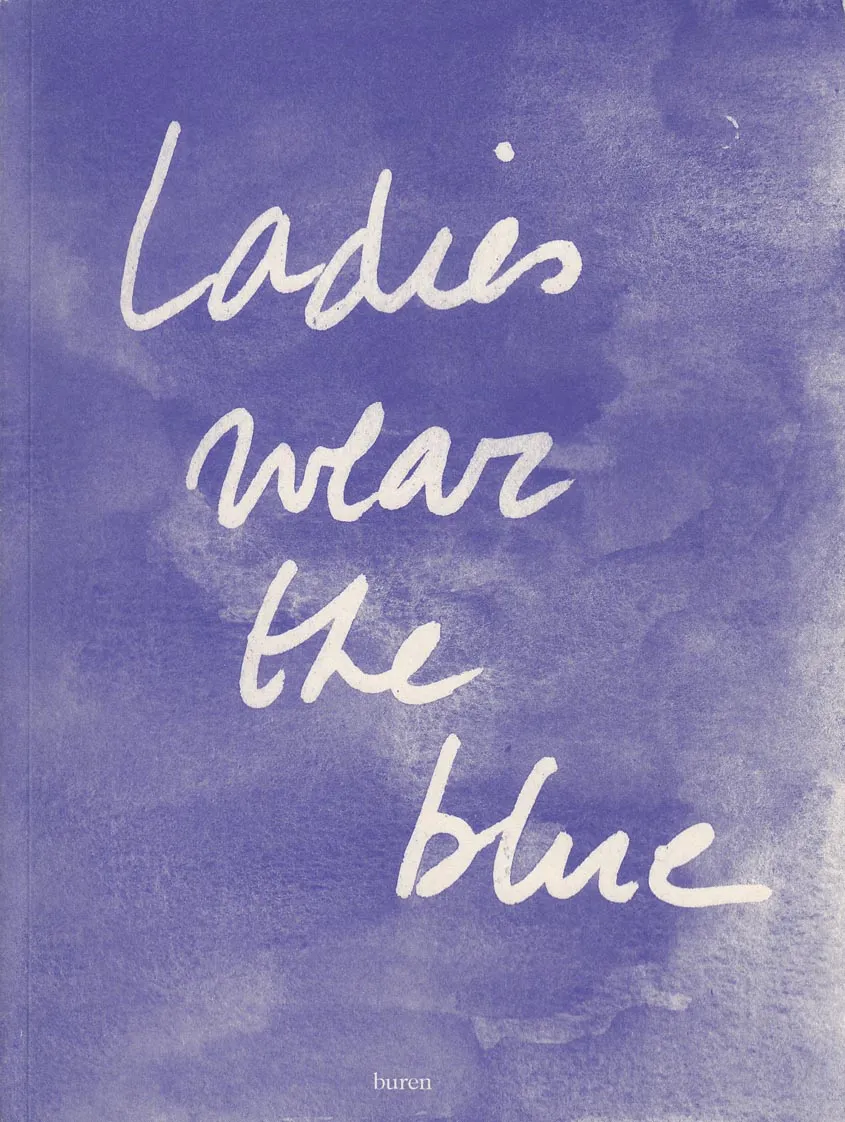
Ladies Wear the Blue
Ladies wear the blue is a collection of watercolour drawings by the hand of Melissa Mabesoone and Oshin Albrecht. The blue watercolours portray women from different moments in time. The adjacent texts describe these women's existence, roles, desires or ideosyncrasies deriving from the 'blue' in their lives. From the first female police officers and Alices all around, to Courtney Love's blue baby dolls and the girl with the blue tattoo Olive Oatman, this publication is an ode to women venturing into the world, and a way to continue telling their herstories.