Artistic Research
Artistic Research

Rong Xin
Various
The name Rong Xin comes from a mini-mall in Flushing that cannot be found on any map. The facade of the mall immediately brings people back to 1980s and 1990s China. Shops stand side by side, dominated by a massive, eye-catching wall covered in recruitment and rental notices. This is indeed the very first landing spot for many new immigrants arriving in New York, where they get SIM cards, search for jobs, and embark on their new, uncertain journeys.
In 2023, several artists/collectives held an exhibition titled “Home-O-Stasis: Life and Livelihoods in Flushing” inside Rong Xin Plaza. The artwork were ingeniously interwoven with the daily details of the mall, creating a subtle dialogue between art, the vibrant bustle of everyday life, and the surrounding reality. Finding ourselves once again in 2026, amid a tempest of screening and deportation against immigrants, how should we engage in conversations about this complex and volatile community? Rong Xin Plaza is not only a microcosm of this community, but also a tangible thing that people can hold onto amidst the maelstrom that is our reality. Rong Xin invited ten artists and scholars, including participating artists, to re-create works spanning short stories, games, self-narratives, interviews, and photography. Through various details, the book outlines the trajectories of new immigrants from arrival and wandering to employment and settlement. Through the nuances of reading and design, one temporarily traverses the intersecting streets and alleys of Flushing, finding a transient sense of security.
Contributors: Herb Tam, Lu Zhang, Xiyadie, Ryan Muchen Wang, Xueli Wang, Janice Chung, Anne Wu, Ou Ning, Yuki He and Qianfan Gu from Mamahuhu
Editors: Michael Guo, Kechun Qin, Herb Tam, Lu Zhang

N°4 Spinal Memory
The moment human fingertips lifted from the ground, upright walking became a privilege rather than a mere posture. The liberated hands could now be used to create tools for defense and hunting. The pupils’ gazes shifted from a level view to a downward perspective, a physical change that also translated into an awareness that overlooked other species. The spine, situated at the center of the human body, acts like a covert ruler, measuring the scale of evolution and supporting the illusion of being “human-centric.” Thus, humans stand, placing themselves far above all other creatures. Following this profound gestural revolution came the imagination and manipulation of non-human animals (the Others), turning them into livestock and companions, as their wildness was rewritten as docility. Their bodies became resources to be medicated and refined, transforming into instruments for milk and nutritious meat production. They became basic knowledge and research data, linking humanity’s ever-expanding and illusory colonial territories.
Discussions and attempts to understand often struggle to escape the limitations of human centrism. Trapped in a persistent ethical dilemma, we find it difficult to navigate the unequal power dynamics that confine us. As the urgency of environmental and ecological issues intensifies, a question repeatedly emerges: Is it possible for us to construct a relatively equal multi-species world? Can we, with greater humility and introspection, relearn how to coexist with the Others? This fourth issue does not offer answers; instead, it comprises reflections and imaginations, as most contributors have long-standing experiences with or ongoing research on non-human animals. Through observation, education, painting, writing, and image-making, they seek to loosen the existing “ethical relationships” and “orderly rules.” Returning to the interior of the body, each vertebra of the spine accumulates traces of human transitions and memories that have yet to dissipate. However, the spine has never fully completed its evolution; its flaws are evident, and the hidden pain it causes always accompanies the body. Perhaps it is this persistent pain that continually reminds us that suffering, which may seem unrelated to us, can be perceived anew from the fissure of spines. By stepping into the bodies of Others, to feel and acknowledge them, a slow exchange occurs that reopens our imagination and generates a relationship that has yet to be named.
Contributors: Eva Koťátková, Hsu Che-Yu and Chen Wan-Yin, Victoria Soyan Peemot, Sha Shuang, Liz Pui Yee Chee, Robert Zhao Renhui, Qindi Hu, Chuangbin Chen, Lei Zhu, Wantanee Siripattananuntakul, Boria Sax, Candice Lin and Justin Torres
Assistant Editor: Jierui Ou
Designer: Can Yang

Movement Research Performance Journal
Issue #57 - Work
Josh Lubin-Levy, John Arthur Peetz and 1 more
Issue 57 of the Movement Research Performance Journal (MRPJ) takes up the keyword “work.” Given that Movement Research has a history of being an organization of artists laboring for and with one another, we invited contributors to consider, revise, or push against questions like: how are things working today? What is the condition of labor in the field of dance and performance? What does it mean to be or have a body that works, on which work is (or isn’t) projected? How do idealizations of the laboring body and/or the ethos of collective practice relate to or obscure the lived experience of making dance works, working in dance, or balancing artistic production with the productive demands of one’s so-called “survival job”? To work in dance (or the arts in general) is indisputably to be exploited. But the contributors to this issue both directly and obliquely take up the experience of working as both enervating and energizing (in often contradictory ways), and draw from their different experiences of working work’s uneven distribution across the globe, the abelism that belies work’s regimentation, and the on-going struggle to find solidarity among arts workers.
More than thematically linked, the issue’s three sections also reflect a desire to address how this publication itself asks artists to work. Artist-run since 1990, the burden of administering a publication like the MRPJ was (perhaps) once outweighed by the promise of what this kind of project could do to shape the field of dance and performance. Today, that editorial and administrative labor dovetails all too well with what has become naturalized as an expectation of practicing artists—that they write about what they are doing or want to do in grant applications, that they create content to be used both for educating and marketing to audiences, and that they develop a discourse that signifies the value of their work in relation to any number of fields other than dance.
For Issue 57, the MRPJ editorial team (Josh Lubin-Levy, John Arthur Peetz, and Nicole Bradbury) gave the keyword “work” to three artists designated as “Contributing Editors” (nora chipaumire, Jerron Herman, and Alex Rodabaugh). nora, Jerron, and Alex were each invited to invite three to five other participants to join the discussion but also encouraged to pass on the administrative and editorial labor to the MPRJ staff.
Issue 57 is only the beginning of thinking about how the structure of a journal on and by artists needs to adapt to an era in which content creation exists in overdrive.

Scent is Present
Michaela Cagáňová, Marta Lopes Santos and 1 more
Scent is Present is an experimental publication exploring the ephemeral notion of olfaction. Through essays, exercises, and artistic contributions, it challenges the limits of language, inviting readers to engage with scent as a non-linear, sensory, and embodied phenomenon. Contributors including olfactory artists, scent designers, and sound artists share their practices and reflections that foreground smell in political and ecological contexts.
The publication stems from a workshop by the same name, carried out in Petrohradská kolektiv in the summer of 2025 by Sleepy Press and Michaela Cagáňová. The workshop accompanied holo-collective’s exhibition ‘AUTOCHORA’ at Jeden Dva Tři Gallery in Prague.
Workshop Participants: Magdalena Škerenčák, Nela Pietrová, Eva Fajčíková, Františka Blažková, Jasmína Horváthová, Karolína Kučerová Dunja, Varya Starodubova, Ondrej Trhoň, sof, Gabriele Sláma, Kristýna Šuleková, Iman, K, Lucy, Maëlle Magnin-Feysot.
Independent Contributors: Romana Klementis, Lila Tesla, Elektra Stampoulou, Maria Ilieva, Lucia Holásková, Michaela Cagáňová
In collaboration with holo-collective and Petrohradská Kolektiv
Designed by Markéta Skalková and Kamila Valešová

Hospitality Playbook
Fern Ling Chettle, Lucia Holásková and 1 more
Hospitality Playbook aims to re-imagine the stereotypes associated with the artist as hospitality worker, serving to interrogate the precarity of work in the arts and cultural industries in the Netherlands. The publication gathers contributions from 20 Amsterdam-based artists and cultural workers working in hospitality, who share stories of, or inspired by, their work experiences, navigating the intersection between labour, personal value, cultural work, and the concept of ‘hospitality’ itself.
Contributions by Alina Lupu, Anielek Niemyjski, Breaking Bread (yawen fu, Augustina Cai) & Fern Ling Chettle, Bryan Zhang, Catalina Reyes Navarro, Inka Hilsenbek, iulia aionesi & Zeo Mancini, Klara-Emilia Kajdi, Leah Jasmine Nogueira, Lucia Holásková, Malte Hultgren, Matija Stojanovic, Maya Asad, Nati Rijo, Parel Joy, Rozan Aversteeg
Designed by Özgür Deniz Koldaş

Negative Landscape
Sinkholes are geological accidents that indicate the emptying of underground aquifers, places where the earth collapses and caves in, yielding to gravity and creating cavities of varying depths. Although they can occur for natural reasons, they are mostly the result of human activity: changes in river courses, intensive exploitation of water resources, mining activity and abandonment of mining sites. Over the last few decades, their number has increased considerably on the Iranian plateau.
This book presents Kimia Kamvari’s exploration of these cavities between 2019 and 2021. It showcases the core of the work, consisting of a careful and methodical series of photographs, accompanied by cartographic sheets and texts that help to understand the artist’s perspective on the phenomenon and stimulate the reader’s own.
Kimia Kamvari (Cologne, 1986) has a degree in painting from the Azad University of Art and Architecture in Tehran and a master’s degree in Art Research and Creation from the UPV-EHU. Since 2015 she has been living and working in Astigarreta, a small town in the interior of Gipuzkoa. His works go from figurative painting to an increasingly conceptual look that explores new formats and materials. Proof of this are his latest exhibitions Apeiron (Dastan Gallery, 2018), Nature Change (Fundación Cristina Enea, 2019), Event Horizon (Dastan Gallery, 2019) Alef (San Telmo Museoa, 2022) and Larruak eta Izurrak (Tabakalera, 2024)

Aural Poetics (OEI #98–99)
”The domain of the aural opens, at once, on to the act of composition and on to the iterative context of a composition’s reception; it comprises embodiment(s) imbricated with an array of inscriptive practices. The works of these pages instantiate (as compositions) and contemplate (as critical texts) the differing degrees in which techniques of the body enter into dynamic relation with modes of inscription, forming a feedback loop that co-constitutes their capacities. To this degree, an aural poetics – in opposition to the vast discourse of its homonym – can evade the facile separation of an essentialized “oral” and “written,” veer away from the technological determinism and psychosocial developmental model that commentators have grafted upon this faux binary, and compel us to imagine and examine composition across artistic practices through assessing specific articulations of materials and occasion. Here, listening is manifold.” (Michael Nardone)
With contributions by: Alexandre St-Onge, Amber Rose Johnson, Ame Henderson + Evan Webber, Anne Bourne, Brent Cox + Courtlin Byrd, Carolyn Chen + Divya Victor, Cecilia Vicuña, Constance DeJong, Dalie Giroux, Damon Krukowski, Danny Snelson, Diane Glancy, Dylan Robinson, Eyvind Kang, François Lemieux, Gail Scott, Heather Davis, Ida Marie Hede + Steven Zultanski, Henri Meschonnic, Janel Morin + Peter Morin, Jerome Ellis, John Melillo, Laura Ortman, Lauren Turner, Lewis Freedman, Lisa Robertson, Luke Nickel, Marcus Boon, Marshall Trammel, Max Ritts, Merlin Sheldrake, Michael Nardone, Mitchell Akiyama, Nicholas Komodore, Niiqo Pam Dick, Oana Avasilichioaei, Patrick Nickleson, Raven Chacon, Raymond Boisjoly, Sophie Seita, Stacy Doris, Steven Feld + Xenia Benivolski, Tanya Lukin Linklater, Tiziana La Melia + Ellis Sam, Tom Miller, Valéria Bonafé + Lílian Campesato

Pedagogies of the Art Proximate
Pedagogies of the Art-Proximate reflects on the changing landscape of contemporary art’s relationship to formal education, through tracing a history of theories, practices and protests across the twentieth century. In a context of educational funding crises, cuts, and changes, and within a wider frame of shifting understandings of how we know things and who or what we learn from, what can learning mean and in what ways can it happen?
Going beyond a simple chronology of art schools, this book considers the many ways in which art and education meet: how museums learn from those they invite in, how art objects become pedagogical tools, and what happens when a school is an artwork (or vice versa). The book proposes art-proximate practices as a new term for an increasingly blurry realm of practices that include socially engaged art, relational art, and activist art, as well as ‘non art’ forms. Weaving together auto-ethnographic, art historical and educational studies, Pedagogies of the Art-Proximate is about what art puts us in the way of learning – and why that might be politically, socially, and critically urgent today.

LOG: Notes on Building-with
Log: Notes on Building-with documents the construction of a wooden structure in Topolò/Topolove and expands it into a reflection on craft, collaboration and situated making. Through photographs and texts, the book approaches the idea of building-with from four different angles: building-with context, building-with materials, building-with tools and building-with others.
Contributions by: Diogo Amaro, Antônio Frederico Lasalvia, Elena Rucli, Madalena Vidigal, Ola Korbańska, Aljaž Škrlep.

How To Do Things With Groups
STARTING POINT: ALL GROUPS HAVE AN UNCONSCIOUS
This project developed from a shared experience: groups we believe should exist and succeed, from mutual aid collectives to communist cadres, struggle with difficult and often unexamined inter-psychic group dynamics. We take it as a starting point that groups, by their very nature, elicit and enact painful and confusing states, like over-dependence on a leader or fear of contamination. We believe that these dynamics play out beneath the surface and alongside whatever the group is trying to do together. In other words, any group, like any individual, has an unconscious.
OUR BIG QUESTION: WHAT DOES THIS MEAN FOR GROUPS DOING POLITICAL WORK?
Groups break down for all kinds of reasons; political organizing is often brutal, exhausting, disappointing work. Feelings of heartbreak and betrayal, resentment and shame, are common. These can be painful, difficult aspects of group life to discuss. They are also often dismissed as ancillary to the real work of political struggle, especially in times of unabating crisis, genocide, and war.
Although interpersonal drama can be taken up in excess–and distract from our work–group dynamics are not mere distraction, and our hesitations about discussing them do not make them disappear. Ironically, in fact, when groups treat relational dynamics as merely superficial or deleterious, they often wind up mired in confusion about what any given internal conflict is “really” about. Often the confusion is posed as not being able to discern what is interpersonal strife and what is political disagreement—an aggravating situation that, we’ve observed, comes up constantly in groups’ narration of their own breakdown. There are no easy formulas for working through these dimensions of group life, but we believe that being undisciplined about them makes it harder for groups to work together productively—or, for that matter, to separate “well.” This pamphlet offers concepts and questions that you can bring to your own group to perform a group inquiry, to think about what might be happening below the surface.
Groups Group is a collective of clinicians, organizers, writers, artists, and scholars interested in group dynamics in the everyday life of all forms of left social movements. We also do internal process work, popular education, and consult with groups.

TRANSMISSIONS: Radio Essays on Edges, Crossings and Narrowcasting Borderlands
Transmissions: Radio Essays on Edges, Crossings and Narrowcasting Borderlands gathers radio essays—created as part of Robida Collective’s project Radio drugega/The Other Radio—which reveal that to speak of “the border” is never to speak of a single line. There are political borders, conceptual borders, bodily borders; carnivalesque borders, where order collapses into play; linguistic and cultural borders, where words slip between languages and where accents become geographies; archival borders, separating memory from forgetting; borders of abandonment, where life and death enter into a dialectical ballet; economic borders, drawn by property, ownership, enclosure; borders of matter, space and time; acoustic borders, where the voice meets noise and incomprehensibility; cosmic borders, where meteors cross the thin edge of air; ecological borders, porous and breathing, where one species touches another. These are some of the borders this book speaks of – lines that do not divide but resonate, that hold together separation and proximity, distance and relation. Together, these essays form a cartography of friction but also affinity, reminding us that to erase all borders is to erase the very conditions of encounter – and that meaning often emerges not at the centre, but at the edges where worlds meet.
With texts by:
Agnes Cameron, Ajda Bračič, Aljaž Škrlep, Antônio Frederico Lasalvia, Giorgia Maurovich, Jack Bardwell, Kate Donovan, Kat Macdonald, Lijuan Klassen, Luca Vettori, Michael Marder, Moritz Gansen, Olya Korsun, Petra Filagrana, Urška Savič.

How to see rivers in cracks
How to See Rivers in Cracks, an invitation to read through softness rather than certainty. It begins where attention loosens, where listening lingers, and where small cracks let the world in.
Written as a shifting sequence of notes, exercises, and reflections, the publication moves through Moerwijk, The Hague, Antwerp, and in-between spaces, tracing how soil, sound, and urban surfaces remain porous and in constant transformation. Cracks are not treated as damage but as openings where relation becomes visible~ where matter, bodies, and environments co-compose one another.
The text resists a fixed interpretation. Instead, it unfolds as an instruction that can be followed, misread, or left open. In this sense, it does not hold itself steady. Without the reader, it does not fully take place, remaining dependent on attention, proximity, and the act of reading itself.

Walk Notations
Walk Notations brings together traces emerging from Dissident Paths: Walking Together as a Method, a series of artistic walks across Berlin in 2025. Moving between artistic practices, curatorial conversations, and reflections, the book approaches walking as a method for being together in public space. Some contributions revisit specific sites or gestures while others move further afield, driven by personal memory, archival research, theoretical analysis, or speculative fiction. Conceived as a portable companion, Walk Notations invites the readers to navigate the city otherwise—attentive to detours, thresholds, and the possibilities that emerge when paths are made collectively.
With contributions by: Alternative Monument, Yasmeen Al-Qaisi, Elena Biserna, Mirja Busch, Clementine Butler-Gallie, Suelen Calonga, Saverio Cantoni, Bengisu Çağlayan, Raphael Daibert, Eirini Fountedaki, Carolin Genz, handbreastheart kollektiv, House’ it going?, Gabriel Francisco Lemos, Luise Leon Elbern, Mahshid Mahboubifar, Pol Merchan, Harun Morrison, Pitchaya Ngamcharoen, Marlene Oeken & Martha Schwindling, Minh Duc Pham, Project In/Visibility, Liz Rosenfeld, Natthapong Samakkaew, Kaspar Schmidt Mumm, ssssSssssssss (Ashkan Sepavand and virgil b/g taylor), Viviane Tabach, Sarnt Utamachote

Toxicité coloniale: Documenter le Paysage Radioactif
Toxicité coloniale revient sur les programmes nucléaires français menés entre 1960 et 1966 dans le Sahara algérien. Ce programme secret, qui s’est déroulé pendant et après la guerre d’indépendance algérienne (1954-1962), a permis au régime colonial français de mettre à feu quatre bombes atomiques atmosphériques, treize souterraines et de mener d’autres expériences nucléaires dans le désert. Alors que la grande majorité des documents d’archives sont toujours classés secret aujourd’hui, Toxicité coloniale rassemble une variété de sources permettant de documenter l’histoire violente des activités de la France en Algérie. Le livre constitue un corpus de choix à l’intersection de la justice spatiale, sociale et environnementale pour ceux et celles qui s’intéressent à l’architecture, au paysage et aux pratiques d’archivage dans une démarche décoloniale.
Alors que ces bombes ont eu des conséquences durables pour les populations et les environnements locaux ainsi que pour les vétérans français, le manque de contrôle des explosions, les lacunes de sécurité et l’utilisation des Algériens comme main- d’œuvre sur des chantiers particulièrement dangereux apparaissent comme des faits coloniaux d’une importance majeure.

Movement Research Performance Journal
Issue #62 - We Exist in the Ambivalence of Those Motherfuckers
Anh Vo, maura nguyen-donohue and 1 more
What began as a project responding to the fiftieth anniversary of the ‘end’ of the Vietnam War became a project of inhabiting the Movement Research Performance Journal (MRPJ) from within the landscape of contemporary Vietnamese performance art. The result, Issue #62, is a window onto a community of insiders who reflect a set of concerns, questions, historical trajectories, and aesthetic legacies that differ from what has more often been foregrounded in our U.S./New York City-centric publication. Like other documents of this kind, which endeavor to portray a performance scene that will be foreign to many readers, the texts from this group of intergenerational, contemporary artists demonstrate a careful navigation of the dialectics of inside and outside, self and other, performer and audience, seeing and being seen, that informs every exchange across cultural difference.
The texts are also not monolithic, suggesting a range of relations to the Vietnam of the past and present, from within Vietnam’s national borders and among the diaspora. Especially for contributors living and working in Vietnam, writing has also been a practice of choreographing words within a political landscape where to speak publicly, in itself, is a performance of negotiated risk. Embracing the complexities of these differing positions has been the focus of our editorial process—one that has asked the editorial team to embrace the limits of our own knowledge, to recognize we will not be able to recognize all valences others may discover in these texts, and not to edit these layers out of the works that follows.
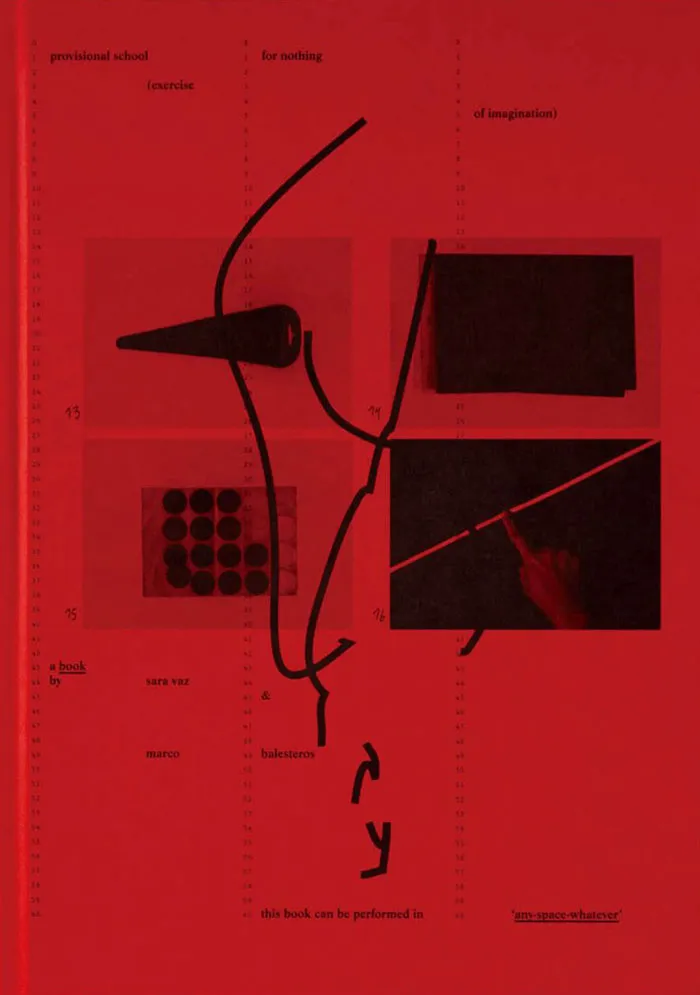
provisional school for nothing—exercise of imagination
Various
‘Provisional School for Nothing—exercise of imagination’ aims to explore forms of parallel education such as self-learning, self-organized schools, unschooling, inner schools, and more. This book is a choir of around 30 invited guests (artists, choreographers, dancers, graphic designers, writers, thinkers and so on). We use the word ‘choir’ since we decided to explore the concept of authorship. The book functions like a language score —comprising words, fragments, and loose ideas that develop throughout a series of conversations we’ve had with our guests via Zoom during the pandemic.
with Marco Balesteros Sara Vaz Alexandru Balgiu Ana Jotta Bráulio Amado Cracked Bolos Igor Dobricic Isabel Carvalho Ivan Martinez João Fiadeiro João dos Santos Martins] Karel Martens Maki Suzuki & Lppl Marco Bene Maria Duarte Marion Cachon Miguel Bonneville Nelson Guerreiro Olivier Lebrun Olga Mesa Francisco Ruiz de Infante Paul Elliman Paul Faure Pedro Barateiro Pedro Rogado Ricardo Nicolau Sara & André Sara Graça T.I.M.E. Tomás Cunha Ferreira Von Calhau! the missing person a man in silence
designed by Sara Vaz Marco Balesteros
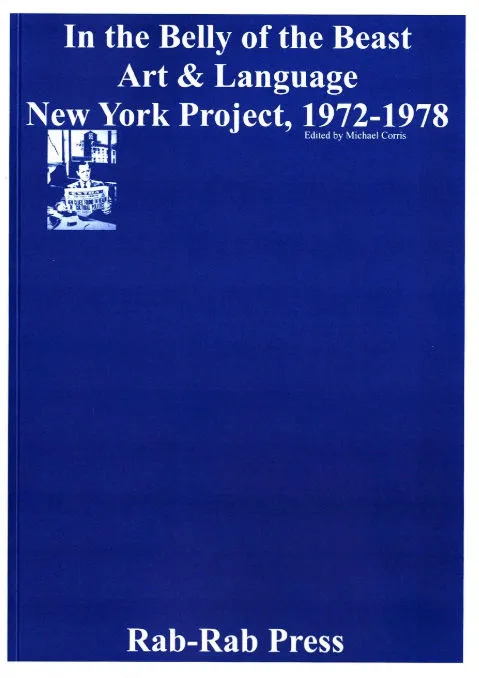
In the Belly of the Beast – Art & Language New York Project 1972-1978
Edited by Michael Corris, the expanded edition of In the Belly of the Beast: Art & Language New York Project 1972-1978 is a survey of the tumultuous years of the political Conceptualism in the mid-seventies New York.
Artists have always experimented with politics, either by organizing themselves or uniting in support of a broader political movement. Today, "activist art" is taught in universities, supported by foundations, and featured in museums and international exhibitions. Is this the only possible way?
In the Belly of the Beast tells a different story, of the work of politically engaged artists and the conflicts they experienced. It is the history of artists wishing to continue working within the boundaries of the artworld and those who were intent on establishing new ideological and class relationships with activists to build a political party.
During the 1970s in New York, the Art & Language collective pioneered institutional critique; published a Marxist-influenced journal; agitated against racism and sexism in museums; challenged the cultural imperialism of international exhibitions; and forged a framework for a socialist organization of artists. This new edition includes previously unpublished documents illuminating the contradictions and disputes that lay at the center of the organization and practices of Art & Language and left-wing groups, such as the Anti-Imperialist Cultural Union and the Artists' Meeting for Cultural Change, mobilizing artists in New York at the time.
The new and expanded edition of In the Belly of the Beast features an extensive interview with Michael Corris, who annotated a collection of previously unavailable documents from the period, including manuscripts, pamphlets, transcripts, and letters.
Art & Language is the name of a group of English artists who choose to work collectively, and the title of a magazine that they founded in 1968. Proposing a critical analysis of the relations between art, society, and politics, Art & Language marks, even in its name, the importance of the “textual turning point” in the 1960s.
Since 1976, Art & Language's project has continued, through Mel Ramsden and Michael Baldwin, with the literary and theoretical collaboration of Charles Harrison. Working with very varied mediums, from painting to rock, these co-founders of Conceptual art remain, even today, attached to observing the consequences of what they themselves call the “depressing collapse of modernism.”

Trophy Logic
Various
We stand at the edge of the world’s mercy, as subjects destined to fall. Instead, we posit: what might unfurl when we discard the uniform of the individual, and instead orient towards tinkering with the fluctuating dynamics of desire, value, infrastructure, touch, and language. Don’t be fooled, for the dynamics are brittle. Unrestricted interplay has a limit, and method is to be found at its rim. That a tangible or decorative item may serve as recognition or evidence of merit might somehow become a logic of itself. This publication presents a collection of explorations of excess, limitation, dehydrated thought, proclivity, sublimation, debauchery, and the narrowly-defined. Indeed, the subject is destined to fall, but ultimately does not! As we reckon with the illegibility of merit, we are beckoned to reconsider our relationship to one another, the unseen settings of nostalgia, the monolithic, and the stifling hold that comes not from the absence of violence, but the sheer overabundance of it. The winner just might take it all,but we’re all destined to some sort of trophy.
with Brandon Chow, Jody Aikman, Kessy Paller-Bain, Maximilian Pellizzari, Milda Valiulytė, António Manso, Preto Macarena, Magaña Villar, Sara Vallis, Cecilie Jensen, Iris Verge Ferrer, Mia You, Mehmet Süzgün, Emma Adjari, gervaise alexis savvias, Emanuella Cunt, Greta þorkelsdóttir. Designed by Miglė Lukoševičiūtė

Crassiers, une chronologie des luttes stéphanoises
"Ces deux collines jumelles sont pour moi des contre-monuments : un héritage industriel délaissé, en friche, conservant une puissance symbolique et politique. Les messages et les crassiers sont indissociables."
La première partie de cette édition est une collecte d'images intégrant des messages sur les crassiers (1948-2024). Ces images ont été récupérées principalement sur internet, complétées par un appel à collecte public sur les réseaux sociaux, ainsi que par la distribution de flyers et le collage d'affiches. Les images sont rassemblées chronologiquement et chaque message est recontextualisé dans son événement politique. La seconde partie présente les crassiers jumeaux en croisant plusieurs perspectives ; historique, géologique, urbaine, écologique et politique. Enfin je définis les crassiers en tant qu'outils et supports tactiques d'affichage public. Ce travail a abouti à cette première impression en janvier 2025.
Cette édition continuera à se développer au fil du temps grâce à des rééditions régulières, intégrant des messages découverts ou récemment apparus.

Bulletin B – Issue 2
Contributions by Jerry Ahn, Han Ok-hee, Han Soon-ae, Lilian Gonzalez, Kim Jeon-seon, Miss Lee, Lee Jeong-hee, Hansen Oh, Yun Park, Seonha Park, Sun Hyejeong, Wang Gyu-won.
Bulletin B is a bilingual editorial project gathering artistic and cultural productions from Korea and its diasporas, with a focus on queer and womxn voices. Borrowing the spirit of an unofficial newsletter, it surfaces when it needs to; assembling poetry, prose, and cultural fragments across time.
Rooted in translation as a practice attentive to power, history, and silenced voices, Bulletin B reconstructs fragmented lineages and constellations of reference through irregular acts of dissemination and exchange, tracing how narratives move between languages, contexts, and material forms.

Scores for Political Desires
The publication of the winners of the Villa Romana Prize has taken the shape of four distinct yet interrelated booklets – an editorial series continuing the tradition of the institution to offer a space for the dissemination and reverberation of the research and work of the Villa Romana Fellows after their ten-months residency in Florence.
Each year, four selected artists are invited to live and work in the same house that, since 1905, generations of artists have continuously inhabited. They always come as a group – a constellation of four people – but all as singular artists. The opportunity of yearly publishing their work in a bundle of four separate books and within an open series allows for a larger combination of echoes across the generations of Villa Romana Fellows. A further occasion for “being singular plural.”
Contributions by Elena Agudio

Sustaining the Otherwise
Sustaining the Otherwise is a collaborative research and artistic project about restitution, reparation and transformation taking place in multiple locations over several years. Initiated and conceptualized by researchers and curators Amal Alhaag & Selene Wendt, it offers a space for artists, activists, scholars and writers to be in dialogue and to explore the topic of restitution in relation to both material and immaterial culture, through a program that frames restitution within the context of contemporary art practice.
Edited by Amal Alhaag & Selene Wendt
Featuring an introduction by Amal Alhaag & Selene Wendt as well as provocations, reflections, and essays by Barby Asante, Michael Barrett, Quinsy Gario, Sana Ginwalla, Aude Christel Mgba, Lennon Mhsishi, Ogutu Muraya, in addition to a sonic contribution by Robert Machiri.

Verlag der Buchhandlung Walther König
Movement Notation
Eshkol and Wachmann focused dance on its basic element: the movement of the human body. They treated the different parts of the body as separate instruments, similar to the musical instruments of an orchestra–each with its own rules for the movements to be performed. This new edition of the 1958 publication is supplemented by contributions from Eshkol’s companions and further archive material, which contextualizes and supplements the history of the 'EWMN’s‘ origins and embeds it in contemporary discourses on dance and movement.
The publication is published in the context of the performance 'Pause: The Noa Eshkol Chamber Dance Group‘ at KW Institute for Contemporary Art (August 2023), as well as the exhibition 'Noa Eshkol: No Time to Dance‘ at the Georg Kolbe Museum (15 March–25 August 2024). The new edition was developed together with the 'Noa Eshkol Foundation for Movement Notation‘.

An Orobic Journey – On Migratory Restlessness, Community, and Multispecies Geographies
Valentina Gervasoni, Lorenzo Giusti
A layered and polyphonic investigation that, setting out from the Orobic Alpine territory in Northern Italy, explores the mountainside not merely as a natural backdrop but as an epistemological lens through which to understand and rethink the contemporary world.
The book originated as an online magazine and an expansion of the biennial program Thinking Like a Mountain (2024–25), a project inspired by Aldo Leopold's exhortation to abandon an anthropocentric gaze in favor of a geological outlook on the peaks, thereby acknowledging the intrinsic value of every natural element. An Orobic Journey developed independently from the exhibition program and is not limited to mere documentation; instead, it functions as a parallel research tool articulated through essays, conversations, and visual documentation, featuring contributions from artists, scientists, researchers, anthropologists, ornithologists, curators, academics, architects, writers, and other experts.
Embracing Ursula K. Le Guin's "carrier bag theory," An Orobic Journey brings together non-heroic tales of resistance, adaptation, and cohabitation. The book opens with a reflection on species migration and "migratory restlessness": a condition that does not only concern the spontaneous return of wolves to the Alps or the transit of birdlife, but becomes a metaphor for a shared condition of continuous movement and searching. The future of the mountain—amid tourist monocultures and acts of transformative care—is investigated by conceiving the Alpine landscape as a political space shaped by power relations, images, and collective memories, and inhabited by multispecies communities that dwell in a place, weaving intergenerational relationships. With both a poetic and political approach, An Orobic Journey attempts to rethink ways of looking at the mountain landscape while imagining new collective rituals.