Books
Books
in random order

Baby
Mangled diction from the cusp of childhood.
Carla Harryman is the author of 11 books of poetry, prose plays and essays. Her two experimental novels, Gardener of Stars (2001) and The Words: after Carl Sandburg’s Rootabaga Stories and Jean-Paul Sartre (1999) are “explorations of the paradise and wastelands of utopian desire.” Baby continues this exploration through the convolutions of Baby, who enters the book as “fire in the womb with a skirt."
Carla Harryman is a poet, experimental prose writer, essayist, and performance writer who has collaborated with multiple visual artists and composers on bodies of work. Her work has been translated into several languages, including French, with her writing represented in more than 30 national and international anthologies. She has received the Foundation for Contemporary Arts Grants to Artists award (2004), the Opera America Next Stage Grant (with composer Erling Wold), the Alexander Gerbode Foundation, and the NEA Consortium Playwrights Commission, among additional grants and awards from the Fund for Poetry.
Harryman was a founding figure of the Bay Area language writing and a co-founder of The San Francisco Bay Area Poets Theater (1979-1986). She currently teaches Creative Writing at Eastern Michigan University and serves on the MFA summer faculty of the Milton Avery School of the Arts at Bard College.

University of California Press
This Connection of Everyone with Lungs
Part planetary love poem, part 24/7 news flash, the hypnotic poems of This Connection of Everyone with Lungs wrap with equal, angular grace around lovers and battleships. These poems hear the tracer fire in a bird's song and capture cell division and troop deployments in the same expansive thought. They move through concentric levels of association and embrace —from the space between the hands to the mesosphere and back again—touching everything in between. The book's focus shifts between local and global, public and private, individual and social. Everything gets in: through all five senses, through windows, between your sheets, under your skin.

Sweat Shame Etc.
Across objects, writing, sound and choreography, British artist Cally Spooner addresses the manners in which specific technological and financial conditions shape and organize life. This volume surveys her artistic output of the last five years.
Sweat Shame Etc. includes a lecture by Spooner along newly commissioned essays by Laura McLean Ferris, Pierre Bal-Blanc, and Lucrezia Calabrò Visconti. A 2018 series of drawings on paper, from which the monograph takes its name, features hastily sketched figures that take care of their bodies while shedding clothes, socks, limbs, and torsos. Though their heads are scratched out, they remain unexpectedly determined and unperturbed.
Published following the eponymous exhibition at the Swiss Institute, New York, in 2018-2019.
Cally Spooner (born 1983 in Ascot, UK, lives and works in London and Turin) is an artist who exhibits performances that unfold across media—on film, in text, as objects, through sound, and as illustrated in drawings.
Edited by Alison Coplan and Laura McLean-Ferris.
Texts by Pierre Bal-Blanc, Lucrezia Calabrò Visconti, Laura McLean-Ferris, Cally Spooner.

Burn & Gloom! Glow & Moon!
Retrospective monograph: a journey through over two decades of intersectional and queering practices in film, performance, sculpture, community work, and textiles.
In Daschner's textile-based works, threads are minimal yet highly visible, akin to the pinch needed to wake up from a dream. These works—as well as her collages—merge with her confronting yet inviting image politics: she cuts and pastes stories of love and pleasure, violence and resilience, death and rebirth.
The written contributions reflect on Katrina Daschner as part of a hardworking generation of queer artists and makers who have been responding to the major conceptual shifts and gender upheavals happening in contemporary art since the 1990s, especially in New York and London. They highlight Katrina Daschner's longstanding line of intersectional queer interest that continues to undermine (neo-)liberal, heteropatriarchal conceptions of sexuality, gender, subjectivity, and relationships
Edited by Övül Ö. Durmuşoğlu.
Texts by Amelia Groom, Tim Stüttgen; foreword by Övül Ö. Durmuşoğlu; interviews by Rike Frank.

Spike #88 – Spirituality
For our Summer 2026 issue, amid the latest revival of SPIRITUALITY in culture, Spike asked: what are people reaching for beyond what can be measured? The answers are eclectic, emphatic, and most of all personal: Johanna Hedva’s essay about the human voice’s part in the divine; portraits of mystic artists Lee “Scratch” Perry, Natasha Tontey, and Santiago Yahuarcani by Isis Semaj-Hall, Riar Rizaldi, and Miguel A. López; Jamieson Webster’s psychoanalytic look at Renaissance painting’s body of Christ; a spiritual history of perfumes by Élisabeth de Feydeau; Patrick McGraw’s soulful reading of America’s (perhaps) greatest living author, Joy Williams; queries of Gen Z’s search for God by Lamorna Ash, the disappearance of atheism by Steven Phillips-Horst, and a new form of contemplation by Aodhan Madden; and LIFEMAXXING recommendations to purge the soul, sometimes devilishly. Plus, some backpage words of wisdom from Tea Hačić-Vlahović: “Devotion and humiliation are holy.”

Anarchitecture After Everything: A Trans Manifesto
A revolutionary way of seeing bodies and built environment that unites radical politics and trans aesthetics.
From a leading author and queer theorist known for reframing many of the most pressing questions about counter-intuitive ways of being.
Anarchitecture, a radical aesthetic practice of unmaking the built environment, staged a vigorous confrontation with urban renewal and gentrification projects in the 1970s. In Anarchitecture After Everything, Jack Halberstam identifies a powerful lexicon of transformation within anarchitecture, joining the movement’s practices of cutting and splitting with the destabilizing power of transness to detonate acts of formal violence in our time.
Anarchitecture describes the aesthetic practice of splitting and cutting, dismantling and undoing, unmaking, unbuilding, and ultimately unworlding. The trans body splits bodily coherence, dismantles the gender binary, and unbuilds bodily meaning. In these chapters, Gordon Matta-Clark’s cuts, along with Alvin Baltrop’s 1970s images of collapsing warehouses and Beverly Buchanan’s post-demolition fragmentary sculptures, return with a vengeance through the contemporary aesthetic gestures of Yve Laris Cohen, Jesse Darling, Nicole Eisenman, Kiyan Williams, Cassils, boychild, and Every Ocean Hughes. Anarchitecture unmakes space and offers a new rhetoric for emptiness. In its conclusion, the book explores this rhetoric through Renee Gladman’s anarchitectural experiments with language.
By reading anarchitecture through transness and transness through anarchitecture, Halberstam helps us see the trans body as a space of radical unmaking and as a portal to new lexicons for transformation.

It Was Like Watching
Dear ____,
I happened to look for a while out of “my” window on the 17th floor Palliativstation of the Wiener Allgemeinen Krankenhauses last night, where an enormous orange moon was hanging about, consorting with a lick of dark cloud, near to the tiny gaggle of skyscrapers. I didn’t have much to say for myself and so it just sort of looked back at me.
Every day friends and well-wishers come here and as always I want to run to my room and read a book until they’ve left but for the first time in my life my room is also the room they want to visit, and so I can’t. I wrote down yesterday as best as I could the words of my last long conversation with Marina: there might be more, but the words are running away from her now, which only makes you realise how small and insignificant they are, fleeing from something (from someone) who remains exactly who they were even in their absence: like dust falling from the sun.
*
A voyage in the insight which comes as a kiss and follows as a curse, made after you ran out of things to say.——first halting efforts at mutual understanding——love letters from twelve years ago. journal entries from fifteen years before lick at the edges like flames. Opaque coloured shadows, projected in three dimensions——of a——future that——has. never ceased to exist and which——Doesn’t——.——.——arrive to speak about their fears.—— Beginning with a naked bathroom selfie.
An attempt to live nonjudgmentally and without fear, against the desire to be something other than who you were, as a basic form of class hatred, a fear of the common and of everything that happens there, near speechlessness, trailing off, only sometimes coming back to life again, shame dies so that everything else can be saved, and everything else remains present against the background of this absence, beneath the harsh overhead light, as you pull on the pathetic, unassuming string of the pullcord.
Dedicated to one person, written by one another. “Poems written by / different poets / are my nakedness.”

Read Me: Selected Works
Read Me gathers the tools necessary to make sense of contemporary problems so ubiquitous they seem too big to name. Spanning a multiplicity of genres, media, and tonal registers, this book surveys Holly Melgard’s formally experimental poetic works produced between 2008 and 2023, including sound poems, essays on poetics, and books that exploit print on demand to, for example, counterfeit money. In often wildly comic turns of thought, Melgard’s work cleaves personal agency from automated defaults by mapping trauma and technocracy from the inside out.
From critical talks to fictional monologues, the poet translates into language the unremarkable torments of neoliberalization in the digital age.

This Is Not My Cat
Renowned Japanese photographer Takashi Homma observes his daily life through the poses of his cat.
A cat wanders, perches, and lounges in various spaces around a humble Tokyo apartment. It is perfectly tranquil in its surroundings, simply going about its daily life. In one image, the cat lays serenely amidst pot plants on the balcony, squinting in morning sunlight; in others, it balances precariously on the edge of the bath, snuggles beneath a sleeping bag, plays in a cardboard box, hides beneath an open umbrella. Here and there, evidence of the cat's fellow inhabitant in the apartment—a man, who also happens to be the internationally renowned photographer Takashi Homma—creeps into the frame. A knee, a foot, a shock of blonde hair, half of a face. There are artefacts of his life and practice too. Framed photographic prints draped in bubblewrap lean against a wall; a tangle of musical effects pedals make for colourful constellation against the cool blue of the carpet.
Many have written of the unique atmosphere and energy of Takashi Homma's pictures. His photographic mannerisms are so light, so subtly empathetic to his subjects, that we all but dissolve into the world he creates. The photographs that populate This Is Not My Cat are no exception. Unencumbered by a sense of fussiness or perfection, these images are casual, diaristic, and quotidian. As viewers, we become part of the images and their atmosphere, rather than poring over their details. They are about feeling as much as they are about looking
The title—This Is Not My Cat—seems multipart. Whereas the anomaly imbedded in Homma's iconic photobook Tokyo and My Daughter is that the girl pictured was not in fact his own child, here, his own cat is recast as belonging to another. Or perhaps it is that a cat's independence cannot be truly curbed. They quietly live, play, and exist alongside us. They move through life in our shadow, but forever in their own world.
Takashi Homma (born 1962, lives and works in Tokyo) is one of the most internationally recognised Japanese photographers active at the front lines of contemporary photography today.

REMMUS
When living things bloom & molder all in a heartskip, when they expand toward death, this is what worms hear.
Artist’s book of paintings by Mikołaj Moskal: gouache, archival paper elements, simple & meaningful captions. REMMUS is a graft of Podlasie earth-water-sky and Mikołaj’s pigments, heart, and intuition. Designed in close collaboration with graphic artist and designer Kaja Gliwa.
The paintings are bracketed by a poem each by Kuba Niklasiński (“Flows | Flaws”) and Stefan Lorenzutti (“What Worm Heard”), handwritten by Mikołaj in English and Polish.

The Loveliest Vowel Empties: Collected Poems
The Loveliest Vowel Empties presents for the first time in English the collected poems of legendary Swiss Surrealist Meret Oppenheim, printed with facing-page originals in German and French.
Oppenheim's poetry, 49 poems written between 1933 and 1980, moves beyond Surrealism to inhabit a voice all her own, with imagery and sound that, as the Herald Tribune wrote, 'express witty and poetic responses to the surprises of life.' A key figure of the Paris art scene in the 1930s, Oppenheim moved in a circle that included Andér Breton, Man Ray, Marcel Duchamp, Max Ernst, and Elsa Schiaparelli. Writing for the Village Voice about her work, Gary Indiana noted that 'the singularity of Meret Oppenheim's work is such that nothing seems dated... the range of the work and its quirky self-assurance are striking.' The publication of her collected poems coincides with a major retrospective exhibition of her artwork at the Museum of Modern Art in New York.

Translation is a Mode = Translation is an Anti-neocolonial Mode
Don Mee Choi is the author of three books of poetry and hybrid essays, and an award-winning translator of contemporary Korean women’s poetry. In this pamphlet, Translation is a Mode=Translation is an Anti-neocolonial Mode, she explores translation and language in the context of US imperialism—through the eyes of a “foreigner;” a translator; a child in Timoka, the made-up city of Ingmar Bergman’s The Silence; a child from a neocolony.
This pamphlet is part of UDP’s 2020 Pamphlet Series: twenty commissioned essays on collective work, translation, performance, pedagogy, poetics, and small press publishing. Each offers a different approach to the pamphlet as a form of working in the present, an engagement at once sustained and ephemeral.

Le Chauffage — Issue #2
Francesca Percival, Felix Rapp and 1 more
Le Chauffage (french for “The Heater”) is an artist-run publication based in Brussels and Vancouver. It is conceived as a cross-continental, community oriented platform. Le Chauffage brings together the work and writing of artists / friends from different cities with the intent to spark discussion and fuel casual forms of critical discourse.
The second issue of Le Chauffage contains photographs and texts, photographs of text, photographs as text and vice versa. Loosely thinking through the format of The Photo Essay celebrated by John Szarkowski in an eponymously titled exhibition at MoMA in 1965, this issue considers some of the artistic possibilities that can be found in such an archaic and historically male-dominated form.
Many of the contributions that make up this second issue are not photo essays per se. But each one of them considers the printed page as a space in its own right. The magazine becomes an interior where words and images entertain a malleable and distinctly porous relationship. At times, it is also a space where artists and writers from different cities were invited to meet and collaborate. And since interest in other people is also an interest in yourself, it is always unclear who is really transforming who?
Contributions by: Bob Cain & Linda Miller, Moyra Davey, Laurie Kang, Niklas Taleb, Madeleine Paré & Diane Severin Nguyen, Josephine Pryde, Slow Reading Club, Ken Lum, Isaac Thomas, Vijai Maia Patchineelam, Artun Alaska Arasli & Graeme Wahn, Stephen Waddell, Maya Beaudry & Chloe Chignell, Lisa Robertson, groana melendez, Victoria Antoinette Megens and Will Holder.
Editors: Emile Rubino and Felix Rapp
Co-Editor: Francesca Percival
Design: Francesca Percival and Felix Rapp
Cover Design: Francesca Percival
Printed by: Cassochrome, Belgium
Edition of 350

Estonian Academy of Arts / EKA GD MA
to flaunt, really
“… Ever since its inception as a profession, graphic design has exhibited its necessity to make information public. Its urge to expand and to reproduce reflects its capitalist inheritance. This desire however isn’t always shared by all stories molded and articulated by the discipline.
Publishing is preceded by a series of labours, but the act itself consists just of a very instant. It is one loud shriek from the top of a hill. A toppling-over. From then on a story will tumble downhill—distribute and disseminate. However that happens, and who it reaches is an unpredictable process. Thereafter publishing enables, and sets in motion, all its future readings and retellings.
Wondering the many contradictory sensibilities contained in this process, we attempt to grasp their whys, their hows and their ifs. The following essays— written by Sunny Lei, Haron Barashed, Agathe Mathel, Alina Scharnhorst, Villem Sarapuu, Gal Šnajder, Seppe-Hazel Laeremans, Fernanda Saval and Eva Claycomb—stretch and curl in between these various registers of opening up and closing in.
Unraveling the movements, strategies, forms and intentions of publishing, this book attempts to unfold their utterances, platforms, languidities, reinterpretations, identities, tactilities, ambiguities, characters and audiences.”
—from the introduction by Seppe-Hazel Laeremans and Agathe Mathel.

Essays
Poetry as both a form and genre has many possibilities to exist within; however, poetry too often is burdened by the imperative to have an argument and a set of imagery and meanings that are preconceived and placed within the poem. In this way, poetry gets conflated with writing a thesis or project, and the poet simply the presenter of perfectly argued language. When poets attempt to bridge the gap between genres and write within the contemporary essay form, they are tasked to construct perfect arguments there as well and avoid the associative and aesthetic logic that makes poems important. The term essay itself was coined by Michel de Montaigne in the 1500s — it comes from the French word essai, which means to test or experiment with what one knows as a learning tool, and is in partial opposition to the terms we use to discuss the essay now
ESSAYS calls on thinkers and writers to move beyond this linear thinking into the realm of what an essay by someone like Montaigne might do. His essays do as they say they will—they test out ideas, they are unafraid to get messy in their execution, they are brave enough to go forward into the uncharted waters. In them, it’s completely beside the point to get back to where they started, let alone where they’d say they would go. They are simply beside the point. It’s true.
ESSAYS, edited by Dorothea Lasky, is a book of essays on the essay, which enact and query these directives. The volume collects essays by poets Ariel Goldberg, Ken Chen, Wayne Koestenbaum, Tracie Morris, Anaïs Duplan, Raquel Salas Rivera, Brandon Shimoda, Cecilia Vicuña, Fred Moten, and Mónica de la Torre.

Mousse #93
Andrew Berardini on Artificial Intelligence; Pepón Osorio; Arash Nassiri; Gloria E. Anzaldúa; Marcela Guerrero speaks with C. Ondine Chavoya; Daisy Lafarge; Dani Blanga Gubbay; Davide Stucchi speaks with Alex Bennett; Luca Lo Pinto on Hanuman Editions; Reynaldo Rivera & Abdellah Taïa; Jungle Books...
This issue comes with different covers, randomly distributed.

Unfit
Ariana Harwicz, Jessie Mendez Sayer
A bracing novel that asks how far we would go for the ones we love—and what we would do to destroy the ones we hate.
Lisa has lost custody of her young twin boys. Caught between the French legal system’s sluggish bureaucracy and her sinister, scheming in-laws, she’s alone and lost, an Argentine migrant in rural France picking grapes for a pittance, only allowed to see her children in supervised visits once a month. Scapegoated and outcast, destitute and desperate, Lisa decides to take radical action: early one morning, she sneaks into her in-laws’ farmhouse, takes back her children, sets the barn ablaze, and makes her escape.
What follows is a white-knuckled road trip that explores human beings pushed to the edge. Clearly, Lisa is not in her right mind, and as Harwicz deftly mingles a chorus of contradictory voices into her very unreliable narration, the reader comes to regard the protagonist with an unsettling mixture of sympathy and suspicion. Written in savage, chiseled prose, Unfit shoots off, a gripping chase that questions all our assumptions—and points out our hypocrisies— about motherhood, custody rights, love, violence, anti-semitism, and migration. The latest novel by the acclaimed author of Die, My Love (soon to be adapted to a film starring Jennifer Lawrence), Unfit is addictively terrifying, savagely sophisticated, and shockingly brilliant.
Translated from Spanish by Jessie Mendez Sayer

To After That (Toaf)
A warm-spirited elegy to an abandoned work, brilliantly comic and wryly contemplative, by one of the great artist-investigators of our time.
Originally published in 2008 in the groundbreaking Atelos series, To After That (TOAF) introduced a new kind of writing—somewhere between criticism and memoir and philosophy—that Renee Gladman has continued to explore in books like Calamities and My Lesbian Novel.
TOAF is a recuperative song, an effort to give space and life to an abandoned project, but it is also, itself, a beautiful meditation on process and distance and duration, and a reminder that time is the subject of any writing.
![Cover of [45-120]](https://rile.space/storage/3794/conversions/01K7RPFBTZPK0NE1VQTCYB68XK-webp.webp)
[45-120]
Personal space is understood as the distance between 45 and 120 cm that surrounds a person. This bilingual anthology brings together the work of eighteen contemporary poets who take this intimate measurement as a starting point to challenge its apparent rigidity and explore how political, social, sexual, racial, class, and accessibility factors shape it. Beyond a simple physical distance, personal space also becomes a stage where desire draws and negotiates the boundaries between the inside and the outside.
The publication contains contributions by Samuel Ace, Justin Chin, Kyle Dacuyan, Rhea Dillon, Tracy Faud, Elijah Jackson, Taylor Johnson, Nadia Marcus, Park McArthur, Nat Raha, Joan Retallack, Trish Salah, Juan de Salas, María Salgado, Assotto Saint, Cedar Sigo, S*an D.Henry-Smith, Nayare Soledad, Perla Zúñiga.
Bilingual edition, edited by Juf.
JUF (Bea Ortega Botas and Leto Ybarra) explores the relationship between poetry, contemporary art, and theatricality through the organization of performances, readings, and exhibitions. They also publish online texts and a PDF series as an extension of their curatorial and research practice. Currently based between Madrid and New York.

Diversity of Aesthetics
Jose Rosales, Andreas Petrossiants
Critical conversations and reflections about lessons learned at the intersection of social movements and artist production.
Diversity of Aesthetics collects powerful and timely conversations among leading cultural critics, artists, and organizers to connect the threads between some of the most pressing social struggles and conflicts of our time: policing, war, borders and migration, economic crisis.
Across three themes—infrastructure, migration, and riots—militant thinkers, artists, educators, and others discuss aesthetic production, forms of social organization, modes of struggle against gendered and racialized capitalism, and revolutionary theory. Common to all three conversations is a commitment to rethinking the relationship between forms of critique and forms of struggle undertaken by collective social practices, offering lessons for tactics, strategies, and practices.
With contributions by Claire Fontaine, Iman Ganji, Saidiya Hartman, Vicky Osterweil, Andreas Petrossiants, Christina Sharpe, Stevphen Shukaitis, Michael Rakowtiz, Shellyne Rodriguez, Jose Rosales, Rinaldo Walcott, Andreas Petrossiants, Jose Rosales
Andreas Petrossiants is a writer and associate editor of e-flux journal. His work has appeared in Historical Materialism, Social Text, New Inquiry, AJ+ Subtext, Frieze, Bookforum.com, Roar Magazine, the Verso blog, the Brooklyn Rail, Hyperallergic. He is a PhD candidate in performance studies at NYU where he is researching anti-eviction, squatting, and tenants’ movements as they relate to the production of social space.
Jose Rosales is an independent researcher and journalist based in Lisbon, Portugal. His work has appeared in e-flux notes, Lumpen: A Journal of Poor and Working Class Writers, and has contributed a chapter called “Communism As the Riddle Posed to History” in Double Binds of Neoliberalism (2022).
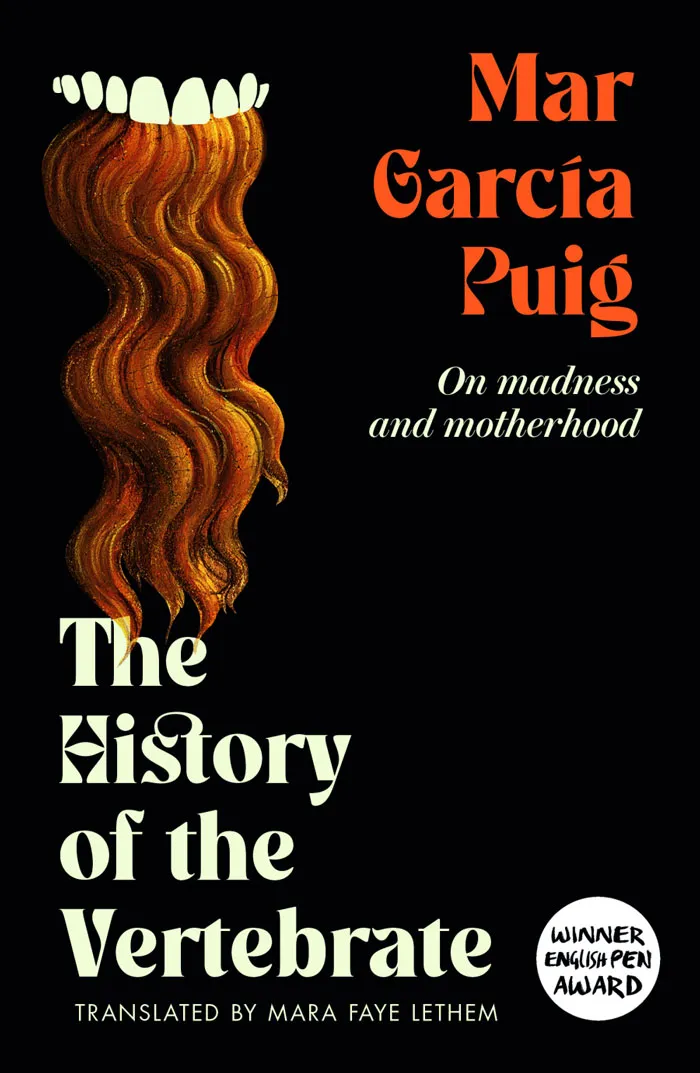
The History of the Vertebrate
Mar García Puig, Mara Faye Lethem
‘On 20 December 2015 I became a mother and I went mad.’
On a single day, Mar García Puig gives birth to twins and becomes elected to the Spanish Parliament as a member of the insurgent left-wing party Podemos. What might have been the best day of her life becomes the start of a terrifying ordeal; García Puig’s grip on reality begins to slip as she grapples with uncertainty, the weight of expectation, and misogyny in both of her new roles.
In defiance of a culture that tells her the problem lies within, García Puig chooses to look outwards, examining the imbrication of madness and motherhood across centuries of science, myth, and politics while dissecting the ways in which women have been pathologized and banished from public life.
At once intimate and epic, The History of the Vertebrate is a searing account of postpartum madness. Moving between memory, culture, and the history of medicine, García Puig transforms her experience into a story about the countless women who have felt that sanity was leaving them, and about the patriarchal forces that have silenced them.
MAR GARCÍA PUIG is an editor and author. From 2015 to 2023 she was a member of the Spanish Congress of Deputies for Podemos, where she served on the Culture Committee and the Equality Committee. Her books include The History of the Vertebrate and This Thing of Darkness.

Theory & Practice
With echoes of Shirley Hazzard and Virginia Woolf, a new novel of startling intelligence from prize–winning author Michelle de Kretser, following a woman looking back on her young adulthood, and grappling with the collision of her emotions and her values.
In the late 1980s, the narrator of Theory & Practice—a first generation immigrant from Sri Lanka who moved to Sydney in her childhood—sets up a life in Melbourne for graduate school. Jilted by a lover who cheats on her with another self-described "feminist," she is thrown into deeper confusion about her identity and the people around her.
The narrator begins to fall for a man named Kit, who is in a “deconstructed relationship” with a woman named Olivia. She struggles to square her feminism against her jealousy toward Olivia—and her anti-colonialism against her feelings about Virginia Woolf, whose work she is called to despite her racism.
What happens when our desires run contrary to our beliefs? What should we do when the failings of revered figures come to light? Who is shamed when the truth is told? In Theory & Practice, Michelle de Kretser offers a spellbinding meditation on the moral complexities that arise in this gap. Peopled with brilliantly drawn characters, the novel also stitches together fiction and essay, taking up Woolf’s quest for adventurous literary form.

Thing
Robert Ford, Trent Adkins and 1 more
Started in 1989 by designer and writer Robert Ford, THING magazine was the voice of the Queer Black music and art scene in the early 1990s. Ford and his editors were part of the burgeoning House music scene, which originated in Chicago’s Queer underground, and some of the top DJs and musicians from that time were featured in the magazine, including Frankie Knuckles, Gemini, Larry Heard, Rupaul, and Deee-Lite. THING published ten issues from 1989-1993, before it was cut short by Ford’s death from AIDS-related illness. All ten issues of THING are collected and published here for the first time.
As House music thrived, THING captured the multidisciplinary nature of the scene, opening its pages to a wide range of subjects: poetry and gossip, fiction and art, interviews and polemics. The HIV/AIDS crisis loomed large in its contents, particularly in the personal reflections and vital treatment resources that it published. An essay by poet Essex Hemphill was published alongside the gossip columnist Michael Musto and Rupaul dished wisdom alongside a diary from the March on Washington for Lesbian, Gay, and Bi Equal Rights and Liberation. Joan Jett Blakk’s revolutionary presidential campaign is contained in these pages, as are some of the most underground, influential literary voices of the time, such as Dennis Cooper, Vaginal Davis, Gary Indiana, Marlon Riggs, David Wojnarowicz, and even David Sedaris.
THING was very much in dialogue with the club kids in New York and other Queer publishing ventures, but in many ways, it fostered an entirely unique perspective—one with more serious ambitions. In a moment when the gay community was besieged by the HIV/AIDS crisis and a wantonly cruel government, the influence and significance of this cheaply-produced newsprint magazine vastly exceeded its humble means, presenting a beautiful portrait of the ball and club culture that existed in Chicago with deep intellectual reflections. THING was a publication by and for its community and understood the fleetingness of its moment. To reencounter this work today, is to reinstate the Black voices who were so central to the history of HIV/AIDS activism and Queer and club culture, but which were often sidelined by white Queer discourse. In many ways, THING offered a blueprint for the fundamental role a magazine plays in bringing together a community, its tagline summing up the bold stakes of this important venture: “She Knows Who She Is.”
The magazine included contributions from Trent D. Adkins, Joey Arias, Aaron Avant Garde, Ed Bailey, Freddie Bain, Basscut, Belasco, Joan Jett Blakk, Simone Bouyer, Lady Bunny, Bunny & Pussy, Derrick Carter, Fire Chick, Chicklet, Stephanie Coleman, Bill Coleman, Lee Collins, Gregory Conerly, Mark Contratto, Dennis Cooper, Dorian Corey, Ed Crosby, The Darva, Vaginal Davis, Deee-Lite, Tor Dettwiler, Riley Evans, Evil, The Fabulous Pop Tarts, Mark Farina, Larry Flick, Robert Ford, Scott Free, David Gandy, Gemini, Gabriel Gomez, Roy Gonsalves, Chuck Gonzales, Tony Greene, André Halmon, Lyle Ashton Harris, Larry Heard, Essex Hemphill, Kathryn Hixson, Sterling Houston, Ishmael Houston-Jones, Gary Indiana, Candy J, Jamoo, Jazzmun, Gant Johnson, Owen Keehnen, Lady Miss Kier, Spencer Kincy, Iris Kit, Erin Krystle, Steve LaFreniere, Larvetta Larvon, Marc Loveless, Lypsinka, Malone, Marjorie Marginal, Terry A. Martin, Rodney McCoy Jr., Alan Miller, Bobby Miller, Michael Musto, Ultra Naté, Willi Ninja, Scott “Spunk” O’Hara, DeAundra Peek, Earl Pleasure, Marlon Riggs, Robert Rodi, Todd Roulette, RuPaul, Chantay Savage, David Sedaris, Rosser Shymanski, Larry Tee, Voice Farm, Lawrence D. Warren, Martha Wash, LeRoy Whitfield, Stephen Winter, David Wojnarowicz, and Hector Xtravaganza.

Tripwire 16 - Performance/Writing
A special issue focused on performance writing, with work by Tanya Lukin Linklater (with Michael Nardone), Jibade-Khalil Huffman & Simone White, Jean-Thomas Tremblay, Claudina Domingo (trans. Ryan Greene), Kim Rosenfield, Nathan Walker, Liz Knox, Rona Lorimer, Léo Richard, & Hector Uniacke, Mohamed A. Gawad & Dalia Neis, Mei-mei Berssenbrugge & Teddy Yoshikami, interviewed by Michelle N. Huang, Kyoo Lee and Jocelyn Saidenberg, Adriana Garriga-López, Gabrielle Civil, plus a Kevin Killian Tribute, with Eileen Myles * Scott Hewicker * Cliff Hengst * Karla Milosevich * Craig Goodman * Michelle Rollman * Anne McGuire * Wayne Smith * Tanya Hollis * Steve Orth * Lindsey Boldt * Maxe Crandall * Arnold J. Kemp * Carla Harryman, Lee Ann Brown & Tony Torn * Susan Gevirtz * Laynie Browne * Patrick Durgin * Norma Cole * Jo Giardini. & reviews: Jessica Lopez Lyman & Jocelyn E. Marshall on Gabrielle Civil, alex cruse on Merce Cunningham, Rob Stanton on Anne Boyer, Jack Chelgren on Miyó Vestrini, David Grundy on Stephen Jonas, Virginia Konchan on Sarah Vap.