Books
Books
in random order

Playboy
The prequel to Love Me Tender, narrating Debré's transformation from affluent career woman to broke single lesbian and writer.
I see all her beauty, I see the beauty of women. I see my own body, new. I tell myself there are so many things that are possible.
First published in France in 2018, Playboy is the first volume of Constance Debré's renowned autobiographical trilogy that describes her decision, at age forty-three, to abandon her marriage, her legal career, and her bourgeois Parisian life to become a lesbian and a writer.
The novel unfolds in a series of short, sharp vignettes. The narrator's descriptions of her first female lovers—a married woman fifteen years older than her, a model ten years her junior—are punctuated by encounters with her ex-husband, her father, and her son.
As Debré recently told Granta: “It was a bit like Saint Augustine and his conversion. In the same week, I had sex with a girl and I had the feeling that I could write. I had this incredible feeling that I could catch things, that life was there to be caught.”
Looking at the world through fresh eyes, the narrator of Playboy questions everything that once lay beneath the surface of her well-managed life. Laconic, aggressive, and radically truthful, she examines gender and marriage, selfishness and sacrifice, money and family, even the privilege inherent in her downward mobility.
Writing her way toward her own liberation, Debré chronicles the process that made her one of the most brilliant, important French writers today.

Pina #3
Exhibitions by American Artist and CB Evans, conversations with Che Gossett and Dean Spade, and short stories by Lola Olufemi and Orion J Facey.
Pina is a printed, portable exhibition space. We function as a commissioning platform, collaborating with artists to create exhibitions existing solely within the pages of a magazine.

Six or So Tufts
Six Or So Tufts is made of attempts to calm down, mostly through looking at things, both real and imagined. These poems follow the repeated process of placing relationships, objects, neuroses, myths, and ideas against a background of gold, gray, and then against the Umbrian sun, a procedure derived from Rilke’s “Notes on the Melody of Things.” What results is a quasi scientific accounting traversing the study of clouds, theology, and the desire to understand what “the core” is.
This chapbook is a partial record of the iterative mechanisms of memory, thought, and presentness, “gathering under the auspices of knowledge as light;” the various architectures of urban experience, erotics, remembering, friendship, and light and shadow all juxtaposed upon one another to create a scalar and spatial portrait; the repeating tessellated muquarnas that consitute the ceiling of the Süleymaniye Mosque.
"Clouds pass, bodies alight: between the two there must be another mechanism / that grinds or twists, something that turns the mind back to itself, shifts and wallows / with forgetting and then remembering."

Mon musée de la Cocaïne
L’or et la cocaïne sont les deux matériaux bruts de Mon musée de la Cocaïne. C’est au cours de leur transformation et raffinement que ces deux substances ramènent avec elles une histoire de l’oppression et de l’esclavage.
Dans ce livre, l’anthropologue australien Michael Taussig prend comme point de départ la proposition de bâtir un musée de la Cocaïne (qui serait l’image reflétée du musée de l’Or de la Banque de la République à Bogotá) et dresse un portrait sans concession de la vie des mineurs afro-colombiens aspirés dans le monde dangereux de la production de cocaïne au fin fond de la forêt tropicale, sur la côte pacifique de la Colombie. Il décrit la violence, la pauvreté, mais aussi les croyances qui surgissent des marais envahis de mangroves et des rivières tropicales qui, pendant plus de cinq cent ans, ont attiré, ruiné et décontenancé Amérindiens, orpailleurs, conquistadors et pirates, esclaves africains, ingénieurs russes et guérilleros marxistes.
Mon musée de la Cocaïne se présente comme un assemblage éclectique d’histoires et d’anecdotes, présenté comme autant de salles d’un hypothétique musée de la Cocaïne, au sein desquelles le lecteur est invité à déambuler, en croisant des références qui vont de Charles Dickens à Franz Kafka en passant par la poésie de Seamus Heaney.

Otherhow: Essays and Documents on Art and Disability 1985–2024
Otherhow brings together four decades of writings, lectures, interviews, and documentation of work by the artist Joseph Grigely. Deaf since the age of ten, his art and writing have long questioned and made use of various modes of communication—photographs, handwritten notes, lipreading, newspaper headlines, paintings, and TV captions—to examine and scrutinize the ableism embedded in cultural and media production. From his brilliant series of postcards addressed to Sophie Calle, where he began to formulate a theory on the intersection of disability and art, to his epic lecture “On Failure,” which brings together the poet Keats, “the first woman of fly tying” Helen Shaw, and the filmmaker Andrei Tarkovsky to the same table for a conversation on beauty, Grigely’s writing is erudite, but clear; righteous with fury, but dryly humorous.
An underlying theme throughout are modes of access and how issues of accessibility and their resolution provide a benefit to everyone, not just the disabled. Chapters devoted to art, access, and advocacy underpin the interconnected nature of these issues in a maddening, but ultimately enlightening manner. Letters of complaint, faxes and emails, unpublished op-eds, exhibition proposals, statements on equality and access; each provide a glimpse into how Grigely’s work has been shaped by—or constructed from—the “tangled process” of opening access.
Joseph Grigely, artist, educator, and activist, is currently a Professor of Visual and Critical Studies at the School of the Art Institute of Chicago. He holds a Doctorate in Philosophy from Oxford in English literature and has taught at Gallaudet University, Stanford University, and the University of Michigan. Exhibiting widely in the US and Europe, his most recent show In What Way Wham? was presented at MASS MoCA in 2023–24. His work is in the collections of the Museum of Modern Art (NY), the Whitney Museum of American Art, the Tate Modern, and the Stedelijk Museum, among others.

Hack 'N' Slash
Kamil Bouzoubaa-Grivel réalise au printemps 2020 la série de dessins Hack’n’slash.
Ces collages sont faits à partir d’aplats de couleur autocollants Letrafilm Color/Tint Overlay, que l’on pourrait traduire par Couleur/Teinte Superposition, permettant ainsi de nommer l’importance des jeux de profondeur qui s’y trouvent.
L’artiste se calque là-dessus et joue alors avec la confrontation entre le hack: détournement et réemploi d’outils techniques (trames numériques, encres d’imprimante, dessin manuel) – et le slash: le fait de trancher/juxtaposer les formes venant de différentes dimensions pour composer ses dessins.
Chaque édition a une couverture unique sérigraphiée sur du papier Pantone Letraset par l’Atelier PPP et un texte critique-fiction de Mia Brion.

Mystic Transport
Mystic Transport is an exhibition project initiated through a chance encounter between two artists, Koen Theys and Gülsün Karamustafa. Both are very much intertwined with the city they live in; Brussels and Istanbul and integrate visible and invisible materials and remnants from their immediate surroundings within their practice.
Intrigued by religious parades, the hamam, war propaganda, gender issues and the entertainment industry, Theys and Karamustafa use these phenomena as starting points for their video work, installations and performances. In doing so, both artists sketch a critical portrait of the society and culture in which we live and reside, reflecting on cultural canons and differing socio-economic realities. Mystic Transport thus results in unique crossovers.

The Adventures of Leucippe and Clitoris
Various
Leucippe and Clitoris is based on one of the first romantic novels written in 192 AD by Achilleas Tattius. A very Katsarida Press retelling of an ancient story.
This is the second WOMANWOOD Kindling, a reprint of the original zine first published in Athens
WOMANWOOD Kindling is devoted to full-length chapbooks/zines published in between releases of WOMANWOOD, the smut gazette.
Riso-printed in an edition of 60, bound by blue linen thread with embellishments from the riso scrap pile.

The Pain Journal
"The Pain Journal" is the last finished work by Los Angeles writer and artist Bob Flanagan and is the extraordinary chronicle of the final year of his life before his death from cystic fibrosis at the age of 43. Flanagan created performances with Sheree Rose that shocked and inspired audiences as he combined text, video, and live performance to create a highly personal exploration of childhood, sex, illness, and mortality.

Dominique: The Case of an Adolescent
"Dolto’s Dominique is the only case I’ve found that rivals Freud, and brings us up to date, replete with questions of incestuous trauma, repressed sexualities, autism and cognitive disability, and a profound sense for the contradictions of polite society and histories of colonial and racist violence. I love this child and encountering Dolto’s otherworldly voice as an analyst." — Jamieson Webster
While the child psychoanalyst Françoise Dolto stands alongside Jacques Lacan as a leading light of the Other French School, she has been little translated and remains curiously unknown in the English-speaking world. First published in 1971, Dominique: The Case of an Adolescent is frank and close to the clinical experience. A masterpiece of the genre, it is at once a granular psychological portrait of a troubled adolescent and his familial inheritance, and a historical case study, set in the France of the 1960s, of the of the relationship between subjectivity, nationality, and time and space.
With a foreword by Michael Ryzner-Basiewicz
Translated by Ivan Kats, revised by Lionel and Sharmini Bailly
Cover image by Mike Kelley, Untitled 1975
Françoise Dolto (born 6 November 1908, Paris) was a psychoanalyst and paediatrician. Alongside private practice at her home, where she saw adults and children, Dolto practised in four institutions where she saw only children patients: the Polyclinique Ney, the Centre Claude Bernard, the Hôpital Trousseau and the Centre Etienne Marcel. From 1967 to 1969, Dolto answered adult and child listeners of the French radio station Europe No. 1, live and anonymously under the name ‘Docteur X’. The programme enjoyed excellent ratings, but Dolto found dialogue to be hindered by the demands of live broadcasting and advertising. In 1976, she agreed to return to radio with Lorsque l’enfant paraît on France Inter, on the condition that she replied to listeners’ letters, which enabled her to go into depth. The programme was a huge success, and would make her a household name. In 1978 Dolto retired as an adult psychoanalyst: her fame had become such that it distorted the therapeutic relationship with patients. She now devoted herself to prevention, training of young analysts, group and individual supervision, publications, conferences and radio and television broadcasts. She also continued her work with children in the care of the Aide Sociale à l’Enfance, some of whom she received at her home until the end of her life. In 1979, along with a small team, she founded the Maison Verte, a place for early-years socialisation welcoming children from ages zero to four along with their caregivers, for sessions of play and talk. This model spread throughout France and Europe, to Russia, Armenia and Latin America. Dolto is the author of more than a dozen books, and several essays, interviews and seminars. In English, her books have been translated as Psychoanalysis and Pediatrics (Routeledge, 2013) and The Unconscious Body Image (Routledge, 2022). Françoise Dolto died on 25 August 1988 in Paris.

Love, Leda
Newly discovered in the author’s archives and published for the first time in the UK in 2023, this portrait of queer, working class London drifts from coffee shop to house party, in search of the next tryst.
Leda is lost. He spends his days steeped in ennui, watching the hours pass, waiting for the night to arrive. Trysts in the rubble of a bombsite follow hours spent in bed with near strangers, as Leda seeks out intimacy in unlikely places. Semi-homeless and estranged from his family of origin, he relies on the support of his chosen one: a community of older gay men and divorced women who feed and clothe him, gently encouraging him to find a foothold in a society which excludes him at every turn. And then there is Daniel, a buttoned-up man of the Lord, for whom Leda nurses an unrequited obsession—one which sends him spiraling into self-destruction. Pre-dating the British Sexual Offences Act of 1967, Love, Leda was first published in 2023 in the UK. This long lost novel is a portrait of London’s Soho that is now lost, an important document of queer working-class life from a voice long overlooked.

A4 review N°4
Gorge Bataille, Marc Buchy and 2 more
Founded in 2023, A4 is a poetry review which showcases and explores contemporary writings practices. Run by Littérature Supersport collective, the object is seen as the extension of their events. The review takes the form of 4 postcards which, when placed side-by-side, form an A4-sheet. A light (even precarious) format for literature that slips into the back pocket of pants and hangs on fridge doors. Each issue features unpublished texts by 4 authors.
This issue presents texts by: Gorge Bataille, Marc Buchy, Samy Manga, Elke de Rijcke.

Tar Hollow Trans: Essays
"I've lived a completely ordinary life, so much that I don't know how to write a transgender or queer or Appalachian story, because I don't feel like I've lived one.... Though, in searching for ways to write myself in my stories, maybe I can find power in this ordinariness."
Raised in southeast Ohio, Stacy Jane Grover would not describe her upbringing as "Appalachian." Appalachia existed farther afield—more rural, more country than the landscape of her hometown.
Grover returned to the places of her childhood to reconcile her identity and experience with the culture and the people who had raised her. She began to reflect on her memories and discovered that group identities like Appalachian and transgender are linked by more than just the stinging brand of social otherness.
In Tar Hollow Trans, Grover explores her transgender experience through common Appalachian cultural traditions. In "Dead Furrows," a death vigil and funeral leads to an investigation of Appalachian funerary rituals and their failure to help Grover cope with the grief of being denied her transness. "Homeplace" threads family interactions with farm animals and Grover's coming out journey, illuminating the disturbing parallels between the American Veterinary Association's guidelines for ethical euthanasia and the World Professional Association for Transgender Health's guidelines for transgender care.
Together, her essays write transgender experience into broader cultural narratives beyond transition and interrogate the failures of concepts such as memory, metaphor, heritage, and tradition. Tar Hollow Trans investigates the ways the labels of transgender and Appalachian have been created and understood and reckons with the ways the ever-becoming transgender self, like a stigmatized region, can find new spaces of growth.

Erotism: Death and Sensuality
Taboo and sacrifice, transgression and language, death and sensuality—Georges Bataille pursues these themes with an original, often startling perspective. He challenges any single discourse on the erotic. The scope of his inquiry ranges from Emily Bronte to Sade, from St. Therese to Claude Levi-Strauss, and Dr. Kinsey; and the subjects he covers include prostitution, mythical ecstasy, cruelty, and organized war. Investigating desire prior to and extending beyond the realm of sexuality, he argues that eroticism is "a psychological quest not alien to death."

nnn2. - no no no celestial journal
published commonly, no no no expounds an experimental poetic offering, both text & art.
each issue features a limited edition artwork. which can be tacked or framed or stored in a drawer.
celestial in nature, no no no takes the form required, and necessary.
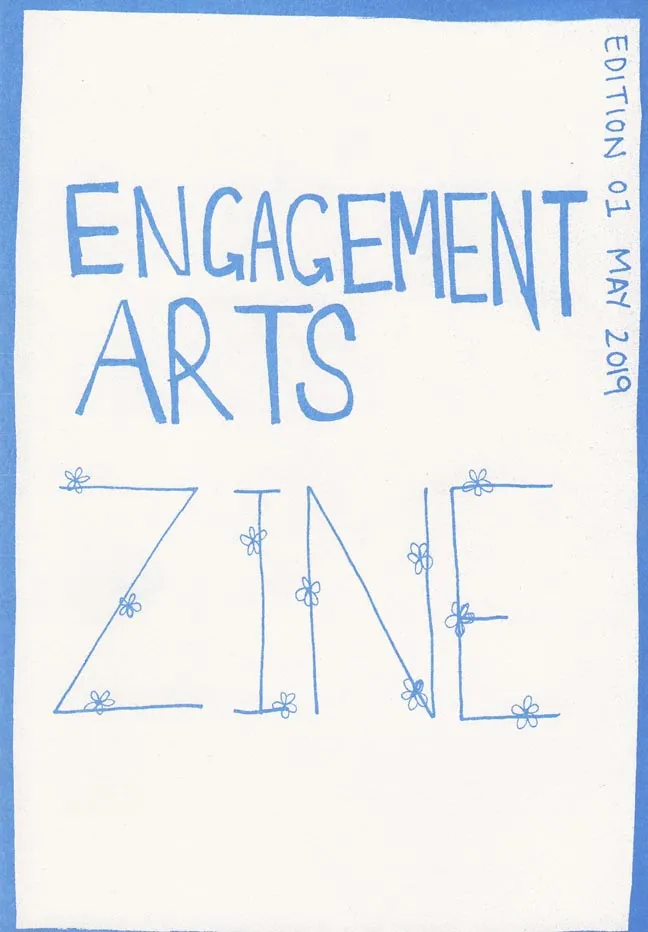
Engagement Arts Zine #1
First edition of the Engagement Arts Zine.
Published May 2019

fierce pussy
This eponymously titled publication by fierce pussy brings together thirty-nine of the legendary art collective’s posters, from works made in the urgent early days of the AIDS crisis to present-day advocacy for Queer and Trans rights. In keeping with fierce pussy’s activism in public spaces, the publication is designed to allow readers to tear out any of the posters to share, wheatpaste, scan, photocopy, and distribute or to easily open the book to any page to hang it on a wall. Combining calls for political and social action, proud reclamations of derogatory language, and pointed questions, the posters in fierce pussy address pressing sociopolitical issues in the group’s distinctive voice.
Emerging during a decade steeped in the AIDS crisis and LGBTQ+ activism, fierce pussy brought Queer identity directly into the streets in a manner characterized by the urgency of those years. In recent years they have expanded to also present their work in galleries and museums, while continuing to intervene in the public space, always working with an economy of means and a collective ethos of inclusion and solidarity.
This publication was originally published by Printed Matter in 2008 to coincide with a retrospective exhibition of the collective’s work. This new expanded edition includes twenty-five additional posters.
fierce pussy is an art collective formed in New York City in 1991. Originally composed of a fluid and often-shifting cadre of dykes, the collective was active through 1994. In 2008, the four core founding members Nancy Brooks Brody (1962–2023), Joy Episalla, Zoe Leonard, and Carrie Yamaoka began working together again. Adamantly low-tech and low-budget, fierce pussy has always relied on modest resources: old typewriters, found photographs, and their own baby pictures. In the early days, much of the work was produced using materials and resources they had on hand and the equipment at their day jobs. This publication exemplifies the ethos of the group—to share their work and messaging with the masses.
Managing Editor: Jules Spector
Designers: Garrick Gott and Bryce Wilner

Revue Phylactere n°2 - Oh là là !
Roxanne Maillet, Auriane Preud'homme
Phylactère est une revue annuelle à voix multiples, née du désir d’explorer l’écriture de l’oralité et les possibilités de retranscription de performance, à travers des visions authentiques, subjectives et spontanées. Donnant la parole à des amateur·ice·s, artiste·s, designer·s et penseur·se·s, la revue Phylactère regroupe des écrits de transition, assumant tous les glissements entre un script, l’action réalisée et sa traduction, avec une attention extrême et aventureuse pour la manière dont les contextes, gestes, émotions et espaces sont mis en jeu lors de cette retranscription.
Initiée par Roxanne Maillet et Auriane Preud’homme à l’invitation de Camille Videcoq lors de la résidence Entrée Principale (Marseille), Phylactère conjugue pratique graphique et éditoriale et démarche curatoriale en intégrant au processus de publication l’organisation de différents événements.
Pour son deuxième numéro, Phylactère prend pour titre l’onomatopée Oh là là !
Avec les contributions de : Anne Lise Le Gac, Benoît Le Boulicaut, Camille Videcoq, Cecil Serres, Claudia Pagès, Considered to be Allies (Margaux Parillaud & Mie Frederikke Fischer Christensen), Ghita Skali, Giuliana Zefferi, Lauren Tortil, Loreto Martínez Troncoso, Louise Hervé & Clovis Maillet, Mona Gérardin-Laverge, Nygel Panasco, pauline l. boulba, Sarah Browne, Susie Green (with Kim Coleman, Simon Bayliss & Rory Pilgrim), Tahnee, L’autre and Tiziana La Melia.
Conception graphique : Auriane Preud'homme et Roxanne Maillet.

exit ambition
Exit Ambition is a catalogue of practices, documents, videos, and other projects - virtual & actual. The book operates as an incomplete index of a series of installations, instructions, anti-plays, performance scores, descriptions, etc.
Jake Reber lives and works in Buffalo, NY, where he co-curates hystericallyreal.com.

How to Sleep Faster 2
Various
How to Sleep Faster 2 is the second of our biannually published journals that form the backbone of Arcadia Missa’ critical collaborative discourse on participation, post-digital visual-production and institutional subjectivity.This issue explores moments of collapse, shift and potential in a cultural moment framed by economic, political and societal disturbance.
Arcadia Missa Publication; eds Rozsa Farkas, Tom Clark et al.

Burn & Gloom! Glow & Moon!
Retrospective monograph: a journey through over two decades of intersectional and queering practices in film, performance, sculpture, community work, and textiles.
In Daschner's textile-based works, threads are minimal yet highly visible, akin to the pinch needed to wake up from a dream. These works—as well as her collages—merge with her confronting yet inviting image politics: she cuts and pastes stories of love and pleasure, violence and resilience, death and rebirth.
The written contributions reflect on Katrina Daschner as part of a hardworking generation of queer artists and makers who have been responding to the major conceptual shifts and gender upheavals happening in contemporary art since the 1990s, especially in New York and London. They highlight Katrina Daschner's longstanding line of intersectional queer interest that continues to undermine (neo-)liberal, heteropatriarchal conceptions of sexuality, gender, subjectivity, and relationships
Edited by Övül Ö. Durmuşoğlu.
Texts by Amelia Groom, Tim Stüttgen; foreword by Övül Ö. Durmuşoğlu; interviews by Rike Frank.

[45-120]
Personal space is understood as the distance between 45 and 120 cm that surrounds a person. This bilingual anthology brings together the work of eighteen contemporary poets who take this intimate measurement as a starting point to challenge its apparent rigidity and explore how political, social, sexual, racial, class, and accessibility factors shape it. Beyond a simple physical distance, personal space also becomes a stage where desire draws and negotiates the boundaries between the inside and the outside.
The publication contains contributions by Samuel Ace, Justin Chin, Kyle Dacuyan, Rhea Dillon, Tracy Faud, Elijah Jackson, Taylor Johnson, Nadia Marcus, Park McArthur, Nat Raha, Joan Retallack, Trish Salah, Juan de Salas, María Salgado, Assotto Saint, Cedar Sigo, S*an D.Henry-Smith, Nayare Soledad, Perla Zúñiga.
Bilingual edition, edited by Juf.
JUF (Bea Ortega Botas and Leto Ybarra) explores the relationship between poetry, contemporary art, and theatricality through the organization of performances, readings, and exhibitions. They also publish online texts and a PDF series as an extension of their curatorial and research practice. Currently based between Madrid and New York.

Walking from Scores
An anthology of text and graphic scores to be used while walking, from Fluxus to the critical works of current artists, through the tradition of experimental musicand performance, gathered and presented by Elena Biserna.
Walking from Scores is a hundred or so collection of non site-specific protocols, instructions and textual and graphic scores centred on walking, listening and playing sound in urban environment. It explores the relationship between art and the everyday, the dynamics of sound and listening in various environments and the (porous) frontiers between artists and audiences. It starts with two premises: an interest in walking envisaged as a relational practice and tactic enabling us to read and rewrite space; an interpretation of scores understood as open invitations and catalysers of action in the tradition of Fluxus event scores.
With scores and texts by Peter Ablinger, Milan Adamčiak, G. Douglas Barrett, Elena Biserna, Blank Noise, George Brecht, Cornelius Cardew, Stephen Chase, Giuseppe Chiari, Seth Cluett, Philip Corner, Viv Corringham, Bill Dietz, Amy Dignam, David Dunn, Haytham El-Wardany, Esther Ferrer, Simone Forti, Francesco Gagliardi, Jérôme Giller, Oliver Ginger, Anna & Lawrence Halprin, David Helbich, Dick Higgins, Christopher Hobbs, Jérôme Joy, katrinem, Debbie Kent, Bengt af Klintberg, James Klopfleisch, Milan Knížák, Alison Knowles, Takehisa Kosugi, Jirí Kovanda, Anne Leilehua Lanzilotti, Bob Lens, Ligia Lewis, Alvin Lucier, Walter Marchetti, Larry Miller, iLAND/Jennifer Monson, Max Neuhaus, Alisa Oleva, Pauline Oliveros, Yoko Ono, Open City & Emma Cocker, Nam June Paik, Michael Parsons, Ben Patterson, Cesare Pietroiusti, Mathias Poisson, Anna Raimondo, Pheobe riley Law, Jez riley French, Paul Sharits, Mieko Shiomi, Mark So, Standards, Nicolas Tardy, Davide Tidoni, Ultra-red, Isolde Venrooy, Carole Weber, Manfred Werder, Franziska Windisch, Ben Vautier, La Monte Young.
Elena Biserna is a scholar and independent curator based in Marseille, France. She is associate researcher at PRI SM (AMU / CNRS) and TEAMeD (Université Paris 8). Her interests are focused on listening and on contextual, "situated" art practices in relationship with urban dynamics, sociocultural processes, the public and political sphere. Her writings have appeared in several publications. As a curator, she has collaborated with different organisations and presented her projects internationally.

Plain Text 3
Various
From fiction to theory, from mystical analyses to visual works, Plain Text explores typographic imaginaries, moving beyond a strictly historical and technical framework, with a taste for the unknown and the dormant potential of writing. This third issue looks at typography as a multiple practice, from rhythms and ornaments to asemic writing, absent letters, and unseen worlds.
With: Benjamin Dumond, Eugénie Bidaut, Luther R. Marsh, Laurent Mbaah, Mălin Neamțu, Mathis Borel, Alex Balgiu, Johanna Drucker, Gabriele Čepulytė, Hélène Marian, Lucas Descroix, Mankun Guo, and Ariel Martín Pérez.