Books
Books
in random order

Répondeur
Slow Reading Club (SRC) is a semi-fictional reading group initiated and run by Bryana Fritz and Henry Andersen. Since 2016, in numerous contexts, they have rehearsed alternatives to the kinds of reading they were taught in school, actively suppressing semantic content through strobe lights, strange postures, sociality, and toxins. Operating at the contact zones between reader and text, text and text, reader and reader, they attempt to build a practice from within the unstable space of reading itself.
Répondeur is an extensive account of SRC’s practice in collective reading sessions, exhibitions, and textual bootlegging. Imagined as a scroll, with a rhyme structure and typesetting by Will Holder, the book brings together facsimiles of SRC readers, a wide-ranging interview by Alicja Melzacka, new texts by Joyelle McSweeney and Bill Dietz, and visual work and translations by SRC. These discrete elements are interwoven into a complex, shimmering whole, delighting in the ruptures and elisions of one text’s move into the next.

The Circle: Chronologie pour une constellation
A visual and text based investigation led by Moroccan artist Bouchra Khalili during many years following the traces left by the Mouvement des travailleurs arabes, a group fighting for the rights of the Arab workers in France at the turn of the 1970s.
Khalili focused her attention on the theatre groups Al Assifa and Al Halaka who were created in this political environment. The publication unfolds from The Circle (2023), a video installation shown for the first time at the 15th Sharjah Biennale (2023), at Macba (2023) and at the Luma Foundation (in Arles in 2023-2024 and Zurich in 2025).
The book is published in conjunction with Bouchra Khalili's exhibitions as guest visual artist of the Festival d'Automne in Paris in 2025.
Texts by KJ Abudu, Bouchra Khalili, Mohamed Amer Meziane, Abdellali Hajjat ; interviews with Saïd Bouziri, Hedi Akkari, Smaïne Idri, Mustapha Mohammadi, Philippe Tancelin, Mia Radford, Lucas Yahiaoui.

Immemory: Gutenberg Version
Filmmaker, photographer, writer and traveler Chris Marker (1921-2012) never respected boundaries between genres. His landmark 1962 film La Jetée is almost entirely stills, its one moving image as thrilling as the Lumières’ films must have been for their original audiences. Each of Marker’s films (including the widely celebrated Sans Soleil) stretched the definition of the art, merging at times with the essay, political manifesto, personal letter, even computer game.
In Immemory, Chris Marker originally used the format of a CD-ROM to create a multi-layered, multimedia memoir. The reader investigates “zones” of travel, war, cinema, and poetry, navigating through image and text as if physically exploring Marker’s memory itself. The result is a veritable 21st-century Remembrance of Things Past, an exploration of the state of memory in our era. With it, Marker both invented a literary form and perfected it. And yet the digital format he chose for his experiment was quickly rendered obsolete.
Immemory: Gutenberg Version reinvents this unique work for the printed page, a project the author dreamed up, titled, and developed with Exact Change before his death. Now finally realized, Immemory: Gutenberg Version brings this seminal work by Chris Marker into the present and future via a time-tested, durable format of the past — the book.
Edited & with an Introduction by Isabel Ochoa Gold

Your Silence Will Not Protect You
With a preface by Reni Eddo-Lodge and an introduction by Sara Ahmed.
Audre Lorde (1934-92) described herself as ‘Black, lesbian, mother, warrior, poet’. Born in New York, she had her first poem published while still at school and her last the year she died of cancer. Her extraordinary belief in the power of language – of speaking – to articulate selfhood, confront injustice and bring about change in the world remains as transformative today as it was then, and no less urgent. This edition brings Lorde’s essential poetry, speeches and essays, including ‘The Master’s Tools Will Never Dismantle the Master’s House’, together in one volume for the first time.

Not One Day
A tour de force of experimental queer feminist writing, Not One Day is renowned Oulipo member Anne Garréta's intimate exploration of the delicate connection between memory, fantasy, love, and desire. Garréta, author of the acclaimed genderless love story Sphinx and experimental novel In Concrete, vows to write every day about a woman from her past. With exquisite elegance, she revisits bygone loves and lusts, capturing memories of her past relationships in a captivating, erotic composition of momentary interactions and lasting impressions, of longing and of loss.
Anne Garréta, author of the groundbreaking novel Sphinx (Deep Vellum, 2015), is a member of the renowned Oulipo literary group. Not One Day won the Prix Médicis in 2002, recognizing Garréta as an author “whose fame does not yet match their talent.” Garréta is also the author of In Concrete, translated by Emma Ramadan (Deep Vellum, 2021).
Emma Ramadan is a literary translator of poetry and prose from France, the Middle East, and North Africa. She is the recipient of a Fulbright, an NEA Translation Fellowship, a PEN/Heim grant, and the 2018 Albertine Prize. Her translations for Deep Vellum include Anne Garréta’s Sphinx and In Concrete, Fouad Laroui's The Curious Case of Dassoukine's Trousers, and Brice Matthieussent's Revenge of the Translator.

That They Were at the Beach
For this collection of poems and prose, Leslie Scalapino has gathered four sequences into what she calls an “aeolotropic series.” The poems reflect each other like crystals and change like highly polished glass illuminated by a shifting light. They follow the mind from thought and observation to afterthought, reflection, and obsession.
Leslie Scalapino (1947-2010) is the author of thirty books of poetry, prose, inter-genre fiction, plays, and essays, including numerous collaborations with artists, writers, and dancers. Her long poem way (North Point Press, 1988) won the Poetry Center Award, the Lawrence Lipton Prize, and the American Book Award from the Before Columbus Foundation. Scalapino taught at the Naropa Institute, Bard College, Mills College, and UC San Diego. She was the editor and founder of O Books.

Recto verso – An Anthology of Works and Writings by Asier Mendizabal
A comprehensive retrospective of the Spanish artist's work, covering his major exhibitions (Manifesta, Reina Sofia, MACBA, Raven Row, etc.) and including all of his texts published as fanzines over a period of twenty years, a new critical essay by Kim West, and a wide-ranging conversation.
Conceived as a compilation of works and writings of the last two decades, this book is structured as an alternating succession of four different registers: four recurrent modes. A long-form interview, a series of questions from different collaborators, documentation of a selection of projects, and a compilation of the facsimilia of the brochures published by the author since 2008. The aim of this concatenation of recurring sections is to delay the linear progression suggested by the narrative of a compilation, by the apparent causal string of decisions, ideas, references and works displayed as an accumulative "biography" of the artist's practice. However, this being a bound book, the suggestion of an interwoven relation between all the works, regardless of when, where or how they were made, must submit to the order locked by the sewn spine of its signatures, the folder of bound pages that forms each section of a book.
Designed by Filiep Tacq, the book includes an essay by Kim West and a long-form interview by Beatriz Herráez, punctuated by questions from Filiep Tacq, Lisa Tan, Jon Mikel Euba, Antonio Menchen, Alex Valijani, Johanna Gustafsson Fürst, Itziar Okariz, Olatz Otalora, Antonia Majaca, Pablo Lafuente and Koenraad Dedobbeleer.
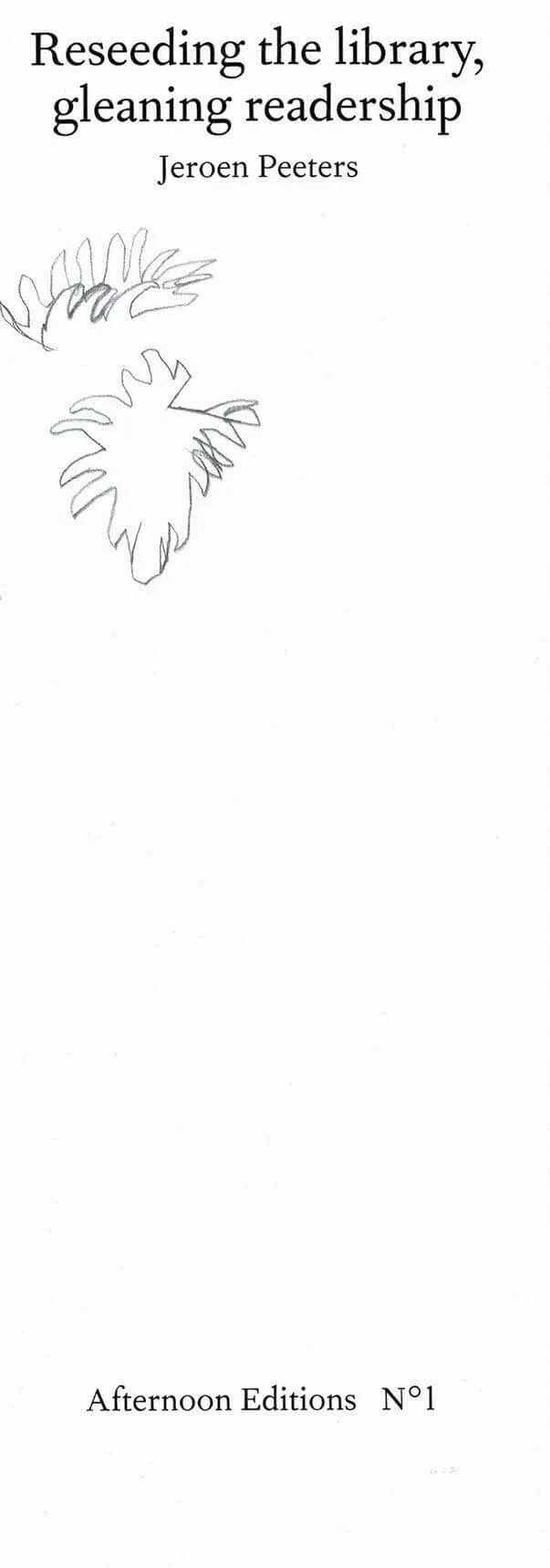
Reseeding the library, gleaning readership
Afternoon Editions no. 1: an essay by Jeroen Peeters titled Reseeding the library, gleaning readership. In May 2017, Time has fallen asleep in the afternoon sunshine settled during three weeks in the Ravenstein Gallery in Brussels as part of the Kunstenfestivaldesarts. Invited as a writer in residence, Jeroen Peeters visited the library of living books on a daily basis and recorded his observations by hand in a notebook, which formed the basis for Afternoon Edition #1. Reseeding the library, gleaning readership is an essay on the seed library, on the dispersion of literature through wind, water and animals, on biodiversity and commoning at the heart of readership. On the cover a drawing by Wouter Krokaert of a Philodendron Xanadu. Published May 2018.

The Soft Layer
A performance text by Jozef Wouters, The Soft Layer traces and proposes visions and words that enfold the historic building of Dar Bairam Turki in Tunis like a cloak. How can we imagine possible futures for such a place and the community inhabiting it, beyond nostalgia and the spectres of the past? Several voices muse in three languages (Tunisian, French and English) on renovation and history, destruction and cleansing, the limits of science-fiction and the soothing quality of aloe vera.
Published by Varamo Press in the essay series Gestures
First edition May 2022
48 pages, 11.0 x 16.5 cm, sewn perfect binding
ISBN 978-82-691492-4-1

Wistlin is did
Chris Mann is an Australian-American composer, poet and performer specializing in compositional linguistics. Mann studied Chinese and linguistics at the University of Melbourne, and his interest in language, systems, and philosophy is evident in his work. Mann founded the New Music Centre in 1972 and taught at the State College of Victoria in the mid-1970s. Mann moved to New York in the 1980s and was an associate of American composers John Cage and Kenneth Gaburo. Mann has recorded with the ensemble Machine For Making Sense with Amanda Stewart and others, Chris Mann and the Impediments, and Chris Mann and The Use. Mann currently teaches in the Media Studies Graduate program at The New School.

More Than Chilli
Chilli is one of the most popular food ingredients in contemporary China, and symbolic of modernisation. More Than Chilli goes beyond its trendy façade to explore Chongqing, known for its tradition of spicy food. From the perspective as a local, Rossy Liu reflects on her own personal memories associated with chilli. A combination of fragmented scenes, objects, dialogues, movements and sounds are drawn on to unravel the locality of culinary identity. While chilli has become a ubiquitous flavour in today's global society, the book emphasises the hidden intimacy that still exists between Chongqing locals and their unfiltered connection to chilli.

Image RIP: After Printing, Work & Planet Earth
Image RIP, the first publication from Source Type, is centered around New York graphic designer Geoff Han’s investigation into the Shenzen-based printer Artron and explores subjects ranging from design, production, work, and the environment in the post-industrial economy. The book gathers essays by Danielle Aubert, David Bennewith, Geoff Han, Ming Lin, Shanzhai Lyric, David Reinfurt, Mindy Seu, and Dena Yago, and features images by Ann Woo. Image RIP reflects a consistent theme in Han’s practice of the manipulation of image reproduction, printing, production, code, and other techniques to affect the process of viewing and reading.

The Flight of the Sparrow: Lingua 1 Poems and Other Theaters
A composition for one actor and tape, or two actors. Score. 1970

L'Alpin chez lui
L’ Alpin Chez Lui - Les jolis jouets du Queyras présente une collection de jouets en bois artisanaux fabriqués dans les Alpes. Ces figurines naïves aux couleurs vives et aux contours découpés, montées sur un socle et conçues pour une main d’enfant, attirent le regard par leur graphisme épuré.
Depuis 1920, les Jouets du Queyras sont fabriqués à Arvieux, dans les Hautes-Alpes. Cet ouvrage, réalisé par Clémence Passot, retrace l’histoire et l’évolution de la coopérative ouvrière « L’Alpin chez Lui », offrant un témoignage unique sur la vie sociale et économique de la montagne.
Conception graphique et direction éditoriale: Magali Brueder & Clémence Passot

bruit
Edition of 265 copies. A deluxe edition, accompanied by an original work numbered n/508 (oil pastel on paper A3), has been produced in 35 copies signed and numbered by the artist.
Hardcover, offset printing, 508 p., 31.8 x 25 cm. Printed by Cultura, Gent.

Translation is a Mode = Translation is an Anti-neocolonial Mode
Don Mee Choi is the author of three books of poetry and hybrid essays, and an award-winning translator of contemporary Korean women’s poetry. In this pamphlet, Translation is a Mode=Translation is an Anti-neocolonial Mode, she explores translation and language in the context of US imperialism—through the eyes of a “foreigner;” a translator; a child in Timoka, the made-up city of Ingmar Bergman’s The Silence; a child from a neocolony.
This pamphlet is part of UDP’s 2020 Pamphlet Series: twenty commissioned essays on collective work, translation, performance, pedagogy, poetics, and small press publishing. Each offers a different approach to the pamphlet as a form of working in the present, an engagement at once sustained and ephemeral.

Forms Of Life Of Forms
FORMS OF LIFE OF FORMS brings artistic research into form – not merely as an aesthetic question but as a social and political one. Indeed, there are no politics without form! With Forms of Life, Rob Ritzen curated several “Moments” that assembled works, collective readings, and other references into a single installation. This publication reshuffles documentation of these “Moments” as a visual reflection of the trajectory of this research.
Rob Ritzen works as a curator with a background in philosophy. His curatorial practice is focusing on self-organized and cooperative formats. Consciously positioned at the margins of established institutions and outside of market-oriented spaces, his practice is placed in close association with communities of cultural practitioners. His initiatives are attempts to reconfigure the politics of making art and alternative forms of production and presentation.

Sudden Wealth with Roy Claire Potter
Chris Evans, Roy Claire Potter
Proposed by Chris Evans, Sudden Wealth is a collaboration with Morten Norbye Halvorsen, Graham Kelly and invited poets and artists who use spoken word as their medium.
Sudden Wealth looks to how the flux of subjectivity in language can be shaped, agitated and re-imagined through a triangulation between written composition, intonation, and extrinsic sound composition. The latter spans analogue and digital instrumentation, foley recordings and algorithmically derived musical patterns. Divergent methods of composition work on and into a voice, modelling intonation, and affecting its sense and intent.
This first iteration has been made with Roy Claire Potter, an artist who tells stories from fragmented, intense images that depict moving bodies or domestic scenes and architectural settings. A rapid vocal delivery, a sense of restricted or partial views of space, complex social and group dynamics and the aftermath of violent events are recurrent strands of Potter’s writing, which are often delivered with a dark and sometimes wilful humour.
Chris Evans was the bassist with the now defunct Life Without Buildings and has previously produced musical compositions with Morten Norbye Halvorsen together with farmers and accountants for his ongoing series ‘Jingle’. Graham Kelly joins Evans and Halvorsen for this present series, Sudden Wealth.
Vocals: Roy Claire Potter.
Electronics: Morten Norbye Halvorsen.
Bass: Chris Evans.
Guitar: Graham Kelly.
Arranged and mixed by Morten Norbye Halvorsen.

On Breathing
A beautiful, expansive essay about care, dependence, and what it means to breathe in an age of environmental catastrophe.
A few moments after birth we begin to use our lungs for the first time. From then on, we must continue breathing for as long as we are alive. And although this mostly happens unconsciously, in a society plagued by anxiety, climate change, environmental racism, and illness, there are more and more instances that ‘teach us about the privilege that is breathing.’
Why do we so easily forget the air that we breathe in common? What does it mean to breathe when the environment that sustains life now threatens it? And how can life continue to flourish under conditions that are increasingly toxic?
To approach these questions, Jamieson Webster draws on psychoanalytic theory and reflects on her own experiences as an asthmatic teenager, a deep-sea diver, a palliative psychologist during covid, a psychoanalyst attentive to the somatic, and a new mother. The result is a compassionate and timely exploration of air and breathing as a way to undo the pervasive myth of the individual by considering our dependence on invisible systems, on one another, and the way we have violently neglected this important aspect of life.

Paying Attention: Essays on Art and Culture
From award-winning novelist and cultural critic Lynne Tillman, Paying Attention is the first collection of essays devoted to her incisive, provocative, and singular reflections on art and culture.
Paying Attention gathers more than fifty of the best and varied examples of Lynne Tillman’s writings in reference to art and culture published over the course of forty years. In essays that operate outside typical categories or genres, Tillman reflects on forms including film, painting, photography, poetry, and fiction, as well as notions of fame, originality, embodied viewing and thinking, collective activity, aging, illness, American identity, cultural politics, modernity, strangeness, and time. Such is the stuff that relates art to life, and life to art.
Collected mainly from museum and gallery catalogues, artists’ books and monographs, her column in Frieze, and magazines including Aperture and Artforum, these meditations on artists and writers, in the broadest sense of these labels, collide as a portrait of our cultural moment. Tillman’s inventive use of language and lateral thought, her ability to evoke conditions of the larger world in often just two thousand words on a specific artwork or individual, make her one of the most significant critics of our time. As she acknowledges, in a piece on the artist Robert Gober, “In writing on art, words reach for other words, phrases, idioms, and through them more images and ideas leap out.” In her introduction, Elizabeth Schambelan notes that a hallmark of Tillman’s writing alongside artists is an “elegant rendering of complexity,” and in approaching Tillman’s body of work and thought, Schambelan herself imbricates the art, voice, and language of criticism.

The Glover Group – A Los Angeles Story
A portrait of the cohesive community of women artists in Frogtown, Los Angeles, including Ruby Neri, Hilary Pecis, Megan Reed, Lily Stockman, and Austyn Weiner.
The Glover Group: A Los Angeles Story narrates the journey of an extraordinary group of artists who have nurtured their unique artistic voices within the same studio complex in Frogtown, Los Angeles. The Glover Group includes Ruby Neri, Hilary Pecis, Megan Reed, Lily Stockman, and Austyn Weiner, a coincidental yet cohesive community of women artists sharing a unique bond through their interconnected workspace.
This catalog, designed to document their collaborative exhibition held at MASSIMODECARLO in Milan during July and August 2023, features interviews to the artists by Cecilia Alemani, Alison M. Gingeras, Justine Ludwig, Marta Papini, and Heidi Zuckerman, together with photographs by Tracy Nguyen.
Contributions by Ruby Neri & Alison M. Gingeras, Hilary Pecis & Cecilia Alemani, Megan Reed & Marta Papini, Lily Stockman & Heidi Zuckerman, Austyn Weiner & Justine Ludwig.

The New Fascist Body
The success of new far-right movements cannot be explained by fear or rage alone – the pleasures of aggression and violence are just as essential. As such, racism is particularly intense when it is erotically charged, migration presenting as a sexual threat to white women being one of many examples. Germany’s strikingly successful right-wing political party Alternative für Deutschland is, according to the historian Dagmar Herzog, characterized by this “sexy racism,” with its second main feature being that of an obsessive antidisability hostility—both elements resonating strongly with Nazism. In The New Fascist Body, Herzog connects her analysis of fascism’s libidinous energy with its animus against bodies perceived as imperfect. Only by studying the emotional and intellectual worlds of past fascisms can we understand and combat their current manifestations.
The book features an afterword by Alberto Toscano, author of Late Fascism: Race, Capitalism and the Politics of Crisis (Verso 2023).

Necropolitics
In Necropolitics Achille Mbembe, a leader in the new wave of francophone critical theory, theorizes the genealogy of the contemporary world, a world plagued by ever-increasing inequality, militarization, enmity, and terror as well as by a resurgence of racist, fascist, and nationalist forces determined to exclude and kill. He outlines how democracy has begun to embrace its dark side—-what he calls its “nocturnal body”—-which is based on the desires, fears, affects, relations, and violence that drove colonialism. This shift has hollowed out democracy, thereby eroding the very values, rights, and freedoms liberal democracy routinely celebrates. As a result, war has become the sacrament of our times in a conception of sovereignty that operates by annihilating all those considered enemies of the state. Despite his dire diagnosis, Mbembe draws on post-Foucauldian debates on biopolitics, war, and race as well as Fanon's notion of care as a shared vulnerability to explore how new conceptions of the human that transcend humanism might come to pass. These new conceptions would allow us to encounter the Other not as a thing to exclude but as a person with whom to build a more just world.
(October 2019)

Semi-Nomadic Debt-Ridden Bedouins
Semi-Nomadic Debt-Ridden Bedouins offers an in-depth look at nearly two decades of artistic output by the Palestinian artist and filmmaker Basma al-Sharif. Retracing her practice from recent works back to her earliest experiments, the book provides an original overview of how her visual language and conceptual concerns have evolved over time.
Basma al-Sharif's films and installations navigate the unstable terrains of displacement, colonialism, and representation—often shaped by the ongoing reality of the occupation of Palestine. Through a rich selection of images and curatorial essays, the monograph highlights the layered political and cinematic frameworks within which her works are embedded.
Also included are two newly commissioned literary contributions: a fictional piece by Karim Kattan that resonates with the themes of place and estrangement, and a conversation between al-Sharif and the artist Diego Marcon, in which they reflect on shared affinities, artistic processes, and their long-standing dialogue. Blurring the personal and the political, the real and the imagined, Semi-Nomadic Debt-Ridden Bedouins captures the complexity and urgency of al-Sharif's artistic journey.
Texts by Basma al-Sharif, Karim Kattan, Diego Marcon, et al.
Basma al-Sharif (born 1983 in Koweit) is a Palestinian artist working in cinema and installation. She developed her practice nomadically between the Middle East, Europe, and North America and is currently based in Berlin. Her practice looks at cyclical political conflicts and confronts the legacy of colonialism through satirical, immersive, and lyrical works.