rile*books

Search books

Search books by title, author, publisher, keywords...

Explore

Categories
Visit
Collections
Publishers
Back in stock
Any books
Cover of A Mouth Holds Many Things: A De-Canon Hybrid Literary Anthology

Fonograf Editions

A Mouth Holds Many Things: A De-Canon Hybrid Literary Anthology

Dao Strom ed., Jyothi Natarajan ed.

€36.00

A Mouth Holds Many Things collects hybrid-literary works from 36 women and nonbinary BIPOC writer-artists. Spanning experimental poetry and prose, image-text, collage, performance text, AI-generated writing, and more, this ground-breaking full-color print volume illuminates and expands the interstitial spaces where text blends, blurs, and morphs with visual and other media.

At the restless heart of this collection is a challenge to some fundamental questions: What is reading? What is writing? Lifting language beyond the domain of the letter, the works collected here present language in other forms: visual, embodied, sonic, asemic, tactile. Language, after all, is multi-textu(r)al, interwoven, punctured, fragmented, grafted, possessing power to construct and deconstruct, fed into by many rivers of experience: marginalizations and migrations, diasporas and displacements, invisibilities and hyper-visibilities.

A project of the Portland-based literary-social art project, De-Canon, which creates unique spaces and experiments to center works by writers of color, this collection is edited by Dao Strom and Jyothi Natarajan.

A Mouth Holds Many Things was, in the short stories/poetry/anthologies category, the winner of a 2024 PubWest Book Design Award.

Full list of contributors

Stephanie Adams-Santos, Kimberly Alidio, Samiya Bashir, Aya Bram, Victoria Chang, Jennifer S. Cheng, Gabrielle Civil, desveladas (Macarena Hernández, Sheila Maldonado, Nelly Rosario), Carolina Ebeid, Nadia Haji Omar, Christine Shan Shan Hou, Imani Elizabeth Jackson, Vi Khi Nao, Diana Khoi Nguyen, Quyên Nguyễn-Hoàng, Cindy Juyoung Ok, Monica Ong, Shin Yu Pai, Jenne Hsien Patrick, Jennifer Perrine, Alley Pezanoski-Browne, Kelly Puig, Ayesha Raees, Jhani Randhawa, Paisley Rekdal, Daisuke Shen, Sasha Stiles, Sandy Tanaka, Arianne True, Addie Tsai, Vauhini Vara, Divya Victor, Anna Martine Whitehead, Kathy Wu

Published in 2024 ┊ 337 pages ┊ Language: English

recommendations

Cover of Bird Watching and Their First Three Books of Poetry

Fonograf Editions

Bird Watching and Their First Three Books of Poetry

Eileen Myles

Poetry €24.00

Any future film director planning to make a movie of Myles's iconic novel Chelsea Girls (it's always just about to happen) would be wise to read Bird Watching first. Written in 1978 and unpublished until now, the central character of the book is a twenty-something that is already filled with memories. Living in New York City, resplendent, full of both grandeur and awkwardness, they are about to embark on a life fully invested in art. Bliss happens, as does uncertainty. Everything is here and now.

The Irony of the Leash, A Fresh Young Voice from the Plains, and Sappho's Boat, the other collections contained in the volume, comprise the first three books that Myles published, when their promise as one of the most important writers of their generation was just coming into view. Immensely readable, raw, and slightly unhinged, the poetry that comprises these three texts is post young. Slight creaky but fully functional, all of these poems are beautiful and funky.Bird Watching and Their First Three Books of Poetry contains a critical foreword by poet and scholar Rosa Campbell, along with a preface by Eileen Myles contextualizing the book within our contemporary moment.

Eileen Myles (them/them, b. 1949) is a poet, novelist and art journalist whose practice of vernacular first-person writing has made them one of the most recognized writers around town (globally). They live in New York & in Marfa, TX.

Cover of Alice Notley, Live in Seattle

Fonograf Editions

Alice Notley, Live in Seattle

Alice Notley

Poetry €23.00

Entirely comprised of poems contained in her latest collection, 2016’s Certain Magical Acts, Live in Seattle elucidates why Alice Notley is one of the world’s most revered poets, the recipient of the Los Angeles TimesBook Award, the Griffin Prize, the Shelley Memorial Award, the Lenore Marshall Prize, and the Poetry Foundation’s Ruth Lilly Prize. “I am alive outside written memory” is how one of the speakers of Notley’s poem “Voices” puts it and listening to the poet read her work live, in front of an entranced audience, serves to detail the intangibility of sound vis-à-vis language.

Live in Seattle also includes excerpts of the onstage conversation Notley had with Seattle poets John Marshall, Christine Deavel and Rebecca Hoogs. Among other topics, the talk revolves around concepts of success, what it means to write a female poetry circa 2017, and the importance of always creating from a position of disobedience.

As part of Seattle Arts & Lectures’ Poetry Series, Live in Seattle was recorded at McCaw Hall in Seattle, Washington on Wednesday, April 5th, 2017 and mastered and engineered by Gus Elg at Sky Onion in Portland, Oregon in the Summer of 2017. 

Purchase of Live in Seattle includes a 11×11 insert of Notley’s poem “FOUND WORK (lost lace),” as well as a download card for the entire album. Live in Seattle can also be found digitally on Spotify and Bandcamp. The record itself is not black but clear.

Cover of Early Works

Fonograf Editions

Early Works

Alice Notley

Poetry €26.00

Early Works collects Alice Notley’s first four out of print poetry collections, along with 80 pages of previously uncollected material. A must have for any Notley fan. Includes original collection cover artwork by Philip Guston, Philip Whalen and George Schneeman, among others.

From editor Nick Sturm’s “Introduction” to Early Works:

In the author’s note that begins Grave of Light: New and Selected Poems 1970-2005, Alice Notley writes, “My publishing history is awkward and untidy, though colorful and even beautiful.” I have always been enamored of this sentence, which reminds us that an array of dispersed and varying publishing contexts are the original sites that give shape to such a book’s form. It is also something of an invitation into that color and untidiness, a prompt to become more curious about the awkwardness and beauty of Notley’s publishing history. This book, Early Works, accounts for a significant portion of that history by bringing back into print the complete versions of her first four books, a little-known 22-poem sonnet sequence, and a large selection of early uncollected poems gathered from little magazines. In doing so, Early Works joins an important set of recent volumes that put Notley’s earlier poetry back into circulation, including Manhattan Luck (Hearts Desire, 2014), which collects four long poems written between 1978 and 1984, and Songs for the Unborn Second Baby, originally published by United Artists in 1979 and reissued in a facsimile edition by London-based Distance No Object in 2021. Each in their own way, and especially taken together, these books continue to confirm that, as Ted Berrigan writes in The Poetry Project Newsletter in 1981, “Alice Notley is even better than anyone has yet said she is.”

Cover of The Speak Angel Series

Fonograf Editions

The Speak Angel Series

Alice Notley

Poetry €28.00

The Speak Angel Series is composed of six full-length books in various forms but towards the achievement of a unifying epic narrative in which the poet, as character, leads all the souls of all the living and dead to a point zero where the remaking of the cosmos can be performed. As this is being done, the official public world takes place in Paris, France and the United States, and new “characters” are incorporated from the news and from the poet’s life.

The forms include a long-line narrative broken by lyric stand-alones, an operatic form designed to make the reader chant if reading aloud, two spiritual sequels to the author’s book The Descent of Alette, written in the same stanzaic form, a book that is simply a collection of different kinds of poems, a book formed by literary collaging, and a final, long book that is the volume’s ultimate culmination.

The Speak Angel Series took years to accomplish but is finally ready; it is meant to be read for plot, pleasure, musical experience, wisdom and truth. Why not? The books present something like a cosmology in the philosophical sense, a reading of existence and of death. The dead are very close-by and available in the series, which is a work of stunning ambition.

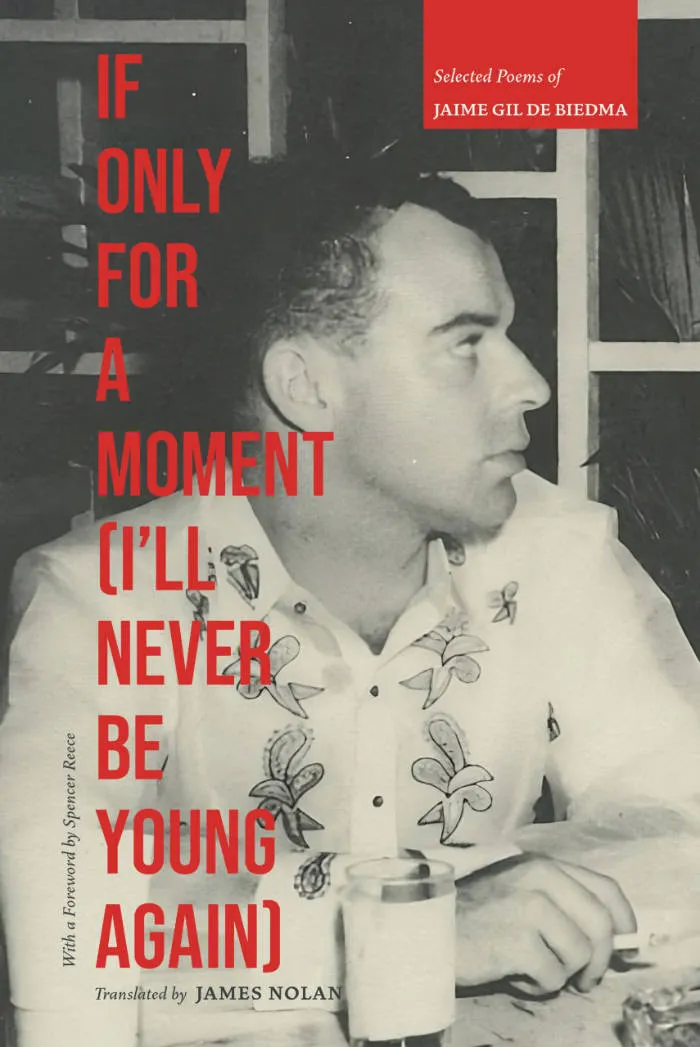
Cover of If Only For a Moment (I’ll Never Be Young Again)

Fonograf Editions

If Only For a Moment (I’ll Never Be Young Again)

Jaime Gil de Biedma, James Nolan

Poetry €19.00

Jaime Gil de Biedma is the most original and influential among the poets known as the ‘50’s Generation in Spain, and is considered the greatest Spanish poet to emerge in the second half of the 20th century. His life and literary career were bracketed almost entirely by the rise and fall of Generalissimo Francisco Franco, notorious for the suppression of literature. Born in 1929, Gil de Biedma was six years old when García Lorca was murdered in Granada at the outbreak of the Civil War, and his collected poems, Las personas del verbo, first appeared in 1975, the year Franco died. What is surprising is that Gil de Biedma was a leftist, homosexual poet from the Catalan capitol, Barcelona – all of Franco’s favorite things – who not only published books of autobiographical poetry in Spain but was known as a poet of social conscience as well as erotic lyricism. Like other Spanish poets of his time, he chose his words carefully. Gil de Biedma died of AIDS in 1990.

If Only For a Moment (I’ll Never Be Young Again) consists of an extensive bilingual selection of Gil de Biedma’s poetry, including all of his most well-known work. The book additionally consists of a Foreword by Spencer Reece, Jaime Gil de Biedma’s short essay “I wanted to be the poem,” and two different essays on Gil de Biedma and the art of translation by James Nolan, the volume’s translator.

Cover of Tripwire 16 - Performance/Writing

Tripwire Journal

Tripwire 16 - Performance/Writing

David Buuck, Kevin Killian

Performance €18.00

A special issue focused on performance writing, with work by Tanya Lukin Linklater (with Michael Nardone), Jibade-Khalil Huffman & Simone White, Jean-Thomas Tremblay, Claudina Domingo (trans. Ryan Greene), Kim Rosenfield, Nathan Walker, Liz Knox, Rona Lorimer, Léo Richard, & Hector Uniacke, Mohamed A. Gawad & Dalia Neis, Mei-mei Berssenbrugge & Teddy Yoshikami, interviewed by Michelle N. Huang, Kyoo Lee and Jocelyn Saidenberg, Adriana Garriga-López, Gabrielle Civil, plus a Kevin Killian Tribute, with Eileen Myles * Scott Hewicker * Cliff Hengst * Karla Milosevich * Craig Goodman * Michelle Rollman * Anne McGuire * Wayne Smith * Tanya Hollis * Steve Orth * Lindsey Boldt * Maxe Crandall * Arnold J. Kemp * Carla Harryman, Lee Ann Brown & Tony Torn * Susan Gevirtz * Laynie Browne * Patrick Durgin * Norma Cole * Jo Giardini. & reviews: Jessica Lopez Lyman & Jocelyn E. Marshall on Gabrielle Civil, alex cruse on Merce Cunningham, Rob Stanton on Anne Boyer, Jack Chelgren on Miyó Vestrini, David Grundy on Stephen Jonas, Virginia Konchan on Sarah Vap.

Cover of Yellow Songs 1: Voiced-Voiceless

The 3rd Thing

Yellow Songs 1: Voiced-Voiceless

Dao Strom

Essays €18.00

Fifty years after the fall of Saigon, Dao Strom’s Yellow Songs vibrates with the ramifications and ripples of Empire. Each of the four Yellow Songs books reckons with the intimate consequences of the colonial project, reconfiguring them into complex and lucid, literal and figurative songs of selfhood. Embodied, critical, wholehearted, collective, personal, genre-defying—Yellow Songs renders the brute force of history with tender precision. Art book quality printing in full color with felt paper inserts.

Yellow Songs 1: Voiced-Voiceless unearths, unwinds, un-bodies the violence of stigma, reclaiming the ventriloquized voice of David Bowie's "China Girl” through a lyric-critical essaying (assaying) of cultural tropes, racialized and gendered power plays, and memory.

Cover of Not a Force of Nature

Futurepoem

Not a Force of Nature

Amy De'Ath

Poetry €21.00

If capital makes life a seething, complex nightmare for most people on the planet's surface, if "words do cleave the producer from the land," then what does all this dispossession feel like? Amy De'Ath turns poetry into a hot, potent, and highly funny form of criticism, in which social force is felt intimately, and voiced in the acid niceness of a work email. Amy's poems move like pieces of machinery in a cognitive amusement park, which spit you a thousand feet into the air but keep your viewpoint fixed on the same spot as before—what's different? "Land in Saskatchewan, land in Delhi," or "everything…that you want from women and gays." Not a Force of Nature makes me want to change everything. "Behold me I'm you now," Amy writes—we should be so lucky, to be thus transformed. — Kay Gabriel

Not a Force of Nature's expertly crafted poems explore the catastrophe we live among and speak through. They form a sort of feminist manifesto addressed to all forms of resistance. But also: here are love sonnets! This book is angrily precise and always a lot of fun. "No, you're a Canadianist!" — Kevin Davies

Not a Force of Nature is the kind of book that becomes possible only after rejecting the "we" evoked so often in contemporary literary culture—sometimes said to need poetry now more than ever, sometimes called community. Amy De'Ath's motley vision of solidarity, of "actual emboldened people," is way weirder, more lively, and possible. Nor do these poems content themselves, like the ghost of Marxist theory past, with pointing towards the contradictions that surround them. Do you remember email? Sonnets? Not a Force of Nature is like that, thrashing inside generic forms and always coming next: after the tendency of the rate of profit to fall, after Jane's abortion service, after the 1970s, 80s, and 90s, after Creeley, after Raworth, after Mayer, after the Xenofeminist Manifesto, after Pluto enters Aquarius. "There are still tactics like this roaming free," De'Ath writes. There are still these fervent lyric parries. Be with Not a Force of Nature now. — Stephanie Young

Through slips of verbal acuity, Amy De'Ath scrapes her way out of determinism to a world "made by hands," where our material relations are ours to make and break. History is long and history is short. History is translucent. De'Ath presents the Ferris wheel of capitalist production, where the subject lives once as worker, twice as commodity. Here, in these "concrete trousers," is a "totally liberated" working class poem turning everything into nothing as praxis. — Anahita Jamali Rad

Cover of Homie

Graywolf Press

Homie

Danez Smith

Poetry €16.00

Homie is Danez Smith’s magnificent anthem about the saving grace of friendship. Rooted in the loss of one of Smith’s close friends, this book comes out of the search for joy and intimacy within a nation where both can seem scarce and getting scarcer. In poems of rare power and generosity, Smith acknowledges that in a country overrun by violence, xenophobia, and disparity, and in a body defined by race, queerness, and diagnosis, it can be hard to survive, even harder to remember reasons for living. But then the phone lights up, or a shout comes up to the window, and family—blood and chosen—arrives with just the right food and some redemption.

Part friendship diary, part bright elegy, part war cry, Homie is the exuberant new book written for Danez and for Danez’s friends and for you and for yours.

& colin kaepernick is my president, who kneels on the air
bent toward a branch, throwing apples down to the children
& vets & rihanna is my president, walking out of global summitswith wine glass in hand, our taxes returned in goldto dust our faces into coins
& my mama is my president, her grace stuntson amazing, brown hands breaking brown bread overmouths of the hungry until there are none unfed & my grandma is my president
& her cabinet is her cabinetcause she knows to trust what the pan knowshow the skillet wins the war  
—from “my president”

Cover of nnn2. - no no no celestial journal

no more poetry

nnn2. - no no no celestial journal

nmp

Periodicals €10.00

published commonly, no no no expounds an experimental poetic offering, both text & art.

each issue features a limited edition artwork. which can be tacked or framed or stored in a drawer.

celestial in nature, no no no takes the form required, and necessary.

Cover of Paces the Cage

The Song Cave

Paces the Cage

S*an D. Henry-Smith

Poetry €19.00

S*an D. Henry-Smith’s second full-length book of poems, PACES THE CAGE, lifts off from their previous book, Wild Peach (2020), by expanding an already-queered language to near breaking point. Through the complexities of Henry-Smith’s personal experiences and the use of a poetically fragmented voice, the literal and metaphorical are here remixed in real time. Henry-Smith’s occasional inclusion of ambient sounds and a musical language and tone used throughout the book helps to build a rich auditory landscape that enhances the immersive quality of the poems, creating a deep and evocative collection by this adventurous and endlessly exciting artist. As if it were an improvised performance itself, PACES THE CAGE actively tunes personal and historical narratives of oppression and adversity with the act of speaking, and what it means to be truly heard by a community of one’s fellow creators and collaborators.

PACES THE CAGE extends S*an D. Henry-Smith’s interdisciplinary, improvisational listening into a poetics of “fissure and measure,” where silence and the sonic converge in boundless motion. Tuning language toward the frequencies of breath, pulse, and sociality, Henry-Smith's poems transport us from natural worlds to communal forms to Bill Gunn’s STOP, recovering wayward images and utterances to compose a surround sound of loss and renewal. What emerges is both reckoning and remedy—a lush sensitivity to the ways language becomes live, as in now, as in “eyes open, full of rage.”

Maxe Crandall

S*an D. Henry-Smith’s reverberant propositions seek the music of mutual renewal, constantly and impatiently approaching the present. This is a field of spiraling, alliterative song, the wild signature of Henry-Smith’s lyric, that renews commitments to militancy by naming and knowing its enemies as doubtlessly as it names and knows it lovers. PACES THE CAGE considers a set of conditions—technical, material phenomena—that produce collective and contradictory imaginations and gives words to the song that makes the gathering last, “all in for all…” PACES THE CAGE is a beautiful rehearsal of attentiveness, a rigorous and generous correspondence with the edges of the frame.      

– dove, Christine Kirubi

S*an's PACES THE CAGE recalls to me Akilah Oliver’s 2004 An Arriving Guard of Angels, Thusly Coming to Greet. A lyrical unleashing into the many selves, the author here plays conduit for many beautiful bodies; for those souls wandering at daybreak; for the pudgy greased cheeks and those that murmur in the dew of twilight uncloaked. It is as if the poet has extracted from the marsh, the runoff, roundup and peat to stockpile and make lush a new yet familiar world. S*an has created a collection of diamonds from the salty mines of turtle tears. The divorced defanged possessive absent its apostrophe, left to the mud puddle for butterfly nuptials throughout, tells the reader: How you know me Now will be Different from how you knew me. These buoyant poems that are S*an’s latest songs have not missed the train this time. Make certain that you don’t. I’m in awe.

–LaTasha N. Nevada Diggs 

S*an D. Henry-Smith is a poet and photographer, working by extension in sound, performance, and publishing.

Cover of The Rose

Graywolf Press

The Rose

Ariana Reines

Poetry €17.00

Drawing on the history of “romance” as the troubadours knew it and the titular flower’s ancient allegories for sexuality and mystery, Reines plunges into feminine archetypes to explore masculine pain: “I have always liked helpless / & terrible men because they break my mind.” In these poems, inherited ideologies of gender performance are replaced with bold vulnerability: paradoxes of power and surrender transmute the speaker’s understanding of suffering, desire, and the soul.

The voice in The Rose is wry and bare, approaching the connection between erotic love and spirituality with humor. Investigating war, maternity, violent sensuality, and the role of language in magical acts, Reines is unafraid to uncover the “secret / & terrible shovelings / Of love,” and the result is a bloody and pulsing, sexy and unabashed bloom.