Books
Books
in random order

Steering The Craft
A Twenty-First-Century Guide to Sailing the Sea of Story.
With an introduction by Theo Downes-Le Guin, Karen Joy Fowler, Molly Gloss and Kelly Link.
Steering the Craft is Ursula K. Le Guin’s carrier bag of the tools of a writer’s craft: how – and why – to write. From the sound of language to tenses to point of view, Le Guin offers a comprehensive and generous guide to the fundamental components of narrative, illustrating her incisive analysis with examples from some of her favourite writers. Revised and updated for the twenty-first century, this handbook includes exercises that the writer can do alone or in a group.
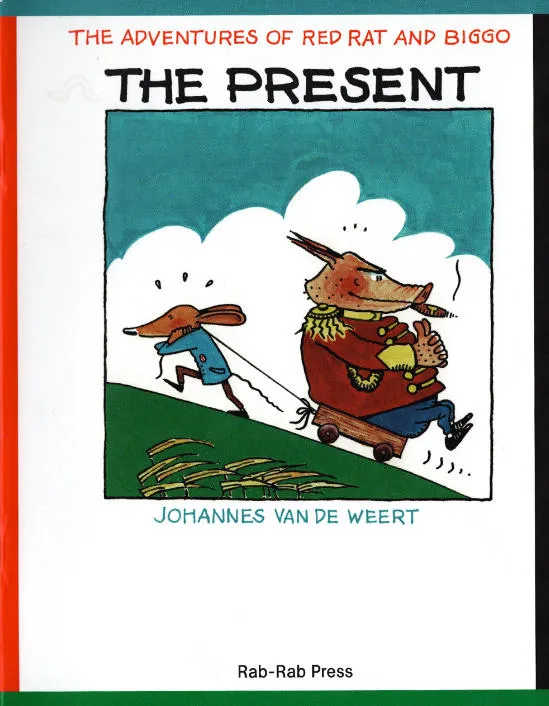
The Adventures of Red Rat and BIGGO – The Present
A children's book by Johannes van de Weert, a veteran of the punk underground (Rondos, The Ex, Red Rat, Raket).
The Adventures of Red Rat and BIGGO – The Present is a remake of Bram konijn en Piet de muis [Bram the Rabbit and Piet the Mouse], a 1982 children's book by Johannes van de Weert, a veteran of the Dutch punk underground who played with Rondos and The Ex, and who was the force behind Red Rat and Raket editions.
The Present is a 2010 remake telling the story of a bully pig who terrifies a poor rat on a daily basis. After a while, the rat falls ill with fear and has to stay in bed. The lonely, evil pig has no one to play with and becomes depressed. The pig gives the rat a present—a bunch of beautiful flowers—and all is well. Now the two can play together.
The 2010 remake, featuring different characters and intended for a North Korean audience, was never published. The 2025 English version opens with an introduction by Van de Weert, telling a bizarre story of a failed political career and an absurd vaudeville class struggle behind the seemingly harmless educational children's book.
Johannes van de Weert was a cartoonist active in the Rotterdam punk and squatter's movements of the 1980s. He was a singer with the punk band De Rondos and he started self-publishing small comic booklets in the late 1970s. He created his character "Redrat" for the fanzine Raket in 1980. The character soon became an icon for the squatter's movement.

Selected Writings of Gertrude Stein
This collection, a retrospective exhibit of the work of a woman who created a unique place for herself in the world of letters, contains a sample of practically every period and every manner in Gertrude Stein’s career. It includes The Autobiography of Alice B. Toklas in its entirety; selected passages from The Making of Americans; "Melanctha"from Three Lives; portraits of the painters Cezanne, Matisse, and Picasso; Tender Buttons; the opera Four Saints in Three Acts; and poem, plays, lectures, articles, sketches, and a generous portion of her famous book on the Occupation of France, Wars I Have Seen.

Survival Takes a Wild Imagination: Poems
In the powerful follow up to her critically acclaimed debut collection, poet and activist Fariha Róisín is writing, praying, clawing, and scratching her way out of the grips of generational trauma on the search for the freedom her mother never received and the kindness she couldn’t give.
This collection of poetry asks a kaleidoscope of Who is my family? My father? How do I love a mother no longer here? Can I see myself? What does it mean to be Bangladeshi? What is a border? Innately hopeful and resolutely strong, Fariha's voice turns to the optimism and beauty inherent in rebuilding the self, and in turn, the world that the self moves through. Ubiquitous to the human experience, Survival Takes a Wild Imagination is an illuminating breath of fresh air from a powerful poetic voice.

Crossings: Creative Ecologies of Cruising
It’s difficult to pinpoint the origins of cruising. While the term was used by men seeking casual encounters with other men in the parks and streets of New York City as early as the 1920s, historical records show the practice is much older. Cruising has existed for as long as anyone outside the dominant sex and gender systems has sought sexual encounters outside of sanctioned norms. This book offers a serious exploration of queer sex and sex cultures, exploring cruising as a mode of thinking with the body and communicating through sexuality.
A creative dialogue between a queer artist and a queer academic reminiscing about and thinking with their cruising experiences, Crossings takes queer sex practices and cultures seriously as ways of knowing and world-making. The result is an erotic hybrid form hovering between scholarship and avant-garde experimentation, between critical manifesto and sex memoir. Here, the voices of each author, merged together in one, invite the reader to inhabit the erotic spacetime between self and other, the familiar and the strange, desire and pleasure, climax and release. That is, the spaces and temporalities of cruising itself.
CUNY Center for the Humanities
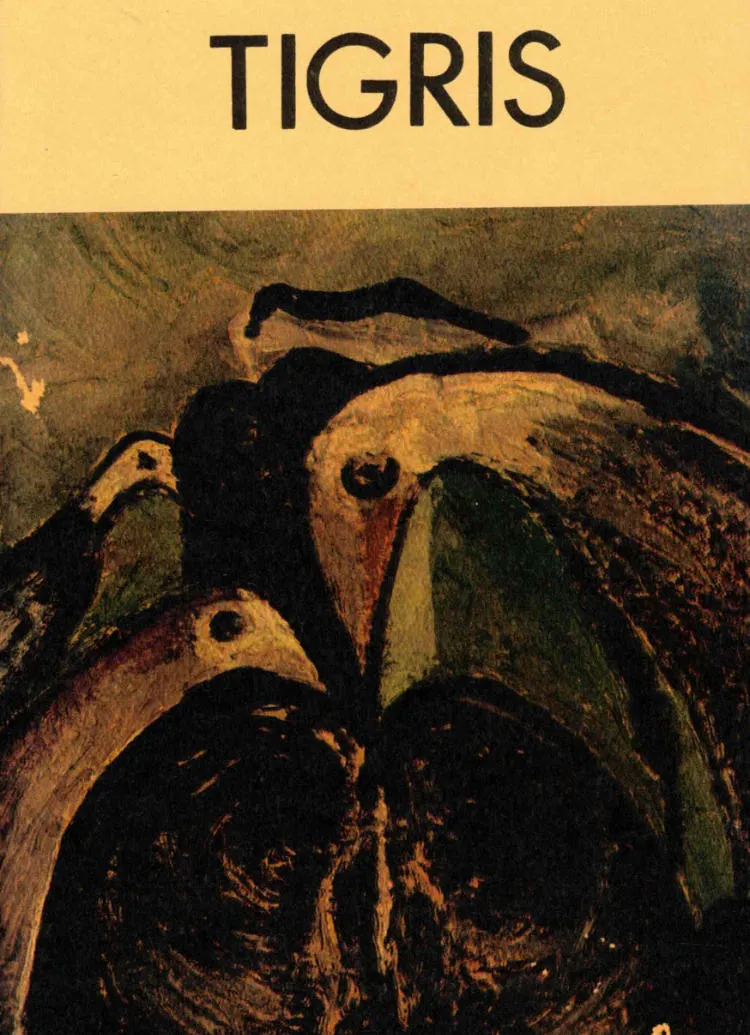
Tigris Vol. 1
In 1971, the great Iraqi poet Sargon Boulus (1944-2007) published a single issue of an English-language literary anthology that he called Tigris. The magazine—a whisper on the literary landscape that appeared three years after Boulus’s arrival in the US—brings together work by Boulus and several of his literary friends, in translation by Boulus and Etel Adnan.
Tigris was not an end in itself, but rather a temporary solution to the lifelong problem of how to devote oneself to poetry across different countries, eras, and styles: how to live poetry. Yet, in so doing, the small anthology includes significant work: Etel Adnan’s “Jebu,” translated by Adnan, and poetry by Boulus, Fouad Rifkah, Yusuf al-Khal, Mouayad al-Rawi, and Riadh Fakhouri, all in Boulus’s translations, as well as a work by Ankido, a “street-activist poet-café worker of importance to the Palestinian Liberation Movement.”

The Lesbian Avenger Handbook
Launched in New York City, in 1992, the Lesbian Avengers rejected the picket line and ordinary demo for media-savvy, nonviolent direct action.
They were superheroes arriving "to make the world safe for baby dykes everywhere;" warriors with capes and shields doing a line dance; dykes "Lusting for Power," pushing a giant bed float down Sixth Avenue in New York (with lesbians on it); nationally-ambitious Avengers eating fire in front of a hostile White House; lovers reuniting a statue of Alice B. Toklas with Gertrude Stein, then waltzing in the snow in Bryant Park. And homos who shamelessly chanted, "Ten percent is not enough, recruit, recruit, recruit."
Originally published in 1993, Homocom edition 2021

My Lesbian Novel
The latest in writer and visual artist Renee Gladman's ever-expanding body of imaginative investigation is a sui generis novel of queerness and art-making, philosophy and sex.
The narrator of My Lesbian Novel is Renee Gladman, an artist and writer who has produced the same acclaimed body of experimental art and prose as real-life Renee Gladman, and who is now being interviewed by an unnamed interlocutor about a project in process, a seeming departure from her other works, a lesbian romance.
Between reflections on art making and on the genre of lesbian romance - "though aspects of the formula drive me crazy... people who write these stories understand how beautiful women are" - a romance novel of her own takes shape on the page, written alongside the interview, which sometimes skips whole years between questions, so that time and aging become part of the process.
The result is a beautifully orchestrated dialogue between reflection and desire, or clarity and confusion, between the pleasures of form and the pleasures of freedom in the unspooling of sentences over time.
Renee Gladman is a writer and artist preoccupied with crossings, thresholds, and geographies as they play out at the intersections of poetry, prose, drawing, and architecture. She is the author of fourteen published works, including a cycle of novels about the city-state Ravicka and its inhabitants, the Ravickians, all published by Dorothy— Event Factory, The Ravickians, Ana Patova Crosses a Bridge, and Houses of Ravicka. She has been awarded fellowships, artist grants, and residencies from the Radcliffe Institute for Advanced Study at Harvard, Foundation for Contemporary Arts, the Lannan Foundation, and KW Institute for Contemporary Art (Berlin), and was a 2021 Windham-Campbell Prize winner in fiction. She makes her home in New England with poet-ceremonialist Danielle Vogel.

Pourquoi les chats sont dans la rue?
Manuel d’actions et réactions adaptées aux différentes situations, dessiné à partir de l’expérience d’Edwige Ehlinger.

Night Night Fawn
From the author of Confessions of the Fox comes a novel in which a yenta on her deathbed gives an unrepentant account of all her failures—including her child.
“Jordy Rosenberg might be one of our most fearless living novelists. There are no half-measures in his work, just big ideas and living characters and gorgeous sentences and metafictional panache and surprise after heart-stopping surprise. Night Night Fawn is extraordinary.”—Carmen Maria Machado, author of In the Dream House
In a cluttered rent-controlled apartment in the middle of Manhattan, Barbara Rosenberg is terminally ill, high on opioids, and writing the story of her life. She has opinions about her smutty late husband, her career as the receptionist for a disreputable plastic surgeon, her glory days as an accomplished jazzerciser, and her failed aspirations to be a film noir actress. But what she really wants to talk about are unhinged thoughts on gender, Karl Marx, Zionism, and her two great disappointing loves: an estranged trans son and a long-lost best friend whose betrayal haunts Barbara still. As she descends further into delirium and illness, Barbara finds herself in a nightmare from which she cannot escape, and her circumstances put her on a crash course with these intimates—or are they avenging nemeses?—once again.
Part novel, part someone’s mother’s unauthorized memoir—all diatribe, gutter schtick, and deranged manifesto, Night Night Fawn is a ferociously candid account of intergenerational conflict.

The Word for World: The Maps of Ursula K. Le Guin
When Ursula K. Le Guin started writing a new story, she would begin by drawing a map. The Word for World presents a selection of these images by the celebrated author, many of which have never been published before, to consider how her imaginary worlds enable us to re-envision our own.
Le Guin’s maps offer journeys of consciousness beyond conventional cartography, from the Rorschach-like archipelagos of Earthsea to the talismanic maps of Always Coming Home. Rather than remaining within known terrain, they open up paradigms of knowledge, exemplified by the map’s edges and how a map is read, made and re-made, together. The Word for World brings her maps together with poems, stories, interviews, recipes and essays by contributors from a variety of perspectives to enquire into the relationship between worlds and how they are represented and imagined.
Contributors: Federico Campagna, Theo Downes-Le Guin, Daniel Heath Justice, Bhanu Kapil, Canisia Lubrin, Una McCormack, David Naimon, Nisha Ramayya, Shoshone Collective, Standard Deviation, Marilyn Strathern.
Co-published by Spiral House and AA Publications to coincide with an exhibition of Ursula K. Le Guin’s maps at the Architectural Association, London, opening on 10 October 2025.
”One of the literary greats of the 20th century.” Margaret Atwood

Spill: scenes of black feminist fugitivity
In Spill, self-described queer Black troublemaker and Black feminist love evangelist Alexis Pauline Gumbs presents a commanding collection of scenes depicting fugitive Black women and girls seeking freedom from gendered violence and racism. In this poetic work inspired by Hortense Spillers, Gumbs offers an alternative approach to Black feminist literary criticism, historiography, and the interactive practice of relating to the words of Black feminist thinkers. Gumbs not only speaks to the spiritual, bodily, and otherworldly experience of Black women but also allows readers to imagine new possibilities for poetry as a portal for understanding and deepening feminist theory.
Alexis Pauline Gumbs is a poet, independent scholar, and activist. She is coeditor of Revolutionary Mothering: Love on the Front Lines and the Founder and Director of Eternal Summer of the Black Feminist Mind, an educational program based in Durham, North Carolina.

Fanta For The Ghosts
fanta for the ghosts by Elisabeth Molin
120mm x 210mm
edition of 500
Co-published with OneThousandBooks and Elisabeth Molin

Pommes Girl / أحتفل بالحياة التي تحتفل بي
Rim Battal, Abdelilah Khattabi
The story of a meeting between a woman and a man linked by music for one night, in a nuptial dance of bodies and words doomed to failure: an ode to desire by the Franco-Moroccan poetess.
Rim Battal (born 1987 in Casablanca, lives and works between Paris and Rabat since 2012) is a French artist and poet.
Edited by Yasmina Naji.
Translated into Arabic by Abdelilah Khattabi.

DAISYWORLD MAGAZINE #4
CONTRIBUTORS Anna Bierler, India Boxall, Craig P Burrows, Alex Hampshire, Kayla Adara Lee, Marijn van der Leeuw, Melanie Matthieu, Gabriella T Moreno, Amira Prescott, Harrison Pickering, Astarte Posch, Ananda Serné, Zazie Stevens, Gedvile Tamosiunaite, Mia You.
cover image Ananda Serné & Poyen Wang
DAISYWORLD MAGAZINE is a seasonal art publication on perception, the sensory, the non-human, ecology & erotica with an emphasis on interconnectedness. The artist's intimate knowledge based on observation, questioning anthropocentrism through beauty & language. Reflecting on the past season while softly moving into the next, each issue launches in-between seasons; appreciating experience, transition, and metamorphosis instead of anticipating the next big thing.

In Thrall
Dear Miss Maxfeld . . . What I’m really afraid of is that I am a homosexual human being. I wish you were one too but I don’t think it’s possible there could be so many in one school, do you? Probably there is only one person who is homosexual in one place at one time and that one person (I am afraid) is me . . .
After sixteen-year-old Lynn writes her thirty-seven-year-old English teacher a letter they embark on one of the funniest and saddest love affairs in fiction, shrouded in secrecy and guilt. Set in the year Kennedy was shot, all Lynn knows about “lezbos” is that they wear their hair in crew cuts, buy suits like her father’s, and sprout mustaches over their upper lips. Trying to pass, Lynn continues to neck with her boyfriend and make bigoted jokes with her friends. Feigning innocence with her parents, each night she checks the mirror for tell-tale signs of perversion. Profound, witty, poignant, and highly charged, In Thrall is the first in Jane DeLynn’s trilogy of novels on sexuality and authority. It is as believable in its depiction of a closeted teen as it is heartbreaking.
With an introduction by Colm Tóibín
Flawless comic timing. —Colm Tóibín, from the Introduction
All Lynn’s phobias, aversions and hang-ups make her exaggerated but real . . . The great triumph of this novel is that DeLynn has captured the way adolescents felt, talked, and behaved during the early 1960s. —San Francisco Chronicle
A dazzlingly gritty exposure of a girlhood experience usually neglected by both private and public consciousness. —Reba Maybury

saké blue. Selected Writings
Can critical thinking spring from both a fortune cookie and Jacques Lacan’s most obscure seminar footnote? Estelle Hoy says yes. In saké blue, overpriced cheesecakes are the starting point for an essay on art writing; shoplifting in Berlin opens to a reflection on the economies of activist practices; fiction allows us to discuss the legacy of institutional critique, queer mélanges, or quiet melancholy. To her, the story of art becomes more nuanced in light of lyrics by Arthur Russell, the posthumous sorrow of Sylvia Plath, or a poem by Yvonne Rainer.
saké blue gathers critical essays, art reviews, and poetic fiction. Written in dialogue with the work of Martine Syms, Marlene Dumas, Hervé Guibert, or Camille Henrot, these texts combine the subjective and analytic, addressing power relations and the force of affect. Hoy spares nothing—and no one, exposing cultural clichés and urgent political issues through fast-paced acerbity. She advocates the work of women artists, mocks stereotypes, questions myths, and champions desire, sadness, and boredom. Simultaneously beautiful, lyrical, and cutthroat, her writing echoes to the reader like l’esprit d’escalier—we think of the perfect reply just a little too late.
“Estelle Hoy practises philosophy as an unsettled but deeply committed query into existing together. She reads, she looks, she writes, to find out something essential about the future and living for it.”
—Lisa Robertson, author of The Baudelaire Fractal
“Estelle Hoy's prose slap and bite, saké blue is a sharp pleasure to read.”
—Calla Henkel, author of Scrap
“Hoy’s renditions of all-too familiar scenes are made more visceral than life with sparkling prose and a sly attention to life’s many shifting values that feels more than appropriate for anyone truly interested in art.”
—Natasha Stagg, author of Artless
Edited by Antonia Carrara
With an introduction by Lisa Robertson

My Kevin, My Paris
In the fall of 2017, Obe Alkema got acquainted with the American poet Kevin Killian, first at the New Narrative conference at UC Berkeley, then at the Poets & Critics Symposium in Paris that was all about his poetry. A year and a half later, Alkema traveled back to Paris, this time as a participant of a writing residency. He was there to research the landscape of memory, but more than he expected and initially realized, Kevin’s death the previous month (June 2019) affected his return. Besides inevitable, mourning and remembering became obsessions for Alkema, as he shows in ‘My Kevin, Our Paris’, a memoir about Kevin Killian (1952–2019), but especially about his Kevin and their Paris.

When My Body Was A Clinched Fist
"Back in the day when KRS-One intoned —The Bridge is over!— he did not prefigure a poet from Queens of the fierce attitude and intellectual magnitude of Enzo Silon Surin. WHEN MY BODY WAS A CLINCHED FIST gives the Heisman to such a refrain with lyrical power-packing poetics that settles the score with a succinct— Not! No the Bridge is not over, for Surin's Queens is alive and well and under the gaze of a master observer who eulogizes lives that though at times are battered have always mattered.
Enzo Silon Surin's poems get you caught up in the deeply personal experiences of growing and visceral all-encompassing knowing from an acute witness of every breath and follicle of Black life from palm trees, sand and sea to street corner projects, suburban houses and fistfuls of black water. Surin writes about the confused and disconnected, trigger happy wannabes trapped by outdated notions of masculinity, the cracked head crackheads all held in the clutch of society's clinched fist through which the trauma that comes with being of color, addicted, broke, lost and tossed, is itself a clinched fist of black bodies caught in the Russian nesting doll America's clinched fists make.
WHEN MY BODY WAS A CLINCHED FIST is an elegy for 'the premature exits.' It is a blues for the black-on-black black and blue. Surin yields his pen like a microscopic scalpel whereby an autopsy of possibility is performed to un-clinch the remarkable bone gristle poetry in these unflinching heart-wrenching pages."—Tony Medina
Enzo Silon Surin, Haitian-born poet, educator, speaker, publisher and social advocate, is the author of two chapbooks, A Letter of Resignation: An American Libretto (2017) and Higher Ground. He is the recipient of a Brother Thomas Fellowship from The Boston Foundation and is a PEN New England Celebrated New Voice in Poetry. Surin's work gives voice to experiences that take place in what he calls "broken spaces" and his poems have appeared in numerous publications including Crab Orchard Review, Origins, Transition Magazine/Jalada, Interviewing the Caribbean, jubilat, Soundings East, The BreakBeat Poets: New American Poetry in the Age of Hip-Hop, and sx salon. Surin holds an MFA in Creative Writing from Lesley University and is currently Professor of English at Bunker Hill Community College and founding editor and publisher at Central Square Press. His debut full-length poetry collection is WHEN MY BODY WAS A CLINCHED FIST (Black Lawrence Press, 2020).

The Glover Group – A Los Angeles Story
A portrait of the cohesive community of women artists in Frogtown, Los Angeles, including Ruby Neri, Hilary Pecis, Megan Reed, Lily Stockman, and Austyn Weiner.
The Glover Group: A Los Angeles Story narrates the journey of an extraordinary group of artists who have nurtured their unique artistic voices within the same studio complex in Frogtown, Los Angeles. The Glover Group includes Ruby Neri, Hilary Pecis, Megan Reed, Lily Stockman, and Austyn Weiner, a coincidental yet cohesive community of women artists sharing a unique bond through their interconnected workspace.
This catalog, designed to document their collaborative exhibition held at MASSIMODECARLO in Milan during July and August 2023, features interviews to the artists by Cecilia Alemani, Alison M. Gingeras, Justine Ludwig, Marta Papini, and Heidi Zuckerman, together with photographs by Tracy Nguyen.
Contributions by Ruby Neri & Alison M. Gingeras, Hilary Pecis & Cecilia Alemani, Megan Reed & Marta Papini, Lily Stockman & Heidi Zuckerman, Austyn Weiner & Justine Ludwig.

Regaining Unconsciousness: Poems
Harryette Mullen is one of contemporary poetry’s most influential voices, for her inventive language play, keen wit, formal experimentation, and pointed critique of American culture. In Regaining Unconsciousness, her first new collection in twelve years, Mullen confronts the imminent dangers of our present to sound an alarm for our future, to wake us out of our complicity and despondency: Can we, even still, find our way to our unconscious selves, beyond our capacity to harm, subdue, and consume?
In eleven taut sections written in the eleventh hour of our collective being, these poems address climate change, corporate greed, racist violence, artificial intelligence, the pollution of our oceans, individualism at the cost of mutual wellness, and the consequences of not addressing these pressing issues. Mullen imagines, as we must, our apocalypse, and yet, in an astounding feat, she does so with playfulness and wry referentiality that make these poems surprisingly buoyant, funny, and readable. Our end may be inevitable, Mullen admits, but maybe we begin with gratitude.

The Poeticians

A4 review N°3
Marjolein Guldentops, Ahmed Saleh and 2 more
Founded in 2023, A4 is a poetry review which showcases and explores contemporary writings practices. Run by Littérature Supersport collective, the object is seen as the extension of their events. The review takes the form of 4 postcards which, when placed side-by-side, form an A4-sheet. A light (even precarious) format for literature that slips into the back pocket of pants and hangs on fridge doors. Each issue features unpublished texts by 4 authors. Wrapped in colors, A4 is distributed by post and available in good bookshops, in Brussels, Liège, Paris and Marseille.
This third issue presents texts by : Lila Maria de Coninck, Gabriel Gauthier, Marjolein Guldentops & Ahmed Saleh.
Ahmed Saleh (born 1998) is a Palestinian writer and poet from Gaza. He studied business administration and political science and is currently living in Brussels. Ahmed writes articles in Arabic and English, several of which have been published on various platforms.
Marjolein Guldentops (Belgium, 1994) is a visual artist, author, and performer. Her artistic practice spans various mediums, including text, video and performance. Rooted in the concept of worlding, her work explores the urban rhythms, flows, and semantics that shape perceptions of space and language in both physical and metaphysical senses.
Gabriel Gauthier is a graduate of the Beaux-arts in Paris. He writes books, performs and makes music. He has published Simurgh & Simorgh and Contra at Théâtre Typographique (2016, 2024) and Speed at Vies Parallèles (2020). He has designed pieces at the border of dance and visual arts (Cover, Rien que pour vos yeux). Space, his first novel, was published by Corti.
Lila Maria de Coninck (2004) is a Belgian creator living in The Hague. She makes music, theatre and writes poetry. The guiding principle in her works is the use of multilingualism and miscommunication to promote creativity in her mother tongue, Dutch.

bruit
Edition of 265 copies. A deluxe edition, accompanied by an original work numbered n/508 (oil pastel on paper A3), has been produced in 35 copies signed and numbered by the artist.
Hardcover, offset printing, 508 p., 31.8 x 25 cm. Printed by Cultura, Gent.