Books
Books
in random order

Trophy Logic
We stand at the edge of the world’s mercy, as subjects destined to fall. Instead, we posit: what might unfurl when we discard the uniform of the individual, and instead orient towards tinkering with the fluctuating dynamics of desire, value, infrastructure, touch, and language. Don’t be fooled, for the dynamics are brittle. Unrestricted interplay has a limit, and method is to be found at its rim. That a tangible or decorative item may serve as recognition or evidence of merit might somehow become a logic of itself. This publication presents a collection of explorations of excess, limitation, dehydrated thought, proclivity, sublimation, debauchery, and the narrowly-defined. Indeed, the subject is destined to fall, but ultimately does not! As we reckon with the illegibility of merit, we are beckoned to reconsider our relationship to one another, the unseen settings of nostalgia, the monolithic, and the stifling hold that comes not from the absence of violence, but the sheer overabundance of it. The winner just might take it all,but we’re all destined to some sort of trophy.
with Brandon Chow, Jody Aikman, Kessy Paller-Bain, Maximilian Pellizzari, Milda Valiulytė, António Manso, Preto Macarena, Magaña Villar, Sara Vallis, Cecilie Jensen, Iris Verge Ferrer, Mia You, Mehmet Süzgün, Emma Adjari, gervaise alexis savvias, Emanuella Cunt, Greta þorkelsdóttir. Designed by Miglė Lukoševičiūtė

Time Suspended
Herman Asselberghs, Els Opsomer and 1 more
The first thing a traveller has to learn in Palestine is to wait: the Palestinians have been doing it for more than 50 years. In the refugee camps in the Gaza Strip and on the West Bank, they have been waiting for permission to return ever since the Nabka, the catastrophe of 1948, when they were driven out of their houses and away from their land.
In November 2002, the Brussels-based authors of Time Suspended went on a ten-day visit to Palestine. Like most, everything they knew of the country came from media. They discovered a complex and intricate society that could not be summed up in a soundbite. The many full-bleed images of Palestine presented here (many of them depict a somewhat deserted, laid-back, sleepy, place) challenge years of media-tainted observation and truly give insight into the daily lives of its inhabitants.

Writing Wounds to Heal

Weaknesses
Afternoon Editions no. 2: text and drawings by Chrysa Parkinson titled Weaknesses. Between January and March 2019 Time has fallen asleep in the afternoon sunshine was presented as a solo-exhibition at Index Foundation in Stockholm. During this period Chrysa Parkinson was invited as a guest writer for Afternoon Editions. Weaknesses is a leap in memory.
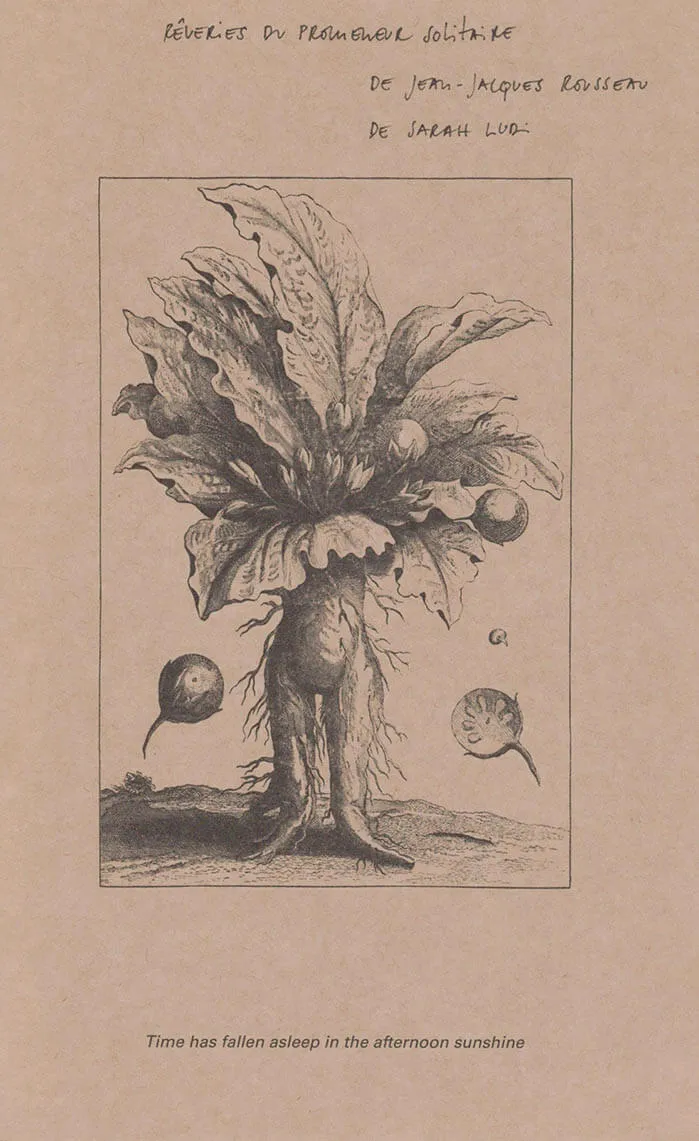
Time has fallen asleep in the afternoon sunshine
Rêveries du promeneur solitaire
For the project Time has fallen asleep in the afternoon sunshine a group of people/ performers memorize a book of their choice. Together they form a library collection consisting of living books. After years of learning by heart and reciting for readers, some of the books have now been written down from memory to create new editions, versions resulting from this process. This book is one of those books, chosen by one person, learned by heart and recited many times, and now written down again from memory. This edition is not a re-edition of the original text. It is a re-writing of the text after the process of reading, memorizing and reciting, with all the alterations that might have occured in the course of this process.

When My Body Was A Clinched Fist
"Back in the day when KRS-One intoned —The Bridge is over!— he did not prefigure a poet from Queens of the fierce attitude and intellectual magnitude of Enzo Silon Surin. WHEN MY BODY WAS A CLINCHED FIST gives the Heisman to such a refrain with lyrical power-packing poetics that settles the score with a succinct— Not! No the Bridge is not over, for Surin's Queens is alive and well and under the gaze of a master observer who eulogizes lives that though at times are battered have always mattered.
Enzo Silon Surin's poems get you caught up in the deeply personal experiences of growing and visceral all-encompassing knowing from an acute witness of every breath and follicle of Black life from palm trees, sand and sea to street corner projects, suburban houses and fistfuls of black water. Surin writes about the confused and disconnected, trigger happy wannabes trapped by outdated notions of masculinity, the cracked head crackheads all held in the clutch of society's clinched fist through which the trauma that comes with being of color, addicted, broke, lost and tossed, is itself a clinched fist of black bodies caught in the Russian nesting doll America's clinched fists make.
WHEN MY BODY WAS A CLINCHED FIST is an elegy for 'the premature exits.' It is a blues for the black-on-black black and blue. Surin yields his pen like a microscopic scalpel whereby an autopsy of possibility is performed to un-clinch the remarkable bone gristle poetry in these unflinching heart-wrenching pages."—Tony Medina
Enzo Silon Surin, Haitian-born poet, educator, speaker, publisher and social advocate, is the author of two chapbooks, A Letter of Resignation: An American Libretto (2017) and Higher Ground. He is the recipient of a Brother Thomas Fellowship from The Boston Foundation and is a PEN New England Celebrated New Voice in Poetry. Surin's work gives voice to experiences that take place in what he calls "broken spaces" and his poems have appeared in numerous publications including Crab Orchard Review, Origins, Transition Magazine/Jalada, Interviewing the Caribbean, jubilat, Soundings East, The BreakBeat Poets: New American Poetry in the Age of Hip-Hop, and sx salon. Surin holds an MFA in Creative Writing from Lesley University and is currently Professor of English at Bunker Hill Community College and founding editor and publisher at Central Square Press. His debut full-length poetry collection is WHEN MY BODY WAS A CLINCHED FIST (Black Lawrence Press, 2020).

Fugue
Aaron Amar Bhamra, Céline Mathieu
Fugue is published on the occasion of the eponymous duo exhibition by artists Aaron Amar Bhamra and Céline Mathieu, presented at Jester in Genk, Belgium. The title, derived from the Latin fuga (flight), evokes both its musical and psychological meanings: a contrapuntal compositional technique and a state of dissociation. These dual connotations—aural and mental—resonate throughout the exhibition and this accompanying publication.
Céline Mathieu's work moves between the sensory and the conceptual, integrating multiple media to explore the circulation of thoughts and materials in relation to specific sites. Aaron Amar Bhamra's practice draws on recurring forms and materials to construct evolving personal and social archives, often reactivating exhibition spaces by engaging with their historical contexts.
In addition to documenting the exhibition, the publication features an introduction by Jester's artistic director Koi Persyn, a visual score of a sound composition by Charlie Usher, written contributions by Céline Mathieu, curator Eloise Sweetman, and researcher Johanna Schindler, as well as a series of analog photographs by Aaron Amar Bhamra.
Contributions by Koi Persyn, Céline Mathieu, Charlie Usher, Eloise Sweetman, Johanna Schindler, Aaron Amar Bhamra.
Austrian artist Aaron Amar Bhamra (born 1992) often procures exhibition spaces that subtly expose their systematics and physical experience by incorporating imprints reminiscent of other spaces or past exhibitions. He occasionally uses recurring forms and materials, weaving a site of shifting personal and social archives.
Céline Mathieu (born 1989) is a Belgian artist and writer. Her practice is often site and condition specific, using sound, scent, sculpture, performance, text and different materials in performative installations. The work is both sensory and conceptual. Her work looks into the circulation of thoughts and materials. Material and economic cycles merge with hyper-personal items, resulting in fluid work that cannot quite be pinned down.

Invisible Oligarchs
Bill Berkson's Invisible Oligarchs is like a book jotted on the back of a poet's hand—a hand that picks up everything that sings to it, from gold-leaf proverb to chopstick sheath, on its quick trip through a few places in urban Russia, 2006. Across faintly ruled Japanese paper, many pages reproduced here in facsimile, snapshots change hands, new poems blink, and poetry politics meet political gossip over lunch in St. Petersburg. Berkson's educated guesswork about that elusive quality once known the Great Russian Soul, is framed here by letters from his friend Kate Sutton and encompassing encounters with poets and cab drivers, Moscow conceptualists and a White Night at the Mariinsky Ballet. As a sharply observant poet and the most soulful art critic alive, Berkson knows how to get us behind the set, and reading this book is as nice as taking a high dive with him into a perfectly mixed White Russian.
Bill Berkson was born in New York in 1939. He moved to Northern California in 1970 and now divides his time between San Francisco and New York. He is a poet, critic, sometime curator, and professor emeritus at the San Francisco Art Institute, where he taught art history and literature for many years. A corresponding editor for Art in America, he has contributed to such other journals as Artforum, Aperture, Modern Painters, and artcritical.com. His recent books include PORTRAIT AND DREAM: NEW & SELECTED POEMS (Coffee House Press, 2009); BILL, a words-and-images collaboration with Colter Jacobsen; Lady Air; Not an Exit with drawings by Léonie Guyer; REPEAT AFTER ME (Gallery Paule Anglim, 2011), with watercolors by John Zurier; and a collection of his art writings, FOR THE ORDINARY ARTIST (BlazeVOX books, 2010), as well as a new collection of his poems, Expect Delays, from Coffee House Press in 2014 and INVISIBLE ORLIGARCHS out from Ugly Duckloing Presse in 2016.

Profusione
A comprehensive overview of the unique work of the Italian artist born in 1931 and "discovered" late on the international scene, with numerous texts and an interview.
Published after the eponymous exhibition at Consortium Museum, Dijon, April 26th – September 8th 2024.
Born in Naples, Italy, in 1931, Isabella Ducrot is a young artist with a young career. Like many women of her generation, she moved into art after raising her children. Her formative years were marked by continuous travels with her late husband, during which they amassed hundreds of Persian miniatures and rare antique textiles of many kinds.
Contributions by Franck Gautherot & Seungduk Kim, Verena Lueken, Tobias Pils, Tschabalala Self, Andrea Viliani, Miranda Fengyuan Zhang.

Firespitter
Like the jazz rhythms that inspired and punctuated her practice, Jayne Cortez improvised her way through and across disciplines, bridging poetry and performance with music and the visual arts to create a unique body of work. Consciously rupturing the boundaries between art and politics, Cortez’s practice uneasily fits within literary movements of the 20th century, residing everywhere and nowhere between the Black Arts Movement, Surrealism, feminism, and early performance art. As intersectional as it is interdisciplinary, her work is consistently visceral and fearless, acting as a powerful expression of collective rage on behalf of the disenfranchised and dispossessed. In the words of historian Robin D.G. Kelley, “her poetry was never ‘protest’ but a complete revolt, a clarion call for a new way of life.”
The appearance of Firespitter (Nightboat, 2025), a 600-page-plus collected poems, is immensely valuable and long overdue . . . Hers [Jayne Cortez’s] is a voice—both on and off the page—that speaks with authority, curiosity, and an unshakeable faith in the power of poetry to change consciousness and change lives. - David Grundy, Poetry Foundation
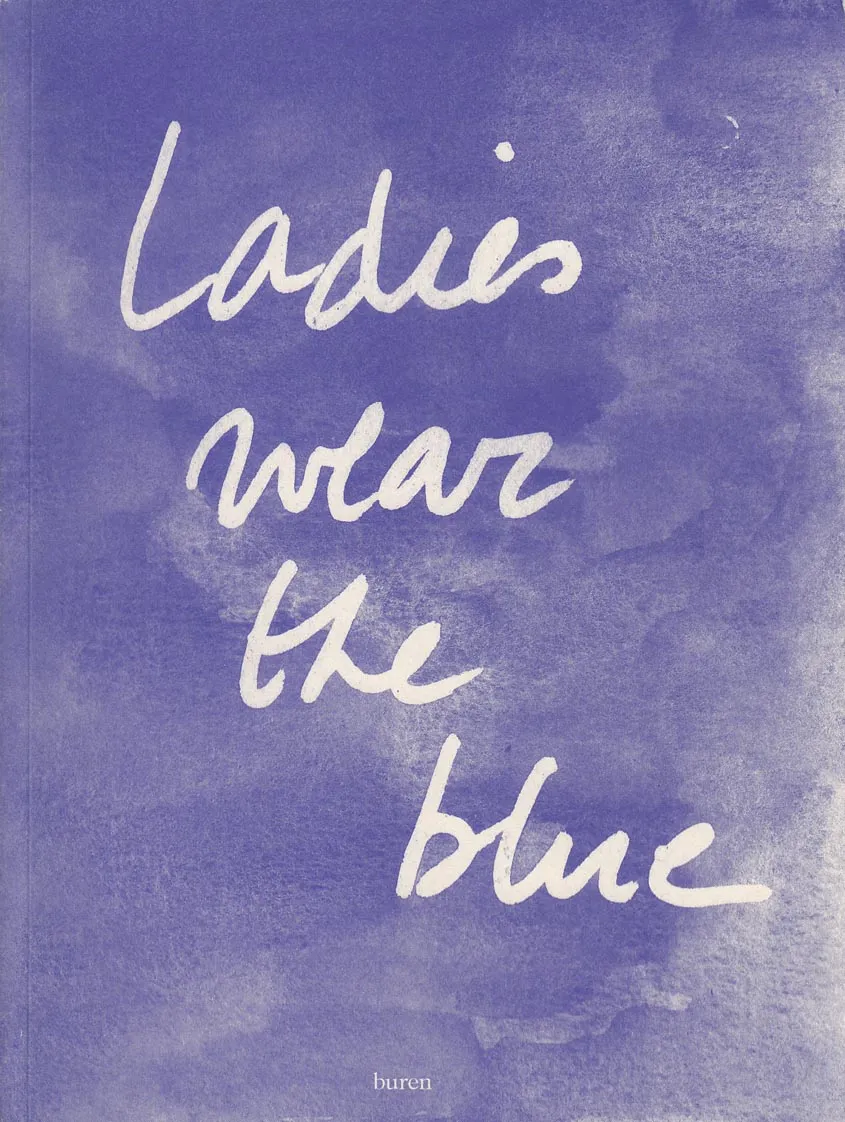
Ladies Wear the Blue
Ladies wear the blue is a collection of watercolour drawings by the hand of Melissa Mabesoone and Oshin Albrecht. The blue watercolours portray women from different moments in time. The adjacent texts describe these women's existence, roles, desires or ideosyncrasies deriving from the 'blue' in their lives. From the first female police officers and Alices all around, to Courtney Love's blue baby dolls and the girl with the blue tattoo Olive Oatman, this publication is an ode to women venturing into the world, and a way to continue telling their herstories.

Metal Works
A complete survey of the cast, forged, and fabricated metal sculptures made by Danish artist Sidsel Meineche Hansen since 2017.
The artist's practice addresses the industrial complex of virtual and robotic bodies and their relationship to labor in tech, pornography and gaming. While some sculptures were conceived as individual pieces, others were created with digital counterparts within installations that typically include CGI animation, documentary video, drawing and prints.
By presenting the metal works as stand-alone pieces, this book adheres to Meineche Hansen's concern with the material means of production, highlighting their concrete yet elusive nature. Several pieces in the publication are accompanied by poems written by artist Diego Marcon in response to the works. As an artist's project and an archival document, the publication echoes the tradition of documentary photography devoted to sculpture.
Sidsel Meineche Hansen (born 1981 in Denmark, lives and works in London) is a Danish artist. She produces exhibitions, interdisciplinary seminars and publications that foreground the body and its industrial complex, in what she refers to as a "techno-somatic variant of institutional critique". Meineche Hansen questions the body in the field of industrial representations: robotic or virtual bodies, and their relationship with the working world of industries of gaming, pornography, and new technologies. Her research-led practice has taken the form of woodcut prints, sculptures and CGI animations, often made by combining her own low-tech manual craft with outsourced, skilled digital labour.
Edited by Fredi Fischli and Niels Olsen.
Poems by Diego Marcon.

A book with a hole in it
Kamelya Omayma Youssef’s A book with a hole in it uses the poetry of the fragment and the language of everyday survival to gesture towards the fallibility of language at the juncture of the multiple, intersecting wars on women, on "terror," on the non-White body, and on people and language in diaspora. Drawn from a set of journals written over a four-month period, A book with a hole in it throws the formal, official work of poetry into relief, asking what knowledge exists beyond knowledge, which silences are too deep to be surfaced on the page, and how to pierce through trauma and violence to approach a politics of redemption.

Pages 11 - Stage So Near So Far
Nasrin Tabatabai, Babak Afrassiabi
The new issue consists of 8 plays and performance texts by Iranian women writers living in or outside Iran. Whether based on actual experience, fictional, or drawn from archives, these texts deal in one way or another with the question of the stage. They produce a contested space of performance that is inevitably linked to the performer's body, whose thresholds are stretched and contracted into potentially new forms of staging. The authors in this issue place their writing in performative relation to the specific historical and sociopolitical conditions in which they live and work. In many ways, the writings interrogate the politics that delineate the stage itself.
The authors in this special issue are: Nasim Ahmadpour, Nil (Alista) Aghaee, Naghmeh Manavi, Athena Farrokhzad, Nazanin Sanatkar, Azade Shahmiri, Zahra Mohseni and Naghmeh Samini.

GOAT FOIL
"Marie’s fragrance, smashed out of the bottle for another breath. We should always doubt that the air is pure. We should always doubt that the air is not."
–Alexandre Curlet
Includes an excerpt from Josh Barber's "Omnipotence".
Published as part of Paraphernalia and Addenda 2.2 of Tabloid Publications.

If
A canary flies in Golestan Palace of the Qajars in Tehran, IF, unfolding through fragmented, interwoven narratives that consider the possibility of a bird narrating what it sees: three famines forced upon Iran; the forced unveiling of women; the partitioning of the country between dominant powers; and the nationalization of oil leading to the coup against Mohammad Mosaddegh all appear as fragments left unresolved rather than explained, as if the bird were saying: you will not understand me, let’s keep it that way.
This pamphlet is a section of a longer book that moves across a specific historical juncture in Iran, from the Iranian Constitutional Revolution (1906–1911) to 1953, when a joint CIA–MI6 coup d’état disrupted and set back years of gradual effort toward democracy and independence in Iran. Much like the rest of Mosadeq’s work, this piece is shaped by misunderstanding, distance, and misreading. IF, mirroring the territory it explores, resists a coherent narrative.

Charismatic Spirals
Charismatic Spirals is for an America circa 2024, where poetry—the art of developing new means of speaking—has never been of such artistic, technological and political consequences.
An archetypal outsider, Will Alexander released his first poetry collection aged forty-four while working at the Los Angeles Lakers' ticket office. Three decades on, he has ascended to the legendary status of the city's great living surrealist, existing, as Eliot Weinberger wrote, in a state of "imaginal hyperdrive," with forty such collections to his name.
Operating at the edge of language, Alexander deploys words in a way that feels prophetic—human psyches synthesize with technological artifacts; atoms and archetypes collide; bodies are vacated, voices are newly incarnated. His America—like Glissant's—is multinational and—like Coover and Spiegelman's—multivalent and symbolically unstable. That is to say, he belongs to an America circa 2024, where poetry—the art of developing new means of speaking—has never been of such artistic, technological, and political consequence.
In doing so, Alexander draws from a vast array of influences, from luminaries like Aimé Césaire, Bob Kaufman, Andre Breton, Antonin Artaud, and Philip Lamantia, to holistic visions such as Sri Aurobindo's Integral Yoga, the Mayan numerical system, and Cheikh Anta Diop's perspectives on ancient Egypt. In a preview of Charismatic Spirals in the New York Times, Anne Boyer captured the essence of his work: "visionary poetry [that] achieves its effect through sound, not image...Cadence [that] can shatter us, set the world ablaze."
Read it syllabically, surf it quickly—there is no single way to approach this work.
Will Alexander (born 1948 in Los Angeles) is an African-American artist, philosopher, poet, novelist, essayist and pianist.

Palma Africana
Dans Palma africana, l’anthropologue australien Michael Taussig explore la production d’huile de palme en Colombie. Alors que cette dernière envahit tout, des chips au vernis à ongles, l’auteur examine les conséquences écologiques, politiques et sociales de cette exploitation.
Bien que la liste des horreurs induites par la culture du palmier à huile soit longue, nos terminologies habituelles ne permettent plus de rendre compte des réalités qu’elles décrivent. À travers cette déambulation anthropo-poétique au cœur des marécages colombiens, c’est donc la question du langage que l’auteur interroge. Comme William Burroughs, pour qui les mots sont aussi vivants que des animaux et n’aiment pas être maintenus en pages – Michael Taussig souhaite couper ces dernières, et les rendre à leur liberté.
Pensé à partir d’une vie d’exploration philosophique et ethnographique, Palma africana cherche à contrecarrer la banalité de la destruction du monde et offre une vision pénétrante de notre condition humaine. Illustré de photographies prises par l’auteur et écrit avec la verve expérimentale propre à l’anthropologue, ce livre est le Tristes Tropiques de Michael Taussig pour le XXIe siècle.
Traduit de l’anglais par Marc Saint-Upéry.

Raven Chacon: A Worm’s Eye View From a Bird’s Beak
Stefanie Hessler, Katya García-Antón and 1 more
A career-spanning catalogue featuring excerpts from Raven Chacon’s scores, musical prompts, and drawings interspersed with full-color documentation and descriptive texts of installations, sculptures, and performances. Raven Chacon is a composer and artist creating musical experiences that explore relationships among land, space, and people.
In an experimental practice that cuts across the boundaries of visual art, performance, and music, Chacon breaks open musical traditions and activates spaces of performance where the histories of the lands the United States has encroached upon can be contemplated, questioned, and reimagined. In 2022, Raven Chacon became the first Native American to win the Pulitzer Prize for Music, and was awarded a prestigious MacArthur “genius” fellowship in 2023.
Texts by Raven Chacon, Lou Cornum, Aruna D'Souza, Candice Hopkins, Anthony Huberman, Ingir Bål Nango, Marja Bål Nango, Dylan Robinson & Patrick Nickleson, Eric-Paul Riege, Sigbjørn Skåden, Ánde Somby.
Foreword by Katya García-Antón and Stefanie Hessler.

Tis of Thee
With figures X, Y, and Z, Fanny Howe constructs "a repressed but emotional history" of encounters and unions between races, classes, genders, and epochs. Considering race as "the most random quality assigned to a soul," Howe has undertaken an (American) history of a racially mixed population. The work bears evidence to many creative unions as well: with Ben Watkins, who provided the photographs; with graphic artist Maceo Senna, who illustrated the text; with Nya Patrinos, set designer, video artist, and director of the original production; as well as with composers Miles Anderson and Erica Sharp, whose score adds another voice to the spoken three. The book includes a link to an audio recording of the work, originally performed at the Porter Troupe gallery in San Diego, 1997, with Paul Miles (X), Stephanie French (Y), and Andre Canty (Z). "So whiteness is what is dependent on a witness. / The moon's opaque and egg-like sheen is the kind of zero / that wants to be more than air and negativity."

DMZ Colony
Woven from poems, prose, photographs, and drawings, Don Mee Choi's DMZ Colony is a tour de force of personal and political reckoning set over eight acts. Evincing the power of translation as a poetic device to navigate historical and linguistic borders, it explores Edward Said's notion of "the intertwined and overlapping histories" in regards to South Korea and the United States through innovative deployments of voice, story, and poetics. Like its sister book, Hardly War, it holds history accountable, its very presence a resistance to empire and a hope in humankind.

And Then Comes the Chorus
In the high-octane essay And Then Comes the Chorus, Jon Refsdal Moe pursues the imagination of theatre opened up by Alfred Jarry when he slipped an ‘r’ into a profanity as he exclaimed ‘Merdre!’ on stage. ‘What matters is that the words became flesh and that this flesh exploded right in the world’s face. What matters is that literature stood up at the Théâtre de l’Œuvre on December 10, 1896 and cried FUCK! and all hell broke loose and the world has never been the same since.’
Jon Refsdal Moe is a writer and dramaturg from Oslo. He has written two novels, one doctoral dissertation, several essays and a lot of criticism. He was artistic director of Black Box teater in Oslo from 2009 to 2016 and is now professor of dramaturgy at Stockholm University of the Arts.
Published by Varamo Press in the essay series Gestures
First edition November 2022
48 pages, 11.0 x 16.5 cm, sewn perfect binding
ISBN: 978-82-691492-8-9
Graphic design by Michaël Bussaer

Eros the Bittersweet: An Essay
Anne Carson's remarkable first book about the paradoxical nature of romantic love. Since it was first published, Eros the Bittersweet, Anne Carson's lyrical meditation on love in ancient Greek literature and philosophy, has established itself as a favorite among an unusually broad audience, including classicists, essayists, poets, and general readers.
Beginning with the poet Sappho's invention of the word "bittersweet" to describe Eros, Carson's original and beautifully written book is a wide-ranging reflection on the conflicted nature of romantic love, which is both "miserable" and "one of the greatest pleasures we have."

Local Warming
For Sebastian Black, 2020 was a year like no other: a pandemic; three exhibitions; a move to Los Angeles; a presidential election; a baby, too. Local Warming is Black's tale of it all, as recorded in his diary.
One million years ago, when I started making the paintings compiled here, I was listening to lots of audiobooks and recorded philosophy lectures. It was the winter of 2019, my paintings were about this and about that, and every brushstroke drifted safely over a net of ideas. I was gathering a list of things that I knew to be true because I was sick of having nothing to say when people asked me to explain myself. Then a professor, who to me is now a holy exegete, said that difference precedes identity as the substance of reality. I'd been eavesdropping on YouTube as he taught a continuing-ed class on Deleuze for a claque of narrative therapists. Difference before identity. I couldn't grasp the idea— only touch it. That's okay, said the professor, as though speaking directly to me, the point of thinking isn't to grasp things that are true but rather to prod things that are interesting. — Sebastian Black
Sebastian Black is an artist/writer. He was born in New York City in 1985. He lives and works in Los Angeles.