rile*books

Search books

Search books by title, author, publisher, keywords...

Cover of three six five: prompts, act, divinations

Siglio Press

three six five: prompts, act, divinations

Lucy Ives

€36.00

There are 365 exercises for writing in this book, but it is not simply a book of writing exercises.

three six five is a “how-to” book of questions—not answers. It is an ars poetica of expanding possibility, a tarot deck of acts instead of images, a book of bending hours, a diary of contemplation and imagination, an antidote to consumption in the shape of care and attention.

These prompts, acts, and divinations—in alchemical combinations with new drawings by Nick Mauss—invite both aspiring and experienced writers to learn and unlearn, to mine memory and forgetting, to enter impossible spaces and create new ways of telling time, to inhabit multiple, other, and conflicting perspectives, to discover the elasticity of language and its constraints, to write by drawing, walking, listening, and even by being distracted.

While this is an inexhaustible compendium for writing, it is also an enduring reservoir for those who have no desire to be(come) a writer. Many exercises take the form of play, encourage collaboration with friends, strangers, and non-human beings, and operate off the page, often in the world, in the spirit of discovery rather than result. All intend to nurture and cultivate possibility.

Published in 2026 ┊ 416 pages ┊ Hardcover ┊ Language: English

recommendations

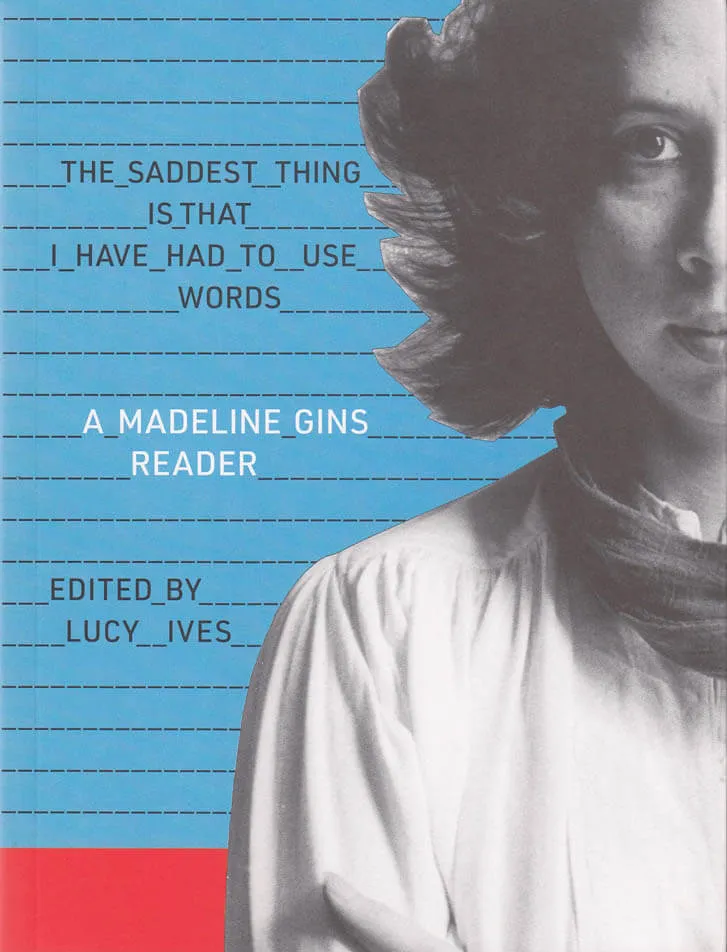
Cover of The Saddest Thing Is That I Have Had to Use Words: A Madeline Gins Reader

Siglio Press

The Saddest Thing Is That I Have Had to Use Words: A Madeline Gins Reader

Madeline Gins

Poetry €28.00

Poet, philosopher, speculative architect and transdisciplinary artist, Madeline Gins is well known for her collaborations with her husband, the artist Arakawa, on the experimental architectural project Reversible Destiny, in which they sought to arrest mortality by transforming the built environment. Yet, her own writings — in the form of poetry, essays, experimental prose and philosophical inquiries — represent her most visionary and transformative work. Like Gertrude Stein before her, Gins transfigures grammar and liberates words. Like her contemporaries in conceptual art, her writing is attuned to the energized, collaborative space between reader and page.

The Saddest Thing Is That I Have Had to Use Words: A Madeline Gins Reader is a revelatory anthology, edited and with an introduction by the writer and critic Lucy Ives. It brings never-before-published poems and essays together with a complete facsimile reproduction of Gins' 1969 masterpiece, WORD RAIN (or A Discursive Introduction to the Intimate Philosophical Investigations of G, R, E, T, A, G, A, R, B, O, It Says), along with substantial excerpts from her two later books What the President Will Say and Do!! (1984) and Helen Keller or Arakawa (1994). Long out of print or unpublished, Gins' poems and prose form a powerful corpus of experimental literature, one which is sure to upend existing narratives of American poetics at the close of the 20th century.

Edited by Lucy Ives. 

Cover of Cancelled Confessions (or Disavowals)

Siglio Press

Cancelled Confessions (or Disavowals)

Claude Cahun

First published in 1930 by anti-fascist, avant-garde publisher Éditions du Carrefour in Paris as Aveux non Avenus, Cancelled Confessions (or Disavowals) is Claude Cahun’s wildly radical answer to an invitation to write a memoir. Shattering the very premise of the “memoir”—the singularity of identity—into sharp and prismatic fragments, Cahun assembles an ever-mutating inquiry into the instability of “self” and its many masks.

Masculine? Feminine? It depends on the situation. Neuter is the only gender that always suits me.

Using a multitude of forms (fables, jokes, aphorisms, letters, dialogues, dreams, hymns, pronouncements, etc.), to plumb the subjects of desire, love, gender, sex, fear, faith, religion, and vanity (among others), Cancelled Confessions (or Disavowals) is a tour-de-force work of resistance: it provokes the reader to enter the capacious, provocative, playful, and deeply imaginative space constructed by Cahun in defiance of all categorization, to repudiate a delimited, censured world and embrace, instead, the outcasts and cast-offs, the unknowable and the unknown.

I believe, but in the conditional: I would like to believe.

Thoughtfully redesigned to emulate the original artist’s book, this revised edition of the out-of-print English translation by Susan de Muth—originally published in the UK by the Tate in 2007 and in the U.S. by MIT Press in 2008—includes novelist and critic Pierre Mac Orlan’s original 1930 preface along with contemporary essays by scholar Amelia Groom and translator de Muth. Almost 100-years-old, it is not only prescient, but urgent, in.

It’s not enough to be vanquished, you also have to know how to turn defeat to your advantage.

Translated by Susan de Muth, preface by Pierre Mac Orlan, essay by Amelia Groom.

Cover of Glaring

Wendy's Subway

Glaring

Benjamin Krusling

Poetry €18.00

Glaring: a sustained look of anger, an obvious fact, a situation of such brightness and intensity that vision is obscured. In his debut book of poems, Benjamin Krusling is concerned with reading domination and violence and entering their psychotic motion, the better to do otherwise. Through the thicket of anti-blackness, militarism, surveillance, impoverishment, and interpersonal abuse and violence, Glaring investigates the things that haunt daily life and make love difficult, possible, necessary.

Benjamin Krusling's Glaring is the winner of our 2019 Open Reading Period, and was selected by guest judge Lucy Ives.

Cover of Spells: 21st Century Occult Poetry

Silver Press

Spells: 21st Century Occult Poetry

Sarah Shin, Rebecca Tamas

Poetry €17.00

Spells are poems; poetry is spelling.

Spell-poems take us into a realm where words can influence the universe.

Spells brings together over forty contemporary voices exploring the territory where justice, selfhood and the imagination meet the transformative power of the occult. These poems unmake the world around them, so that it might be remade anew.

Kaveh Akbar, Rachael Allen, Nuar Alsadir, Khairani Barokka, Emily Berry, A.K. Blakemore, Jen Calleja, Anthony V. Capildeo, Elinor Cleghorn, CAConrad, Nia Davies, Paige Emery, Livia Franchini, Alexis Pauline Gumbs, Will Harris, Caspar Heinemann, Lucy Ives, Rebecca May Johnson, Bhanu Kapil, Amy Key, Daisy Lafarge, Dorothea Lasky, Francesca Lisette, Canisia Lubrin, Karen McCarthy Woolf, Lucy Mercer, Hoa Nguyen, Precious Okoyomon, Rebecca Perry, Nat Raha, Nisha Ramayya, Ariana Reines, Sophie Robinson, Erica Scourti, Sarah Shin, Himali Singh Soin, Tai Shani, Rebecca Tamás, Bones Tan Jones, Dolly Turing, Jane Yeh, Flora Yin Wong

Introduced by So Mayer
Afterword by Sarah Shin

Cover of Dwell

Lingua Press

Dwell

Lingua Press

A collection collecting of generative grammars.

Cover of Unfinished Histories – Radical Rediscoveries: Performance Texts from the Women’s Theatre Movement 1969-1987

Montez Press

Unfinished Histories – Radical Rediscoveries: Performance Texts from the Women’s Theatre Movement 1969-1987

Jane Arden, Winsome Pinnock and 1 more

Performance €50.00

Radical Rediscoveries: Performance Texts from the Women’s Theatre Movement 1969–1987 is the first of three volumes by Unfinished Histories as part of Montez Press imprint Scores, in collaboration with the Associate Artists programme at London Performance Studios. This collection brings together six seminal works of British alternative feminist and women’s theatre from the archive, with a contextual introductory text by Dr. Susan Croft, co-founder of Unfinished Histories.

The play texts included are: Vagina Rex and the Gas Oven by Jane Arden (1969), Go West Young Woman by Pam Gems (1974), Ophelia by Melissa Murray (1979), Minutes by Hesitate & Demonstrate (1979), Room by Natasha Morgan (1981) and The Wind of Change by Winsome Pinnock (1987).

Cover of Other Forms of Presence

Varamo Press

Other Forms of Presence

Quim Pujol

When he was prevented from guiding a writing workshop, Quim Pujol resorted to collecting exercises for the participants to work with by themselves, either alone or in small groups. These exercises, suggestions and scores draw on a wide variety of sources, such as poetry, experimental literature, dance, popular performance practices, visual art and all kinds of text populating everyday life. Now expanded into a book, they are invitations to read, write and daydream, to ‘complicate our relationship to language’ and imagine texts in multiple guises. Potential literatures that give pause, redirect the attention or, at times, simply ‘produce a comforting doodle in the volatile palimpsest of human flesh’.

Quim Pujol is an experimental artist and curator working at the crossroads of language and live arts.

Cover of Scores for Political Desires

Archive Books

Scores for Political Desires

Sergio Zevallos

The publication of the winners of the Villa Romana Prize has taken the shape of four distinct yet interrelated booklets – an editorial series continuing the tradition of the institution to offer a space for the dissemination and reverberation of the research and work of the Villa Romana Fellows after their ten-months residency in Florence.

Each year, four selected artists are invited to live and work in the same house that, since 1905, generations of artists have continuously inhabited. They always come as a group – a constellation of four people – but all as singular artists. The opportunity of yearly publishing their work in a bundle of four separate books and within an open series allows for a larger combination of echoes across the generations of Villa Romana Fellows. A further occasion for “being singular plural.”

Contributions by Elena Agudio