rile*books

Search books

Search books by title, author, publisher, keywords...

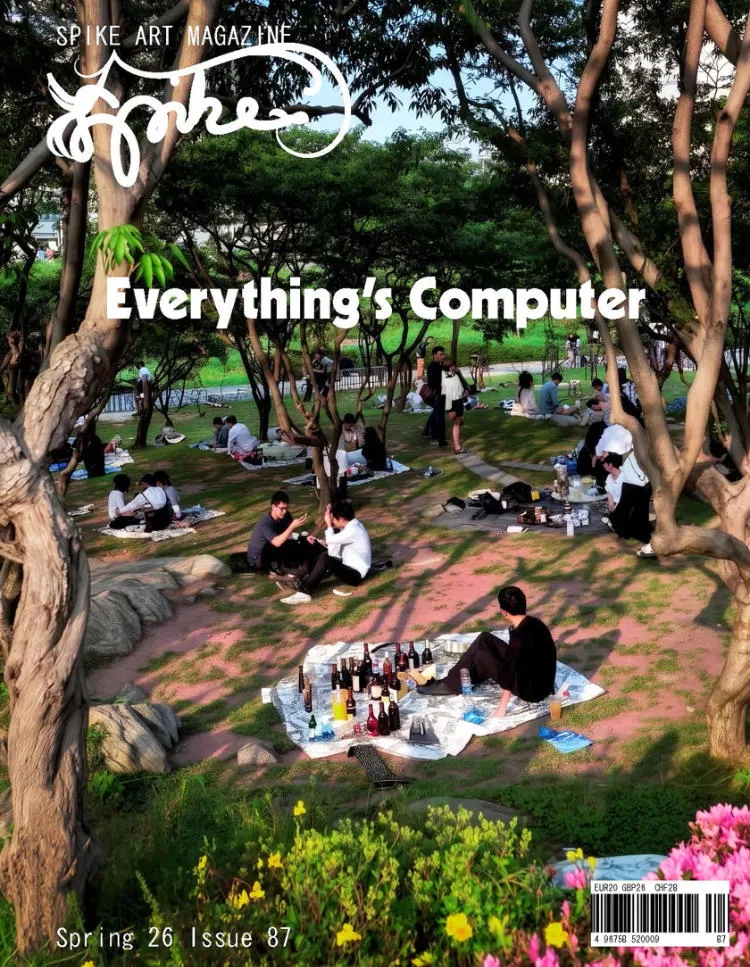
Cover of Spike #87 – Everything's Computer

Spike Magazine

Spike #87 – Everything's Computer

€20.00

Art in the digital age. 

Go on, admit it. There's no longer a meaningful distinction between "real life" and life online, up to and including sitting around in the park. So why shouldn't art reflect the furious, melancholic, psychedelic sensation that, even when we make our screens dark, we've all been permanently logged on? A new era deserves new aesthetics, but also fables, values, and protocols. Everything is interwoven. Everything's computer.

Featuring Brian Droitcour on lore and NFTs; Marek Poliks & Roberto Alonso Trillo on exocapitalism; the godmother of internet girlhood, Ann Hirsch; locating the tech-feminist to tech-fascist spectrum with Anan Fries; Anika Meier on the post-artist; a visual essay by Ruba Al-Sweel & Al Hassan Elwan (POSTPOSTPOST); a defense of useless images by Gideon Jacobs; the second life of memes by Dena Yago; a prophecy of a neo-oral age by Günseli Yalcinkaya; a primer on internet cinema with Dana Dawud; Gary Zhexi Zhang's guide to Shenzhen, "China's Silicon Valley"; and the never-miss backpage from Tea Hačić-Vlahović: "Underground communities prevail against odds. Like rats and nuclear bombs." Plus! Our new lifestyle section, LIFEMAXXING.

Published in 2026 ┊ 160 pages ┊ Language: English

recommendations

Cover of Spike #86 – Salad Days!

Spike Magazine

Spike #86 – Salad Days!

Periodicals €20.00

Spike #86 is turning to the wild season of youth – life’s Salad Days.

Forget all the Boomer panic about a generational crisis; the kids are alright, living out our hyperconnected present to its strangest limits. New kinds of aesthetics, of activism, of entrepreneurship; new images as much as new perspectives on what images are; and, above all, a new, very quantum attitude towards fact and fiction, history and the future: young people are modeling how to be in our very confused times – and producing some of the most interesting forms of culture we’ve ever seen.

Featuring a Zoomer’s guide to the Slopgeneration; an essay of on being young at art in the Instagram age; a rundown of contemporary art’s nepo babies; reality checks on culture’s obsessions with youth and dying young; portraits of couture-sculptor Tenant of Culture, Turner Prize-nominated photographer Rene Matić, e-waste sculptor Brian Oakes, and Austrian painter Lukas Posch; send-ups of teenage fiction’s ecstatic weirdness and youth-quakers’ political promise; a critique from Silicon Valley of the industrialization of young risk-taking; art’s perfect Los Angeles metaphor; and a splash of back-page advice: “You shouldn’t be fun at twenty-one. You should be tortured.” 

Cover of Image RIP: After Printing, Work & Planet Earth

Source Type

Image RIP: After Printing, Work & Planet Earth

Geoff Han

Image RIP, the first publication from Source Type, is centered around New York graphic designer Geoff Han’s investigation into the Shenzen-based printer Artron and explores subjects ranging from design, production, work, and the environment in the post-industrial economy. The book gathers essays by Danielle Aubert, David Bennewith, Geoff Han, Ming Lin, Shanzhai Lyric, David Reinfurt, Mindy Seu, and Dena Yago, and features images by Ann Woo. Image RIP reflects a consistent theme in Han’s practice of the manipulation of image reproduction, printing, production, code, and other techniques to affect the process of viewing and reading.

Cover of Viscose 01: Style

Viscose Journal

Viscose 01: Style

Jeppe Ugelvig

Periodicals €35.00

The very first issue of Viscose tackles the expansive notion of “style”. Both a noun and a verb, style can be understood as the most basic unit or currency of fashion. Style names the very movement of aesthetics in society, and thus holds an important place in the critique of art and visual culture more broadly.

As a verb, it connotes a tactic: a dynamic tool for persuasion and communication through the bricolage of signifiers. It also relates directly to the contemporary profession of “styling”; a practice native to the fashion industry, but increasingly prevalent across the arts, media, consumerism, and politics. Thiss issue of Viscose sets out to critically gesture to all of these connotations and their potential intermingling through concrete case studies and cross disciplinary philosophical speculation.

with contributions by:
Shanzhai Lyric, David Lieske, Bakri Bakhit, Dena Yago, Matthew Linde, Burke Battelle & Ada O’Higgins, Davide Stucchi, Taylore Scarabelli, Mahoro Seward, Jordan Richman, Giorgi Gago Gagoshidze, Hito Steyerl, & Milos Trakilović, Laura Gardner, Avena Gallagher, Alex Esculapio, Elise by Olsen and Jeppe Ugelvig

Cover of Viscose 02: Clothes

Viscose Journal

Viscose 02: Clothes

Jeppe Ugelvig

Design €35.00

Issue 2 inverts issue 1’s focus on the immaterial notion of style to instead explore the most material of fashion’s building blocks: clothes Clothes are literally everywhere and cite complicated systems of production, distribution, and exchange on their paths around the world. Still, they never fully reveal their journey or destination, and may often signify little else than their own commodity status, the total genericness of the fashion product.

Bringing together a wide range of artists, thinkers, and writers, the issue sets out to explore clothes as a signifier at once empty and over-burdened: as expressions of desires, people and places, as palimpsests for capitalist production cycles and histories of dressed bodies, and even, as nondescript material debris. While not necessarily foregoing an analysis of the fashion system, we hope to develop a form of fashion criticism that begins – and perhaps ends – with the single garment, that takes the everyday use of clothing objects as an intellectual starting point.

What knowledge can we gather from the studying of fashion objects, be they material or immaterial? What is the difference between clothes and fashion? And to which extent is even “fashion” ever successfully signified by things?

with contributions by:
Shanzhai Lyric, David Lieske, Bakri Bakhit, Dena Yago, Matthew Linde, Burke Battelle & Ada O’Higgins, Davide Stucchi, Taylore Scarabelli, Mahoro Seward, Jordan Richman, Giorgi Gago Gagoshidze, Hito Steyerl, & Milos Trakilović, Laura Gardner, Avena Gallagher, Alex Esculapio, Elise by Olsen and Jeppe Ugelvig

Cover of Exocapitalism – Economies with absolutely no limits

becoming press

Exocapitalism – Economies with absolutely no limits

Roberto Alonso Trillo, Marek Poliks

Essays €16.00

A rigorous and mind-blowing account of the dynamics of capitalism today through an in-depth exposition of software, speculative finance, and the highest scales of arbitrage.

At the centre of Marek Poliks and Roberto Alonso Trillo's argument is the idea that capital does not belong to humans, it belongs to—and is governed by—itself. Traditional economic theory struggles to keep up with the rapid rate of acceleration, and this book steps in to address this:

"The critical orthodoxy is slowing; it's tired, it's not especially good at the internet, it's probably never manned a Starbucks counter or an anonymous cubicle. Its younger adepts—though digitally native—are chronically underemployed, unavailable, drowning in the student debt (or student opportunity cost) required for entry into the critical apparatus. Few have any patience for the numbing slop-speak of the LinkedIn economy, the libertarian enclave of forex and HFT and memecoins, the quarter-zip depravity of employment at the charnel houses of McKinsey or Deloitte or Accenture, the blazingly random mood-swings of venture capital that lubricate all of the above. This impatience is—in the parlance of the above—a blocker: it means that the critical apparatus underestimates the power of the software economy, struggles to articulate the morphological density of digitally-realized capitalism, comprehensively ignores the functional death of labor, and doesn't understand scale."

Introduction by Charles Mudede.
Afterword by Alex Quicho.

"A masterpiece... Nick Land for adults."
— 0nty

Cover of Catflap Issue 05

Catflap Magazine

Catflap Issue 05

So Mayer

LGBTQI+ €16.00

catflap is the annual publication of new queer writing from Outburst Arts, a hot mix of open call submissions, curated interviews and smart queer writing with a disco heart.

Cover of Mother Tongue Magazine

Istasyon

Mother Tongue Magazine

Periodicals €16.00

In celebration of February 21st, International Mother Language Day, we’re happy to present our new yearly magazine: μητρική γλώσσα (Mitrikí Glóssa) / Lingua Maternal / (Leşono Emhoyo)  ܠܫܢܐ ܐܡܗܝܐ / Anadil / Mother Tongue. 

Our first issue gathers three mother languages within Turkey and their dialects : Anatolian Greek, Ladino and Syriac. With an interest in everyday life, personal memories and cultural production, Mother Tongue Magazine brings together people who work and produce in these languages along with contributors who speak them, are learning them or never had the chance to learn them, embracing plurality over standardisation. Given the discourse surrounding the survival of these mother tongues, we are especially delighted to have received contributions by so many young people that are striving to keep them alive!

With contributions by: Lukas Aktaş, Nesi Altaras, Nektaria Αnastasiadou, Syrian Cassette Archives, Dilara Lüle Baklacıoğlu, Onur Çimen, Alp Etensel, Atra Givarkes, Fayrouz Library, The Pontian Library, Sara Jajou, Isla Hanna Karademir-Khoury, Iokasti Kyriaki Zografou Mantzakidou, Melisa Yağmur Saydı, Münir Tireli, Lîs Yayınevi, Beni Yorohan

Design / Illustration: Bilge Emir

Cover of ztscript 33 : Lisa Fittko

ztscript

ztscript 33 : Lisa Fittko

ztscript

Typeface by Bea Schlingelhoff, from the Project "Women against Hitler"

Eric Bell & Kristoffer Frick: Rainbow Rope, 2017 1, Crystal Table (II), 2017 2, 63, Platonic Solid, 2018 64, Kolumne 3, Sara MacKillop: WC2N 4, 10, 15, 24, California Cannabis Legalization 9, Letzte Ausgabe der Spartakusbriefe, Oktober 1918 11, Delia Gonzales 16-21, Cordula Daus 22, Christina Irrgang 25, Eric Ellingsen 26, Hugo Canoilas: L’ô 29, 30, 35-38, Sadie Plant 31, Markus Krottendorfer: aus der Serie TERMINAL, 2017 32, Kate Rich: Feral Trade 39, Julia Knass 44, Walter Hetzer: World Trade Center 1972 46, Lidl, Wiedner Hauptstraße 15, Wien (ehemals Generali Foundation, gebaut 1993-95, Architektur Jabornegg & Pálffy) 50, One Hour and a Half in the Life of Ztscrpt 62-52

Cover of How to Sleep Faster 1

Arcadia Missa

How to Sleep Faster 1

Various

Periodicals €10.00

How to Sleep Faster is published as part of the collaborative discussion that form the critical direction of the gallery. and sits alongside the first two exhibitions – Sleep Faster (February), and How to Carve Totem Poles (March). It has been put together as an open ended continuation of this dialogue through which we seek to understand the contradictions / complexities that define and form our experience, existence and participation in a contemporary digital-analogue creative environment.

Arcadia Missa Publications; Rozsa Farkas, Tom Clark, Jammie Nicholas, Laura Farley (eds).

Cover of Pina #2

Pina Magazine

Pina #2

Forensic Architecture, Edgar Calel

Periodicals €25.00

Exhibitions by Edgar Calel and Forensic Architecture, conversations with Lisette Lagnado and between Eyal Weizman, Agata Nguyen Chuong, Zoé Samudzi and Irmgard Emmelhainz, and short stories by Portia Subran and Rémy Ngamije.

Forensic Architecture presents ‘A Counter-Archive of the Ovaherero and Nama Genocide’, a powerful investigation into the early 20th-century genocide committed by German colonial powers in today’s Namibia. Drawing on years of archival research and spatial analysis, the exhibition traces the lasting impact of colonial violence in three parts: from the ideological roots of racialised imperialism, to the design of the concentration camp, to the ongoing environmental degradation and dispossession affecting Indigenous communities today.

Edgar Calel’s ‘Dreams and memories dazzle through the flickering of fireflies’ is an exploration of dreams, memory and everyday life within his multi-generational family home in Comalapa, Guatemala. Each morning, dreams are shared among family members, as a practical and poetical way to sense the energy of the day ahead. Concrete business plans and reminders to cook certain dishes emerge from these retellings: a ritual so entwined in the architecture of their every day, that, even when apart, they recount their visions through shared voice notes.

Pina is a printed, portable exhibition space. We function as a commissioning platform, collaborating with artists to create exhibitions existing solely within the pages of a magazine.