rile*books

Search books

Search books by title, author, publisher, keywords...

Cover of Sister Love: The Letters of Audre Lorde and Pat Parker 1974-1989

Sinister Wisdom

Sister Love: The Letters of Audre Lorde and Pat Parker 1974-1989

Julie R. Enszer ed.

€16.00

Poets Audre Lorde and Pat Parker first met in 1969; they began exchanging letters regularly five years later. Over the next fifteen years, Lorde and Parker shared ideas, advice, and confidences through the mail. They sent each other handwritten and typewritten letters and postcards often with inserted items including articles, money, and video tapes.

Sister Love: The Letters of Audre Lorde and Pat Parker 1974-1989 gathers this correspondence for readers to eavesdrop on Lorde and Parker. They discuss their work as writers as well as intimate details of their lives, including periods when each lived with cancer. Sister Love is a rare opportunity to glimpse inside the minds and friendship of two great twentieth century poets.

Language: English

recommendations

Cover of Celebrating the Michigan Womyn's Music Festival

Sinister Wisdom

Celebrating the Michigan Womyn's Music Festival

Sinister Wisdom

Sinister Wisdom 103: Celebrating the Michigan Womyn's Music Festival honors the forty-year legacy of the Michigan Womyn’s Music Festival (1976–2015). Sinister Wisdom 103: Celebrating the Michigan Womyn's Music Festival celebrates this embodiment of radical feminist separatist collaboration, transformational self-defined autonomous spaces, a commitment to sisterhood and matriarchal culture, and a musical city sprung from the earth for one week in the woods.

A collective of five womyn each with a deep connection to Fest operated by consensus to create this issue. Striving to represent a range of womyn’s voices, values, traditions, and experiences of Fest, the collective highlighted what Fest has meant to generations of womyn, documented its chronology, and bore witness to the power of this community. Sinister Wisdom 103: Celebrating the Michigan Womyn's Music Festival includes womyn from multiple races, geographies, sexualities, generations, and gender and other social identities. Just as Fest brought together womyn from various backgrounds, our collection includes a range of artistic experience, from seasoned authors and photographers to those womyn new to publishing.
Sinister Wisdom 103: Celebrating the Michigan Womyn's Music Festival remembers the transformations, possibilities, and hopes for spaces cultivating the ongoing empowerment of womyn.

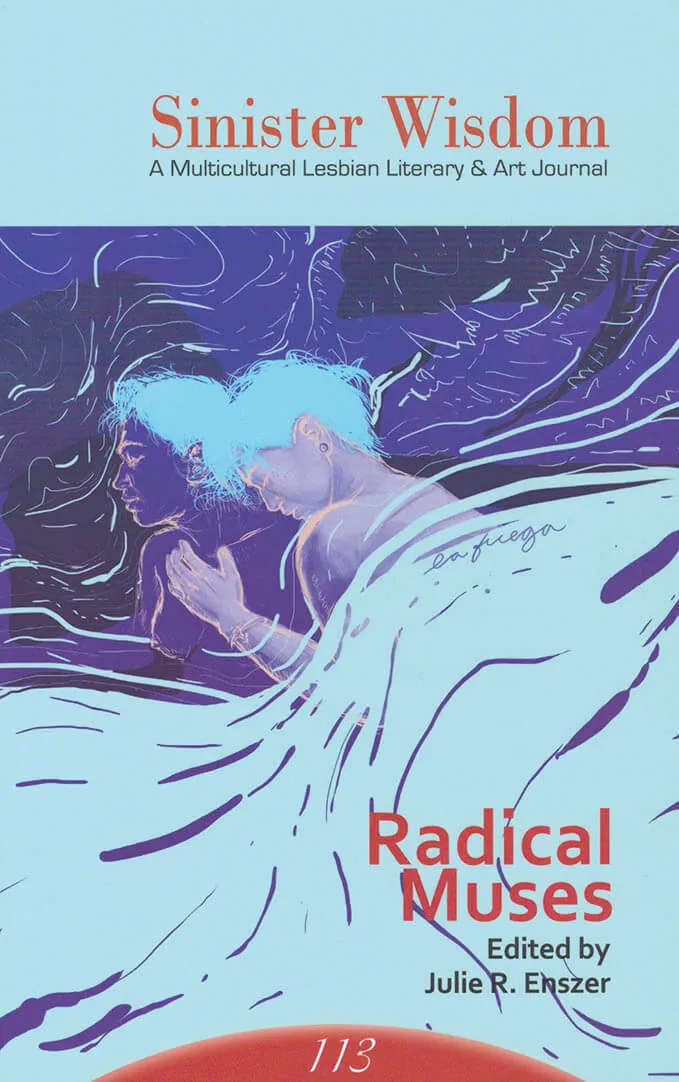
Cover of Radical Muses (Sinister Wisdom nr. 113)

Sinister Wisdom

Radical Muses (Sinister Wisdom nr. 113)

Julie R. Enszer

Sinister Wisdom 113: Radical Muses features an eclectic array of contemporary poetry, prose, and art by lesbians from around the world, including new work by: Andrea Assaf, Tara Shea Burke, Cheryl Clarke, Marina Chirkova, Estela González, Barbara Haas, Nancy E. Lake, Vi Khi Nao, H. Ní Aódagaín and much more!

Cover of Cassell's Encyclopedia of Queer Myth, Symbol and Spirit

Cutt Press

Cassell's Encyclopedia of Queer Myth, Symbol and Spirit

Randy P. Conner, David Hatfield Sparks and 1 more

Bootleg edition by Cutt Press. 

Foreword by Gloria Anzaldua.

Drawing on religion, mythology, folklore, anthropology, history and the arts, this encyclopoedia is a collection of queer spirit. It contains articles on the world's spiritual traditions; entries on deities, symbols, spiritual teachers, spiritually focused artists; and related subjects.

Did you know that in medieval French folklore a person might change sex by passing under a rainbow? Or that same-sex unions have been celebrated by peoples of the ancient Mediterranean, Africa, China, and indigenous America? Or that Sappho, da Vinci, Emily Dickinson, Nijinsky, Benjamin Britten, Mishima, Adrienne Rich, Audre Lorde, Keith Haring, Boy George, and Derek Jarman number among those who have explored the spiritual dimension of gender and sexuality in their works? While the terms many of us employ today to identify ourselves – ‘queer’, ‘lesbian’, ‘gay’, ‘bisexual’, ‘transgendered’ – differ markedly from those of peoples of other times and places, we are nevertheless the bearers of a rich spiritual history that has been ignored or suppressed, a history encoded in sacred texts as well as in works of art, music, dance and other media. Drawing upon religion, mythology, folklore, anthropology, history and the arts, the Encyclopedia is a cornucopia of queer spirituality, containing over 1,500 alphabetically arranged entries from Aakulujjuusi to Zeus.

Cover of The Letters of Audre Lorde and Pat Parker 1974-1989

the87press

The Letters of Audre Lorde and Pat Parker 1974-1989

Julie R. Enszer

Poets Audre Lorde and Pat Parker first met in 1969; they began exchanging letters regularly five years later. Over the next fifteen years, Lorde and Parker shared ideas, advice, and confidence through the mail. They sent each other handwritten and typewritten letters and postcards often with inserted items including articles, money, and videotapes.

The Letters of Audre Lorde and Pat Parker 1974-1989 gathers this unique correspondence in which Lorde and Parker discuss their work as writers as well as the intimate details of their lives, including periods when each lived with cancer. These letters are a rare opportunity to glimpse inside the minds and friendship of two great twentieth century poets.
Introduction by Mecca Jamilah Sullivan.

Cover of The Lesbian Body

Winter Editions

The Lesbian Body

Monique Wittig

LGBTQI+ €22.00

In this genre- and gender-breaking work of theory-fiction, legendary writer and cofounder of the 1970s French feminist movement Monique Wittig celebrates the body—lesbian, literary and defiantly political—and challenges the order of heterosexuality in literature. 

First published in French in 1973, The Lesbian Body mines the relationship between a lover and a beloved—also a writer and a text—to explore the ideological and historical constructions of the female subject. Organized according to the principle of montage, poetic passages are juxtaposed with anatomic lists that mark lesbian eros. Through expressions of joy, violence, and tenderness, the site of pleasure is celebrated. In her transfiguration of gender and its paradigms, Wittig transformed French vocabulary, feminizing grammar and lesbianizing myths. This edition brings the English translation of Wittig’s groundbreaking work back into circulation for the first time since the mid-1980s, revised according to the author's notes, and with an introduction by Paul B. Preciado.

The Lesbian Body is a fundamental work of lesbian existence. Wittig's applied vision is a state of natural delirium, a revolutionary excess of utopianism, refusal, and mutual self-creation. Revisiting it reveals how much passionate free thought has been lost, and simultaneously, how many of her tropes and discoveries have integrated into our collective consciousness.” — Sarah Schulman

“In this stunning new rendering of The Lesbian Body by the French author, theorist, activist and teacher, the late Monique Wittig, we are plunged into an imagined world of passionate violence and erotic lesbian mayhem intertwined in strikingly bold poetic images. Wittig, in the reach and volatility of her imagination, stands alongside such important American writers as Audre Lorde, Adrienne Rich, and Valerie Solanas, all of whose work deserves to be read again, or for the first time.” — Esther Newton

“To read the book is to be forced by Wittig into another grammar and happily contaminated by its strange forms. You will never think straight again.” — Jack Halberstam

“For me, Wittig opened up a sense of the world that had been, quite literally, unimaginable. She tore us apart.” — Judith Butler

“Together with Ursula Le Guin and Samuel R. Delany, Wittig is the first to design a nonbinary utopia, a world in which the binary categorization of sexes and genders will have ceased to exist.” — Paul B. Preciado

Introduction by Paul B. Preciado
Translated by David Le Vay

Cover of Superior and Inferior

Crackers

Superior and Inferior

Carla Accardi

Superior and Inferior presents a facsimile reprint of Italian abstract artist and feminist Carla Accardi's provocatory publication Superiore e Inferiore and the first ever English translation of the full text.

"In this book, I have bought together the transcripts of dialogues I recorded on tape in three girls' classes from the first, second and third year of a state middle school. For having proposed this unauthorised activity, I was dismissed from teaching in the light of a formal complaint". – Carla Accardi introducing her book Superiore e Inferiore, 1972.

First published in 1972 by Carla Accardi, the book Superiore e Inferiore features discussions among girls at a middle school—all between 10 and 13—about society's discriminatory behaviour towards women. They also commented the Manifesto of the revolutionary feminist group Rivolta Femminile—collectively written by Accardi, art critic and feminist activist Carla Lonzi, and Elvira Banotti—which first appeared posted on city walls in Rome in July 1970. For having discussed sex-related issues with pupils, Accardi was fired and permanently suspended from teaching. (Her letter of dismissal issued by the Italian Ministry of Education forms part of the introduction to the book.) Along the lines of Pasolini's Comizi d'Amore (Love Meetings), Accardi's own voice is secondary in the book, giving way to the thoughts, narratives, opinions, and debates expressed among girls on the role of women and girls, family conflicts and intimate relations.

Carla Accardi (1924–2014) was an Italian abstract painter associated with the Arte Informale and Arte Povera movements, and a founding member of the Italian art groups Forma (1947) and Continuità (1961). She experimented with different forms of art, such as black and white painting and Sicofoil. During the late 1970s, she became part of the feminist movement with critic Carla Lonzi. Together, they founded Rivolta femminile in 1970, one of Italy's first feminist groups. Accardi's first solo exhibition in the United States was in 2001 at MoMA PS1.

Cover of The Complete Text Would Be Insufferable / Language as Prosthesis

uh books

The Complete Text Would Be Insufferable / Language as Prosthesis

Chloe Chignell

Poetry €15.00

We begin with the image of an idea in ruin. A small field of assumptions disassembled. A question no longer in need of its mark. A thought not sure where it began. It starts from the body and language. The debris of these three words, crumbling already at and, did not break apart but congealed the separations once made. We start from a research (project) undone and just beginning. 

Typesetting and design: Will Holder
Produced by: A.pass

Chloe Chignell works across choreography and publication taking the body as the central problem, question and location of the research. She invests in writing as a body building practice, examining the ways in which language makes us up.