rile*books

Search books

Search books by title, author, publisher, keywords...

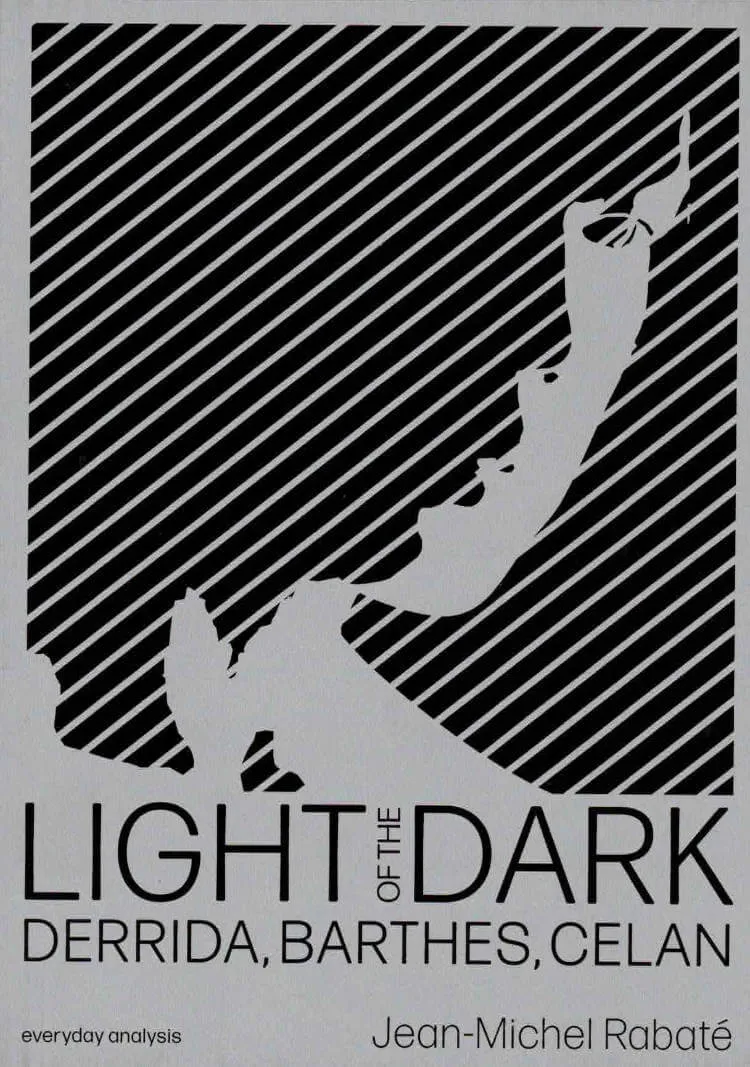
Cover of Light Of The Dark: Derrida, Barthes, Celan

Everyday Analysis

Light Of The Dark: Derrida, Barthes, Celan

Jean-Michel Rabaté

€10.00

Derrida’s essay “Aletheia” discusses the work of Japanese photographer Kishin Shinoyama. Reading Derrida, Rabaté investigates how, behind the classical concept of truth as a beautiful naked woman, Derrida argues that any photographic image tells the Truth, but a truth obscured as it comes to light: “nothing is more black than the visibility of light.” Staging a critical conversation with Roland Barthes’s theses in Camera Lucida and Paul Celan’s poems from Breathturn to Lightduress, Rabaté argues for a theoretical approach to truth that counters the prevailing truth-discourses of today. 

Published in 2025 ┊ 30 pages ┊ Language: English

recommendations

Cover of Sounds Naughty

Everyday Analysis

Sounds Naughty

Karlo Pavlović

Essays €10.00

In this psychoanalytic pamphlet, Croatian philosopher Karlo Pavlović analyses the perversions of the day. Considering the topic of ASMR, a key example of what he calls the generalised deployment of subtle pornography, of depictions of sexuality "in gloves", he argues that society today should be understood through the blue balls phenomenon. This concept, developed playfully by Pavlović, explains that we are all perverts taking the logic of the drive to its extreme; if the whole point of the drive is not to attain its object, but rather, to circle around it, the perverse subject (as the subject of the present times) has, in fact, no problems with this whatsoever.

Karlo Pavlović is completing his PhD in Philosophy at The University of Ljubljana, supervised by Alenka Zupančič.

Cover of Feminist Fatwas

Everyday Analysis

Feminist Fatwas

Rafia Zakaria

Essays €10.00

Feminist Fatwas traces how Muslim feminists are resisting misogynistic interpretations of the Quran (like the verse male clerics have used to condone wife-beating). 

For centuries, the translators and interpreters of the Holy Quran have been men. This is changing now as more and more Muslim feminists cast their eye on the patriarchal contexts of these interpretations. Feminist Fatwas tells the story of  Verse 34 in Chapter 4 which has been interpreted by male clerics as condoning a husband beating his wife. This essay traces the groundbreaking work of knocking down this misogynist Quranic interpretations. The story of how Muslim feminists are doing this work is a chronicle of the slow and quiet feminist revolution taking place within Islam as women take on significant and powerful roles. 

Rafia Zakaria is a Pakistani-American attorney, feminist, journalist, and author. She has written for The Nation, Guardian Books, The New Republic, The Baffler, Boston Review, and Al Jazeera. In 2021, she published Against White Feminism, in which she critiques the emphasis that conventional feminist thought places on the experiences of white women while excluding women of color

Cover of The Almond

1080 Press

The Almond

Theadora Walsh

Poetry €25.00

“Today is the day with the letter,” Celan writes to Bachmann on October 30, 1957. Theadora Walsh’s essay-poem, The Almond concerns, for I hesitate to write “about” or “is in relation to”, the love between Paul Celan and Ingeborg Bachmann. Two Austrian writers flung across Europe by the atrocities of the Holocaust, excavating the narrows of a language not theirs, or taken from them. An almond is the closest two people can be, and becomes the binding structural conceit of the book, two segments reaching across the blank page to each other, across history, time and language.

Cover of The History Of Breathing

Diaphanes

The History Of Breathing

Allison Grimaldi Donahue

Poetry €15.00

In the tradition of poets such as Charles Olsen, Alice Notley and Sappho, Allison Grimaldi Donahues poetry connects the history of breath and language with narratives about the discovery and loss of our own voice.

The Etruscan language knew no blank spaces, no breaks between words—its texture resembled an uninterrupted flow of speech; more singing than speaking, form rather than content. Only in the dictum of the pause, the meaningful fragmentation of the breath and the staccato of the Atemwende (Paul Celan) does language become comprehensible rhythmic expression.

In a world full of slogans and catchphrases, Allison Grimaldi Donahue defends the poetological demand of Sound over Content! The History of Breathing weaves linguistics and poetry, verse and song, meaning and sound into a dense narrative about breathing, rhythm, and the gaps in language that allow words to take on meaning in the first place.

Allison Grimaldi Donahue (born 1984 in Middletown, Connecticut, USA, lives and works in Bologna, Italy) works in text and performance exploring modes in which language and text can move between individual and collective experience. She is author of Body to Mineral and On Endings, and translator of Blown Away by vito m. bonito and Self-portrait by Carla Lonzi. She has given performances at Short Theatre, Almanac Turin, MACRO, MAMbo, Fondazione Giuliani, Kunsthalle Bern, Hangar Biccoca, and Flip Napoli.

Cover of Bad Language

Peninsula Press

Bad Language

So Mayer

Essays €20.00

There is no such thing as a safe word. 

In Bad Language, So Mayer blends memoir and manifesto as they explore the politics of speech, while looking at how language has been used – and abused – in their own life. What is the relationship between language and sexual violence? And how can we ‘make ourselves up’ in language when words themselves are encoded by a dominant culture that insists we see ourselves as powerless listeners rather than active speakers? 

Examining the semantic traps of their multi-lingual childhood – and taking in texts from the Torah to Grimms’ Fairytales, from protest bust cards to the works of Ursula K. Le Guin – Mayer asks who gets to speak, and who is forced into silence. Bad Language calls out the harm that words can do, while searching for crafty ways through which we can collectively reclaim language for protest and pleasure. 

‘Mayer’s writing is generous, astute and sincere; in Bad Language, they choose their words carefully, using incantation and spell to distil a complex argument – the transformative power of language lay in its ability to shape sense perception. For Mayer, the task of ‘making ourselves up’ is another way of asking, what kind of world do we want to live in?’ – Lola Olufemi

SO MAYER is a writer, editor, bookseller and organiser. Truth & Dare, their first collection of speculative fiction, was longlisted for the Republic of Consciousness and Edge Hill Short Story prizes. With Sarah Shin, they co-edited Ursula K. Le Guin, Space Crone, winner of the 2024 Locus Award for non-fiction. Bad Language is their second book for Peninsula, after A Nazi Word for a Nazi Thing.

Cover of Mutual Aid

Verso Books

Mutual Aid

Dean Spade

Mutual aid is the radical act of caring for each other while working to change the world. 

Around the globe, people are faced with a spiralling succession of crises, from the Covid-19 pandemic and climate change-induced fires, floods, and storms to the ongoing horrors of mass incarceration, racist policing, brutal immigration enforcement, endemic gender violence, and severe wealth inequality. As governments fail to respond to—or actively engineer—each crisis, ordinary people are finding bold and innovative ways to share resources and support the vulnerable.  

Survival work, when done alongside social movement demands for transformative change, is called mutual aid.  

This book is about mutual aid: why it is so important, what it looks like, and how to do it. It provides a grassroots theory of mutual aid, describes how mutual aid is a crucial part of powerful movements for social justice, and offers concrete tools for organizing, such as how to work in groups, how to foster a collective decision-making process, how to prevent and address conflict, and how to deal with burnout.  

Writing for those new to activism as well as those who have been in social movements for a long time, Dean Spade draws on years of organizing to offer a radical vision of community mobilization, social transformation, compassionate activism, and solidarity.

Cover of ODD / GARİP

Istasyon

ODD / GARİP

Orhan Veli Kanik

Poetry €14.00

"[…] this new poetry will not serve the taste of the prosperous class. which only represents a minority. The people who populate this earth find the right to live at the end of a constant struggle. Like everything else, they also have a right to poetry, and it will appeal to their taste."

Three friends —Orhan Veli Kanik, Melih Cevdet Anday and Oktay Rifat— followed this principle as they were composing their "odd" poems. Their aim was to write poetry for everyone, about everyone.

This books gathers the poems Orhan Veli published with his friends in Odd (1941), the manifesto he wrote for this new poetry, and the foreword he wrote for the 1945 re-edition.

Cover of T*

Mousse Publishing

T*

Giordano Bonora, Ilaria Bombelli

Photography €20.00

A photographic archive of the transgender community in Bologna in the 1980s. With critical texts by scholars and queer theorists.

This book is inspired by the pictures that Giordano Bonora, a young streetcar operator and aspiring photographer, took of Bologna's small transgender community in 1980 (although it would be more correct to speak, in this case, of proto-Transgenderism). Reproduced here for the first time, these raw and gilded images reflect—during a period in Italy characterized by subversive movements and political revolts that were not just rooted in questions of identity—attempts made by T* people at a construction of the self outside the binary logic of the genotypically XY male/genotypically XX female. By people like Valérie—a woman's face, a hairless chest with no breasts, a fleur-de-lis tattooed on the shoulder, and two pairs of pantyhose—for whom “gender” is not determined biologically but something to be embraced depending on the circumstances. A box containing a jigsaw puzzle with a picture that is constantly changing. Bundled with the photographs, a handful of texts set out to explain how the question of gender involves two cultural levels of sexual difference, the normative and the dissident, and how the decision-making power over organs outside heteropatriarchal systems of sexuality and processes of disidentification are the stakes in the new “somato-political” struggle against hegemonic regimes of oppression conducted by enchanting, allied, opaque, and vulnerable bodies.

Texts by Paolo Barbaro, Paul B. Preciado, Helena Velena, Salvatore Vitale, Wendy Vogel.