rile*books

Search books

Search books by title, author, publisher, keywords...

Cover of Lesbians in the City

Sinister Wisdom

Lesbians in the City

Julie R. Enszer ed.

€7.00

How do lesbians live in the city, whether they live in the city by themselves or within intentional community? How does the city change what being a lesbian means? Sinister Wisdom 117: Lesbians in the City explores these questions—and many more.

The issue features creative work by: Srestha Sen, Carina Julig, Roin Morigeau, t pomar, Rita Mookerjee, Margarita Meklina as well as SPORTS — a selection of work from the Southern Lesbian Feminist Activist Herstory Project, edited by Rose Norman and Merril Mushroom. Plus a great selection of new lesbian writing!

Language: English

recommendations

Cover of Celebrating the Michigan Womyn's Music Festival

Sinister Wisdom

Celebrating the Michigan Womyn's Music Festival

Sinister Wisdom

Sinister Wisdom 103: Celebrating the Michigan Womyn's Music Festival honors the forty-year legacy of the Michigan Womyn’s Music Festival (1976–2015). Sinister Wisdom 103: Celebrating the Michigan Womyn's Music Festival celebrates this embodiment of radical feminist separatist collaboration, transformational self-defined autonomous spaces, a commitment to sisterhood and matriarchal culture, and a musical city sprung from the earth for one week in the woods.

A collective of five womyn each with a deep connection to Fest operated by consensus to create this issue. Striving to represent a range of womyn’s voices, values, traditions, and experiences of Fest, the collective highlighted what Fest has meant to generations of womyn, documented its chronology, and bore witness to the power of this community. Sinister Wisdom 103: Celebrating the Michigan Womyn's Music Festival includes womyn from multiple races, geographies, sexualities, generations, and gender and other social identities. Just as Fest brought together womyn from various backgrounds, our collection includes a range of artistic experience, from seasoned authors and photographers to those womyn new to publishing.
Sinister Wisdom 103: Celebrating the Michigan Womyn's Music Festival remembers the transformations, possibilities, and hopes for spaces cultivating the ongoing empowerment of womyn.

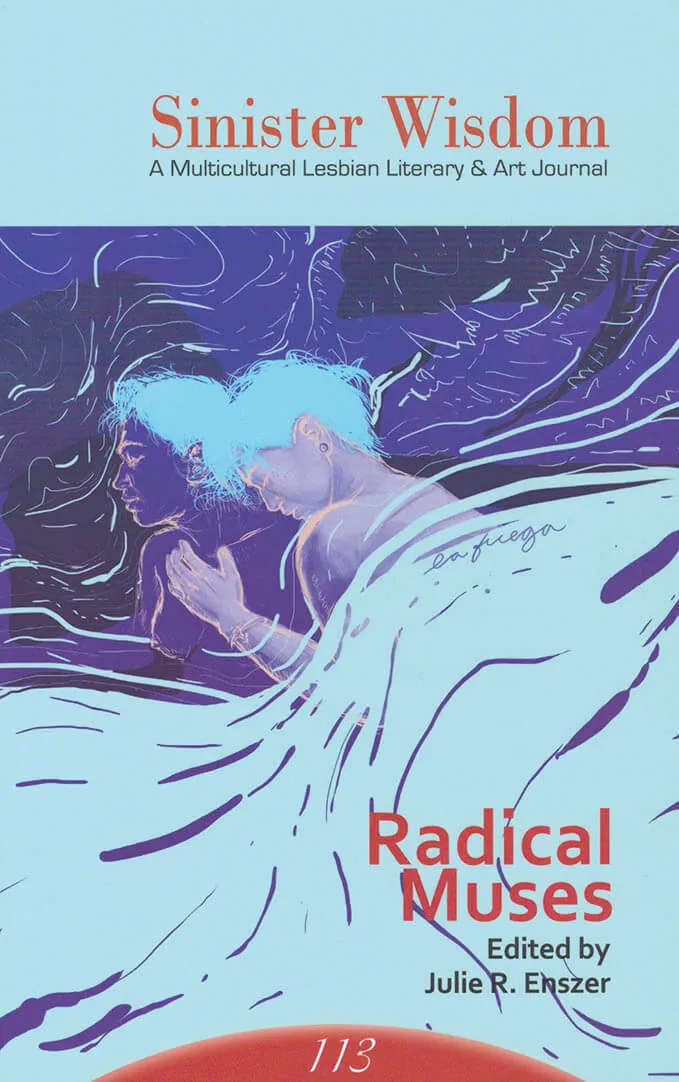
Cover of Radical Muses (Sinister Wisdom nr. 113)

Sinister Wisdom

Radical Muses (Sinister Wisdom nr. 113)

Julie R. Enszer

Sinister Wisdom 113: Radical Muses features an eclectic array of contemporary poetry, prose, and art by lesbians from around the world, including new work by: Andrea Assaf, Tara Shea Burke, Cheryl Clarke, Marina Chirkova, Estela González, Barbara Haas, Nancy E. Lake, Vi Khi Nao, H. Ní Aódagaín and much more!

Cover of The Letters of Audre Lorde and Pat Parker 1974-1989

the87press

The Letters of Audre Lorde and Pat Parker 1974-1989

Julie R. Enszer

Poets Audre Lorde and Pat Parker first met in 1969; they began exchanging letters regularly five years later. Over the next fifteen years, Lorde and Parker shared ideas, advice, and confidence through the mail. They sent each other handwritten and typewritten letters and postcards often with inserted items including articles, money, and videotapes.

The Letters of Audre Lorde and Pat Parker 1974-1989 gathers this unique correspondence in which Lorde and Parker discuss their work as writers as well as the intimate details of their lives, including periods when each lived with cancer. These letters are a rare opportunity to glimpse inside the minds and friendship of two great twentieth century poets.

Introduction by Mecca Jamilah Sullivan.

Cover of Chesil Cliff House and other failures

Sticky Fingers Publishing

Chesil Cliff House and other failures

Sam Moore

LGBTQI+ €14.00

Orbiting around the saddest house in the history of Grand Designs, Sam Moore’s Chesil Cliff House and other failures takes us to North Devon where, standing at the cliff’s edge, we meet Edward Short: a man with a Fred Perry shirt and a dream. Amongst a chorus of characters including Kevin Mcloud as Father Time, Moore by means of Short leads us into a study of creative failure, gender, and, ultimately, the desire to keep writing.

"I struggle to see anyone living here. It feels like a distorted wonder of the world, a cautionary tale. Something that could never have been lived in, but that had to be made."

About the author:
Sam is a writer, artist, and editor. They are the author of All my teachers died of AIDS (Pilot Press), Long live the new flesh (Polari Press), and Search history (Queer Street Press). They are one of the co-curators of TISSUE, a trans reading and publishing initiative based in London.

About A Series of Attempts:
This new series published by Sticky Fingers Publishing explores the essay form through the etymological root of essay: to try, trial or attempt. In 1508, French theorist Michel de Montaigne published a collection of 107 texts called Essais, described by his contemporaries as ‘self-indulgent and embarrassingly confessional.’ It is through these roots we find the attitude and intentions at the heart of this series; that through thinking together, through trying to figure it out on the page, we can reach new and increasingly nuanced ways to understand each other and the worlds we inhabit.

Cover of Woman Journal Vol. 6: Back in Shape

Woman Cave Collective

Woman Journal Vol. 6: Back in Shape

Do we always have to be nice, kind and communicate respectfully? Wouldn't it sometimes be better to change our tone, to use force or even violence? We often want to act in a spirit of “care” and benevolence, but how do we know if we're really being altruistic and sympathetic? Vol.5 asks the question: Nice?

With contributions from :
Muf architecture/art, Mélanie Mazet, Bui Quy Son, Paul-Antoine Lucas, Armelle Breuil, Annabelle Vaillant, Napsugár Trömböczky, Alessandro Di Egidio,
Elsa Muller, Clara Lenoir, Léo Jacqmin, Clem Koren, Pola Noury, Grève cœur and Cassiane C. Pfund

This publication is edited by the Woman Cave collective founded by Leticia Chanliau and Chloé Macary-Carney.

318 black & white pages, brown cover
Micro edition of 700, printed in Aubervilliers by Isiprint.

Cover of HOOT nr. 9 — Moyra Davey & Sophie T. Lvoff

GUFO

HOOT nr. 9 — Moyra Davey & Sophie T. Lvoff

Sophie T. Lvoff, Moyra Davey

Periodicals €12.00

The 9th HOOT pops up for the winter 2022-23, but the conception of this issue started well over a year ago at our beloved Plage Avant (Traduttore, traditore’s studio, Marseille). 

We met Sophie T. Lvoff at many openings and art related events in Marseille these last few years, having a practice that appears mainly as photography, Gufo got curious about all the processes that she uses which involve sound, installation, writing… and more. She welcomed us in her studio of the city of Marseille where she recently settled.

We found out about the “trompe-l’œil” of this iconic checkered table, witnessed the installations of translucid and colored objects evolving on the sunny wall, and looked through her photographic chamber it’s called a large-format camera, but this is funny… For this issue, Sophie suggested to interview another artist, Moyra Davey, who also works in photography and writing, and appeared to have shared experiences too.

The topics of everyday life, intimacy that images embody in both their works, take another dimension as soon as their thoughts, voices and writing expand and express the entirety of their gestures.

This issue is the first interview between two native English-speaking artists, who have ties to the French language from childhood.

The penpals are the main characters of that encounter where we are very welcome to join in their very generous conversations. This is only an excerpt of a long and well referenced correspondence.

Cover of Self-Romancing

Dopamine Books

Self-Romancing

L Scully

Fiction €18.00

In a tonal mash-up of Jenny Holzer’s Truisms, confessional poetry, and fortune telling, Self-Romancing draws you into the amorous and obsessive inner life of an unnamed romantic. Relatable and snarky, heartfelt and horny, L Scully fortifies irony with vulnerability, bringing readers into a narrative as intimate as slumber parties and ordinary as Trader Joe’s. Bursting with the giddy charm of the everyday, Self-Romancing plays with form, turning a book into a crush, a crank call, a manifesto. 

Cover of Katrin – The Tale of a Young Writer

Crackers

Katrin – The Tale of a Young Writer

Unica Zürn, Louis Bazalgette Zanetti

Fiction €15.00

A partly autobiographical novel that the German surrealist artist and author Unica Zürn (1916-1970) wrote for her ten-year-old daughter in 1953, although it would never be published in her lifetime. This is the first translation of the tale from German into English.

Unica Zürn tells the story of fifteen-year-old motherless Katrin, an aspiring writer, who lives with her father, also a writer. The novel is set in an imaginary world, a metropolis called Linit, split into three levels: Oberstadt (Hightown), Mittelstadt (Middletown) and Unterstadt (Lowtown), overlooked by a Volcano where the artists live and crossed by the river Emil. Presented as a book for children, apparently written for her own daughter (named Katrin), Katrin also draws on the personal biography of Zürn herself, in terms of her relationship with her father and the city of Berlin after WWII, and her experience with people on the margins of a society characterised by great tensions.

About Unica Zürn 
Nora Berta "Unika" Ruth Zürn, originally known as Ruth, was born on 6 July 1916 in Berlin. Raised in Berlin, Zürn had a contentious relationship with her mother, while she idolized her absent father. While at school she published her first short stories in magazines for young people, and in 1933 she began to work at the UFA film studios in Berlin (acronym for Universum-Film Aktiengesellschaft, a major German film company producing and distributing motion pictures from 1917 until the end of the Nazi era). In 1942 she married and had two children, Katrin and Christian. Shortly after, she lost the custody of her children. For the next few years she survived by writing short stories for newspapers and radio plays. After the war, she became part of the Bohemian group of Berlin and began to call herself Unika (after her aunt Unika Pudor). She frequented the artistic milieu revolving around the DADA-surrealist cabaret Die Badewanne ("The Bathtub"). In 1953, Zürn met the artist Hans Bellmer, best known for his disassembled dolls in unconventional poses directed at the cult of the perfect body then prominent in Germany, and became his muse. They lived together in Paris for many years, albeit in a conflictual relationship. Zürn concentrated on producing poetic anagrams supplemented by drawings, thus developing her own multidimensional surreal style. From the late 1950s, she suffered from forms of anxiety, later diagnosed as schizophrenia, and produced a wealth of remarkable textual and visual material while in psychiatric institutions across Germany and France. From 1956 to 1964, Zürn had four solo exhibitions of her drawings, and her work was included in the Exposition Internationale du Surréalisme. The exploration of the unconscious dimension would increasingly lose its liberating, positive aspect and turn into a fixation on a narrow space, one in which the self is tormented by distressing visions. Her psychological difficulties inspired much of her writing, especially Der Mann im Jasmin (The Man of Jasmine, published in English in 1971). Other published texts by Zürn include Hexentexte (1954) and Dunkler Frühling (Dark Spring, 1967). Zürn died on 19 October 1970 in Paris, throwing herself from the sixth floor.