rile*books

Search books

Search books by title, author, publisher, keywords...

Cover of Hole Studies

Fonograf Editions

Hole Studies

Hillary Plum

€18.00

Hole Studies is a book about care and the forms it may take. An essay collection on writing and labor, art and activism, attention as a transformative practice, difference and collaboration, adjuncting and the margins of the academy, whiteness and its weapons, professionalization and its discontents, the radical importance of surprise, friendship at work, the self and its public and private modes: Hole Studies keeps listening.

What is it we need from each other? What could we still make happen? This book looks for forms of responsiveness and moments that matter. It honors everyday acts of thinking and trying. Essays explore the music of the Swet Shop Boys, the literature of the US’s brutal war in Iraq, the career of Sinéad O’Connor, the aesthetics of the Dirtbag Left, the legacies of the “war on terror,” feminism on the job, and illness in America. Hole Studies is an intimate document and a critical guide. Hole Studies would like to work for you.

If Montaigne returned today as a feminist and Sontag a poet, they might have together crafted an essay collection as astonishing as Hilary Plum’s Hole Studies. Plum rigorously examines her many subjects (from a history journal’s MLA citations to Sinéad O’Connor’s infamous televised protest) and then rigorously interrogates her examinations. Each page holds more brilliance and artistry than should be possible. Hole Studies is an exciting read and a conceptual achievement, and Plum is one of the best American essayists around. — Jeannie Vanasco

Language: English

recommendations

Cover of Wrong Winds

Fonograf Editions

Wrong Winds

Ahmad Almallah

Poetry €18.00

Ahmad Almallah’s third poetry collection considers the impossible task of being a Palestinian in the world today.

When genocide is the question, can the answer be anything but wrong? In Wrong Winds, written during the first months of Israel’s genocidal assault on Gaza, Palestinian-American poet Ahmad Almallah converses with the screams echoing throughout the West. Traversing European cities, Almallah encounters the impossibility of being a Palestinian, left alone in a world full of sympathizers and enemies. Through a continuous unsettling of words and places, considering the broken voices of Western poetry (Eliot, Lorca, and Celan, among others), the poems in Wrong Winds discover the world again and form an impossible dialogue with the dead and dying.

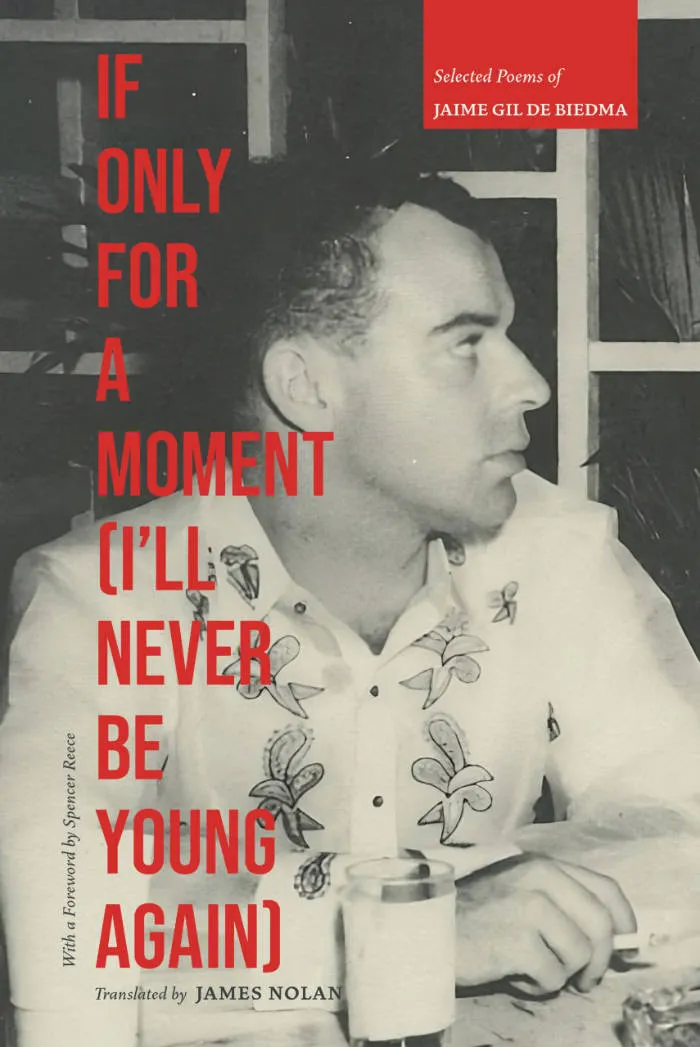
Cover of If Only For a Moment (I’ll Never Be Young Again)

Fonograf Editions

If Only For a Moment (I’ll Never Be Young Again)

Jaime Gil de Biedma, James Nolan

Poetry €19.00

Jaime Gil de Biedma is the most original and influential among the poets known as the ‘50’s Generation in Spain, and is considered the greatest Spanish poet to emerge in the second half of the 20th century. His life and literary career were bracketed almost entirely by the rise and fall of Generalissimo Francisco Franco, notorious for the suppression of literature. Born in 1929, Gil de Biedma was six years old when García Lorca was murdered in Granada at the outbreak of the Civil War, and his collected poems, Las personas del verbo, first appeared in 1975, the year Franco died. What is surprising is that Gil de Biedma was a leftist, homosexual poet from the Catalan capitol, Barcelona – all of Franco’s favorite things – who not only published books of autobiographical poetry in Spain but was known as a poet of social conscience as well as erotic lyricism. Like other Spanish poets of his time, he chose his words carefully. Gil de Biedma died of AIDS in 1990.

If Only For a Moment (I’ll Never Be Young Again) consists of an extensive bilingual selection of Gil de Biedma’s poetry, including all of his most well-known work. The book additionally consists of a Foreword by Spencer Reece, Jaime Gil de Biedma’s short essay “I wanted to be the poem,” and two different essays on Gil de Biedma and the art of translation by James Nolan, the volume’s translator.

Cover of The Grimace of Eden, Now

Fonograf Editions

The Grimace of Eden, Now

Cody-Rose Clevidence

Poetry €19.00

The playful, inventive, and lyrically quick poems comprising The Grimace of Eden, Now orbit the strange space halfway between Tennyson and the Metaverse, veering between the natural world and a sci-fi universe, between inner feelings and outward observations, with questions of divinity alongside domestic life, spiders, dishes, and spaceships. The roving eye of these poems wanders through spacetime carrying irreverent theologies and exploring what it could mean to be living, sensate, and awake in this weird moment in time, exposing a mixture half of awe and half of madness. 

Cody-Rose Clevidence is the author of Aux Arc / Trypt Ich (Nightboat Books, 2021), Listen My Friend, This is the Dream I Dreamed Last Night (The Song Cave, 2021), Flung/Throne (Ahsahta, 2018), and BEAST FEAST (Ahsahta Press, 2014), as well as several chapbooks (Fonograf Editions, flowers and cream, NION, garden door press, Auric). Occasionally a visiting poetry professor at the Iowa Writers Workshop, they live in the Arkansas Ozarks alongside three loyal, sentient pets, and the continuous void.

Cover of Early Works

Fonograf Editions

Early Works

Alice Notley

Poetry €26.00

Early Works collects Alice Notley’s first four out of print poetry collections, along with 80 pages of previously uncollected material. A must have for any Notley fan. Includes original collection cover artwork by Philip Guston, Philip Whalen and George Schneeman, among others.

From editor Nick Sturm’s “Introduction” to Early Works:

In the author’s note that begins Grave of Light: New and Selected Poems 1970-2005, Alice Notley writes, “My publishing history is awkward and untidy, though colorful and even beautiful.” I have always been enamored of this sentence, which reminds us that an array of dispersed and varying publishing contexts are the original sites that give shape to such a book’s form. It is also something of an invitation into that color and untidiness, a prompt to become more curious about the awkwardness and beauty of Notley’s publishing history. This book, Early Works, accounts for a significant portion of that history by bringing back into print the complete versions of her first four books, a little-known 22-poem sonnet sequence, and a large selection of early uncollected poems gathered from little magazines. In doing so, Early Works joins an important set of recent volumes that put Notley’s earlier poetry back into circulation, including Manhattan Luck (Hearts Desire, 2014), which collects four long poems written between 1978 and 1984, and Songs for the Unborn Second Baby, originally published by United Artists in 1979 and reissued in a facsimile edition by London-based Distance No Object in 2021. Each in their own way, and especially taken together, these books continue to confirm that, as Ted Berrigan writes in The Poetry Project Newsletter in 1981, “Alice Notley is even better than anyone has yet said she is.”

Cover of A Mouth Holds Many Things: A De-Canon Hybrid Literary Anthology

Fonograf Editions

A Mouth Holds Many Things: A De-Canon Hybrid Literary Anthology

Dao Strom, Jyothi Natarajan

Poetry €36.00

A Mouth Holds Many Things collects hybrid-literary works from 36 women and nonbinary BIPOC writer-artists. Spanning experimental poetry and prose, image-text, collage, performance text, AI-generated writing, and more, this ground-breaking full-color print volume illuminates and expands the interstitial spaces where text blends, blurs, and morphs with visual and other media.

At the restless heart of this collection is a challenge to some fundamental questions: What is reading? What is writing? Lifting language beyond the domain of the letter, the works collected here present language in other forms: visual, embodied, sonic, asemic, tactile. Language, after all, is multi-textu(r)al, interwoven, punctured, fragmented, grafted, possessing power to construct and deconstruct, fed into by many rivers of experience: marginalizations and migrations, diasporas and displacements, invisibilities and hyper-visibilities.

A project of the Portland-based literary-social art project, De-Canon, which creates unique spaces and experiments to center works by writers of color, this collection is edited by Dao Strom and Jyothi Natarajan.

A Mouth Holds Many Things was, in the short stories/poetry/anthologies category, the winner of a 2024 PubWest Book Design Award.

Full list of contributors

Stephanie Adams-Santos, Kimberly Alidio, Samiya Bashir, Aya Bram, Victoria Chang, Jennifer S. Cheng, Gabrielle Civil, desveladas (Macarena Hernández, Sheila Maldonado, Nelly Rosario), Carolina Ebeid, Nadia Haji Omar, Christine Shan Shan Hou, Imani Elizabeth Jackson, Vi Khi Nao, Diana Khoi Nguyen, Quyên Nguyễn-Hoàng, Cindy Juyoung Ok, Monica Ong, Shin Yu Pai, Jenne Hsien Patrick, Jennifer Perrine, Alley Pezanoski-Browne, Kelly Puig, Ayesha Raees, Jhani Randhawa, Paisley Rekdal, Daisuke Shen, Sasha Stiles, Sandy Tanaka, Arianne True, Addie Tsai, Vauhini Vara, Divya Victor, Anna Martine Whitehead, Kathy Wu

Cover of Palestine is everywhere

Silver Press

Palestine is everywhere

Skye Arundhati Thomas

Poetry €18.00

‘Palestine is everywhere because it names a political subject of radical universal emancipation,’ writes teacher and writer Nasser Abourahme. In Palestine is everywhere, writers, thinkers, poets and artists map the Palestinian struggle for freedom and its global resonances.

Vital dispatches from Gaza, essays, poems, protest chronicles, images and letters from prison reflect upon resistance, solidarity and the right to self-determination. Amid a world-historical moment marked by unknowability and loss, this collection offers essential reading for those interested in Palestinian liberation.

This collection is edited by Skye Arundhati Thomas, with contributions from Alaa Abd El-Fattah, Nasser Abourahme, Amal Al-Nakhala, Muhammad Al-Zaqzouq, Maisara Baroud, Ahmed Bassiouny, Houria Bouteldja, Anees Ghanima, Sahar Khalifeh, Laleh Khalili, Lujayn, Mira Mattar, Lina Meruane, Mohammed Mhawish, Nahil Mohana, Rahul Rao, Nasser Rabah, Adam Rouhana, Ahmad Zaghmouri.

Co-published by TBA21.

All royalties from this project will be donated to Medical Aid for Palestinians (MAP) and The Arab Group for the Protection of Nature (APN).

Cover of Chesil Cliff House and other failures

Sticky Fingers Publishing

Chesil Cliff House and other failures

Sam Moore

Essays €14.00

Orbiting around the saddest house in the history of Grand Designs, Sam Moore’s Chesil Cliff House and other failures takes us to North Devon where, standing at the cliff’s edge, we meet Edward Short: a man with a Fred Perry shirt and a dream. Amongst a chorus of characters including Kevin Mcloud as Father Time, Moore by means of Short leads us into a study of creative failure, gender, and, ultimately, the desire to keep writing.

"I struggle to see anyone living here. It feels like a distorted wonder of the world, a cautionary tale. Something that could never have been lived in, but that had to be made."

About the author:
Sam is a writer, artist, and editor. They are the author of All my teachers died of AIDS (Pilot Press), Long live the new flesh (Polari Press), and Search history (Queer Street Press). They are one of the co-curators of TISSUE, a trans reading and publishing initiative based in London.

About A Series of Attempts:
This new series published by Sticky Fingers Publishing explores the essay form through the etymological root of essay: to try, trial or attempt. In 1508, French theorist Michel de Montaigne published a collection of 107 texts called Essais, described by his contemporaries as ‘self-indulgent and embarrassingly confessional.’ It is through these roots we find the attitude and intentions at the heart of this series; that through thinking together, through trying to figure it out on the page, we can reach new and increasingly nuanced ways to understand each other and the worlds we inhabit.

Cover of Unconscious/Television

becoming press

Unconscious/Television

Lucas Ferraço Nassif

Essays €18.00


This book stems from the author’s discontents with Lacanian Psychoanalysis, by drawing from psychoanalysts like Félix Guattari and Sándor Ferenczi, as well as authors like Viveiro DeCastro, and Thomas Lamarre, to whom the book is dedicated. 

As Lucas Ferraço Nassif elaborates on the possibility of a multiplicitous Unconscious, or rather, a mass of many Unconscious(es), he attempts here to fold the book itself into the text, to make the organisation of the physical book itself a part of the elaboration. 

This 2nd Edition comes with a few editorial changes, and a slightly different design approach. It is being presented now with a suite of endorsements from a group of exciting writers and researchers, including Persis Bekkering, Thomas Lamarre, and Yuchen Li. Much of the first edition is preserved, and an extra text has been added, written by the editor as a part of the lecture at Ifilnova. There has been a focus on making this book more accessible, so we have reworked the design of this edition in Black & White. 

The Unconscious is Semiotic, not Linguistic, and it only jumps out when you read between the lines. Do you remember, back in 1997, when 600 kids had epileptic shocks whilst watching Television—the Pokémon Shock? This might sound strange at first, but Lucas Ferraço Nassif theorises that, contrary to the claim that this was caused by oscillations of blue and red light alone, it could have been caused by microperceptions and intensities within narrative. As Porygon takes Ash and friends into the digital world, the immanence of unconscious assemblages drags viewers in, too. 

Such is the haptic and imagetic nature of this book. Using several design and editorial strategies, and a particular mode of writing, the author attempts to elaborate on their work on the Unconscious by recreating a similar possibility—where book, language and reader collapse into a composition, an assemblage or a haecceity. Unconsciousness operates as the multiplanar compositions of Japanese Anime do, so this book has been organized accordingly—different texts, different temporalities, different voices—and like the Japanese concept of Ma (negative space), or even like CoreCore, something jumps out of the breaks, the gaps in between the layers, and therein lies, for this book, a departure point for elaborating on not just one, but many, Unconscious(es).