Books
Books
in random order

Green Agents in Time
The 71 storyboards in this publication are the result of a collaborative process between G.C. Heemskerk and Bernice Nauta, and function as the foundation for their short film The Plantiarchy (2025). The project proposes a parallel reality in which the relation between plants and humans are drastically transformed. In this proposed universe, the plant is the protagonist: it playfully and critically tells a story of colonial expansion, botany, more-than-human eroticism and speculative plant-sentience, flipping the historicised script of control and dependency.
The Plantiarchy comprises a residency period at Hotel Maria Kapel (Hoorn, NL) and various exhibitions including Museum de Lakenhal (Leiden, NL), IKOB Museum (Eupen, BE) and Marres (Maastricht, NL), followed by the short film which premiered at Go Short (Nijmegen, NL) in 2025.
Introduction by Annosh Urbanke
Edited by Jan-Pieter ‘t Hart
Designed by Tjobo Kho with Lucas M. Franco & Vlad Omelianenko

Trans Girl Suicide Museum
One part ketamine spiral, one part confessional travelogue from the edge of gender, TGSM is a hallucinatory transmission on sex, identity, the internet, and the flickering wish not to exist in a given body at a given point in time. TGSM raises questions with which we have begun to negotiate broadly as a culture: what is actually happening to someone when they transition? how should we understand or describe such processes? what is the role of drugs, of hallucination, of imagination, in transition? is being a trans person in this moment in history, when the identity is ever more carefully traced [and tracked] by larger cultural forces, more liberated than before?
Drawing its source material from chance encounters, wordless interactions in basements or bathrooms or hotel rooms, to archives of 20th century critical theory, sleepover secrets exchanged between old friends, rhetorical barbs deployed in the classrooms of elite universities, arguments on the phone with your parents across timezones, the nonverbal codes of high and low fashion, and scribbled notes on the backs of receipts for medicines you don't know how they work, TGSM is a morbid yet strangely hopeful meditation on the possibilities and meanings of gender variation in our time.
Hannah Baer runs the meme account @malefragility on instagram, and studies clinical psychology in new york city.

After Sex
Who decides what happens after sex? The last decade has seen many significant changes to the laws governing women’s reproductive rights around the world, from liberalisation in Ireland to new restrictions in the USA. After Sex offers personal and political perspectives from the mid-20th century to the present day, setting feminist classics alongside contemporary accounts. These essays, short stories and poems trace the debates and tell the stories; together, they ask us to consider what reproductive justice might look like, and how it could reshape sex.
The writers pay special attention to people — both fictional and real — who have sought control over their sexual lives, and the joy, comedy, difficulties and disappointments that entails. But above all, After Sex testifies to the power of great writing to show us why that freedom is worth pursuing — without shame and without apology.
With contributions from:
Lauren Berlant, Joanna Biggs, Edna Bonhomme, Gwendolyn Brooks, Beverley Bryan, Stella Dadzie and Suzanne Scafe, Storm Cecile, Lucille Clifton, Rachel Connolly, T.L. Cowan, ’Jane Does’, Maggie Doherty, Nell Dunn, Andrea Dworkin, Anne Enright, Deborah Friedell, Tracy Fuad, Kristen Ghodsee, Vivian Gornick, Donna Haraway, bell hooks, Barbara Johnson, Jayne Kavanagh, Lisa Hallgarten and Angela Poulter, Jamaica Kincaid, Patricia Knight, R.O. Kwon, Ursula K. Le Guin, Natasha Lennard, Sophie Lewis, Audre Lorde, Amelia Loulli, Erin Maglaque, Holly Pester, Adrienne Rich, Denise Riley, Sally Rooney, Loretta J. Ross, Madeleine Schwartz, SisterSong, Sophie Smith, Annabel Sowemimo, Amia Srinivasan, Keeanga-Yamahtta Taylor, Judith Jarvis Thomson, Alice Walker and Bernard Williams.

Destination: Tashkent – Experiences of Cinematic Internationalism
The legacy and posterity of the Tashkent Festival for Asian, African and Latin American Cinema, which was held between 1968 and 1988 in Uzbekistan.
Between 1968 and 1988, the Tashkent Festival of Asian, African, and — from 1976 onwards — Latin American Cinema was held in Tashkent, Uzbekistan. As an exercise in soft power and a response to anti-colonial movements and the socio-political upheaval of the late 1960s, the festival grew into a unique gathering for film professionals and became an important platform for South-South solidarity that went beyond the cinema halls of Tashkent. In essays and conversations by researchers, film-makers, and organizers of contemporary film festivals, the Destination: Tashkent Reader reappraises the original festival's programming, while also looking critically at its legacy. From the vantage point of Berlin-based diasporas of Asia, Africa, and Latin America, the reader also investigates how such practices of encounters and collaboration resonate within the film scenes of these three continents today.
Contributions by Cana Bilir-Meier, Souleymane Cissé, Pascale Fakhry, Zach Ramon Fitzpatrick, Sophie Genske, Timur Karpov, Ali Khamraev, Valeriya Kim, Carlos Kong, Bonaventure Soh Bejeng Ndikung, Maren Niemeyer Jacqueline Nsiah, Furqat Palvan-Zade, Marie Helene Pereira, Elena Razlogova, Aykan Safoğlu, Masha Salazkina, Alex Moussa Sawadogo, Can Sungu, Echo Xuedan Tang, Sarnt Utamachote.

Translation is a Mode = Translation is an Anti-neocolonial Mode
Don Mee Choi is the author of three books of poetry and hybrid essays, and an award-winning translator of contemporary Korean women’s poetry. In this pamphlet, Translation is a Mode=Translation is an Anti-neocolonial Mode, she explores translation and language in the context of US imperialism—through the eyes of a “foreigner;” a translator; a child in Timoka, the made-up city of Ingmar Bergman’s The Silence; a child from a neocolony.
This pamphlet is part of UDP’s 2020 Pamphlet Series: twenty commissioned essays on collective work, translation, performance, pedagogy, poetics, and small press publishing. Each offers a different approach to the pamphlet as a form of working in the present, an engagement at once sustained and ephemeral.

Teddy Sandoval and the Butch Gardens School of Art
C. Ondine Chavoya, David Evans Frantz
Published to accompany the artist’s first retrospective exhibition, Teddy Sandoval and the Butch Gardens School of Art examines the work of the inventive yet overlooked Teddy Sandoval, a central figure in Los Angeles’s queer and Chicanx artistic circles. Sandoval was known for producing subversive and playful artworks in a range of media that explored the codes of gender and sexuality, particularly conceptions of masculinity.
This publication surveys Sandoval’s work alongside other queer, Latinx, and Latin American artists whose practices profoundly resonate. This expansive catalogue features essays by C. Ondine Chavoya, David Evans Frantz, Raquel Gutiérrez, and Mari Rodríguez Binnie, as well as biographical entries on other artists featured in the exhibition, including Félix Ángel, Myrna Báez, Álvaro Barrios, Ester Hernández, Hudinilson Jr., Antonio Lopez, María Martínez-Cañas, Marisol, and Joey Terrill.
Design by Content Object
Co-published by Inventory Press, Williams College Museum of Art, Vincent Price Art Museum, and Independent Curators International

Black Revelry: In Honor of ‘The Sugar Shack’
An experiment in book making, which takes up the form of the LP record as a starting point for re-configuring the haptics of the printed book. Presented as a collection of unbound pages inside a gatefold record sleeve, the publication includes a pressed record, as well as written, visual and sonic contributions from scholars, poets, artists, choreographers and DJs.
Through the logic of the detail, each contributor imaginatively (re)produces Ernie Barnes’s iconic painting The Sugar Shack as an archive of personal histories and a universe of intergenerational connections. Held together as an album, it is a performance to be made at home, which invites readers/listeners to feel art’s histories and to be in them with their bodies.
d.a. carter with contributions by Taylor Renée Aldridge; Samiya Bashir; La Marr Jurelle Bruce; DJ Lynnée Denise, Jennifer Harge, Duane Lee Holland, Jr., William H. Mosley, III, Zoé Samudzi, S*an D. Henry-Smith, Melanie Stevens and Phillip B. Williams.

Palestine is everywhere
‘Palestine is everywhere because it names a political subject of radical universal emancipation,’ writes teacher and writer Nasser Abourahme. In Palestine is everywhere, writers, thinkers, poets and artists map the Palestinian struggle for freedom and its global resonances.
Vital dispatches from Gaza, essays, poems, protest chronicles, images and letters from prison reflect upon resistance, solidarity and the right to self-determination. Amid a world-historical moment marked by unknowability and loss, this collection offers essential reading for those interested in Palestinian liberation.
This collection is edited by Skye Arundhati Thomas, with contributions from Alaa Abd El-Fattah, Nasser Abourahme, Amal Al-Nakhala, Muhammad Al-Zaqzouq, Maisara Baroud, Ahmed Bassiouny, Houria Bouteldja, Anees Ghanima, Sahar Khalifeh, Laleh Khalili, Lujayn, Mira Mattar, Lina Meruane, Mohammed Mhawish, Nahil Mohana, Rahul Rao, Nasser Rabah, Adam Rouhana, Ahmad Zaghmouri.
Co-published by TBA21.
All royalties from this project will be donated to Medical Aid for Palestinians (MAP) and The Arab Group for the Protection of Nature (APN).


PARANOID CITI
"Desperate and playful. This iterative poetic series cries through the panic of now to bestill an ecstatic people. Paranoid Citi finds no doubt that if understanding is a matter of form, survival necessitates transformation." - Crystal Odelle, author of Trans Studies
"Who doesn't like to post ethereal lightly? Who isn't a citizenry draped in lilac ethics? Are you a froth? In Shannon Hearn's PARANOID CITI, an interrogative story is shaping up. She's uploading music for grace in crisis. She's writing poems for you, citizen, and kindly so." - Nick Sturm
Includes a bag tag and drawing by Elise Houcek.
Published as part of Paraphernalia and Addenda 2.2 of Tabloid Publications.

Ding Dong Bell
Ding Dong Bell is an invitation to cross the threshold into a world that belongs not only to the imagination, but also to the concrete possibility of a different way of inhabiting reality. In this space, details weave together landscapes and reveal characters, hinting at unexpected encounters in a continuous search for shapes and textures, in a chromatic immersion and a sequence of perspectives on a syncretic and archaic world, on an alchemical pictorial practice, where the complex figurative iconography of living beings and cosmic constellations is progressively enriched with tonal stratifications and semantic density.
The collection of paintings outlines universes in which plants, animals, human beings, and subtle presences coexist outside any pre-established hierarchy. The forms cross each other lymphatically and transform without ever being fully accomplished, metamorphically generating a visual ecosystem based on the continuous exchange of substances and the visceral mixture of matter. In this fluid chorus, everything is constantly redefined in the process of becoming, yet without losing its identity. What emerges is a symbolic horizon that becomes a universal hope: an invitation to living beings, witnesses of contemporaneity, to cultivate mutual respect and nurture a providential alliance, where the different planes of existence vibrate in resonance.
The titles of the works, inspired by traditional English nursery rhymes, and the accompanying texts take the form of ancient and surreal chants, capable of evoking both the childhood of the world and its possible future. Their language, closer to illuminated manuscripts than to linear narration, constructs a vivid imaginary world in which whirlwinds and impulses evoke the idea of original totality: at the end of this long succession of worlds, everything seems to tend towards a single, shared substance of being.
Barbara Cammarata (born in 1977) lives and works in Catania (Sicily).

Two Revolutions a Day
Two Revolutions a Day marks the first in-depth publication devoted to the work of Sophie Nys, whose artistic practice over the past two decades has unfolded through an enterprising interplay of research, observation, and formal experimentation. Moving between exhibition-making, design, and subtle acts of re-framing, Nys has developed an oeuvre that resists fixed categories while remaining acutely attentive to the structures – historical, linguistic, psychological – that shape how meaning is produced and circulated.
Rather than presenting a linear retrospective, Two Revolutions a Day is organised as an extended conversation between Nys and critic Christophe Van Gerrewey that mirrors the artist’s own methods. Together, they revisit key works and exhibitions from the early 2000s to today, tracing recurring motifs and questions while allowing contradictions and shifts in perspective to remain visible.
Throughout the book, Nys’s fascination with systems of power and authority intersects with a sensitivity to intimacy, subjectivity, and the everyday, engaging with feminist perspectives that examine the politics of representation. Historical figures, marginal anecdotes, and overlooked documents appear alongside reflections on resistance, collaboration, design, and the conditions under which artworks –and the social roles they inhabit – come into being. Language, in particular, emerges as both material and problem: a tool that promises clarity while constantly slipping, misfiring, or revealing its own limits.

Christian Eschatology of Artificial Intelligence: Pastoral Technologies of Cybernetic Flesh
The book tracks the overlap of various “regimes of truth” from the Greco- Roman period through to the AI and cybernetic period, in order to present a continuity that ties together Christian Pastoralism and Neoliberal Self-Governance. The result is a fascinating and detailed examination of western hegemonial doctrines and signs, such as the Logos, the Flesh, and the Fall.
Vachnadze leaves us with no conclusion besides a certain feeling in our stomachs, a feeling that often comes when someone makes you aware of something fascinating, but deeply unnerving. The author weaves scripture and theory together in a way which can be as exciting as conspiratorial fictions, but it is executed without compromising the respectable position he has established at the point where non meets sense.

Tuesday or September or the End
During a residency on Fire Island, artist and writer Hannah Black decided to tackle a highly daunting project: the 2020 novel.
The result of her efforts, Tuesday of September or the End, is a slim, playful work of speculative fiction. Written in the aftermath of the early months of the pandemic and the uprisings of summer 2020, the novel explores the ruptures of the year with a satirical sci-fi bent. Black chronicles the lives of two characters, Bird and Dog, as they contend with rapidly changing political possibilities during the pandemic while the run of Moley Salamanders (i.e. Bernie Sanders) concludes and aliens finally invade earth. Through a galvanic vision of how the riots of 2020 might have turned revolutionary, Black offers a meditation on collective life. This crucial novel invites readers to consider who we are—and, by extension, what we are here for—when our normal referents are muted, deleted and upended.
Hannah Black (born 1981) is a New York-based visual artist, critic and writer from Manchester, England. Her work spans video, text and performance and draws from communist, feminist and Afro-pessimist theory. She is the author of Life (2017, with Juliana Huxtable) and Dark Pool Party (2016). Black is represented by the gallery Arcadia Missa in London and Isabella Bortolozzi in Berlin.

Verlag der Buchhandlung Walther König
Movement Notation
Eshkol and Wachmann focused dance on its basic element: the movement of the human body. They treated the different parts of the body as separate instruments, similar to the musical instruments of an orchestra–each with its own rules for the movements to be performed. This new edition of the 1958 publication is supplemented by contributions from Eshkol’s companions and further archive material, which contextualizes and supplements the history of the 'EWMN’s‘ origins and embeds it in contemporary discourses on dance and movement.
The publication is published in the context of the performance 'Pause: The Noa Eshkol Chamber Dance Group‘ at KW Institute for Contemporary Art (August 2023), as well as the exhibition 'Noa Eshkol: No Time to Dance‘ at the Georg Kolbe Museum (15 March–25 August 2024). The new edition was developed together with the 'Noa Eshkol Foundation for Movement Notation‘.

17 Movements
17 Mouvements collects traces of a project that Decoratelier - the workspace and arts platform of Jozef Wouters - did in the fall of 2022 around the ‘5 blocs’ area in Brussels (Rempart Des Moines/Papenvest).
When Nuit Blanche invited them to build a gym, Camille Thiry and other Decoratelier associates did not want to design another generic muscle cage. Together with the neighbourhoods inhabitants, they built 17 distinct movement spaces, each tailor-made to an individual’s size, needs, dreams and aches. The gym equipment has meanwhile been removed from public space, but this eponymous book (ed. by Jozef Wouters) combines notes and reflections (language: French) by Camille with beautiful photography by Enzo Smits, documenting the ingenious and unique negotiations that were a part of this collaboration.
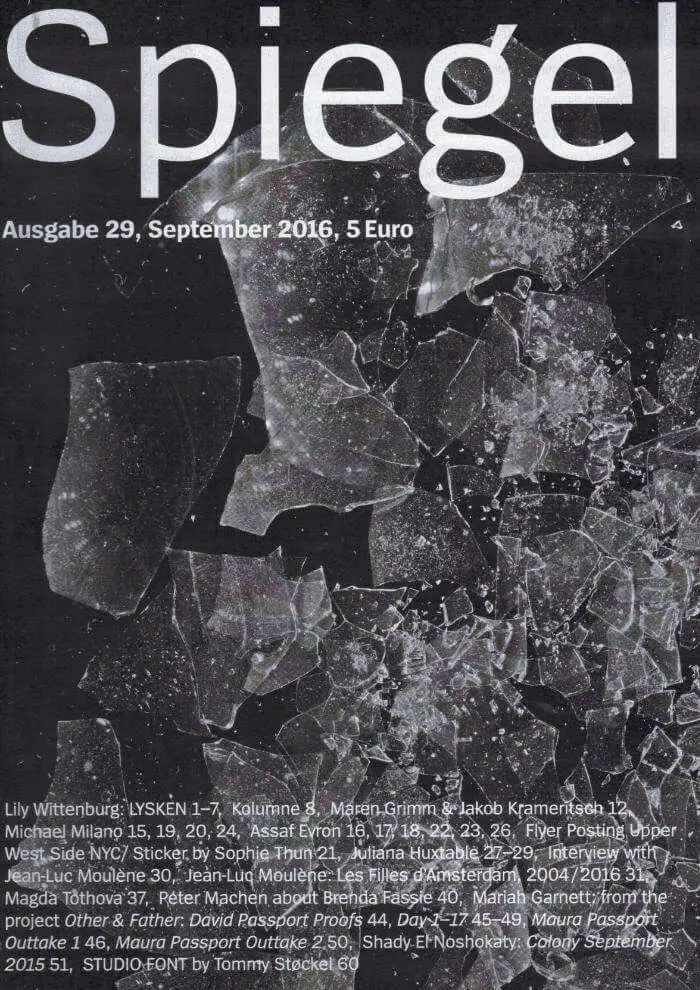
ztscript 29 : Spiegel
This issue uses the font designed for german news magazine Spiegel by amazing Lucas de Groot. The color poster is part of the full print of the series “Les Filles d’Amsterdam” by photographer Jean-Luc Moulène. It is the first time this series is printed in book form and in an exclusive interview the artist tells the story of that work.
Contributors: Lily Wittenburg, Maren Grimm & Jakob Krameritsch, Michael Milano, Assaf-Evron, Sophie Thun, Juliana Huxtable, Interview with Jean-Luc Moulène, poster by Jean-Luc Moulène, Magda Tóthová, Peter Machen on Brenda Fassie, Mariah Garnett, Shady El NoshokatyTommy Støckel

Self-portrait
Allison Grimaldi Donahue, Carla Lonzi
Recorded and transcribed throughout the 1960s, Carla Lonzi’s Self-portrait ruptures the narration of post-war modern art in Italy and beyond. Artmaking struck Lonzi as an invitation to be together in a ‘humanly satisfying way’, and this experiment in art-historical writing is a testament to her belief. Lonzi abolishes the role of the critic, her own, seeking change over self-preservation by theorising against the act of theorising.
The life and work of Carla Lonzi (1931–1982) is inseparable from the cultural, political, and social history of Italy in the decades following the Second World War; she occupies a singular position, which today merits reevaluation. A reputed art critic of the 1960s artistic scene, both friend and collaborator of such figures as Carla Accardi, Luciano Fabro, Giulio Paolini, and Jannis Kounellis, she wrote “Autoportrait” in 1969, a “love letter” to the artists and to creation, but also a farewell chorus to art criticism and the art world. The following year she founded Rivolta Femminile, an active feminist collective, thus becoming the central figure of Italian feminism.
Interviews with Carla Accardi, Getulio Alviani, Enrico Castellani, Pietro Consagra, Luciano Fabro, Lucio Fontana, Jannis Kounellis, Mario Nigro, Guilio Paolini, Pino Pascali, Mimmo Rotella, Salvatore Scarpita, Guilio Turcato, Cy Twombly.
Afterword by Claire Fontaine.
Translated by Allison Grimaldi Donahue.
978-1916425088
105 b&w illustrations
21.6 x 13.9 cm
364 p.
Paperback
November 2021

Necropolitics
In Necropolitics Achille Mbembe, a leader in the new wave of francophone critical theory, theorizes the genealogy of the contemporary world, a world plagued by ever-increasing inequality, militarization, enmity, and terror as well as by a resurgence of racist, fascist, and nationalist forces determined to exclude and kill. He outlines how democracy has begun to embrace its dark side—-what he calls its “nocturnal body”—-which is based on the desires, fears, affects, relations, and violence that drove colonialism. This shift has hollowed out democracy, thereby eroding the very values, rights, and freedoms liberal democracy routinely celebrates. As a result, war has become the sacrament of our times in a conception of sovereignty that operates by annihilating all those considered enemies of the state. Despite his dire diagnosis, Mbembe draws on post-Foucauldian debates on biopolitics, war, and race as well as Fanon's notion of care as a shared vulnerability to explore how new conceptions of the human that transcend humanism might come to pass. These new conceptions would allow us to encounter the Other not as a thing to exclude but as a person with whom to build a more just world.
(October 2019)
-webp.webp)
Notes on Conceptualisms
Vanessa Place, Robert Fitterman
What is conceptual writing, how does it differ from Conceptual Art, what are some of the dominant forms of conceptualism,where does an impure or hybrid conceptualism fit in, what about the baroque, what about the prosody of procedure, what are the links between appropriation and conceptual writing, how does conceptual writing rely on a new way of reading, a “thinkership” that can shift the focus away from the text and onto the concept, what is the relationship between conceptual writing and technology or information culture, and why has this tendency taken hold in the poetry community now? What follows, then, is a collection of notes, aphorisms, quotes and inquiries on conceptual writing. We have co-authored this text through correspondence, shared reading interests, and similar explorations. Notes on Conceptualisms is far from a definitive text, and much closer to a primer, a purposefully incomplete starting place, where readers, hopefully, can enter so as to participate.

If They Come in the Morning...
One of America's most historic political trials is undoubtedly that of Angela Davis. Opening with a letter from James Baldwin to Davis, and including contributions from numerous radicals such as Black Panthers George Jackson, Huey P. Newton, Bobby Seale and Erica Huggins, this book is not only an account of Davis's incarceration and the struggles surrounding it, but also perhaps the most comprehensive and thorough analysis of the prison system of the United State.
Since the book was written, the carceral system in the US has seen unprecedented growth, with more of America's black population behind bars than ever before. The scathing analysis of the role of prison and the policing of black populations offered by Davis and her comrades in this astonishing volume remains as pertinent today as the day it was first published.
Featuring contributions from George Jackson, Bettina Aptheker, Bobby Seale, James Baldwin, Ruchell Magee, Julian Bond, Huey P. Newton, Erika Huggins, Fleeta Drumgo, John Clutchette, and others.

The Faggots and Their Friends Between Revolutions
The Faggots and Their Friends Between Revolutions is a beloved queer utopian text written by Larry Mitchell with lush illustrations by Ned Asta, published by Calamus Press in 1977. Part-fable, part-manifesto, the book takes place in Ramrod, an empire in decline, and introduces us to the communities of the faggots, the women, the queens, the queer men, and the women who love women who are surviving the ways and world of men.
This new edition will feature essays from performance artist Morgan Bassichis, who adapted the book to music with TM Davy in 2017 for a performance at the New Museum, and activist filmmaker Tourmaline.

HUH why didn't I know this?
“Sometimes I find myself explaining to someone at 2 a.m. what a subsidy is. Or how train tickets become cheaper if you have the increased allowance – and what that is exactly. Or in which months you should email a cultural centre if you want to sell a performance. Then those people often say: “Huh, why didn’t I know this?” And: ‘Why isn’t all this just explained somewhere in simple words?’
So I started writing it myself. Because I had to figure these things out myself as a new creator, I can speak from experience. I know better than Kunstenpunt or Cultuurloket what a starting creator struggles with, because I’ve only been doing this for a few years myself. I can explain it better because some things in practice are quite different from the theory.”
Egon Schoelynck (he/him, 1996) is a Sunday child and theatre maker. His work is political-ish and can be found in black boxes, on paving stones and in collective collaborations. His artistic practice was supported by detheatermaker (’22-’25), where he explored, among other things, how to run a soap opera in a café without actors. Together with Runa Robbroeckx and Lennert De Vroey, he created KAK, an ecological shitshow (2025). He also solves global problems with punk songs and children’s instruments, under the name Middle Class Babypunk.
