Books
Books
in random order

Why I Failed in Porn
This book follows my journey of launching, growing, and ultimately failing in the adult entertainment industry. It explores society’s complex relationship with porn and sex education, the challenges of entrepreneurship, and the struggles of working in a deeply stigmatized space. Sometimes funny, often dramatic, and always surprising, it offers an unfiltered look at the business side of porn and what it really takes to challenge the status quo.

Terra Nova
Esther De Soomer, Rudolph Glitz
Terra Nova combines fragments from a novel in the making by Esther De Soomer, in which she explores the parallels between the loss of language and forest dieback, between climate grief and linguistic mourning. Reflecting on her own relationship with language and multilingualism, she traces the feelings of grief that accompany the loss of German, one of her mother tongues. Drawing on existing narratives — such as fairy tales and family stories — she examines the critical state of the disappearing Hambacher Wald in Western Germany and presents language as a means to name and hold on to things.

Bodies Found in Various Places
Elvira Hernández, Daniel Borzutzky and 1 more
The first anthology of Elvira Hernández’s poetry translated into English brings the award-winning contemporary Chilean poet's work of love, survival, persistence, disturbance, amazement, and delight to a new audience.
Elvira Hernández has occupied a marginal position in the Chilean poetic scene for decades, her quiet but mordant voice looking inward and outward, ironizing the circumstances of life that have brought us to this critical point in society. As recently as 2018, her work has become more visible after receiving the Jorge Teillier National Poetry Award (2018), the Pablo Neruda Ibero-American Poetry Award (2018), and the National Literature Prize (Chile 2024). With this belated recognition of her work has come an interest in studying her unique poetic language, with new critical books forthcoming from Spanish and Latin American publishers. Bodies Found in Various Places collects poems written from 1981-2016, providing readers with a curation of texts that show why Hernández is one of the most vital Latin American poets writing today.
"Elvira Hernández wrote her poem “The Chilean Flag” after she herself had been detained and tortured by the dictatorship for not complying with its lies. While Chileans were trained to look the other way, to go quiet by this terror, Elvira Hernández wrote a poem that could not be printed. Yet, the poem escaped like a prisoner and began circulating in Xeroxes, from hand to hand, until ten years later it was finally printed in Buenos Aires. In Elvira Hernández’s poetry, each line restores the right of words to speak. Each word becomes a healer, a prayer for a wounded, enslaved humanity forced to obey the rule of profit over life."— Cecilia Vicuña, author of Spit Temple

Paying Attention: Essays on Art and Culture
From award-winning novelist and cultural critic Lynne Tillman, Paying Attention is the first collection of essays devoted to her incisive, provocative, and singular reflections on art and culture.
Paying Attention gathers more than fifty of the best and varied examples of Lynne Tillman’s writings in reference to art and culture published over the course of forty years. In essays that operate outside typical categories or genres, Tillman reflects on forms including film, painting, photography, poetry, and fiction, as well as notions of fame, originality, embodied viewing and thinking, collective activity, aging, illness, American identity, cultural politics, modernity, strangeness, and time. Such is the stuff that relates art to life, and life to art.
Collected mainly from museum and gallery catalogues, artists’ books and monographs, her column in Frieze, and magazines including Aperture and Artforum, these meditations on artists and writers, in the broadest sense of these labels, collide as a portrait of our cultural moment. Tillman’s inventive use of language and lateral thought, her ability to evoke conditions of the larger world in often just two thousand words on a specific artwork or individual, make her one of the most significant critics of our time. As she acknowledges, in a piece on the artist Robert Gober, “In writing on art, words reach for other words, phrases, idioms, and through them more images and ideas leap out.” In her introduction, Elizabeth Schambelan notes that a hallmark of Tillman’s writing alongside artists is an “elegant rendering of complexity,” and in approaching Tillman’s body of work and thought, Schambelan herself imbricates the art, voice, and language of criticism.

Rejected. Designs for the European Flag
The flag bearing twelve yellow stars on a blue background has become Europe’s most recognisable symbol. Since its introduction by the Council of Europe in 1955, it has stood for the unification of Europe’s nation states. It was precisely this yellow circle of stars that prevailed over more than 150 flag ideas sent to the Council of Europe by a host of diverse private individuals. These colourful designs are being now published in Rejected for the first time. They document the continent’s zeitgeist at a decisive period in the development of European unity. Alongside the flag proposals, the trilingual book (English, German, French) features a written contribution by the German-French poet and writer Marie Rotkopf, who tackles the EU’s neoliberal political cynicism and Germany’s expansion of power with biting irony.

Énergies
Les sculptures et les films de Judith Hopf sont alimentés par des réflexions sur les relations que les êtres humains entretiennent avec la production et la technologie. Pour Énergies, sa première exposition monographique en France qui eut lieu conjointement à Paris à Bétonsalon et au Plateau, Frac Ile-de-France, l’artiste s’est concentrée sur cet élément invisible dont la quête accompagne notre quotidien et nos activités, produit par la conversion de ressources naturelles en puissance. Ce catalogue réunit des reproductions de dessins inédits, un entretien avec l’artiste et un texte critique de Tom Holert qui fait retour sur vingt années de travail.
Judith Hopf's sculptures and films are fuelled by reflections on the relationship human beings have with production and technology. For Énergies, her first solo exhibition in France, held jointly in Paris, at Bétonsalon and Plateau, Frac Ile-de-France, the artist focused on this invisible element whose quest accompanies our daily lives and activities, produced by converting natural resources into power. This catalog features reproductions of previously unpublished drawings, an interview with the artist and a critical text by Tom Holert, looking back over twenty years of work.
Textes / Texts
- François Aubart, Xavier Franceschi et Émilie Renard, "À propos d’énergie, d’amour et de chansons : conversation avec Judith Hopf"
- Tom Holert, "Changements de rythme : La méthodologie énergétique de Judith Hopf"
- François Aubart, Xavier Franceschi et Émilie Renard, "On Energy, Love, and Songs: Conversation with Judith Hopf"
- Tom Holert, "Changing Pace: Judith Hopf’s Energetic Methodology"
Traduction / Translation
Jean-François Caro
Louise Ledour
Typesetting : Olivier Lebrun

Experiments in Imagining Otherwise
This is a book of failure and mistakes; it begins with what is stolen from us and proposes only an invitation to imagine.
In these playful written experiments, Lola Olufemi navigates the space between what is and what could be. Weaving together fragmentary reflections in prose and poetry, this is an exploration of the possibility of living differently, grounded in black feminist scholarship and political organising.
Olufemi shows that the horizon is not an immaterial state we gesture toward. Instead, propelled by the motion of thinking against and beyond, we must invent the future now and never let go of the otherwise.
Lola Olufemi is a black feminist writer and CREAM/Stuart Hall Foundation researcher from London. Her work focuses on the uses of the feminist imagination and its relationship to futurity, political demands and imaginative-revolutionary potential. She is the author of Experiments in Imagining Otherwise and Feminism, Interrupted: Disrupting Power, the co-author of A FLY Girl’s Guide to University, and a member of ‘bare minimum’, an interdisciplinary anti-work arts collective.

Appendix Project
Written in the course of the year following the publication of Book of Mutter, and inspired by the lectures of Roland Barthes, Anne Carson, and Jorge Luis Borges, Appendix Project collects eleven talks and essays. These surprising and moving performances, underscored by the sleeplessness of the first year of their child’s life, contain their dazzling thinking through the work of On Kawara, Roland Barthes, W.G. Sebald, Bhanu Kapil, Walter Benjamin, Theresa Hak Kyung Cha, Marguerite Duras, Marlene Dumas, Louise Bourgeois, Doris Salcedo, Jenny Holzer, and more.

Disavowal
This book argues that the psychoanalytic concept of disavowal best renders the structure underlying our contemporary social response to traumatic and disturbing events, from climate change to unsettling tectonic shifts in our social tissue. Unlike denialism and negation, disavowal functions by fully acknowledging what we disavow. Zupancic contends that disavowal, which sustains some belief by means of ardently proclaiming the knowledge of the opposite, is becoming a predominant feature of our social and political life. She also shows how the libidinal economy of disavowal is a key element of capitalist economy.
The concept of fetishistic disavowal already exposes the objectified side of the mechanism of the disavowal, which follows the general formula: I know well, but all the same, the object-fetish allows me to disregard this knowledge. Zupancic adds another twist by showing how, in the prevailing structure of disavowal today, the mere act of declaring that we know becomes itself an object-fetish by which we intercept the reality of that very knowledge. This perverse deployment of knowledge deprives it of any reality.
This structure of disavowal can be found not only in the more extreme and dramatic cases of conspiracy theories and re-emerging magical thinking, but even more so in the supposedly sober continuation of business as usual, combined with the call to adapt to the new reality. To disrupt this social embedding of disavowal, it is not enough to change the way we think: things need to change, and hence the way they think for us.

A Queen in Bucks County
An epistolary sequence about sex, exchange and social space set along the Northeast Corridor.
In A Queen in Bucks County, our protagonist Turner, who both is and is not the writer, makes his pleasurable way through miserable space. Men "buy him things," lovers drive across state lines, users down volatile cocktails to see what happens, landlords turn tenants out, and Turner writes poetic tracts to friends about it. Part pornography, part novel, all love letter, A Queen in Bucks County is an experiment in turning language upside down to see what falls out.
2023 LAMBDA LITERARY AWARD FINALIST

SIN BUG
A new book by poet-activist CAConrad combining essay, memoir and (Soma)tic poetry rituals. Documenting the pervasive homophobic violence of the 1980s and the overwhelming losses of AIDS, this work is an unwavering testament to queer resilience. CA’s text forms a resounding incantation to friends and lovers lost. SIN BUG is the first book published as part of the Open Narratives series.
he wrote “I have AIDS
and kissed this wall”
X marked the spot
I wrote “I’m not afraid”
and kissed him back
wherever he is
CAConrad has been writing poems for more than 50 years and working with (Soma)tic poetry rituals for over 20 years. Their latest book is Listen to the Golden Boomerang Return (Wave Books / UK Penguin 2024). The Book of Frank is available in 9 different languages, most recently French and Italian. They also exhibit poems as sculpture with recent shows in London, Melbourne, Porto, Santander, and Tucson. Please visit them online at CAConrad.com.

Grab Bag
Cult novelist Dennis Cooper launches the third title of Little House on the Bowery, the Akashic series he is editing and promoting.
Grab Bag is comprised of two interrelated novels, Dark Rides and Wish Book, from one of Canada’s most important young writers. Both books are set in the same small rural city, in different eras (1950s, 1930s), each characterized by McCormack’s spare and elliptical prose.
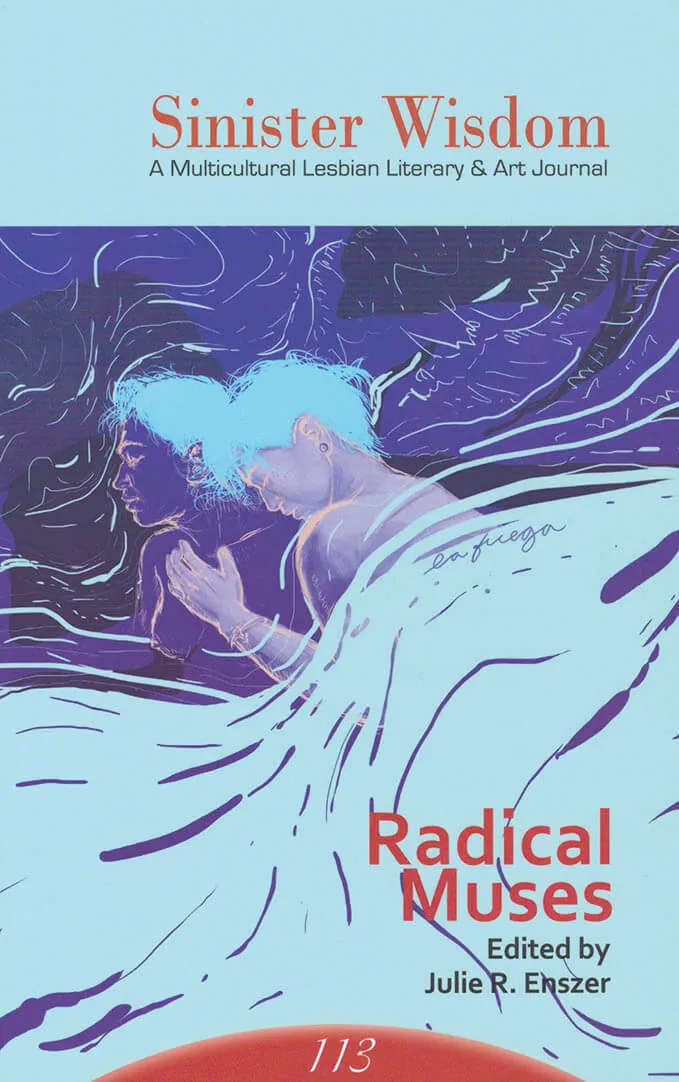
Radical Muses (Sinister Wisdom nr. 113)
Sinister Wisdom 113: Radical Muses features an eclectic array of contemporary poetry, prose, and art by lesbians from around the world, including new work by: Andrea Assaf, Tara Shea Burke, Cheryl Clarke, Marina Chirkova, Estela González, Barbara Haas, Nancy E. Lake, Vi Khi Nao, H. Ní Aódagaín and much more!

La rabbia / Anger
In a first-time English language translation by Cristina Viti to mark the poet’s centenary, Tenement Press will publish Pier Paolo Pasolini’s groundbreaking, filmic work of prose and verse, La rabbia / Anger.
Why is our life dominated by discontent, by anguish, by the fear of war, by war? In order to answer this question I have written La rabbia, not following a chronological or perhaps even a logical thread, but only my political reasons and my poetic sense. - Pier Paolo Pasolini
Written in response to producer Gastone Ferranti’s request for his comments on a set of newsreel items, the poet would respond with a montage of his own. Via the unfolding of a chrysalis of images, in La rabbia (1963), Pasolini’s lens pans over Soviet repression in Hungary; the Cuban revolution; (the utopian object of) space exploration; political imprisonment in Algeria; the liberation of the former European colonies; the election of Pope John XXIII; the prospect of revolution in Africa and the Middle East; in Europe and in Latin America... Here, we’ve a panoply of photorealist intimations of Pasolini’s ‘poetic sense.’ The death of Marilyn Monroe crests as an idea in this tidal pooling of reflections, and as the poet’s line lights out for conceptual rhymes and counterpoints.
In Viti’s translation, the weave of prose and poetry that forms La rabbia portrays the vitality of Pasolini’s work in its capacity to speak to both the specifics of his contexts, the character of our own present tense, and the ironic fact of a life lived against the gulf of discontent in its myriad forms. Here, we’ve a startling confrontation of a revolutionary struggle in stasis set in lines that crystallise a rallying call against blindness. ‘I’ll not have peace, not ever,’ he writes. A lucid acceptance of the poet’s restlessness, and a marker for Pasolini’s commitment to a solidarity with the oppressed that we find reaffirmed on every page, in La rabbia the poet charts how ‘the powerful world of capital takes an abstract painting as its brash banner’ in this unravelling of ‘crisis in the world.’

Tense (Silver Edition)
Tense is a never-realised publication, written and composed by Lucy Lippard and Jerry Kearns in 1984, that only now has been released in a very limited run on our imprint. The book accompanied the exhibition Top Stories, which took a closer look at the 29 issues of the prose periodical with the same title, founded in the late 1970s by Anne Turyn.
Top Stories was dedicated to fiction by emerging women artists and writers from that time. Tense was originally intended to become part of the series as well, but never made it to print. It was only recently – during the making of the exhibition at Amsterdam’s Kunstverein – that the original mock-up was retrieved from the editor’s archives and finally sent off to the printer.

¶#3: The mental traveller
¶#3 consists of texts and images found on the online collaborative encyclopedia Wikipedia, BIC pen drawings by Kim David Bots and the poem The Mental Traveller by William Blake. ¶#3 is assembled by Kim David Bots, designed by Tjobo Kho, edited by Jan-Pieter ‘t Hart and published in an edition of 150 by OUTLINE in May 2022.

Gaza, un génocide annoncé
La nouvelle catastrophe subie par le peuple palestinien est pire que la Nakba de 1948. C'est le premier génocide perpétré par un État industriel avancé depuis 1945, avec la participation des États-Unis et la soutien de l'Occident, France incluse. Chercheur franco-libanais spécialiste du Moyen-Orient, auteur de nombreux ouvrages traduit en vingt langues et contributeur régulier au Monde diplomatique, Gilbert Achcar dévoile le processus historique qui a mené à ce génocide et mène une réflexion rigoureuse et documentée sur ses conséquences pour le peuple palestinien, les peuples de la région et pour l'ensemble des relations internationales.

Girlbeast
Highly acclaimed in Denmark, Girlbeast is a fearless, unsettling, and poetic reimagining of the Lolita narrative, where power shifts unpredictably, and desire and coercion become indistinguishable. In a world that fetishises girlhood, it asks whether a girl be blamed for internalising the roles imposed upon her? Can she wield her youth as power in a system designed to render her powerless?
With sharp, fast-paced prose and an addictive plot, Cecilie Lind crafts a daring examination of female agency, sexuality, and the complexities of consent. The novel evokes the idea of the girl as animal – a creature conditioned to be both docile pet and wild beast, torn between submission and rebellion, innocence and desire.
Brave, provocative, and unflinching, Girlbeast is a gripping, vital novel for our times.
WINNER OF THE 2023 DANISH CRITICS PRIZE, SHORTLISTED FOR THE DR NOVEL PRIZE, MONTANA’S LITERATURE PRIZE & THE JYLLANDS-POSTEN FICTION PRIZE
Cecilie Lind (b. 1991) studied at Forfatterskolen (The Danish Academy of Creative Writing), and debuted in 2010 with The Wolf Ate My Eyeliner. Lind’s breakthrough in Denmark came with the publication of the highly acclaimed book-length poem My Child, which was shortlisted for the 2020 Critic’s Prize and the Politiken’s Literary Award. She was awarded The Native Language Prize in 2020, and Girlbeast won the Danish Critics Prize in 2023. Lind’s most recent novel, Bristefærdig (Ripe), was published to critical acclaim in 2025.
Hazel Evans (b. 1994) is an artist, writer and literary translator based near Aarhus, Denmark. She was the 2022/23 emerging translator for Danish to English at the National Centre for Writing, and her debut translation, Into a Star by Puk Qvortrup, was published by Hamish Hamilton. In 2024, she received The Inger and Jens Bruun Translation Prize for her translation of Rasmus Daugbjerg’s Troll, forthcoming from Penguin Press.

addictive no an adjective
A text on speaking, listening and being understood made in conversation with iOS speech-to-text software.

Brickmakers
Oscar Tamai and Elvio Miranda, the patriarchs of two families of brickmakers, have for years nursed a mutual hatred, but their teenage sons, Pájaro and Ángelito, somehow fell in love. Brickmakers begins as Pájaro and Marciano, Ángelito's older brother, lie dying in the mud at the base of a Ferris wheel. Inhabiting a dreamlike state between life and death, they recall the events that forced them to pay the price of their fathers' petty feud.
The Tamai and Miranda f-amilies are caught, like the Capulets and the Montagues, in an almost mythic conflict, one that emerges from stubborn pride and intractable machismo. Like her heralded debut, The Wind That Lays Waste, Selva Almada's fierce and tender second novel is an unforgettable portrayal of characters who initially seem to stand in opposition, but are ultimately revealed to be bound by their similarities.
Almada enlarges the tradition of some of the most distinctive prose stylists of our time. In Brickmakers, she furthers her extraordinary exploration of masculinity and the realities of working-class rural life. This is another exquisitely written and powerfully told story by a major international voice.

The Letters of Douglas Oliver and J. H. Prynne
Douglas Oliver (1937–2000) and J. H. Prynne (b. 1936) are two of the most original and ambitious poets of the contemporary era. Eschewing the conservativism of mainstream postwar British verse and embracing influences from America and Europe, each developed their craft through continuous correspondence and exchange as part of the febrile scene of poetical community and contestation that emerged in Cambridge in the 1960s. Their works over the following decades exhibit frequent shifts in form and style, from Prynne’s radical transformation and dispersal of the lyric tradition to Oliver’s adaptation of dream visions and medieval-inspired verse satires.
Their letters are a record of both the high stakes and playful experiments that constitute the writing lives of two singular poets determined not just to engage with modern political and social life during decades of crisis and upheaval, but to contribute through the circulation and publication of poetry to what Oliver calls “a community of political ethic.” Over the course of more than thirty years of friendship and mutual appreciation, the motivations for, and consequences of, their poems are constantly worked through, tested out, evaluated, and contradicted, always with a view to what the poetry means for the other, for the poetical communities they inhabit, and for the life of poetry itself.
This volume collects for the first time the majority of Oliver and Prynne’s correspondence, allowing new insights into the literary, political, and historical contexts of their lives and writing. An introduction, notes, and appendices provide a scholarly apparatus to situate Oliver and Prynne among the poets and publishers with whom they worked and socialized, and to identify and expand upon their frequent references to an enormous range of source material and reading matter.
“The correspondence between J. H. Prynne and Douglas Oliver is gripping and illuminating, brilliantly edited and completely absorbing. Two great poetic intelligences respond to each other’s work and to the society around them, thinking through the issues at stake in their poetic practice, their differences in approach, the different worlds they inhabit, their shared commitment to writing poetry and their admiration of each other’s work. The letters, complex as their matter can be, repay repeated reading; taken together, over a period of 33 years, they chart the context and creation of some of the most significant work in late twentieth-century poetry. This is an utterly engaging volume, and should be read by anybody interested in poetry and its place in the contemporary world.”—Ian Patterson
“For writers who welcome each other as peers, the exchange of letters is the spontaneous moment of exposure, the drawing out of selves. It is thinking in mutuality. In this thoughtfully edited and carefully, even beautifully, presented correspondence between Douglas Oliver and J. H. Prynne, two of the preeminent poets of the ‘British Poetry Revival’ of the post-World War II generations, we witness two writers of immense gifts thinking with each other, coming alive to thought and, ultimately, a shared world or community of wish. There is life, there is death; there is grief, there is anger – and love – but always there is a seeking, an attempt to arrive at a language for our worlds. Henceforth, one cannot imagine reading the work of either Oliver or Prynne without this correspondence and all that it offers in openings onto what Oliver himself saw as ‘the poet’s full performance [which] is the whole life’s work.’ It is a glimpse into an athanor of poetic creation.”—Michael Stone-Richards

Black Phoenix: Third World Perspectives on Contemporary Art and Culture
Facsimile compilation of the late-'70s journal on diasporic and colonial histories that paved the way for the British Black Arts Movement.
Published in three issues between 1978 and 1979, Black Phoenix: Journal of Contemporary Art & Culture in the Third World (the subtitle was changed to Third World Perspectives on Contemporary Art and Culture for its second and third issues) stands as a key document of its time. More than a decade after '60s liberation movements and the historic Bandung and Tricontinental Conferences that called for social and political alignment and solidarity to dismantle Western imperialism and (neo)colonialism, Black Phoenix issued a rallying call for the formation of a Third World, liberatory arts and culture movement on the eve of Margaret Thatcher's election in 1979.
Based in the UK, and both international and national in scope, Black Phoenix positioned diasporic and colonial histories at the center of an evolving anti-racist and anti-imperialist consciousness in late 1970s Britain—one that would yield complex and nuanced discourses on race, class and postcolonial theory in England in the decade that followed.
A precursor to the British Black Arts Movement that formed in 1982 (which encompassed such cultural practitioners as the Black Audio Film Collective and cultural studies theorist Stuart Hall), Black Phoenix proposed a horizon for Blackness beyond racial binaries, across the Third World and the colonized of the interior in the West.
This single-volume facsimile reprint gathers all three issues of the journal, which include contributions by art critics, scholars, artists, poets and writers, including editors Rasheed Araaen and Mahmood Jamal, Guy Brett, Kenneth Coutts-Smith, Ariel Dorfman, Eduardo Galeano, N. Kilele, Babatunde Lawal, David Medalla, Ayyub Malik, Susil Sirivardana and Chris Wanjala.

How to Sleep Faster 5
What are our politics of refusal? Sleep? Catatonia? Hedonism? Transgression even? #hustle?
[Can refusal can be performed as resistance and not operate as preemptively fucked. . .]
Arcadia Missa Publications; Rózsa Farkas, Holly Childs, Leila Kozma, Tom Clark (eds)

Real Estate Portfolio
Real Estate Portfolio by Claire Barrow
7 panel concertina + covers / total of 16 pages
9.6 × 14 cm folded / 98 cm extended
Riso 250gsm recycled offset exterior, litho 135gsm recycled offset interior
Glassine sleeve, digitally printed on the front & back
Self-published edition of 300, signed by the artist
Constructed in the UK (£0.016 per cm²)
The zine was drawn in one session using the right wrong hand.