rile*books

Search books

Search books by title, author, publisher, keywords...

Cover of The Odd Years

Wendy's Subway

The Odd Years

Morgan Bassichis

€30.00

Every Monday in 2017 and 2019, comedic performance artist Morgan Bassichis created a to-do list. THE ODD YEARS is a collection of those lists, which served both as a way to generate material for live performances and as a place to archive the logistical, emotional, and political business that just kept piling up throughout this two-year project. A record of routine and impossible tasks—some completed and others left unfinished—THE ODD YEARS is one response to the oddness of times in which intensified crisis becomes ordinary.  

THE ODD YEARS is the fourth title in the Document Series, an interdisciplinary publishing initiative that highlights work by time-based artists in printed form.

Morgan Bassichis is a comedian and musician living in New York City. Morgan's performances include Nibbling the Hand that Feeds Me (Whitney Museum, New York 2019), Klezmer for Beginners (Abrons Arts Center, New York, 2019), More Protest Songs (Danspace Project, New York, 2018), and The Faggots & Their Friends Between Revolutions: The Musical (New Museum, New York, 2017).

Published in 2020 ┊ 124 pages ┊ Language: English

recommendations

Cover of Nowhere Near

Wendy's Subway

Nowhere Near

Miko Revereza

Nowhere Near follows the author’s psychogeographic journey from Los Angeles to Pangasinan to Mexico City after his departure from the United States, where he lived undocumented for twenty-six years. Returning to the Philippines with his grandmother to search for lost land and to confront a “family curse,” Revereza surfaces legacies of Spanish colonialism and US imperialism as they bear out in its continued present. Through film stills, photographs, family archives, and a rapt, first-person narrative, Nowhere Near excavates the amnesias and silences that shape personal and historical memory in the exilic, diasporic impasse.

Miko Revereza's Nowhere Near is the 2021 Open Reading Period Book Prize winner, and was selected by guest judge John Keene.

About the author

Miko Revereza (b. 1988, Manila, Philippines) is an award-winning experimental filmmaker raised in California and currently residing in Oaxaca City. His upbringing as an undocumented immigrant and current exile from the United States informs his relationship to moving images. He has made a series of personal documentaries informed by his experiences with migration and exile: DROGA! (2014), Disintegration 93 – 96 (2017), No Data Plan (2018), Distancing (2019), El Lado Quieto (2021), and Nowhere Near (2023). These works have been screened at festivals and institutions such as Locarno, TIFF, NYFF, and MoMA. No Data Plan is recognized with such honors as the Sheffield Doc Fest Art Award, and was listed in BFI’s Sight & Sound Magazine’s 50 Best Films of 2019, Hyperallergic’s Top 12 Documentary and Experimental Films of 2019, and CNN Philippines’ Best Filipino Films of 2019. Nowhere Near (recipient of Hubert Bals Fund) was among Film Comment’s Best Undistributed Films of 2023 and CNN Philippines’ Best Filipino Films of 2023. Revereza was included in Filmmaker Magazine’s New Faces of Independent Cinema, is a Flaherty Seminar featured filmmaker, and is a recipient of the 2021 Vilcek Prize in Filmmaker. He holds an MFA from Bard College, Milton Avery Graduate School of the Arts. His films are distributed by LUX, London

Praise

In his powerful and entrancing voice, fueled by irony and critique, Miko Revereza explores neoliberal capitalism, the challenges facing undocumented families, the non-existent “American dream,” and internal and external exile, showing how borders of all kinds (geographical, racial, psychic), though regularly traversed, are policed and criminalized. Nowhere Near is a cri de coeur about twenty-first century American society.
—John Keene

Miko Revereza’s captivating book is a companion to his diaristic 2023 feature of the same title, and it is a pleasure to encounter on the page the resonant literary voice he developed while making that film. Befitting its rich entwining of personal and political histories, Nowhere Near contains a wondrous range of modes and moods: raw and revealing one moment, sharply and humorously observant the next, by turns poetic and plainspoken.  
—Dennis Lim

Nowhere Near is a document of lives lived undocumented. Here, form matters: text branches out from image, while dialogue counterpoints an easy, self-reflexive poetic. With the acuity necessitated by a status requiring constant vigilance, negotiating the privatized avenues of America’s dream, Revereza’s words carry a weight that belies their simplicity. Here and now, our attention matters, as America’s icy grip chills us all.
—Alia Syed

Cover of Glaring

Wendy's Subway

Glaring

Benjamin Krusling

Poetry €18.00

Glaring: a sustained look of anger, an obvious fact, a situation of such brightness and intensity that vision is obscured. In his debut book of poems, Benjamin Krusling is concerned with reading domination and violence and entering their psychotic motion, the better to do otherwise. Through the thicket of anti-blackness, militarism, surveillance, impoverishment, and interpersonal abuse and violence, Glaring investigates the things that haunt daily life and make love difficult, possible, necessary.

Benjamin Krusling's Glaring is the winner of our 2019 Open Reading Period, and was selected by guest judge Lucy Ives.

Cover of She Follows No Progression

Wendy's Subway

She Follows No Progression

Rachel Valinsky, Juwon Jun

Anthology €30.00

She Follows No Progression reflects on the plurality of Theresa Hak Kyung Cha (1951–1982)’s work and legacy, collecting essays, personal narratives, poems, conversations, letters, and the extratextual in a reader that attests to Cha’s genre-bending vision and political imagination. The writers, artists, scholars, organizers, and educators collected here, each unique in their voice and method, multiply approaches to language, colonial history, migration, and time in dialogue with Cha’s unequivocally interdisciplinary practice. Their contributions traverse subjects from Asian American studies to literary history, translation, film theory, and experimental poetics, while attending to the gaps between these fields and the intractable entanglements of race, class, and gender that underlie them. She Follows No Progression echoes Cha’s appeal for a liberatory horizon emergent from all that we are affixed to in the present.

She Follows No Progression is published on the occasion of the 2022 program, The Quick and the Dead: Theresa Hak Kyung Cha Edition. The Quick and the Dead is a yearlong, multiphase project that highlights the life, work, and legacy of a deceased writer by bridging their work to that of contemporary practitioners. In its third year, the program focused on Theresa Hak Kyung Cha.

Contributors:

Sam Cha, Marian Chudnovsky, Jesse Chun, Una Chung, Anton Haugen, Irene Hsu, Valentina Jager, Juwon Jun, Youbin Kang, Eunsong Kim, Youna Kwak, Jennifer Kwon Dobbs, Andrew Yong Hoon Lee, Jennifer Gayoung Lee, Sujin Lee, Florence Li, Serubiri Moses, Jed Munson, Yves Tong Nguyen, Wirunwan Victoria Pitaktong, Brandon Shimoda, Caterina Stamou, Megan Sungyoon, Teline Trần, and Soyoung Yoon.

Cover of A Grammar Built with Rocks

Wendy's Subway

A Grammar Built with Rocks

Shoghig Halajian, Suzy Halajian

Featuring writing and artistic practices that trace the racialized and gendered relationship between bodies and land, A Grammar Built with Rocks explores artists’ engagement with sites of physical dispossession and socio-ecological crisis, highlighting how creative research methodologies can serve as radically new place-making practices. The publication brings together a range of feminist-decolonial texts and visual contributions that explore how movement, transience, and improvisation offer alternative ways of being-together while being-in-place.  

Contributions by: Basel Abbas and Ruanne Abou-Rahme with Fawz Kabra, Jheanelle Brown and Julien Creuzet, Carolina Caycedo, Ryan C. Clarke and Cauleen Smith, DAAR—Decolonizing Architecture Art Research with Nicola Perugini, Sandra de la Loza, Demian DinéYazhi’, rafa esparza, Mashinka Firunts Hakopian, Tia-Simone Gardner, Raquel Gutiérrez, Suzanne Kite with Mahpíy̌a Nážinn, Candice Lin, Jumana Manna, K-Sue Park, Christine Rebet, Susan Silton, and Asiya Wadud.

The book also includes a reader, with grounding texts, sources of inspiration, and research references, by Jason Allen-Paisant, Dionne Brand, Suzanne Césaire, Lisa Lowe, Camila Marambio and Cecilia Vicuña, Robyn Maynard and Leanne Betasamosake Simpson, M. NourbeSe Philip, and K. Wayne Yang.

About the editors

Shoghig Halajian is a curator, writer, and artist whose work explores queer and diasporic imaginaries, place-based practices, and experiments in collectivity and collaboration. She is co-editor of the online journal, Georgia, which is supported by a Creative Capital | Andy Warhol Foundation Arts Writers Grant. Select curatorial projects include: A grammar built with rocks (Human Resources LA, One Archives at the USC Libraries, and REDCAT, 2018); At night the states (Hammer Museum, 2017); DISSENT: what they fear is the light (LACE, 2016); and rafa esparza: I have never been here before (LACE, 2015). She was a TBA21 Ocean Space Fellow in Venice (2021) and a curatorial fellow at École du Magasin in Grenoble (2011), where she co-curated the exhibition, The Whole World is Watching, on the the collective Vidéogazette (1973–76), which organized a public access television program in the city. She received her PhD in Art History, Theory, and Criticism with a specialization in Critical Gender Studies from the University of California, San Diego in 2024. 

Suzy Halajian is a curator and writer based in Los Angeles, where she serves as the Executive Director and Curator at JOAN. Her practice is invested in long-term collaborations with artists, critically engaging with the intersections of art, politics, and social histories. She explores strategies of image-making through the lens of colonial histories and contemporary surveillance states. Halajian has curated exhibitions and public programs at institutions such as Los Angeles Contemporary Exhibitions (LACE), ONE Archives at the USC Libraries, the Hammer Museum, and Human Resources Los Angeles, as well as Tanya Bonakdar Gallery (New York), Oregon Contemporary (Portland), Kunstverein (Amsterdam), UKS (Oslo), Galerie Hubert Winter (Vienna), and the Sursock Museum (Beirut). She also serves on the Programming Committee at Human Resources and has worked with nonprofit organizations including the MAK Center for Art and Architecture (Los Angeles) and Ashkal Alwan (Beirut). Her curatorial work and writing have been supported by the Graham Foundation, the Andy Warhol Foundation Arts Writers Grant—for Georgia, a journal she co-founded and co-edits with Anthony Carfello and Shoghig Halajian—and a Curatorial Research Fellowship from the Andy Warhol Foundation for the Visual Arts. Halajian’s writing has appeared in ArteEast, BOMB, X-TRA, Ibraaz, and other publications. She holds an MA from the Center for Curatorial Studies at Bard College and is currently a PhD candidate in the Film and Digital Media program at the University of California, Santa Cruz.

Cover of Ad Học

Wendy's Subway

Ad Học

Teline Trần

Poetry €12.00

Teline Trần's Ad Học traverses the improvisational structures that shape social life in order to reflect their valences as both insufficient and abundant. In their first poetry chapbook, Trần locates those junctures with bittersweet pleasure and biting critique and asks how to sustain both at once. This is, Trần shows us, the work of living, against and within the ongoing attrition and amnesia at scales historical and governmental, interpersonal, familial, and social. Ad Học asks the reader to turn inwards, towards a personal politic, to self-revolution, in order to seek horizons dreamier, queerer, and hopefully insurgent.

Teline Trần is a writer from Orange, California or Gabrieleño/Tongva land. They write about home and interstitial faith via several mediums such as fiction, poetry, film, and ultimately, the browser. Teline works as the Membership and Community Engagement Coordinator at Wendy’s Subway, where they were a Fellow in 2020. They also work as the Development Coordinator at Mekong NYC, a Southeast Asian grassroots organization in the Bronx. They hold a degree in Comparative Literature from Reed College.

Cover of The Faggots and Their Friends Between Revolutions

Nightboat Books

The Faggots and Their Friends Between Revolutions

Larry Mitchell

Poetry €17.00

The Faggots and Their Friends Between Revolutions is a beloved queer utopian text written by Larry Mitchell with lush illustrations by Ned Asta, published by Calamus Press in 1977. Part-fable, part-manifesto, the book takes place in Ramrod, an empire in decline, and introduces us to the communities of the faggots, the women, the queens, the queer men, and the women who love women who are surviving the ways and world of men.

This new edition will feature essays from performance artist Morgan Bassichis, who adapted the book to music with TM Davy in 2017 for a performance at the New Museum, and activist filmmaker Tourmaline.

Cover of Textdemic: A Retrospective on Jenny Holzer’s Laments

GenderFail

Textdemic: A Retrospective on Jenny Holzer’s Laments

A.L. Steiner

Poetry €22.00

Textdemic | A Retrospective on Jenny Holzer’s Laments” Ed. by A.L. Steiner and GenderFail, a publication based on A.L. Steiner + Friends on Jenny Holzer at Dia Chelsea. This book is based on the Artists on Artists Lecture Series when the Dia Art Foundation invited Steiner to curate a public program based on a work of the artist's choice.

Steiner chose Jenny Holzer’s Laments and invited Morgan Bassichis, Riel Bellow, Gregg Bordowitz, Alexander Chee, Malik Gaines, Guadalupe Maravilla + Alexa Mishell Guillen, Lucas Michael, Eileen Myles and Pamela Sneed to present in Dia’s first in-person program after the Covid-19 pandemic began in 2021. This publication features records of the poems, lectures, and performances during this memorial program. The book's design plays homage to the 1990 Laments publication by the Dia Art Foundation.

For this publication, Steiner and GenderFail invited Matilde Guidelli-Guidi, Associate Curator at Dia Art Foundation and the organizer of the Artists on Artists Lecture Series, to write an afterword for the book. In this, she states: "Dispensing altogether with the monographic formula that characterizes the institution, for her Lecture A.L. Steiner convened a group of artists, writers, and activists to join her in responding to Jenny Holzer’s 1989 text-based installation, Laments. Holzer identified the thirteen texts that comprise Laments as 'voices of the dead,' a visual choir in response to the raging HIV/AIDS epidemic and government inaction. Over the protracted COVID-19 lockdown, Steiner developed the idea to organize an evening for the voices of the living to lament today's crises.”

Cover of Catalog issue 17 — ‘Introduction’

Cataloging

Catalog issue 17 — ‘Introduction’

Lieven Lahaye

Catalog is a serial publication about cataloging, written by Lieven Lahaye and designed by Ott Metusala. This is Catalog issue 17, ‘Introduction’, it’s part of a sub-series, researching the life, work and near invisibility of writer Duncan Smith (1954–1991).

Cover of Numbered Map

Goswell Road

Numbered Map

Archie Chekatouski

Goswell Road publishes ‘Numbered Map’ by Archie Chekatouski, to accompany his exhibition 'You can do so much more with a chair than you can with a painting?'. The publication is edited in 30 copies and focuses on Chekatouski’s Paint-by-numbers Series.

Bio: Archie Chekatouski (born 1996 in Minsk, Belarus) lives and works in Paris. His works are touchingly silly and beautifully simple.
 

Cover of Vostok

SB34

Vostok

SB34

The theme was built around the idiom “VOSTOK”, the title given by Stéphanie Pécourt to her cycle dedicated to performative semantics, in which carte-blanches signed by guest curators at the Centre Wallonie-Bruxelles are deployed. Buried beneath several kilometers of ice, Lake Vostok acts as an invitation that both fascinates and refuses us. This sub-glacial lake on the edge of Antarctica, the largest identified, becomes the mirror-object of our desires and fears for the abyssal depths. The title of the program, Now I am a Lake, is taken from Sylvia Plath's poem Mirror (1961).

This booklet includes the scripts and texts of the performances, translated exclusively into French for the occasion, as well as images from the videos presented at the eponymous event. The compilation focuses on Sylvia Plath's poem Mirror, and includes an introductory text by curator Pauline Hatzigeorgiou

edited by SB34
graphic design by Raphaëlle Serres / Solid Éditons

Contributions by Signe Frederiksen, Pauline Hatzigeorgiou, Margaux Schwarz, Hagar Tenenbaum, Sylvia Plath & Eleanor Ivory Weber

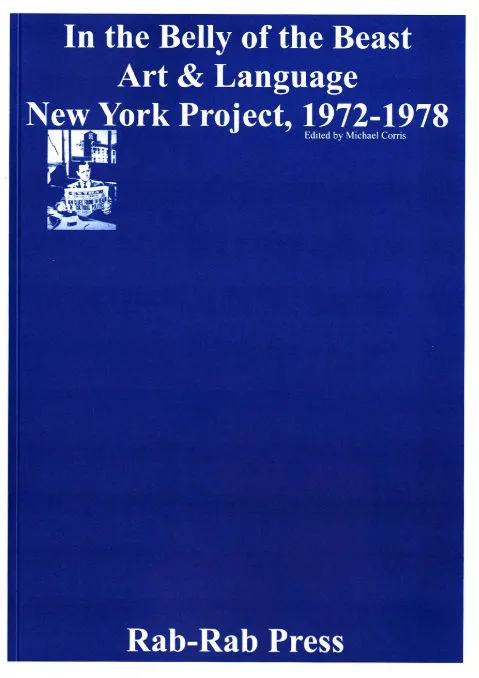
Cover of In the Belly of the Beast – Art & Language New York Project 1972-1978

Rab-Rab Press

In the Belly of the Beast – Art & Language New York Project 1972-1978

Art & Language

Edited by Michael Corris, the expanded edition of In the Belly of the Beast: Art & Language New York Project 1972-1978 is a survey of the tumultuous years of the political Conceptualism in the mid-seventies New York.

Artists have always experimented with politics, either by organizing themselves or uniting in support of a broader political movement. Today, "activist art" is taught in universities, supported by foundations, and featured in museums and international exhibitions. Is this the only possible way?

In the Belly of the Beast tells a different story, of the work of politically engaged artists and the conflicts they experienced. It is the history of artists wishing to continue working within the boundaries of the artworld and those who were intent on establishing new ideological and class relationships with activists to build a political party.

During the 1970s in New York, the Art & Language collective pioneered institutional critique; published a Marxist-influenced journal; agitated against racism and sexism in museums; challenged the cultural imperialism of international exhibitions; and forged a framework for a socialist organization of artists. This new edition includes previously unpublished documents illuminating the contradictions and disputes that lay at the center of the organization and practices of Art & Language and left-wing groups, such as the Anti-Imperialist Cultural Union and the Artists' Meeting for Cultural Change, mobilizing artists in New York at the time.

The new and expanded edition of In the Belly of the Beast features an extensive interview with Michael Corris, who annotated a collection of previously unavailable documents from the period, including manuscripts, pamphlets, transcripts, and letters.

Art & Language is the name of a group of English artists who choose to work collectively, and the title of a magazine that they founded in 1968. Proposing a critical analysis of the relations between art, society, and politics, Art & Language marks, even in its name, the importance of the “textual turning point” in the 1960s.

Since 1976, Art & Language's project has continued, through Mel Ramsden and Michael Baldwin, with the literary and theoretical collaboration of Charles Harrison. Working with very varied mediums, from painting to rock, these co-founders of Conceptual art remain, even today, attached to observing the consequences of what they themselves call the “depressing collapse of modernism.”

Cover of “If It's For The People, It Needs To Be Beautiful,” She Said

What You See Is What You Hear

“If It's For The People, It Needs To Be Beautiful,” She Said

Jeremiah Day

Performance €25.00

Accompanying a series of solo collaborations in 2020, this publication offers the first comprehensive and global perspective on Jeremiah Day's work as an artist, performer, researcher and teacher. As it details Day's specific works and evolution between visual and performing arts and between political reflection and engagement the result also serves as sourcebook for the legacy of the intersection between dance and the visual arts of the 1960s and 70's and the models of cultural practice emerging from the work of Hannah Arendt.

In his work, the Berlin-based American artist Jeremiah Day (born 1974 in Plymouth) re-examines recent political struggles and conflicts, revealing their subjective contexts and traces. To do this, he has developed a narrative and choreographic form in which personal and political realities intermingle, thus offering a thoroughly singular vision of these at times forgotten moments of history. 

The distinctive feature of his method lies in a transversal approach. As a student of and regular collaborator with Simone Forti, one of the pioneers of Post-Modern Dance, he has turned performance into a now central and structure-providing practice. Since 2014, Jeremiah Day has in effect presented many performances, which contain movement, improvisation, photography and the spoken word, in order to broach universal historical and political subjects, but within an intimate and incarnated context.