rile*books

Search books

Search books by title, author, publisher, keywords...

Cover of Glaring

Wendy's Subway

Glaring

Benjamin Krusling

€18.00

Glaring: a sustained look of anger, an obvious fact, a situation of such brightness and intensity that vision is obscured. In his debut book of poems, Benjamin Krusling is concerned with reading domination and violence and entering their psychotic motion, the better to do otherwise. Through the thicket of anti-blackness, militarism, surveillance, impoverishment, and interpersonal abuse and violence, Glaring investigates the things that haunt daily life and make love difficult, possible, necessary.

Benjamin Krusling's Glaring is the winner of our 2019 Open Reading Period, and was selected by guest judge Lucy Ives.

Language: English

recommendations

Cover of A book with a hole in it

Wendy's Subway

A book with a hole in it

Kamelya Omayma Youssef

Poetry €18.00

Kamelya Omayma Youssef’s A book with a hole in it uses the poetry of the fragment and the language of everyday survival to gesture towards the fallibility of language at the juncture of the multiple, intersecting wars on women, on "terror," on the non-White body, and on people and language in diaspora. Drawn from a set of journals written over a four-month period, A book with a hole in it throws the formal, official work of poetry into relief, asking what knowledge exists beyond knowledge, which silences are too deep to be surfaced on the page, and how to pierce through trauma and violence to approach a politics of redemption.

Cover of She Follows No Progression

Wendy's Subway

She Follows No Progression

Rachel Valinsky, Juwon Jun

Anthology €30.00

She Follows No Progression reflects on the plurality of Theresa Hak Kyung Cha (1951–1982)’s work and legacy, collecting essays, personal narratives, poems, conversations, letters, and the extratextual in a reader that attests to Cha’s genre-bending vision and political imagination. The writers, artists, scholars, organizers, and educators collected here, each unique in their voice and method, multiply approaches to language, colonial history, migration, and time in dialogue with Cha’s unequivocally interdisciplinary practice. Their contributions traverse subjects from Asian American studies to literary history, translation, film theory, and experimental poetics, while attending to the gaps between these fields and the intractable entanglements of race, class, and gender that underlie them. She Follows No Progression echoes Cha’s appeal for a liberatory horizon emergent from all that we are affixed to in the present.

She Follows No Progression is published on the occasion of the 2022 program, The Quick and the Dead: Theresa Hak Kyung Cha Edition. The Quick and the Dead is a yearlong, multiphase project that highlights the life, work, and legacy of a deceased writer by bridging their work to that of contemporary practitioners. In its third year, the program focused on Theresa Hak Kyung Cha.

Contributors:

Sam Cha, Marian Chudnovsky, Jesse Chun, Una Chung, Anton Haugen, Irene Hsu, Valentina Jager, Juwon Jun, Youbin Kang, Eunsong Kim, Youna Kwak, Jennifer Kwon Dobbs, Andrew Yong Hoon Lee, Jennifer Gayoung Lee, Sujin Lee, Florence Li, Serubiri Moses, Jed Munson, Yves Tong Nguyen, Wirunwan Victoria Pitaktong, Brandon Shimoda, Caterina Stamou, Megan Sungyoon, Teline Trần, and Soyoung Yoon.

Cover of An Eros Encyclopedia

Wendy's Subway

An Eros Encyclopedia

Rachel James

Poetry €18.00

To want to reveal; to want to reveal enough; to desire; to desire in the right way, the right amount: in her debut book, Rachel James narrates the desiring subject’s nuanced and entangled intimacies with histories of power. How, in other words, under patriarchy, against misogyny, within capitalist strictures, is knowledge shaped, contained, and transferred? Tracing traditions of theater, pedagogy, and faith, An Eros Encyclopedia offers up desire and the attunement to its many objects as the atmosphere of a life—a method to navigate, perceive, and relate against the illusion of separation.

Cover of Memorial Park: Revisiting Vietnam

Wendy's Subway

Memorial Park: Revisiting Vietnam

Minh Nguyen

€22.00

Fifty years after the Fall of Saigon and twenty years after her family’s emigration to America, Minh Nguyen returns to her native Vietnam to find out what’s left of the old revolutionary project. In Memorial Park, a collection of essays pairing travelogue and criticism, Nguyen encounters relics of proletarian romance and vestiges of authoritarian control amid an evermore corporatized society. Along the way, she considers how contemporary artspeak confuses state censors, the rise of luxury “Smart Cities” as they supplant socialist housing complexes, and the enduring appeal of propaganda signs that once promised utopia. 

Driven by a diasporic curiosity that seeks discovery over dwelling on loss, Memorial Park avoids nostalgic idealism or reflexive condemnation. Instead, Nguyen takes seriously the legacy of Vietnamese liberation by naming what it has become—and what it has not. What emerges is a complex picture of the country today and a reflection on how we inherit and reckon with radical histories that shape our world.

Minh Nguyen is a writer and curator based between New York City and Ho Chi Minh City. She is the curator of Dogma, a collection and gallery in Ho Chi Minh City focused on art and political graphics, and managing editor of e-flux journal. Her art and film criticism has appeared in publications such as Art in America, Artforum, e-flux, Momus, Mousse, and frieze, and she has curated exhibitions and programs at Wing Luke Museum, Northwest Film Forum, King Street Station, Gene Siskel Film Center, and Chicago Cultural Center. Formerly an instructor at Parsons School of Design—The New School, she has received a Warhol Arts Writers Grant, Fogo Island Arts Writing Award, and New York University’s Asia/Pacific/America Institute Visiting Scholar fellowship.

Vietnam is dissected under Minh Nguyen’s sharp scalpel. Attending to the unresolved pathologies of the past and the detours of the present, Memorial Park sketches the multiple faces of a country in full mutation. In turn lucid, sensitive, acerbic, and full of humor, this collection of essays mixes personal narrative, and social, cultural, and historical critique with discerning observations to interrogate what remains of that old dream of a communism that is “too good to be true.”
— Thuận, author of Chinatown and Elevator in Sài Gòn

What would it mean to “normalize” one of the most transformative conflicts of the Cold War in public consciousness? And how might the diasporic imaginary trouble such narratives, whether revolutionary or reactionary? Some five decades after the fall of Saigon, Minh Nguyen returns to her ancestral home to confront both the live and mediated reality of Vietnam on the ground—and elsewhere. In deeply poetic, incisive, and insightful reflections, she speaks to what is “hauntingly unassimilable” about the present tense of the American War.
— Pamela M. Lee, author of Think Tank Aesthetics

With confidence and measure, this thoughtful collection investigates culture in Vietnam in today’s so-called post-socialist context. Nguyen makes sense of the nation through the conjunction of what she was told by her parents as a diasporic kid growing up in America, and what she experiences when she returns to Vietnam as an adult. Her writing unfolds complex political histories and their ongoing implications for contemporary art and cultural practice, with unique attention to process and how research happens. This book takes the reader on a journey at the end of which everything is as it was, but different through her telling.
— Yaniya Lee, author of Selected Writing on Black Canadian Art

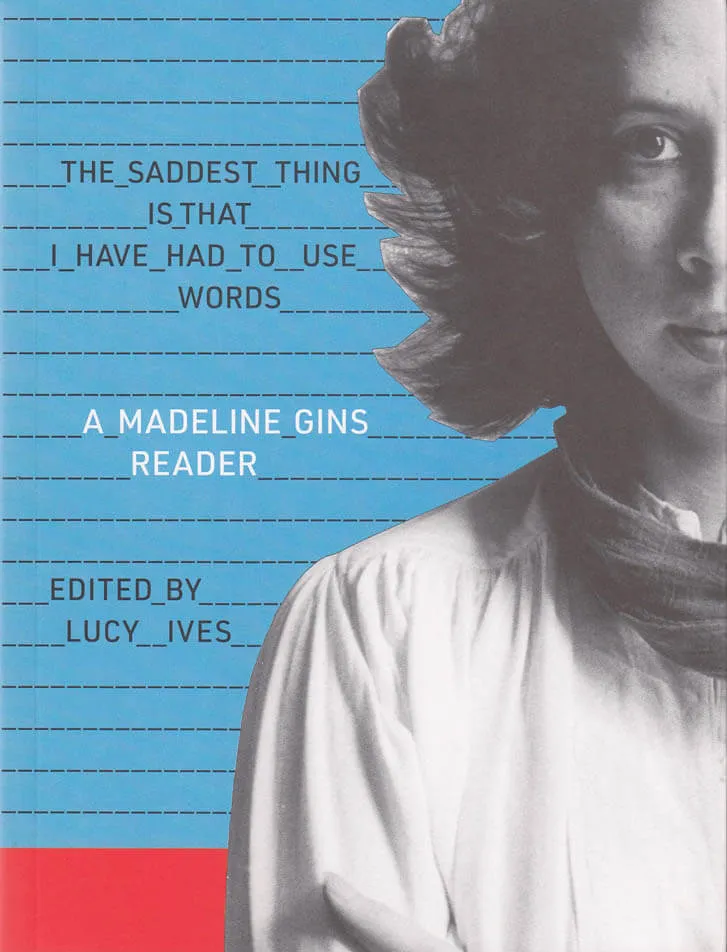
Cover of The Saddest Thing Is That I Have Had to Use Words: A Madeline Gins Reader

Siglio Press

The Saddest Thing Is That I Have Had to Use Words: A Madeline Gins Reader

Madeline Gins

Poetry €28.00

Poet, philosopher, speculative architect and transdisciplinary artist, Madeline Gins is well known for her collaborations with her husband, the artist Arakawa, on the experimental architectural project Reversible Destiny, in which they sought to arrest mortality by transforming the built environment. Yet, her own writings — in the form of poetry, essays, experimental prose and philosophical inquiries — represent her most visionary and transformative work. Like Gertrude Stein before her, Gins transfigures grammar and liberates words. Like her contemporaries in conceptual art, her writing is attuned to the energized, collaborative space between reader and page.

The Saddest Thing Is That I Have Had to Use Words: A Madeline Gins Reader is a revelatory anthology, edited and with an introduction by the writer and critic Lucy Ives. It brings never-before-published poems and essays together with a complete facsimile reproduction of Gins' 1969 masterpiece, WORD RAIN (or A Discursive Introduction to the Intimate Philosophical Investigations of G, R, E, T, A, G, A, R, B, O, It Says), along with substantial excerpts from her two later books What the President Will Say and Do!! (1984) and Helen Keller or Arakawa (1994). Long out of print or unpublished, Gins' poems and prose form a powerful corpus of experimental literature, one which is sure to upend existing narratives of American poetics at the close of the 20th century.

Edited by Lucy Ives. 

Cover of Spells: 21st Century Occult Poetry

Silver Press

Spells: 21st Century Occult Poetry

Sarah Shin, Rebecca Tamas

Poetry €17.00

Spells are poems; poetry is spelling.

Spell-poems take us into a realm where words can influence the universe.

Spells brings together over forty contemporary voices exploring the territory where justice, selfhood and the imagination meet the transformative power of the occult. These poems unmake the world around them, so that it might be remade anew.

Kaveh Akbar, Rachael Allen, Nuar Alsadir, Khairani Barokka, Emily Berry, A.K. Blakemore, Jen Calleja, Anthony V. Capildeo, Elinor Cleghorn, CAConrad, Nia Davies, Paige Emery, Livia Franchini, Alexis Pauline Gumbs, Will Harris, Caspar Heinemann, Lucy Ives, Rebecca May Johnson, Bhanu Kapil, Amy Key, Daisy Lafarge, Dorothea Lasky, Francesca Lisette, Canisia Lubrin, Karen McCarthy Woolf, Lucy Mercer, Hoa Nguyen, Precious Okoyomon, Rebecca Perry, Nat Raha, Nisha Ramayya, Ariana Reines, Sophie Robinson, Erica Scourti, Sarah Shin, Himali Singh Soin, Tai Shani, Rebecca Tamás, Bones Tan Jones, Dolly Turing, Jane Yeh, Flora Yin Wong

Introduced by So Mayer
Afterword by Sarah Shin

Cover of Fuel

Nightboat Books

Fuel

Rosie Stockton

Poetry €18.00

Traversing multivalent intimacies from the underworld of California’s Central Valley oil fields to the quotidian domestic and love’s painful retraction, Stockton’s poems articulate the blurry modes of extraction, fantasy, loss, gender, and labor as they interact and overlap in the shadow of environmental and personal collapse. Between gas station gifts, Venmo requests, and nocturnal love letters, Fuel unravels the self and violent systems of domination, longing for a togetherness that transcends its own ending.

In these poems, Stockton plunges into petrologic, long drives, the beginnings of ends—whatever enters into love between people and makes it so abstract, or common. In other words, its great subject is the edge, and Fuel is a book of horizons. - Benjamin Krusling

Rosie Stockton is the author of Permanent Volta (Nightboat Books 2021) which was the recipient of the Sawtooth Prize as well as being a finalist for the California Book Awards in Poetry and the Publishing Triangle’s Audre Lorde Award for Lesbian Poetry. Their poems have been published by Social Text Journal, VOLT, Jubilat, Apogee, Mask Magazine, Tripwire and WONDER PRESS. They hold an M.A. in Creative Writing from Eastern Michigan University and are currently a Ph.D. Candidate in the Gender Studies Department at UCLA. Rosie lives and works in Los Angeles.

Cover of Strange Biology

Wendy's Subway

Strange Biology

Charlotte Strange

Poetry €14.00

Strange Biology, Charlotte Strange’s first chapbook, opens with a social media advertisement marketing a probiotic as an alternative to the “nuclear bomb” of antibacterial acne medication. As Strange investigates the treatment of the human body as a landscape submissive to medical intervention, they ruminate on the contemporary relationship between microbes, gut-directed medical technologies, and capitalism’s encroachment on life. Drawing on the vernacular of social media marketing, they deftly oscillate between instructive and personal registers, stretching the private across a nexus of microbial interminglings. Strange Biology reflects on the semiotic science of the gut: how the language of medicine defines the mutating edges of the human body.