rile*books

Search books

Search books by title, author, publisher, keywords...

Cover of Revue Faire °29: Girls, the Troopers of Dance

Éditions Empire

Revue Faire °29: Girls, the Troopers of Dance

Alexandra Midal

€7.00

The British origins of synchronized dancing—invented in 1880 by John Tiller in a cotton mill—were quickly forgotten in Berlin, where periodicals established themselves as the expression of standardization and American capitalism. The famous Tiller Girls had become the modern figure of the “New Woman”, performing in shows attracting more than four million spectators each year. A seduced Hitler asked for his own troupe: the Hiller Girls. Face to face, both periodicals look like strictly indistinguishable replicas, apart from their opposite messages.

Synchronized dancing revealed the democratic and fascist forms given to the political discourse of the Weimar Republic when the NSDAP seized power. Between the power of forms and forms of power, amid the destruction of cities, decrees banishing the use of Fraktur, and the destruction of degenerate art, those dance shows, undoubtedly because of their popularity, showed that National Socialism was using insidious and invisible strategies to empty forms of their content only to maintain their appearance intact, thus revealing a shadow practice that, in the end, turned out to be just as barbaric as world-wide destruction or the burning of books.

Language: English

recommendations

Cover of Elika Hedayat

Éditions Empire

Elika Hedayat

Elika Hedayat

Monograph €30.00

First monograph of the Franco-Iranian artist.

This monographic catalogue looks back over the first 15 years of work by Iranian artist Elika Hedayat through more than 110 reproductions. Two of these are on a 1:1 scale, and a detailed set offers a comparison of the dimensions of the works in relation to each other.

Françoise Docquiert introduces the issues at stake in her practice with an essay, complemented by an interview with Joana P.R. Neves.

"Elika is a Parisian-Iranian artist. This cultural blend  is  slightly  ironic  though  very  significant, as it nourishes her artistic work and practice. Inspired by her childhood, her life, and the violence in her native country, she makes films, videos, and drawings always filled with beauty, scathing humour and cruelty." - Annette Messager

Born 1979 in Tehran, Elika Hedayat lives and works between Paris and Tehran. Arriving in France in 2004, she was admitted to the École Nationale Supérieure des Beaux-Arts in Paris in Annette Messager's studio, from wich she graduated with the Jury's congratulations in 2008.

For her works, Elika Hedyat often uses testimonies and experimental documentaries stage in a dreamlike and imaginary universe. Her stories are contemporary and her characters are real. All of her works revisits historical references, transferring them to the field of personnal experience, mainly using the various possibilities of her repertoire as a narrative document and memory retrieval tool. Reality, memory and imagination come together in a personal story under different forms : drawing, video, documentary, painting and performance. 

Text by Françoise Docquiert.
Interview with Elika Hedayat by Joana P. R. Neves.

Cover of Épopées Célestes / Epopee celesti

Éditions Empire

Épopées Célestes / Epopee celesti

Gustavo Giacosa, Barbara Safarova

A veritable panorama of Art Brut at an international level, through 180 works selected from Bruno Decharme's collection.

Art brut has never ceased to shake up the history of art and nourish minds resistant to norms as it questions classic notions of art and creation as well as those relating to the normal and the pathological. But who are they, these artists of a special kind, witnesses to another world, strangers to stylistic trends and influences? They stay—or are kept—away from the culture of fine art as well as the codes and places that constitute it such as schools, academies, museums, art fairs, etc.

Featuring A.C.M., Noviadi Angkasapura, Anselme Boix-Vives, Marie Bodson, Giovanni Bosco, Gustavo Enrique Buongermini, Aloïse Corbaz, Fleury-Joseph Crépin, Egidio Cuniberti, Henry Darger, Fernand Desmoulin, Janko Domsic, Dong-Hyun Kim, Jaime Fernandes, Eugen Gabritschevsky, Pietro Ghizzardi, Madge Gill, Paul Goesch, Jorge Alberto Hernández Cadi, Paul Humphrey, Zdeněk Košek, Joseph Lambert, Gustave Pierre Marie Le Goarant de Tromelin, Augustin Lesage, Pascal Leyder, Alexander Pavlovitch Lobanov, Ramon Losa, Dwight Mackintosh, Lázaro Antonio Martínez Durán, Mettraux, Edmund Monsiel, John Bunion Murray, Iwona Mysera, Koji Nishioka, Masao Obata, Jean Perdrizet, M. Pierron, Photographies Spirites, Miloslava Ratzingerová, Marco Raugel, Achilles G. Rizzoli, Leopold Strobl, Harald Stoffers, Mose Tolliver, Melvin Way, Scottie Wilson, Adolf Wölfli, Anna Zemánková, Carlo Zinelli, Unica Zürn.

Cover of Jocaste #0 revue de psychanalyse et de discussions

Éditions Empire

Jocaste #0 revue de psychanalyse et de discussions

Thatyana Pitavy

Periodicals €20.00

The inaugural issue of the journal of psychoanalysis and interdisciplinary discussions, around the figure of the fold.

Jocaste, a journal of psychoanalysis and discussion, co-published by the International Lacanian Association and Empire Editions, with graphic design by Syndicat studio, aims to be a place for encounters and exchanges between current advances in psychoanalysis and proposals from various disciplines. This journal welcomes contributions from contemporary artists, essayists, poets, psychoanalysts, and women and men engaged in praxis and in the times in which we live.

Texts by Philippe Azoury, Valérie Batteux, Jean Brini, Guillaume Cassegrain, Alexis Chiari, Julie Everaert, Cristiana Fanelli, Virginia Hasenbalg, Christiane Lacôte-Destribats, Sabine Laran, Marie-Christine Laznik, Colin Lemoine, Federico Leoni, Cyrille Noirjean, Thatyana Pitavy, Massimo Recalcati, Jean-Paul Sauzède, Jean-Claude Silbermann, Gibus de Soultrait, Stéphane Thibierge, Eriko Thibierge-Nasu; conversations with Gautier Deblonde, François Petit, Simon Schubert, Gibus de Soultrait.

Cover of ztscript  29 : Spiegel

ztscript

ztscript 29 : Spiegel

ztscript

This issue uses the font designed for german news magazine Spiegel by amazing Lucas de Groot. The color poster is part of the full print of the series “Les Filles d’Amsterdam” by photographer Jean-Luc Moulène. It is the first time this series is printed in book form and in an exclusive interview the artist tells the story of that work.

Contributors: Lily Wittenburg, Maren Grimm & Jakob Krameritsch, Michael Milano, Assaf-Evron, Sophie Thun, Juliana Huxtable, Interview with Jean-Luc Moulène, poster by Jean-Luc Moulène, Magda Tóthová, Peter Machen on Brenda Fassie, Mariah Garnett, Shady El NoshokatyTommy Støckel

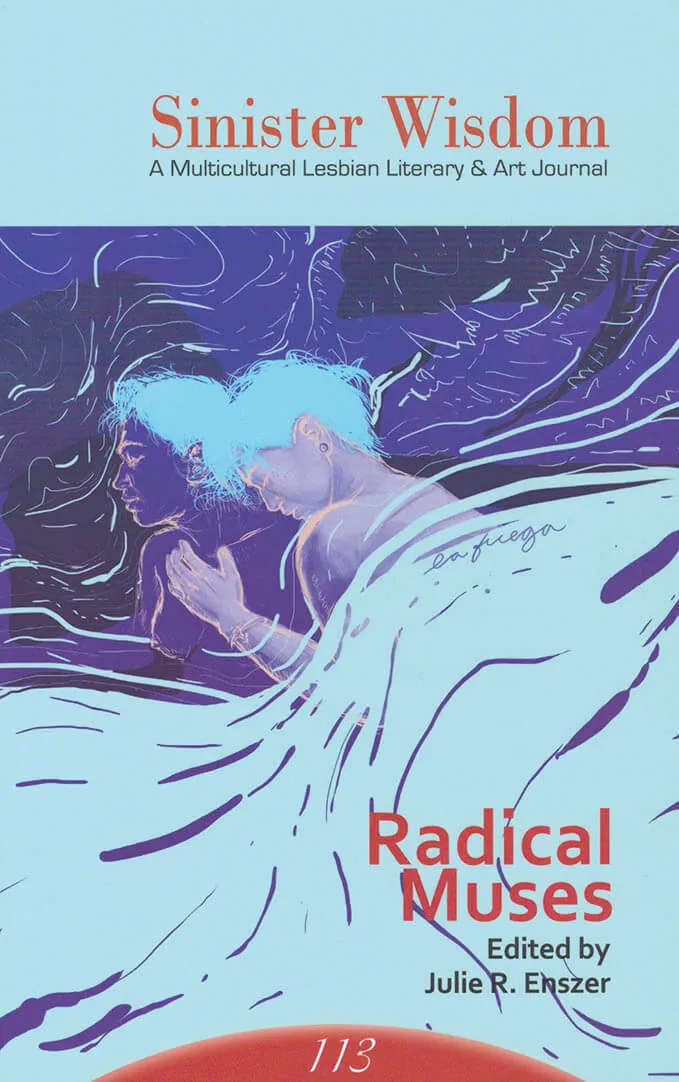
Cover of Celebrating the Michigan Womyn's Music Festival

Sinister Wisdom

Celebrating the Michigan Womyn's Music Festival

Sinister Wisdom

Sinister Wisdom 103: Celebrating the Michigan Womyn's Music Festival honors the forty-year legacy of the Michigan Womyn’s Music Festival (1976–2015). Sinister Wisdom 103: Celebrating the Michigan Womyn's Music Festival celebrates this embodiment of radical feminist separatist collaboration, transformational self-defined autonomous spaces, a commitment to sisterhood and matriarchal culture, and a musical city sprung from the earth for one week in the woods.

A collective of five womyn each with a deep connection to Fest operated by consensus to create this issue. Striving to represent a range of womyn’s voices, values, traditions, and experiences of Fest, the collective highlighted what Fest has meant to generations of womyn, documented its chronology, and bore witness to the power of this community. Sinister Wisdom 103: Celebrating the Michigan Womyn's Music Festival includes womyn from multiple races, geographies, sexualities, generations, and gender and other social identities. Just as Fest brought together womyn from various backgrounds, our collection includes a range of artistic experience, from seasoned authors and photographers to those womyn new to publishing.
Sinister Wisdom 103: Celebrating the Michigan Womyn's Music Festival remembers the transformations, possibilities, and hopes for spaces cultivating the ongoing empowerment of womyn.

Cover of OEI #86/87 Publishing Practices, Publishing Poetics

OEI editör

OEI #86/87 Publishing Practices, Publishing Poetics

Tobi Maier, Cecilia Grönberg and 1 more

Once more, an astonishing issue of OEI – a thrilling, compelling, stimulating feast of ideas regarding publishing and the book: the perfect big companion to read and hug in bed while the virus spreads outside.

Bringing together contributions from circa 130 publishing structures, publishing communities, magazines, small press endeavors, artists, poets, writers, editors, theoreticians, curators, scholars, and art bookstores, OEI # 86–87 reflects upon the challenges, pressures and possibilities of publishing and creating publics in different contexts and places in a time of far-reaching – economical, medial, political, social, technological – transformations.

The potential and the versatility of publishing open it to a diversity of practices and approaches in the arts, but as an eminently social form of art, a collective or micro-collective work with shared responsibilities, it is also a never-ending process of “crafting a variegated approach to how you create, publish, distribute, and build a social ecosystem around your efforts”, of trying to “build up and strengthen the community around these printed forms” (Temporary Services).

It is the conviction of OEI #86–87 that print has the power to play an important part in the construction of social spaces, of a social world. As Benjamin Thorel puts it in one of the essays in the issue, “conceiving of the dynamics of publishing as making publics as well as making things public is not a pun – insofar as the artists/publishers encompass, beyond the book itself, its possible ‘lives’, imagining the different spaces, and the different people, amongst whom a publication will circulate.” This is what Michael Warner has called “a public [as] poetic worldmaking”, implying “that all discourse or performance addressed to a public must characterize the world in which it attempts to circulate, projecting for that world a concrete and livable shape, and attempting to realize that world through address.”

This is also, as stressed by Annette Gilbert and others, what can make publishing such an active force, a force co-constituting texts and publications and publics. Indeed, with Michalis Pichler, it is tempting to say that in publishing as practice – perhaps more than in any other art field – “artists have been able to assert the aesthetic value of their own socio-politically informed concerns and to engage, often under precarious conditions, in cultural activities fully aligned with their political values.”

OEI #86–87 also includes sections on and with contemporary poetry from Canada; Fluxus publishing; Krister Brandt/Astrid Gogglesworth; Kalas på BORD (Öyvind Fahlström); Lars Fredrikson; Claude Royet-Journoud’s poetry magazines; Carl Einstein; Gail Scott; Ållebergshändelser; OEI #79: edit/publish/distribute!; “det offentligas försvinnande” and many many other things. [publisher’s note]

Design by Konst & Teknik

Cover of MsHeresies 4 — Daffodils

Rietlanden Women's Office

MsHeresies 4 — Daffodils

Elisabeth Rafstedt, Johanna Ehde

This fourth issue of MsHeresies republishes the chapter *Daffodils* — a warped monologue about a domestic poisoning — from Rosalind Belben’s book Is Beauty Good (1989).

It is typeset alongside a collage of material from two medieval manuscripts: Isidore of Seville’s Etymologiae and De natura rerum (circa 1130–74), which was illuminated and transcribed by a group of eight nuns at the Benedictine abbey of Munsterbilzen in Maastricht; and the so called Claricia Psalter (late 12th–early 13th century) from the abbey of saints Ulrich and Afra in Augsberg, also made by a group of nuns and named after the novice Claricia who is believed to have drawn herself hanging like the tail of a drop-cap Q in the psalter section of the book.

Cover of Vestiges_07: Catachresis

Black Sun Lit

Vestiges_07: Catachresis

Jared Daniel Fagen

Periodicals €15.00

To wilt tears for an infatuation who has no name of their own. To weep rain like a sentence that passes through the unrequited glimpse. Language is the instrument of our shivers; literature the wink that slips into a wince.

Out of profane necessity we dress the missing words for each circumstance in ecstatic deprivation. Anticipation and alienation. Shock and sorrow. Craving and cruelty. Elation and tension. Emotion is the borrowed absence of transferred meaning: the sensuous "legs" of a table and the sunrise that falls-in-shadow upon the "foot" of a bed. Quintilian's "thirsty" crops that have neither tongue nor throat. Barthes' compassed "wings" of a house. Augustine's "piscina" in which no fish are to be found (and only humans drown). With delirium we endure, and delight in, the abuse of our sensibilities by the sadistic literalization of metaphor.

Featuring Will Alexander, Kimberly Alidio, César Dávila Andrade, Martine Bellen, Stanislav Belsky, Anselm Berrigan, David Buuck, Garrett Caples, Sam Cha, Logan Fry, Lawrence Giffin, Tilghman Alexander Goldsborough, E. Tracy Grinnell, Karen Holman, Elise Houcek, Andrew Joron, Inna Krasnoper, Carlos Lara, Jonathan Larson, Sueyeun Juliette Lee, Michael Leong, Douglas A. Martin, olga mikolaivna, Sheila E. Murphy, Ann Pedone, Sal Randolph, Martha Ronk, Jonathan Simkins, Christophe Tarkos, Edwin Torres, Christina Vega-Westhoff, Wendy Xu & John Yau