rile*books

Search books

Search books by title, author, publisher, keywords...

Cover of Bulletin B – Issue 2

Giselle's Books

Bulletin B – Issue 2

Maria Jooyoung

€14.00

Contributions by Jerry Ahn, Han Ok-hee, Han Soon-ae, Lilian Gonzalez, Kim Jeon-seon, Miss Lee, Lee Jeong-hee, Hansen Oh, Yun Park, Seonha Park, Sun Hyejeong, Wang Gyu-won.

Bulletin B is a bilingual editorial project gathering artistic and cultural productions from Korea and its diasporas, with a focus on queer and womxn voices. Borrowing the spirit of an unofficial newsletter, it surfaces when it needs to; assembling poetry, prose, and cultural fragments across time. 

Rooted in translation as a practice attentive to power, history, and silenced voices, Bulletin B reconstructs fragmented lineages and constellations of reference through irregular acts of dissemination and exchange, tracing how narratives move between languages, contexts, and material forms.

Published in 2026 ┊ Language: English

recommendations

Cover of We Don’t Live Here Anymore

Giselle's Books

We Don’t Live Here Anymore

Tarren Johnson

Poetry €16.00

A fragmented reflection on movement, absence, and the unraveling of identity within the shifting landscapes of departure and return. Tarren Johnson explores the tension between private longing and public expression, where moments of love and vulnerability emerge in transient encounters.

Tarren Johnson grew up in North County San Diego, where she began dancing and writings a child. She continued her studies at CalArts in Los Angeles before moving to Europe, where she built a decade-long career in the performing arts. Her debut book of poetry, We Don’t Live Here Anymore, also serves as the foundation for the stage work of the same title.

Cover of provisional school for nothing—exercise of imagination

Edições Provisórias

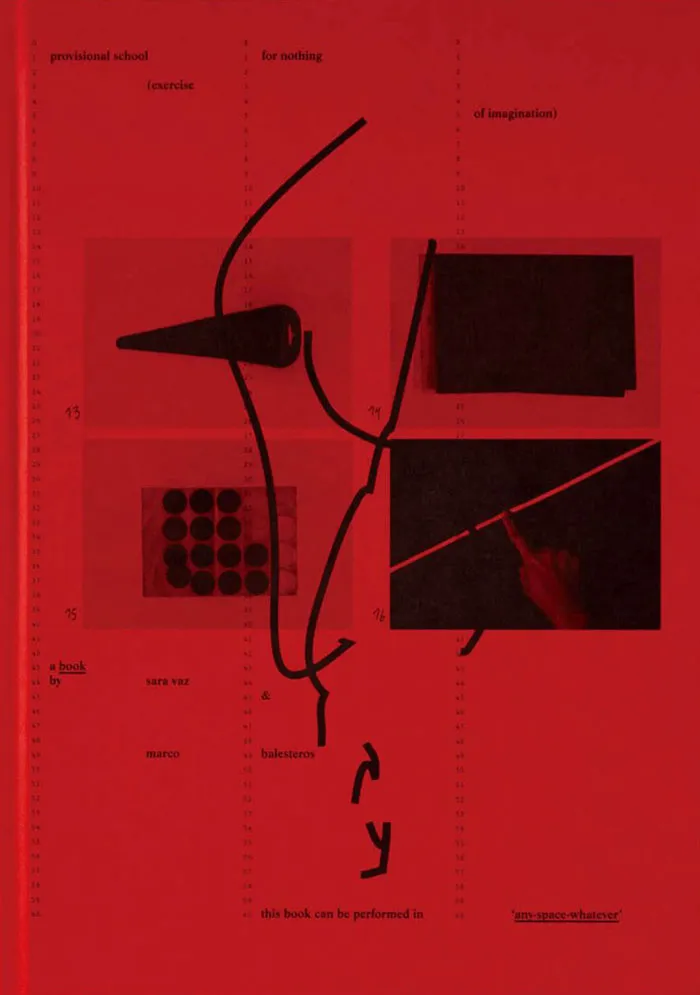
provisional school for nothing—exercise of imagination

Pedagogy €35.00

‘Provisional School for Nothing—exercise of imagination’ aims to explore forms of parallel education such as self-learning, self-organized schools, unschooling, inner schools, and more. This book is a choir of around 30 invited guests (artists, choreographers, dancers, graphic designers, writers, thinkers and so on). We use the word ‘choir’ since we decided to explore the concept of authorship. The book functions like a language score —comprising words, fragments, and loose ideas that develop throughout a series of conversations we’ve had with our guests via Zoom during the pandemic.

with Marco Balesteros Sara Vaz Alexandru Balgiu Ana Jotta Bráulio Amado Cracked Bolos Igor Dobricic Isabel Carvalho Ivan Martinez João Fiadeiro João dos Santos Martins] Karel Martens Maki Suzuki & Lppl Marco Bene Maria Duarte Marion Cachon Miguel Bonneville Nelson Guerreiro Olivier Lebrun Olga Mesa Francisco Ruiz de Infante Paul Elliman Paul Faure Pedro Barateiro Pedro Rogado Ricardo Nicolau Sara & André Sara Graça T.I.M.E. Tomás Cunha Ferreira Von Calhau! the missing person a man in silence

designed by Sara Vaz Marco Balesteros 

Cover of Maisa in Webland

Set Margins'

Maisa in Webland

Maisa Imamović

Design €25.00

What does ‘user-friendly’ website mean if, on it, online behaviors like stalking, teasing, and ghosting — once considered peripheral — are now central to survival, care, and belonging? How to thrive without becoming an “Interdisciplinary Unicorn”: the state’s most beloved user-citizen fluent in multiple registers of production, optimization, and self-branding? How in this beautiful world is one supposed to log off, when surveillance and privacy erosion have been normalized? And how, oh how, could users possibly think of building the alternatives, when cool and cringe online acts, all activate the platform’s reward system: the unleashing of emoji-filled praise? How to resist the platform’s toxic seduction? 

Haunted by screenshots of early cyberfeminist websites and in dialogue with digital sages, web scripts, and business interests, media artist, web developer, and author Maisa Imamović embarks on a philosophical and practice-based crusade through the internet’s surface and its shadows. To expose the various ways of thriving online without surrendering to optimization, the book explores imperfect uses of perfect software, preservation of precarious web infrastructures, tactical content strategies, and experiments with autonomous financial systems — all wrapped in educational efforts to sustain criticality amid automation. Through these traversals beneath the scroll, Maisa finds her Webland: speculative, broken, and oftentimes, poetic infrastructure where logic destabilizes, binaries dissolve, and meaning evades monetization. But can a non-extractive internet exist beyond metaphor? Can poetry rewire protocol? Or will her sanctuary be absorbed into the very architectures it resists?

"In Maisa in Webland, Maisa Imamovic evokes the multidimensional, spontaneous human elements of the early web, using interviews, case studies, critical theory and fiction as her organic materials. She peeks behind the screen and through time to trace the subtle erosion of the web’s early utopian ideals to its cold and extractive present. Imamovic bravely wades through the swampy digital muck that mediates our everyday reality, examining its invisible psychic scaffolding with academic rigor, and a big dose of humor and heart. Was it an inevitable entropy, or an aberration? How and when did we get so off-course? Can we return? Do we want to? In Maisa’s Webland, we might very well be doomed, and maybe that’s a good thing. When the center of this tangled web no longer holds, something new can take shape.” - Nada Alic, author of Bad Thoughts

Cover of Choquer le monde à mort – Elles sont de sortie – Pascal Doury – Bruno Richard

Editions L'Amazone

Choquer le monde à mort – Elles sont de sortie – Pascal Doury – Bruno Richard

Bruno Richard, Pascal Doury and 1 more

"Elles sont de sortie" is the title of a periodic publication launched in 1977 by Pascal Doury and Bruno Richard. The plural and feminine form of the enigmatic phrase "elles sont de sortie," chosen almost by chance, announces a protean work and often collective experience. From its origins to the most recent iterations, including Doury's more confidential individual trajectory after "Elles sont de sortie," Choquer le Monde à Mort traces five decades of a corpus of nearly three hundred publications. It addresses some of the most emblematic editorial works, as well as others that remain unpublished, alongside ambitious and sometimes scandalous exhibitions, few of which are documented.

This work is the result of several years of research, enriched by numerous firsthand interviews, and unfolds in three parts: a chronology and analysis of a singular and marginal artistic history, works and iconographic documents, and an anthology bibliography. Together, these elements reveal the complexity of an editorial object with porous boundaries, both in its forms and its contents, oscillating between graphzine, artist book, poetry collection, and personal journal. Its ramifications, status, and legacy retrospectively reveal the importance of a discreet yet seminal work.

Thus, "Elles Sont de Sortie" also serves as an opportunity to revisit the paths of two aesthetic and provocative artists, deeply devoted to their art and true free spirits in an art world often too narrow for them. It immerses us in a plethora of works that are intimate and raw, as well as subtle and refined, all in service of a project that, in Doury's words, aims to "shock the world to death."

Edited by Tiphanie Blanc, Jonas Delaborde, Anna Lejemmetel.
Contribution by Anna Lejemmetel.

Cover of 17 Movements

Damaged Goods

17 Movements

Jozef Wouters

17 Mouvements collects traces of a project that Decoratelier - the workspace and arts platform of Jozef Wouters - did in the fall of 2022 around the ‘5 blocs’ area in Brussels (Rempart Des Moines/Papenvest).

When Nuit Blanche invited them to build a gym, Camille Thiry and other Decoratelier associates did not want to design another generic muscle cage. Together with the neighbourhoods inhabitants, they built 17 distinct movement spaces, each tailor-made to an individual’s size, needs, dreams and aches. The gym equipment has meanwhile been removed from public space, but this eponymous book (ed. by Jozef Wouters) combines notes and reflections (language: French) by Camille with beautiful photography by Enzo Smits, documenting the ingenious and unique negotiations that were a part of this collaboration.

Cover of Vampyroteuthis Infernalis

Les Presses du Reel

Vampyroteuthis Infernalis

Vilem Flusser

Philosophy €17.00

L'édition inédite et définitive (établie à partir des tapuscrits originaux en français) du traité fabuleux du philosophe tchéco-brésilien Vilém Flusser (1920-1991), une fiction philosophique et poétique qui, par des chemins détournés, nous confronte à la violence et à l'impasse des sociétés contemporaines.

Un monstre venu des profondeurs de l'océan, un poulpe vampire. Sa violence rappelle les nazis, ses mœurs sont libertaires et libidineuses. C'est une créature infernale, cannibale et brutale, pouvant changer de couleur à volonté, et dotée de trois pénis.
Et c'est notre cousin.

Dans cette fable fantastique, Vampyroteuthis infernalis émerge, non des abysses de l'océan, mais du plus profond de nous-mêmes pour nous tendre un miroir, nous montrer à quel point nous, les hommes, sommes ses proches parents et que nos histoires, nos sociétés, nos modes de vie ne sont, au fond, pas si différents.
Ce texte délibérément provocateur du philosophe tchéco-brésilien Vilém Flusser (1920-1991) n'est ni scientifique, ni objectif : c'est une fiction philosophique et poétique qui, par des chemins détournés, nous confronte à la violence et à l'impasse des sociétés contemporaines.

Flusser avait écrit ce texte en français (outre des versions en allemand et en portugais), et ce livre est la première édition du texte original en français. Il est accompagné des fantastiques dessins de son ami l'artiste et « zoosystémicien » français Louis Bec (1936-2018), co-auteur du livre, traduisant en images pseudo-scientifiques les chimères vampyroteuthiques.

Des essais de Marc Lenot, Élise Rigot et Florent Barrère éclairent la démarche de Flusser et de Bec.